


Working Capital: The Definitive Guide to Fueling Business Growth in 2026
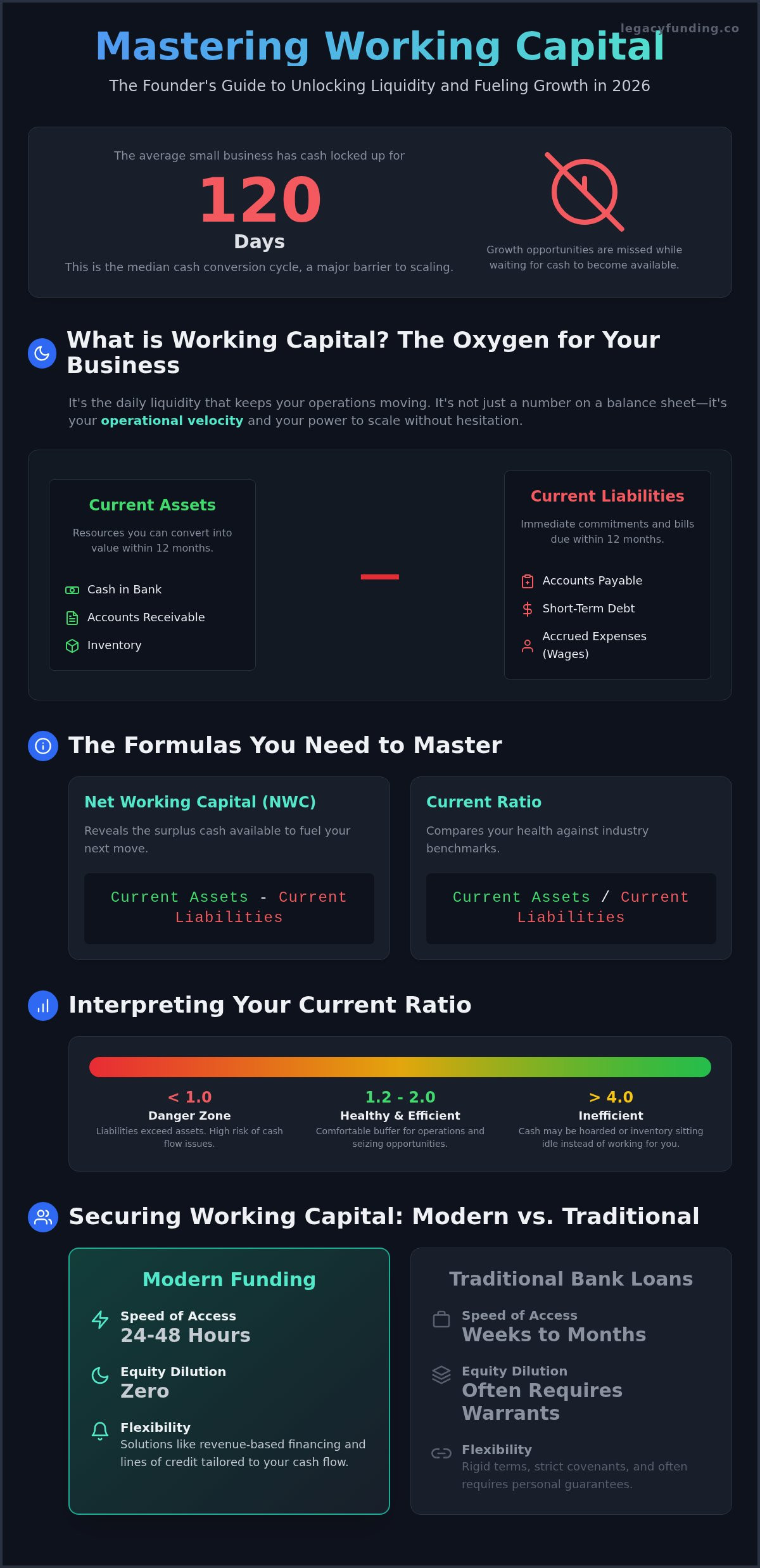
Small businesses in 2026 face a median cash conversion cycle of 120 days, meaning your cash stays locked in operations for a third of the year while growth opportunities pass you by. It's a common frustration. You watch competitors scale because they have the liquidity to grab bulk inventory discounts while you struggle just to meet payroll during a slow month. You know your business is healthy, but your bank account doesn't always reflect that reality. Managing working capital shouldn't feel like a constant defensive maneuver against insolvency.
We're here to change that dynamic. This guide will help you master the mechanics of your cash flow and secure the liquidity you need to scale at speed. You'll gain a clear understanding of your financial health and learn actionable strategies to improve liquidity. We'll show you how to access capital in as little as 24 hours without giving up a shred of equity. From revenue-based financing to optimized lines of credit, it's time to turn your balance sheet into a high-velocity engine for growth. Stop waiting, start scaling, and secure your future.
Key Takeaways
- Learn why Net Working Capital is the ultimate metric for operational velocity and how it fuels your daily growth.
- Master the critical formulas used to calculate your current ratio and assess your business's real-time financial health.
- Discover how to optimize your working capital by unlocking trapped cash in your accounts receivable and streamlining internal processes.
- Evaluate the strategic advantages of positive versus negative capital models to determine the best path for your specific industry.
- Compare modern, fast-access funding alternatives to traditional bank loans to secure the liquidity you need within 24 to 48 hours.
What is Working Capital? Moving Beyond the Balance Sheet
Think of Working capital as the oxygen in your business's lungs. It isn't just a static line item on a balance sheet. It's the daily liquidity that keeps your operations moving and your ambitions within reach. Net Working Capital (NWC) is the simple difference between your current assets and your current liabilities. While traditional institutions view this as a safety net, modern founders treat it as a growth lever. It measures your operational velocity. High velocity means you can pivot, invest, and scale without hesitation. Low velocity means you're stuck in place.
Your capital needs aren't fixed. They fluctuate based on your industry and the season. A retail brand prepping for the holidays requires a massive cash injection for inventory. A software company might see steady needs throughout the year. Understand that survival is the bare minimum. Aim for efficiency. Aim for the ability to move faster than your competition. Your goal is to convert every dollar into more revenue as quickly as possible.
The Core Components: Assets vs. Liabilities
Your current assets represent your immediate firepower. This includes the cash in your bank, the accounts receivable your clients owe you, and the inventory sitting in your warehouse. These are the resources you can convert into value within twelve months. Manage these tightly. Ensure your business remains agile. Every dollar sitting idle in inventory is a dollar that isn't working for your growth.
Conversely, current liabilities are your immediate commitments. These include accounts payable, short-term debt payments, and accrued expenses like taxes or wages. These are the bills that won't wait. When these two forces interact, they determine your burn rate. If your commitments outpace your firepower, you're burning through your future. Balance them to keep your engine running lean and fast. Control your debt. Protect your cash flow.
Why Working Capital is Your Growth Engine
Liquidity is the ultimate competitive advantage. It allows for a rapid response to market opportunities that your competitors might miss. Use your working capital to secure bulk inventory discounts, launch aggressive marketing campaigns, or snap up talent. Speed wins in 2026. If you have to wait for a bank's permission to move, you've already lost the lead. Capital gives you the power to say yes to growth.
Beware the trap of overtrading. It's possible to grow too fast. If your sales explode but your cash is tied up in unpaid invoices, you'll hit a liquidity wall. This death by growth scenario is a preventable tragedy. Maintain a healthy cash cushion to provide psychological peace of mind. When you aren't worried about next week's payroll, you can focus on next year's expansion. Build your fortress. Fund your future. Secure your legacy.
How to Calculate Working Capital: The Formulas You Need
Stop guessing about your liquidity. Data-driven founders don't wait for tax season to understand their cash position. They run the numbers every month. The primary formula for working capital is simple: Current Assets minus Current Liabilities. This single calculation reveals the surplus cash available to fuel your next move. It separates the leaders from those who are merely surviving.
Step-by-Step Calculation Guide
Open your most recent balance sheet. This document holds the keys to your operational velocity. Follow these three steps to find your net position:
- Locate Current Assets: Sum your cash, accounts receivable, and inventory. These are resources you can liquefy within a year.
- Identify Short-term Obligations: Add up your accounts payable, short-term debt, and accrued expenses. These are the bills due within the next 12 months.
- Calculate the Difference: Subtract your total liabilities from your total assets.
The Current Ratio is the relationship between what you own and what you owe. To find it, divide your total current assets by your total current liabilities. This ratio provides a standardized way to compare your health against industry benchmarks.
Interpreting Your Results
A healthy working capital ratio typically sits between 1.2 and 2.0. A ratio of 1.5 means you have $1.50 in assets for every $1.00 of debt. This provides a comfortable buffer for scaling. If your ratio drops below 1.0, you're in the danger zone. You're effectively borrowing from the future to pay for the present. This creates friction that slows down your growth engine.
A ratio that's too high can also be a red flag. A ratio of 4.0 or higher often suggests you're hoarding cash or letting inventory sit idle. This is inefficient. You're missing out on the compounding growth that comes from reinvesting that capital back into the business. Look for "stale" assets. Slow-moving inventory or overdue accounts receivable (AR) can inflate your numbers without providing actual liquidity. If your calculations show a gap between your current position and your growth goals, consult with a funding advisor to bridge the distance.
Check these metrics monthly. Track the trends. If your ratio is shrinking while your sales are growing, you might be overtrading. Catch these patterns early. Use the data to stay ahead of the market. Your balance sheet should be a roadmap, not a post-mortem. Consistent monitoring ensures you're always ready to strike when opportunity knocks.
Positive vs. Negative Working Capital: Analyzing the Gap
A negative figure on your balance sheet isn't always a death sentence. High-turnover businesses, like grocery stores or digital retailers, often thrive with negative working capital. They collect cash from customers before they ever have to pay their suppliers. This creates a lean, agile model where customers effectively fund the operations. However, for most B2B or service-based firms, this gap signals a looming crisis. You must distinguish between strategic agility and operational distress.
The Operating Cycle is the true heartbeat of your liquidity. It measures the time from your initial cash outlay for inventory or labor until the moment cash hits your bank account. In 2024, the median cash conversion cycle (CCC) for US companies was 89 days. Small companies with revenues under $300 million often struggle with a CCC as high as 120 days. If your cycle is long but your cash is short, you're entering the Danger Zone. This is where liabilities consistently outpace cash flow, forcing you into a reactive posture that kills momentum.
When Negative Working Capital is a Red Flag
Chronic shortfalls are loud. They show up as delayed vendor payments, missed payroll, and high-stress mornings. When you lack a buffer, you're forced into high-interest "emergency" borrowing just to keep the lights on. This reactive cycle erodes your profit margins. It also damages your business credit. Premium lenders look for stability. If your liabilities are consistently higher than your assets, you'll find it harder to secure favorable terms when you actually want to scale. Don't let a temporary gap become a permanent handicap.
The Strategic Advantage of Positive Liquidity
A strong cash position is a weapon. It gives you the leverage to negotiate better terms with suppliers. When you can pay upfront or early, you secure discounts that your cash-strapped competitors can't touch. This immediately improves your margins. Positive liquidity also allows you to fund marketing spikes or hire top-tier talent the moment they become available. You don't have to wait for a bank's slow approval process. A robust working capital position makes your business a magnet for premium lenders and strategic partners. It proves you're in control of your destiny. You aren't just surviving; you're dominating. Build your cushion. Protect your speed. Win the market.
Strategies to Optimize and Improve Your Cash Position
Before you search for external funding, look inside your own operations. Your balance sheet often hides significant liquidity in plain sight. Optimizing your internal management creates a leaner, more resilient business. This approach ensures that when you do seek working capital, it's used for aggressive expansion rather than just covering inefficiencies. Start by targeting the areas where cash gets trapped. You'll find that small shifts in policy lead to massive improvements in your bank balance.
Accounts Receivable is usually the largest source of hidden cash. Every day an invoice sits unpaid is a day your capital isn't working for you. Treat your collections with the same intensity you bring to your sales. Inventory management is your next priority. Every pallet sitting in a warehouse represents stagnant cash that could be used for marketing or hiring. Finally, work the other side of the equation with your vendors. Negotiate longer payment terms to keep cash in your account longer. Moving from 30-day to 45-day terms gives you two extra weeks of liquidity without costing a cent.
Accelerating the Cash Conversion Cycle
Speed is your greatest ally. Use tech-forward tools to bridge the gap between delivery and payment. Implement automated invoicing to slash your Days Sales Outstanding (DSO) and remove the friction of manual follow-ups. Don't just send a bill; track it. Offer early payment discounts, such as a 2% reduction for payments made within ten days, to incentivize faster remittances. These small concessions often cost less than the interest on a short-term loan. Remember that inventory turnover is the key metric for retail efficiency, showing exactly how fast you convert stock into sales.
Industry-Specific Capital Needs
Every industry has its own unique rhythm and pressure points. Retailers must manage massive inventory builds months before peak holiday seasons, often straining their cash reserves. Service providers face a different struggle, frequently balancing high contractor payroll costs before a client project is fully billed or completed. In construction, material costs hit your accounts long before milestone payments arrive. These gaps are natural, but they require a proactive strategy to manage. If your internal optimizations aren't enough to cover these industry-specific spikes, connect with our team to discuss a tailored liquidity strategy that fits your business model.
Consistency is vital. Review these internal levers monthly to ensure your working capital remains fluid. By tightening your internal processes, you build a foundation that supports rapid, sustainable scaling. You aren't just managing money; you're managing momentum. Keep your cash moving, and your business will follow.
Securing Working Capital: Modern Solutions for Fast Growth
Traditional banking is built for a world that no longer exists. Legacy institutions demand mountains of paperwork, physical collateral, and months of waiting. By the time they approve a loan, your market opportunity has likely vanished. Modern founders don't wait. They view external funding as a strategic choice to accelerate momentum. Securing working capital through alternative channels allows you to strike while the iron is hot. It's about agility. It's about speed. It's about owning your growth trajectory.
Your business's cash flow history tells a much more compelling story than a static FICO score. In the modern economy, your ability to generate revenue is the ultimate proof of health. We focus on your performance metrics rather than just your credit history. This shift in perspective opens doors that traditional banks keep locked. You've built a machine that works. Now, you just need the fuel to make it run faster.
Revenue-Based Financing and MCAs
Revenue-Based Financing is designed to breathe with your business. Unlike fixed bank payments that can crush you during a slow month, this model aligns with your actual sales volume. If your revenue dips, your obligation adjusts. If you soar, you pay back faster. This flexibility protects your cash flow while providing the working capital needed for expansion. It's a partnership based on shared success.
Merchant Cash Advances (MCAs) offer the ultimate speed for immediate inventory needs. When a supplier offers a limited-time discount or a sudden demand spike hits, you can't wait weeks for a decision. These models offer a significant "no-collateral" advantage. You don't have to put your home or equipment on the line to secure your future. You leverage your future sales to fund today's opportunities. It's clean, efficient, and built for the speed of contemporary commerce.
The Legacy Funding Advantage: Speed and Partnership
We respect your time because we know it's your most valuable asset. Our application process is entirely digital, frictionless, and transparent. We've removed the bureaucratic hurdles that slow down traditional lending. For approved applicants, we provide a 24-48 hour funding window. This means you can identify a growth opportunity on Monday and have the capital to execute it by Wednesday. No wasted space. No unnecessary friction.
Stop letting legacy constraints dictate your business's potential. You deserve a financial ally that understands the high-stakes reality of entrepreneurship. We provide the insider knowledge and the capital injections necessary to scale without equity loss. Take the lead. Move faster. Secure your business’s future with a tailored working capital solution from Legacy Funding Advisors.
Own Your Operational Velocity in 2026
Mastering your working capital isn't just about balancing a spreadsheet; it's about securing your competitive edge. You now have the blueprint to calculate your real-time health, optimize your internal cash cycles, and leverage modern funding as a strategic growth engine. Don't let your ambitions wait on a traditional bank's outdated schedule. Speed is the currency of 2026. Efficiency is the foundation of your legacy. You have the tools to turn your liquidity into a high-velocity weapon for expansion.
We're ready to partner with you to fuel that momentum. We offer tailored capital solutions ranging from $10,000 to over $5 million to fit your specific industry needs. Our no-obligation application process respects your time and focuses on your actual cash flow health. Experience a frictionless 24 to 48 hour funding turnaround that keeps your business moving forward without equity loss. It's time to stop managing obligations and start building your future. Take the first step toward financial independence today.
Apply for Fast Working Capital Funding in Minutes
Frequently Asked Questions
How much working capital does my small business actually need?
Your specific needs depend on your industry and operating cycle. A safe benchmark is to maintain enough liquidity to cover three to six months of operating expenses. This buffer protects you from seasonal slumps and allows you to fund sudden growth opportunities without hesitation. Calculate your average monthly burn rate and multiply it by your desired safety window to find your target number.
Is it possible to have too much working capital?
Yes, an excessive surplus often indicates operational inefficiency. If your current ratio climbs significantly above 2.0, you're likely hoarding cash that could be generating a higher return elsewhere. Stagnant cash doesn't grow your business. Reinvest that excess liquidity into marketing, new equipment, or talent to maximize your compounding growth. Don't let your capital sit idle while your competitors expand.
What are the most common causes of a working capital shortfall?
Rapid expansion and poor inventory management are the leading causes of liquidity gaps. Overtrading occurs when your sales explode but your cash stays trapped in unpaid invoices. Other common triggers include seasonal revenue dips and unexpected emergency repairs. You must monitor your burn rate closely and tighten your collections process to ensure your cash keeps pace with your growth ambitions.
Can I get a working capital loan with a low credit score?
Yes, because modern alternative lenders prioritize your cash flow health over a static FICO score. If your business demonstrates consistent revenue and a strong daily operating history, you can qualify for a working capital loan. We look at the actual performance of your business machine rather than just a three digit number from a credit bureau. Your future potential matters more than your past hurdles.
What is the difference between working capital and cash flow?
Working capital is a snapshot of your liquidity at a specific moment, while cash flow is the movement of money over time. Think of capital as the fuel currently in your tank and cash flow as the rate at which you're pumping and burning it. You need a healthy surplus of both to maintain your operational velocity and ensure you don't stall during a long growth cycle.
How does a Merchant Cash Advance differ from a traditional working capital loan?
A Merchant Cash Advance is a purchase of your future sales rather than a standard loan with fixed monthly installments. It offers superior flexibility because the repayment fluctuates based on your daily credit card receipts. If sales slow down, your payment decreases automatically. This makes it an ideal solution for businesses with variable revenue that need fast, agile working capital without the rigidity of a term loan.
What happens if my working capital ratio falls below 1.0?
A ratio below 1.0 indicates that your current liabilities exceed your assets, which is a clear sign of financial distress. You're effectively borrowing from tomorrow to pay for today. This creates a high pressure environment that kills your ability to scale. Address this immediately by accelerating your accounts receivable or securing an external capital injection to rebalance your sheet and protect your operations.
How quickly can I receive working capital funding from Legacy Funding?
You can receive your capital injection in as little as 24 to 48 hours. Our digital first application process is designed to respect your time and remove the bureaucratic friction found in legacy institutions. We focus on speed and transparency to ensure you have the liquidity to seize market opportunities the moment they appear. Apply today and have the funds you need to scale by mid week.