


What to Do When Your Business Is Out of Cash: A 2026 Survival Guide
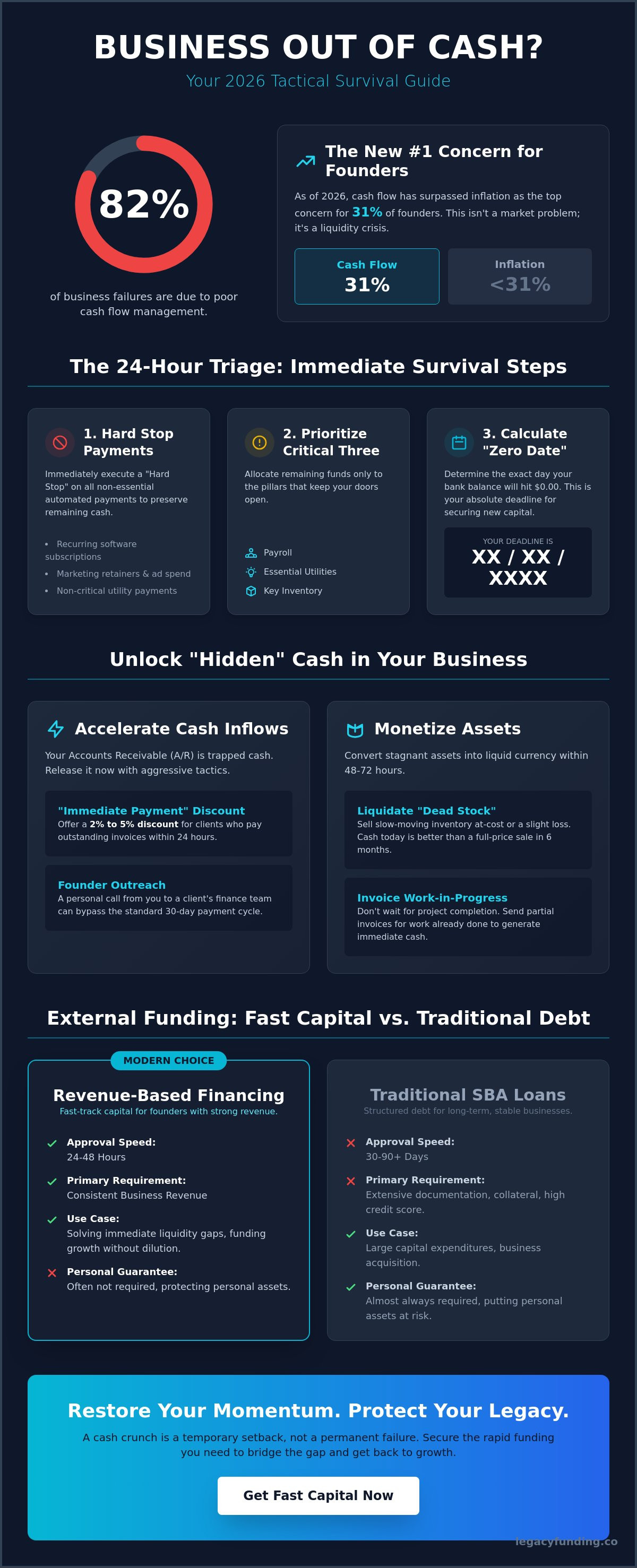
Recent data shows that 82% of businesses that shut their doors do so because of a single, fixable issue: poor cash flow management. If you are staring at a bank balance that won't cover Friday's payroll, you aren't alone. As of May 2026, cash flow has officially surpassed inflation as the top concern for 31% of founders. You feel the weight of aggressive creditor calls and the looming fear of losing everything you built. Knowing what to do when your business is out of cash is the difference between a temporary setback and a permanent closure.
A cash crunch is a liquidity crisis, not a death sentence. It's time to stop reacting and start executing. This 2026 survival guide provides the exact tactical roadmap you need to stabilize your operations right now. You'll discover how to negotiate with creditors, secure fast capital through modern channels like revenue-based financing, and present a clear recovery plan to your stakeholders. We're moving past the panic. Let's restore your liquidity, protect your legacy, and get your business back on the path to growth.
Key Takeaways
- Execute a "Hard Stop" on non-essential automated payments to preserve your remaining liquidity immediately.
- Accelerate cash inflows by offering "Immediate Payment" discounts on outstanding accounts receivable.
- Practice radical transparency with creditors to secure interest-only periods and payment deferrals.
- Discover what to do when your business is out of cash by comparing high-speed alternative financing with traditional SBA loan structures.
- Restore your operational momentum with fast-track capital approvals designed for modern founders with strong revenue.
The 24-Hour Triage: Immediate Steps When Cash Runs Dry
Stop. Breathe. Analyze. When the bank balance hits a critical low, your first instinct is likely panic. Panic leads to poor decisions. Instead, you must distinguish between a liquidity gap and true insolvency. A liquidity gap is a timing issue; you have assets or incoming revenue, but the cash isn't available today. Insolvency is a structural failure where your liabilities permanently outweigh your assets. Understanding what to do when your business is out of cash begins with identifying which of these you are facing. If it's a liquidity gap, you have a math problem you can solve with speed and strategy.
Your immediate move is to execute a hard stop on all non-essential automated payments. Scour your bank statements for recurring software subscriptions, marketing retainers, or automated utility payments that aren't mission-critical. Pause them now. Once the bleeding slows, prioritize the "Critical Three": Payroll, essential utilities, and key inventory. These are the pillars that keep your doors open. Finally, calculate your absolute zero date. You need to know exactly which day the balance hits $0.00. This date is your deadline for securing fresh capital or negotiating a reprieve.
Diagnosing the Root Cause Fast
You cannot fix what you don't understand. Distinguish between a timing issue, such as an Accounts Receivable (AR) lag, and a margin issue where you are simply spending more than you earn. Review the last 30 days of outflows to identify subscription creep. Often, small, forgotten digital tools aggregate into a significant monthly leak. Pinpoint the single largest drain on your daily cash flow and address it immediately. If your margins are healthy but the cash is gone, you have a growth-pacing problem that requires a capital infusion rather than a total pivot.
The Founder’s Mindset: Reacting vs. Leading
Detach emotionally from the numbers. Adopt a consultant mindset; look at your business as if you were a high-level turnaround specialist hired to save it. This detachment allows for objective, clinical decision-making. Communicate with radical transparency to your core leadership team. They need to know the stakes to help execute the recovery. Avoid the common "straw-grasping" trap: do not use personal credit cards to bridge the gap. Mixing personal and professional debt during a crisis often compounds the risk without solving the underlying liquidity issue. Stay focused on professional financing solutions that protect your personal legacy. Knowing what to do when your business is out of cash means leading with logic, not desperation.
Internal Liquidity: How to Find "Hidden" Cash in Your Business
You've stopped the immediate bleeding by halting non-essential payments. Now, look inward. Your balance sheet likely holds trapped capital that can bridge your current gap. Knowing what to do when your business is out of cash often involves unlocking value from assets you already own. This isn't about long-term profitability; it's about immediate survival. You need to convert every possible asset into liquid currency within the next 48 to 72 hours.
Start with your unbilled work-in-progress (WIP). If you are mid-project, don't wait for the final milestone to send an invoice. Convert that labor and material into immediate partial invoices. Additionally, audit your accounts for refundable security deposits or overpaid taxes. While these may seem like small wins, they contribute to the aggregate liquidity needed to maintain operations. For a deeper dive into stabilizing your books, refer to the SBA's guide to managing business finances, which outlines the fundamentals of maintaining a healthy cash position.
Aggressive Accounts Receivable Tactics
Cash in hand today is infinitely more valuable than a full payment scheduled for next month. Implement an "Immediate Payment" discount program immediately. Offer your clients a 2% to 5% discount if they settle their outstanding balance within 24 hours. Most accounts payable departments will jump at the chance to save on their own costs. Don't rely on automated email reminders. Pick up the phone. A personal call from a founder to a client's finance lead often bypasses the standard 30-day processing cycle. For long-term contracts, negotiate "Progress Payments" to ensure you are paid as you work, rather than at the end of a long delivery cycle.
Inventory and Asset Monetization
Inventory that isn't moving is simply frozen cash. Identify your "Dead Stock" and sell it at cost, or even at a slight loss, to generate instant liquidity. It's better to have the cash now than a full-price sale six months from now. If you own high-value machinery or equipment, consider a sale-leaseback arrangement. This allows you to sell the asset for a lump sum of capital while retaining the right to use it through a lease agreement. Your current assets represent a reservoir of "Cash-In-Hand" value that is waiting to be tapped. If internal measures aren't enough to bridge the gap, it may be time to speak with a specialist about external bridge options.
Strategic Negotiation: Buying Time with Creditors and Vendors
Ghosting your creditors is the fastest way to trigger legal action or credit destruction. It's a fatal mistake that many founders make out of shame or fear. Instead, you must practice radical transparency. If you're struggling with what to do when your business is out of cash, the answer starts with a proactive phone call. Most lenders prefer a restructured payment plan over a total default. Request interest-only periods or 30-day payment deferrals from your primary lenders. This keeps your remaining capital directed toward the operations that generate revenue.
Prioritize your payments based on "Business Continuity Impact" rather than the due date on the invoice. If a vendor's absence stops your production line, they get paid first. If they provide a non-essential service, they wait. Negotiate extended terms such as Net-60 or Net-90 with your most loyal vendors. These partners have invested in your long-term success; they'll often help you bridge a short-term gap to protect the future of the relationship. It's about shifting from a defensive posture to a strategic one.
The Vendor Transparency Script
When you call a vendor, frame the situation as a "temporary liquidity gap" rather than a business failure. This language suggests a timing issue that you are actively solving. Propose a "Good Faith" partial payment immediately. Even a small amount demonstrates your commitment to the debt. Once you reach a verbal agreement for a term extension, secure it in writing. This protects your business from late fees or service interruptions while you finalize your external funding. Clear communication builds the trust necessary to keep your supply chain moving during a crunch.
Lease and Utility Management
Your overhead isn't as fixed as it seems. Approach your landlord early to discuss a one-time rent abatement or a deferral where the balance is spread over the next six months. Most commercial landlords would rather keep a paying tenant than face a vacant unit in a shifting market. Similarly, inquire about utility payment plans. Most providers have established programs to avoid service interruptions for businesses in transition. Finally, identify which non-critical vendors can be paused entirely without stopping your core production. Every dollar you don't send out today is a dollar that keeps your team employed tomorrow. Knowing what to do when your business is out of cash requires the courage to ask for the flexibility you need.
External Funding: Evaluating Fast Capital vs. Traditional Debt
Internal triage and vendor negotiations buy you days, but capital buys you a future. When determining what to do when your business is out of cash, you must weigh the speed of funding against the total cost of the debt. Traditional banks are notoriously slow. Large banks fully approve only 44% of small business applications, and the process can drag on for weeks. In a liquidity crisis, you don't have weeks. You must evaluate the "Cost of Capital" against the "Cost of Closure." A higher-rate bridge loan is often cheaper than losing your entire enterprise.
Over 76% of small businesses now report bypassing traditional banks for capital. They're choosing speed over bureaucracy. If your business is currently stalled, waiting for a traditional loan committee is a strategic risk. Alternative financing offers a path to immediate liquidity that aligns with the pace of modern commerce. It's about securing the resources to keep moving while your competitors are still filling out paperwork.
Alternative Financing: Built for Speed
Alternative lenders prioritize your current cash flow over static credit scores. This shift in underwriting allows for rapid approvals, sometimes in as little as 24 hours. Revenue-Based Financing is a primary tool for businesses with consistent sales. You are essentially trading future sales for today's cash. It's flexible; payments scale with your sales volume, which protects you during slower weeks. Similarly, Merchant Cash Advances (MCAs) provide immediate liquidity for businesses with high daily transaction volume. For recurring needs, establish a Business Line of Credit. It acts as a permanent safety net you can tap the moment cash flow dips.
When Traditional Loans Make Sense
Traditional debt is for structure, not speed. SBA loans remain the gold standard for long-term restructuring once your situation stabilizes. As of June 2026, SBA 7(a) variable rates range from 9.0% to 11.5% APR. These are ideal for refinancing existing debt or funding planned expansion. Standard bank term loans, with rates between 8% and 17.25%, offer stability for founders who have the luxury of time. If you are currently juggling multiple high-interest obligations, Debt Consolidation can simplify your monthly outflows into a single, manageable payment. Use traditional loans to build your foundation and alternative capital to fuel your momentum. If you need to bridge a gap immediately, contact our funding specialists to review your capital options.
The Legacy Advantage: Rapid Funding to Restore Your Momentum
Triage and negotiation are defensive plays. They keep you in the game. But to win, you need a powerful offensive strategy. When you are wondering what to do when your business is out of cash, the ultimate solution is a capital partner who values your future potential over your past hurdles. We specialize in rapid funding that restores your operational rhythm. Our approach bypasses the bureaucratic delays of legacy institutions. We provide the liquidity you need to protect your legacy and scale your vision without the typical friction of traditional banking.
Traditional lenders often get bogged down in credit scores and static collateral requirements. We look at your business through a modern, tech-forward lens. Your existing cash flow is your most valuable asset. By leveraging your current revenue, we provide tailored capital solutions designed for the modern founder's speed. You don't have time for a three-week approval process or a distant corporate board. You need a savvy financial ally that understands the high stakes of entrepreneurship in 2026. We view financial support as a generational endeavor. It's about more than a single transaction; it's about building the foundation for your long-term impact.
Our Streamlined 48-Hour Process
Speed is our signature. Our application process is stripped of unnecessary red tape. You focus on your bank statements; we focus on getting you funded. Receive a transparent offer with clear terms and zero hidden surprises. Once approved, capital can hit your account in as little as 24 hours. This efficiency allows you to get back to scaling your vision immediately without the distraction of a prolonged capital search. We prioritize growth metrics over financial obligations, ensuring you have the room to breathe and the resources to build.
Fueling Your 2026 Growth Strategy
Transitioning from survival mode to expansion mode requires a strategic shift in capital allocation. Use Working Capital Loans to bridge seasonal gaps, navigate unexpected market shifts, or seize sudden opportunities. This flexibility is essential for maintaining your competitive edge in a fast-paced economy. Don't let a temporary cash crunch define your year or limit your potential. Secure the resources you need to turn a liquidity gap into a significant growth milestone. We are here to remove the friction from your funding experience and act as your gateway to financial independence. Ready to restore your cash flow? Apply for fast business funding now and take the first step toward your business's next chapter.
Take Decisive Action to Secure Your Business Legacy
Running out of cash is a high-stakes challenge, but it doesn't have to be the end of your story. You now have a tactical roadmap for what to do when your business is out of cash, from executing an immediate 24-hour triage to unlocking hidden liquidity within your own accounts. By prioritizing business continuity and practicing radical transparency with your creditors, you buy the time necessary to secure a more permanent capital solution.
The modern founder needs more than just a loan; you need a strategic partner that moves at the speed of your business. We provide cash-flow centric underwriting that focuses on your revenue, not just your credit score. With national coverage across the US and Canada, we help entrepreneurs bridge liquidity gaps and return to scaling their vision without the bureaucratic friction of traditional banks.
Don't let a temporary crunch stall your momentum. Take the first step toward restoring your operations today. Apply for Fast Business Funding in 24-48 Hours and secure capital in as little as 24 hours. Your legacy is worth protecting, and the right resources are within reach.
Frequently Asked Questions
How long does it take to get a business cash advance?
You can typically secure a business cash advance in as little as 24 to 48 hours. Unlike traditional banks that require weeks of document review, alternative lenders use automated underwriting to analyze your recent bank statements. This speed is essential when you need immediate liquidity to cover payroll or vendor payments. The process is streamlined, digital, and designed for founders who can't afford to wait on a loan committee.
Can I get business funding if I have a low credit score?
Yes, you can secure funding even with a low credit score. Modern alternative financing focuses on your business's health and consistent revenue rather than just your personal credit history. Products like Merchant Cash Advances (MCAs) and Revenue-Based Financing use cash-flow-centric underwriting. If your business shows strong, consistent sales volume, you remain a viable candidate for capital despite past credit challenges.
What is the difference between a merchant cash advance and a loan?
A Merchant Cash Advance is a purchase of your future sales at a discount, while a loan is a debt with fixed interest and terms. MCAs offer more flexibility because payments fluctuate based on your daily sales. If your revenue dips, your payment decreases. A loan requires fixed monthly or weekly payments regardless of your performance. This makes MCAs a popular choice for businesses with variable income.
What happens if my business completely runs out of money?
If your business hits absolute zero, you must distinguish between a temporary liquidity gap and permanent insolvency. Knowing what to do when your business is out of cash means immediately halting non-essential outflows and communicating with your creditors. You may need to liquidate assets or secure an emergency Working Capital Loan to restore operations. Prompt action can often prevent a temporary cash crunch from becoming a permanent closure.
Is revenue-based financing better than a traditional bank loan?
Revenue-based financing is often better for businesses that need speed and flexibility over the lowest possible interest rate. Traditional bank loans offer lower APRs but come with rigid requirements and slow approval times. Revenue-based options allow you to access capital quickly without providing collateral. This is a superior choice for modern founders who need to seize growth opportunities or bridge gaps without the bureaucratic delays of legacy banks.
How much working capital does my business actually need?
Most experts suggest maintaining enough working capital to cover three to six months of operating expenses. However, the exact amount depends on your industry's specific cycle and growth rate. Given that 82% of small businesses fail due to poor cash flow management, having a buffer is critical. A Business Line of Credit can serve as a flexible tool to ensure you always have access to these necessary funds.
Can I consolidate my existing business debts to improve cash flow?
Yes, you can use Debt Consolidation or Reverse Consolidation to streamline your monthly obligations. If you are currently managing multiple high-interest advances or loans, consolidating them into a single payment can significantly improve your daily cash flow. This strategy reduces the administrative burden and often lowers your total weekly outflow. It is an effective way to regain control over your finances while maintaining your operational momentum.
Does applying for fast funding hurt my credit score?
Most fast funding applications begin with a soft credit pull, which does not impact your credit score. This allows you to view your potential offers and terms without any risk to your rating. A hard pull typically only occurs once you move forward with a formal contract. Always ask your funding ally about their specific process to ensure you are protecting your credit while searching for the capital your business needs.