


What Is a Merchant Cash Advance UCC Filing? A Founder’s Guide for 2026
What if the most critical document in your funding journey isn't the contract itself, but the public record that follows it? For many founders, the term "UCC-1" sounds like obscure legal static until it impacts their ability to secure a secondary line of credit. You understand that capital is the fuel for your legacy, but the mechanics of what is a merchant cash advance ucc filing can feel like a hidden barrier to your next phase of growth. It is a standard public notice used by funders to protect their interest in business assets, yet it often creates unnecessary anxiety for the 43% of founders who, according to 2023 Federal Reserve data, find financial paperwork more complex than operational hurdles.
You shouldn't have to choose between fast capital and a clean financial blueprint. We know you want to move at the speed of commerce without the friction of traditional banking red tape. This guide empowers you to master the mechanics of these filings so you can leverage capital with total clarity. You will learn how to identify exactly what you signed, the steps to remove a filing once your obligation is met, and how to manage your business credit with the confidence of a seasoned CFO. Let's unlock the transparency you need to accelerate your scaling strategy in 2026. It is time to get funded with your eyes wide open.
Key Takeaways
- Demystify the legal landscape by understanding exactly what is a merchant cash advance ucc filing and how it establishes a public security interest in your business assets.
- Identify the immediate impact of UCC-1 filings on your borrowing power, including how blanket liens can complicate future SBA or traditional bank funding.
- Navigate the filing process with confidence by learning why funders secure their position with the Secretary of State the moment your capital is approved.
- Protect your financial blueprint from the pitfalls of "stacking" and leverage insider strategies to maintain transparent, sustainable growth.
- Unlock the path to fast capital by shifting your focus toward cash flow-driven funding that bypasses traditional red tape so you can Get Funded and scale your legacy.
Defining the Merchant Cash Advance UCC Filing
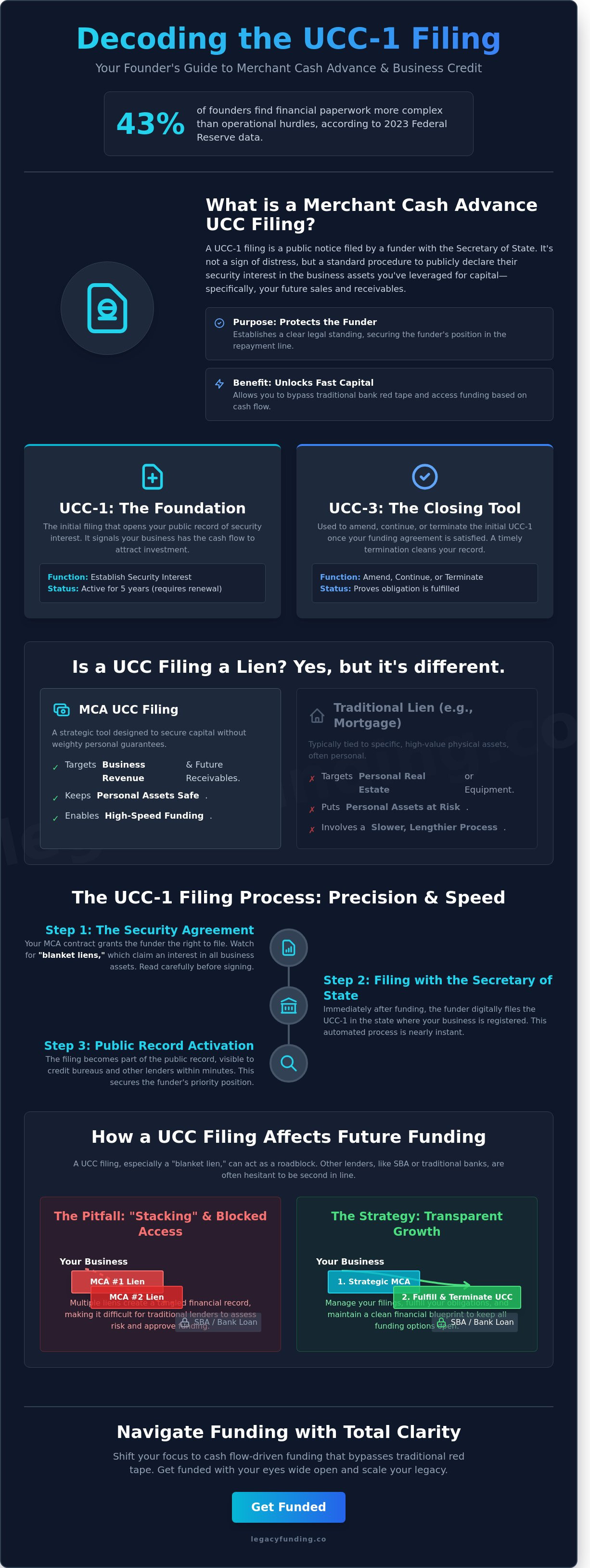
A UCC filing is a public record of a financial partnership. When you seek to accelerate your business growth, understanding what is a merchant cash advance ucc filing becomes your first step toward financial mastery. This legal form, known as a UCC-1, is filed by a funder with the Secretary of State. It serves as a transparent notice to the world that a funder holds a security interest in specific business assets. In the fast-paced world of a Merchant Cash Advance (MCA), this filing specifically targets the future sales you have already sold to the funder. It isn't a sign of distress; it's a blueprint for professional leverage.
Funders use these filings to protect the capital they deploy into your vision. By filing this notice, they establish a clear legal standing regarding your business's accounts receivable and future credit card receipts. This process allows you to bypass the red tape of traditional banks. You get the capital. You scale the business. You build your legacy. Most MCA providers finalize these filings within 24 hours of funding to ensure the transaction remains secure and professional. Get Funded.
UCC-1 vs. UCC-3: Know the Difference
The UCC-1 is the foundation. It's the initial filing that opens your public record of security interest. It typically remains active for a 5-year period before it requires renewal. Smart founders treat this document as a milestone in their business journey. It signals that your enterprise has the cash flow necessary to attract professional investment.
The UCC-3 is your closing or adjustment tool. You use this filing to amend, continue, or terminate the initial notice once you satisfy your funding agreement. Tracking both is essential for a clean financial legacy. A timely UCC-3 termination statement proves to future creditors that you fulfill your obligations. It keeps your credit profile sharp and ready for the next round of expansion. Don't leave your financial history to chance; manage your filings with the same precision you use to manage your sales team.
Is a UCC Filing a Lien?
Technically, yes. It functions as a lien on specific business assets. However, it's vital to distinguish this from a personal mortgage or a tax lien; for those managing complex IRS or state tax disputes, click here to find professional resolution services. An MCA UCC filing typically targets your business revenue rather than your personal real estate or equipment. It’s a strategic tool designed to secure capital without the heavy weight of a personal guarantee.
Funders prioritize "perfection" during this process. Perfection occurs when the funder correctly files the UCC-1 to secure their spot in the repayment line. This ensures they're recognized as a primary stakeholder in the specific assets mentioned. This legal clarity is why the MCA industry can offer such high speed and accessibility. By securing their position, funders can skip the hard credit pulls and focus on your growth metrics. You maintain control of your operations. You keep your personal assets safe. You unlock the capital required to dominate your market. Get Funded.
The UCC-1 Filing Process: How It Works
Funders move with precision. They submit the UCC-1 filing immediately after approval or funding to secure their legal position. This document is filed in the state where your business is legally registered, not necessarily where you live. Once filed, it becomes part of the public record. Any other lender or credit bureau can see it within minutes. This process is automated and standard for almost all commercial funding in 2026.
Understanding what is a merchant cash advance ucc filing requires looking at the digital trail. Funders use third-party services to blast these filings to the Secretary of State. It ensures they are first in line if the business faces a liquidity crisis. Speed is the priority for the funder. Clarity is the priority for the founder.
Step 1: The Security Agreement
Everything starts with the contract. Review the language in your MCA agreement that grants the filing right. Most merchant cash advances use blanket liens. This means the funder claims an interest in all business assets, from equipment to future receivables. Specific collateral filings are rare in this space. Transparency at this stage prevents massive headaches during your next capital raise. Read every line before you sign, and to ensure you have a clear legal standing, learn more about Matthew Fornaro, P.A..
Step 2: Filing with the Secretary of State
The Secretary of State (SOS) acts as the central registry for business debt. Digital filing systems have transformed this from a week-long process to one that takes under 24 hours. Your state of incorporation is the deciding factor for where the filing lives. If you registered in Delaware but operate in Texas, the record stays in Delaware. This central registry allows the financial world to see who has a claim on your company's cash flow.
Step 3: Public Notification and Credit Impact
Data scrapers from credit bureaus like Dun & Bradstreet monitor SOS filings daily. Your business credit profile updates almost instantly. This filing signals a shift in your borrowing capacity to other institutions. It's important to understand how UCC filings can hurt your business if you try to secure traditional bank loans simultaneously. While it impacts your business profile, a UCC filing doesn't typically lower your personal credit score. It remains a corporate obligation.
Smart founders use this capital to scale rapidly and outpace the cost of the lien. If you're ready to accelerate your growth, you can get funded through a streamlined process that respects your time. Focus on the metrics that matter and let the capital do the heavy lifting for your brand.
Why MCA Companies Use UCC Filings
What is a merchant cash advance ucc filing? It is a strategic shield for the funder and a blueprint for your business's financial clarity. Funders use these filings to protect their purchase of your future receivables. It is a matter of securing an asset. By filing, a funder establishes a legal claim to a specific portion of your revenue. This action stabilizes the alternative lending market by reducing funder risk. When risk is managed, capital becomes more accessible for every founder. It creates a predictable environment for growth and ensures that capital continues to reach the businesses that need it most.
Protecting the Purchase of Future Sales
An MCA is a transaction where you sell a slice of tomorrow’s success for capital today. Because it is a purchase rather than a loan, the UCC protects the asset: your future sales. The filing legalizes the funder’s claim to a portion of your daily deposits. It ensures the contract is enforceable across state lines and provides a clear public record of the transaction. This framework is defined by the Uniform Commercial Code (UCC). It transforms the arrangement into a secured interest in your receivables. You get the capital; they get the security. It is a professional exchange designed to fuel rapid expansion.
Preventing Financial Over-Leverage
Stacking too many advances is a fast track to failure. UCC filings serve as a critical stopgap against unsustainable debt. They provide transparency to the entire market. When a funder sees an existing filing, they understand your current obligations. This prevents the over-leverage that contributed to the failure of 42% of small businesses cited in 2024 market reports. Filings establish "priority," which determines who gets paid first if a business closes. Intercreditor agreements manage these priorities when multiple filings exist, ensuring everyone follows the same rules.
Legacy Funding prioritizes your cash flow health above all else. We focus on your ability to scale effectively. We look at your growth metrics and your daily volume to ensure the funding fits your trajectory. Our process is designed to help you Get Funded without the red tape. We offer a streamlined path to capital that respects your business's integrity. Use these filings as a tool for transparency. They help you maintain a clean financial profile while you accelerate your growth. Our approach includes:
- No Personal Guarantee: We focus on the strength of your business sales.
- No Hard Credit Pull: We protect your score while you seek capital.
- Rapid Funding: We move at the speed of modern commerce.
By understanding what is a merchant cash advance ucc filing, you position yourself as a savvy founder. You recognize that these filings are not obstacles. They are the industry standard for securing the capital that builds legacies. Use this knowledge to leverage your sales and unlock your next level of success.
How a UCC Filing Affects Your Ability to Get Funded
Every new lender you approach will perform a search for existing liens during their due diligence. Understanding what is a merchant cash advance ucc filing is the first step toward protecting your future borrowing power. A blanket lien signals to the market that your assets are already pledged as collateral. This doesn't stop your growth; it just changes the strategy. Strategic founders use subordination agreements to manage multiple capital sources simultaneously. Remember: a filing is a hurdle, not a wall for savvy entrepreneurs who know how to move fast.
The Impact on Traditional Bank Loans
Banks are notoriously lien-averse. They demand a first-priority position on your assets before they approve a loan. If an MCA funder holds a blanket lien, the bank will likely pause your application. You can solve this by negotiating a carve-out. This excludes specific assets, such as a $75,000 piece of equipment, from the MCA's reach. Use high-velocity MCAs as a 90-day bridge to hit the revenue targets required for SBA eligibility. It's about using the right tool for the right stage of your climb.
UCC Terminations: Cleaning Your Record
Request a UCC-3 termination statement the moment you make your final payment. Funders often neglect this administrative task, leaving satisfied liens on your record. If a funder fails to remove the lien within 20 days of your written demand, leverage the Self-Help rule under UCC Section 9-513. This allows you to file the termination yourself. Don't let a ghost lien from a 2024 advance haunt your 2026 expansion plans. Stay aggressive with your paperwork to keep your path clear.
Managing Your Business Credit Blueprint
Monitor your business credit report for zombie filings that should have been closed. A 2023 industry report found that 25% of business credit profiles contain errors or outdated lien information. A history of satisfied UCC filings actually proves your reliability. It shows you can handle capital and settle obligations on time. Use this clean record to unlock larger capital pools and better terms. When you investigate what is a merchant cash advance ucc filing, you see it's a public record of your successful scaling. Turn your history into leverage.
Ready to scale without the red tape? Get Funded Now and take control of your business's financial future.
Strategic Capital: Navigating Funding with Legacy Funding
Legacy Funding provides the blueprint for fast, transparent capital. We remove the red tape that stops most founders in their tracks. Our process focuses on your real-time cash flow, not just a static credit report or a list of existing filings. We recognize that your business is a living entity that requires fuel to scale. Understanding what is a merchant cash advance ucc filing allows you to take control of your financial narrative. We partner with you to ensure that narrative leads to expansion. Our team prioritizes your momentum over your history.
We don't just provide funds; we provide a strategic path forward. Traditional institutions often look at a balance sheet and see risk. We look at your daily deposits and see potential. This shift in perspective is why we've successfully deployed capital to thousands of businesses that were previously deemed "unbankable" due to existing liens. We simplify the complex world of commercial finance so you can focus on your mission.
The Legacy Advantage: Speed and Transparency
We deliver results without the typical banking hurdles. Our primary products feature No Hard Credit Pulls and No Personal Guarantees. This protects your personal assets while you build your commercial legacy. We help you navigate existing liens that might be blocking your progress. You get direct access to consultants who break down the mechanics of every filing before you sign. We believe clarity creates confidence. Our 24-hour funding cycles ensure you never miss a market opportunity because of a lack of liquidity.
- Access capital without risking personal assets.
- Navigate existing liens with expert guidance.
- Review every filing detail with a dedicated consultant.
Consolidating Your Way to a Cleaner Profile
Messy records stall growth. If your business has multiple UCC filings, you're dealing with constant points of friction. Our Debt Consolidation and Reverse Consolidation tools are designed to clean up your profile. We replace multiple, fragmented obligations with a single, manageable structure. This process reduces daily administrative stress and improves your debt-to-income ratio. A streamlined profile makes your business more attractive for future credit lines. It's about more than just what is a merchant cash advance ucc filing; it's about how that filing works for or against your future.
By simplifying your obligations, you accelerate your growth trajectory. You stop reacting to daily withdrawals and start planning for long-term dominance. We bridge the gap between where you are and where you need to be. It's time to leverage your success and secure the funding you deserve. Experience a partnership that values your business's long-term legacy. Unlock your business's potential and Get Funded today.
Master Your Capital Strategy for 2026
Mastering the technicalities of what is a merchant cash advance ucc filing gives you the blueprint to protect your business assets while scaling. A UCC-1 filing acts as a public notice that a funder has a security interest in your future receivables; it's a standard legal tool governed by the Uniform Commercial Code across all 50 states. By managing these filings correctly, you maintain the leverage needed to access higher credit lines and better terms as your revenue hits new milestones. Don't let traditional banking red tape or outdated credit requirements slow your momentum. Legacy Funding provides the modern capital you need to accelerate your expansion without the typical friction. Our streamlined process delivers funding in 24 to 48 hours. We offer No Hard Credit Pull and No Personal Guarantee options to keep your personal assets safe and your credit score intact. It's time to build your legacy with a partner who moves as fast as you do.
Ready to accelerate your growth? Get Funded in 24 hours with Legacy Funding.
Frequently Asked Questions
Does a UCC filing mean my business is in trouble?
A UCC filing doesn't signal distress; it's a routine public notice used in 95% of commercial financing transactions. It simply alerts other creditors that a funder has a legal interest in your business assets. Treat it as a standard step to unlock capital and accelerate your growth blueprint. This transparency allows you to leverage assets effectively while you scale your operations with confidence.
How long does a UCC filing stay on my record after I pay it off?
A UCC filing remains active for 5 years from the date of submission according to Uniform Commercial Code Section 9-515. Once you've fulfilled your obligation, the funder should file a UCC-3 termination statement within 20 days. Ensure this happens to keep your record clean. Monitoring your filing status protects your legacy and ensures you're ready to Get Funded for your next expansion phase.
Can a merchant cash advance company take my personal assets because of a UCC filing?
A standard what is a merchant cash advance ucc filing typically targets business assets like receivables or equipment rather than personal property. Your home and personal bank accounts remain safe if your agreement features a No Personal Guarantee clause. Always verify the specific collateral listed in your contract. Protecting your personal wealth is vital while you use business leverage to reach the next level of success.
Will a UCC-1 filing lower my business credit score?
Filing a UCC-1 doesn't automatically lower your business credit score. Credit bureaus like Dun & Bradstreet view these filings as a neutral indication of active financing rather than a delinquency. Your score actually improves when you maintain a history of timely payments and high revenue. Use this capital to build a robust credit profile and secure your business's financial legacy for years to come.
What happens if I have multiple UCC filings on my business?
Multiple filings establish a priority sequence where the first funder to file has the primary claim to your assets. This "first in time, first in right" rule governs how 50 state jurisdictions handle competing claims. Having several filings can make traditional banks hesitant, but savvy funders look at your cash flow instead. Manage your debt obligations carefully to maintain your path to financial freedom and rapid scaling.
How do I check if my business has any active UCC filings?
Visit your state's Secretary of State website to perform a low-cost search of public records. You'll need your exact legal business name to pull the data. Reviewing these records quarterly ensures no outdated liens block your progress. Stay proactive, monitor your status, and keep your blueprint for success clear of unnecessary friction. Get Funded with the peace of mind that your records are accurate.
Can I get an SBA loan if I have an active MCA UCC filing?
Securing an SBA 7(a) loan is challenging with an active what is a merchant cash advance ucc filing because the SBA usually demands a first-priority lien position. You may need to pay off the MCA or negotiate a subordination agreement where the MCA funder steps behind the SBA. This process requires expert coordination and strategic planning. Clear the path early to access lower-cost capital and scale your generational endeavor.
What is a 'blanket' UCC lien versus a 'specific' lien?
A blanket lien covers all business assets, including inventory, equipment, and accounts receivable. A specific lien targets only one piece of collateral, such as a single delivery truck or a specialized machine. Most MCA providers use blanket filings to maximize their security. Understand these terms to better leverage your assets and accelerate your business growth without any surprises. Knowledge is the key to financial control.