


What Credit Score Is Needed for Equipment Financing? The 2026 Guide
Your credit score is a gatekeeper, but it's no longer the judge, jury, and executioner of your business growth. In 2026, the answer to what credit score is needed for equipment financing depends more on your cash flow and the asset's value than a single three-digit number. While traditional banks still demand a 680 or higher, modern online lenders are clearing paths for founders with scores as low as 600, or even 580 with a solid down payment.
It's exhausting to face rejection from legacy institutions when you have an urgent need to replace broken machinery or scale your fleet. You know your business can handle the debt, but the bureaucratic red tape feels designed to slow you down. We understand that time is your most valuable asset, and waiting weeks for a "maybe" isn't an option when your operations are on the line.
This guide provides the exact approval thresholds you need to know and shows you how to use equipment as its own collateral to secure funding. You'll discover how to navigate the 2026 interest rate landscape and maximize the current 100% bonus depreciation rules. Let's move past the confusion and get your business the tools it needs to dominate the market today.
Key Takeaways
- Leverage the equipment itself as its own collateral to unlock high-leverage funding options that traditional unsecured loans cannot provide.
- Discover exactly what credit score is needed for equipment financing to position your business for the most competitive interest rates and terms available in 2026.
- Identify the critical compensating factors like cash flow and time in business that can override a lower credit score during the underwriting process.
- Master the tactical steps to prepare a high-impact application that highlights your growth potential and secures a faster path to approval.
- Learn how to utilize current tax incentives like Section 179 and bonus depreciation to maximize the long-term ROI of your new machinery.
The Reality of Credit Scores in Equipment Financing
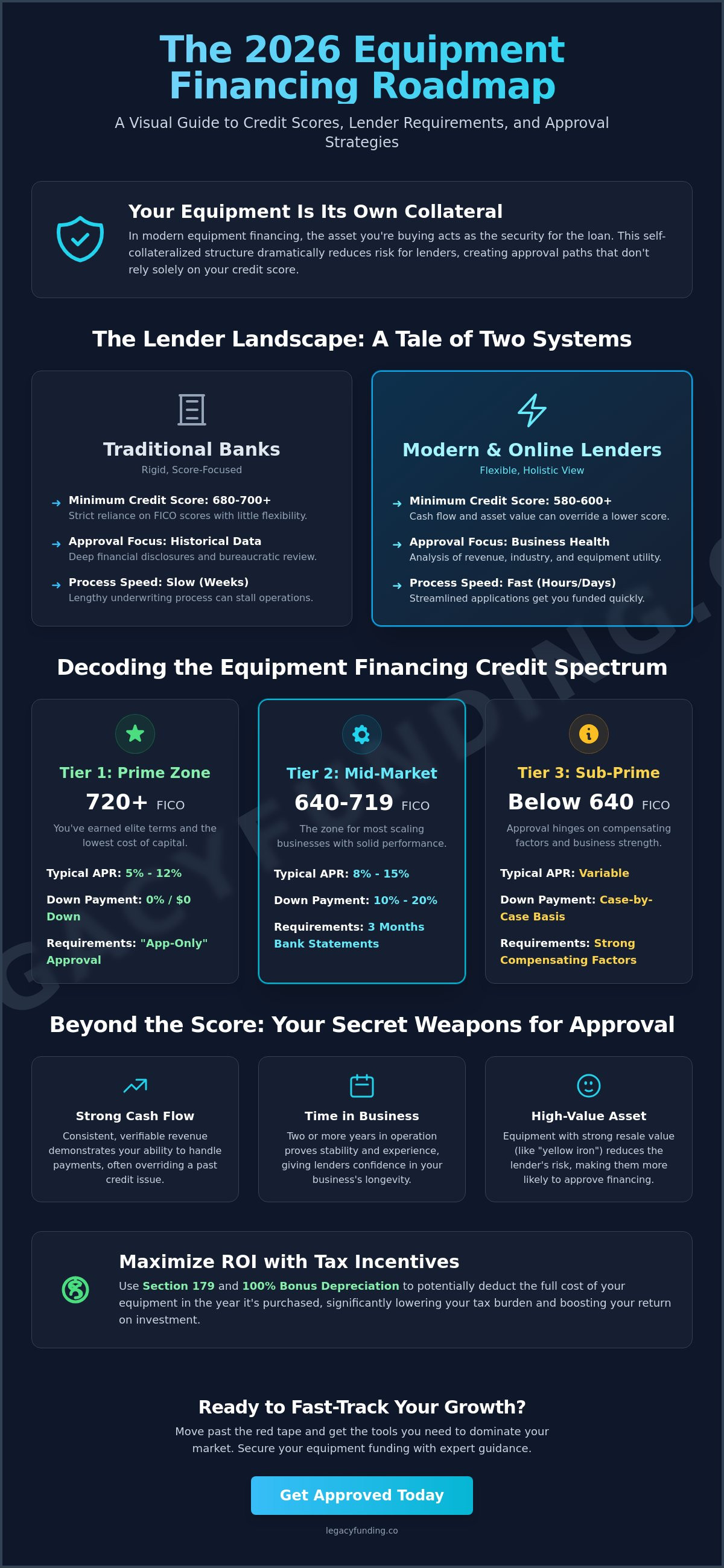
Equipment financing isn't just a loan; it's a strategic partnership backed by a physical asset. This distinction changes everything for the modern founder. When asking what credit score is needed for equipment financing, you must understand that the equipment itself acts as security. This self-collateralized structure reduces risk for the lender, creating a path to approval that doesn't exist with unsecured debt. It's why a "no" from your local bank isn't the end of your growth story.
Big banks demand a 680 to 700 score because they rely on automated, rigid systems. They want a guarantee that you're a safe bet on paper before they even look at your business model. Modern fintech providers take a different approach. They look at the broader health of your company, analyzing your cash flow, your industry, and the specific utility of the tools you're buying. Alternative lenders see the 620 to 640 range as a critical "swing zone." In this bracket, your approval often hinges on your revenue and the equipment's age rather than just your personal history.
Minimum Requirements: Banks vs. Alternative Lenders
Traditional commercial banks and SBA programs remain the most conservative players in the market. They typically require a FICO score of 700 or higher to start the conversation. This rigid standard often ignores the operational strength of your company. In contrast, specialized asset-based lenders have established a floor between 550 and 620 for many programs. If you've been in business for more than two years, these lenders often lower their credit requirements even further. They value your track record of survival and growth more than a fluctuating number on a screen. Key differences include:
- Traditional Banks: Require 700+ FICO and deep financial disclosure.
- Online Lenders: Often approve scores as low as 600 with proof of revenue.
- Asset-Based Lenders: Focus on the equipment value, occasionally accepting scores down to 550.
Why the Equipment Acts as Your Safety Net
Lenders love hard assets because they have a clear liquidation value. If the worst happens, the lender can reclaim and sell the machinery to recoup their investment. This is why high-resale value assets, often called "yellow iron" in the construction industry, can offset a lower FICO score. It helps to understand what a credit score represents in the eyes of a lender. It's a snapshot of perceived risk, but it doesn't tell the full story of your equipment's earning potential. To formalize this, lenders use a UCC-1 filing. This public notice protects the lender's interest in the asset while you use it to generate revenue. It's a transparent, professional arrangement that empowers you to scale without the friction of traditional bank bureaucracy.
Decoding the Equipment Financing Credit Spectrum
Credit scores aren't just numbers; they're the language lenders use to measure your momentum. While the physical equipment secures the deal, your score dictates the ultimate cost of your capital. Understanding credit score benchmarks for equipment loans allows you to enter negotiations with leverage. These tiers serve as essential benchmarks to help you manage expectations and plan your next expansion phase. They aren't absolute laws, but they define the boundaries of the current 2026 lending environment.
Tier 1: The Prime Zone (720+ FICO)
You've earned the right to elite terms. Borrowers in this bracket often secure APRs between 5% and 12%, representing the lowest cost of entry in the market. You can typically access 100% financing with zero dollars down, preserving your liquid cash for operational needs. These are often "App-only" programs. You provide the invoice, the lender provides the capital. There's rarely a need for tax returns or deep audits. Focus on negotiating longer terms, perhaps up to seven years, to keep your monthly payments low and your cash flow high.
Tier 2: The Mid-Market (640–719 FICO)
This is where the majority of scaling businesses operate. You can expect solid approvals with rates typically ranging from 8% to 15%. Lenders in this tier look for stability and proof of performance. They'll usually want to see your last three months of bank statements to verify consistent revenue. Be prepared for a 10% to 20% down payment, though this can be reduced if the equipment has high resale value. If your score sits in this range, speaking with a consultant can help you frame your revenue growth to push for Tier 1-style terms.
Tier 3: The Sub-Prime Zone (Below 640 FICO)
Access is the priority here. When asking what credit score is needed for equipment financing in this bracket, the answer is often "as low as 580" for many alternative lenders. You'll likely face rates of 15% to 25% or higher. Don't obsess over the rate; obsess over the ROI. If the new machinery generates $10,000 in monthly revenue and costs $2,000 to finance, the interest rate is secondary to your profit margin. You can often "jump" into a higher tier by providing additional collateral or demonstrating a significant surge in year-over-year revenue. This tier is a stepping stone to financial independence, not a permanent destination.
Factors That Outweigh a Low Credit Score
Don't let a three-digit number stall your momentum. While many founders obsess over what credit score is needed for equipment financing, savvy underwriters prioritize the "Compensating Factor." This is a specific metric that proves your ability to repay, even if your past credit history shows a few bumps. If your revenue is trending upward, that growth story often carries more weight than a stale credit report. Modern lenders want reasons to say yes, and they find them in your operational data.
Comparable credit is your strongest weapon in a negotiation. If you've successfully managed and paid off similar equipment leases in the past, you've demonstrated industry-specific reliability. Lenders view this as a powerful low-risk indicator. It's often enough to secure an approval that a traditional bank would decline. For those seeking the gold standard of rates and have the time for a long application process, government-backed financing programs remain an option. However, they rarely match the speed of asset-based alternative lenders who prioritize your current performance over your past mistakes.
Equipment Type and Resale Value
Lenders categorize assets by their "Essential Use" status. If the machinery is vital to your daily operations, it's considered a lower risk because you're less likely to default on the tools that keep your doors open. High-resale value equipment, like heavy construction machinery or CNC machines, acts as a secondary safety net for the lender. A two-year-old machine holds its value much better than specialized software or 10-year-old trucks. Most lenders cap "soft costs" like shipping, training, and installation at 15% to 20% of the total loan to keep the deal anchored in physical, liquid value.
Cash Flow and Revenue Consistency
Your bank statements tell a story that your FICO score misses. Underwriters look for consistent "Average Daily Balances" and frequent deposits rather than just a total monthly sum. They use the Debt Service Coverage Ratio (DSCR) to ensure your monthly net income can comfortably cover the new payment. If you can show 12 months of steady or increasing revenue, you can often "outshout" a 600 credit score. This revenue-first logic is the hallmark of modern financing. It treats you as a growing enterprise with a future rather than a static risk profile defined by the past.
How to Secure Financing Regardless of Your Score
Rejection isn't an endpoint; it's a signal to refine your strategy. If you're concerned about what credit score is needed for equipment financing because your current score is lower than you'd like, focus on the variables you can control. Securing a "yes" is about presentation and proof. You're pitching a growth opportunity, not asking for a favor. Lenders want to see that you understand your numbers and have a clear plan for the asset's utility.
Success requires a shift from a defensive posture to an offensive one. Don't let your credit score dictate your business's ceiling. Instead, use these tactical steps to position your company as a high-performing, low-risk investment. When you frame your request through the lens of ROI and operational efficiency, you change the conversation from risk to reward. This proactive approach builds immediate trust with modern funding partners.
Step 1: Audit Your Financial Narrative
Clean up your bank statements before you submit an application. Avoid non-sufficient funds (NSF) flags at all costs; they're a massive red flag for any underwriter. Write a concise, two-sentence "Purpose of Funds" statement. Explain exactly how this equipment will generate revenue or save costs. Gather your last 3 to 6 months of business bank statements and your most recent tax return to show you're ready for immediate action. Organized documentation suggests an organized business.
Step 2: Leverage Additional Collateral
Reduce the lender's anxiety by putting more skin in the game. A down payment of 20% or more can effectively "buy down" your risk profile and secure better terms even with a lower score. Explore cross-collateralization by using equipment you already own free and clear to back the new loan. Be transparent about your willingness to provide a personal guarantee if a corporate-only signature isn't enough to bridge the gap. This commitment shows you're personally invested in the success of the financing.
Step 3: Choose the Right Funding Partner
Avoid "shotgunning" your application to dozens of lenders. Every hard pull can damage your score and make you look desperate to underwriters. Prioritize advisors who specialize in your specific industry, whether it's logistics, medical, or manufacturing. They understand the lifecycle of your equipment better than a generalist bank. Focus on speed and flexibility rather than chasing a low teaser rate that might never materialize. Connect with a funding specialist today to build a custom path to your next major acquisition.
Fast-Track Your Growth with Legacy Funding Advisors
Legacy Funding Advisors isn't a traditional lender. We're the modern alternative to the sluggish bureaucracy of legacy banks. While you've spent the previous sections learning exactly what credit score is needed for equipment financing, we focus on the speed of your opportunity. We bridge the gap between financial obligation and rapid expansion. Our team operates as your high-level consultant. We're personally invested in your growth. We understand that your business isn't just a balance sheet; it's your legacy.
Broken equipment can't wait for a committee vote. We offer a 24-48 hour funding window to keep your operations moving. This isn't just a transaction; it's a generational endeavor. We provide the smart capital you need to build a lasting legacy. Stop letting outdated institutional standards dictate your pace. We provide the keys to financial independence and business scaling. Our approach is bold, transparent, and slightly disruptive to the status quo.
Our Cash Flow-First Approval Model
We prioritize your current revenue trajectory over a static three-digit score when determining what credit score is needed for equipment financing within our flexible programs. If your business is generating cash, you're a candidate for growth. We look at where your business is going, not just where it has been. We fund high-impact projects across the United States, Puerto Rico, and Canada. Our entry requirements are low-barrier. We want to remove friction, not create it. We speak the language of modern founders who value growth metrics and rapid scaling. Our underwriting is built for the speed of contemporary commerce.
Our model focuses on the 5 C's of credit with a specific emphasis on capacity and collateral. We recognize the intrinsic value of the tools you use to build your company. This allows us to offer flexible terms that legacy institutions simply can't match. We're here to fuel your rapid expansion with accessible capital. We move the reader quickly from a specific pain point to the relief of a streamlined process.
Ready to Scale? Take the First Step
Our application process is simple, fast, and transparent. We've removed the bureaucratic vocabulary of traditional institutions. You'll experience a streamlined flow designed for maximum efficiency. There is no wasted space in our messaging or our methods. Every step is designed to move you closer to the equipment you need. We've optimized our system to ensure you spend less time on paperwork and more time on production.
Focus on the triad of benefits we offer: speed, accessibility, and long-term impact. Take control of your business scaling today. Don't let a broken machine or an outdated bank stop your momentum. We're ready to partner with you to secure your future and build something that lasts. Apply for Equipment Financing in Minutes.
Secure Your Tools and Scale Your Legacy
The traditional banking model is outdated. You've learned that while FICO scores provide a baseline, your equipment's value and your company's revenue trajectory are the true drivers of approval. The question of what credit score is needed for equipment financing shouldn't keep you up at night. Focus on your cash flow and the ROI of your new machinery. We treat your growth as a generational endeavor, not a simple loan application.
Legacy Funding Advisors provides the modern path to acquisition. We offer national coverage across North America and a revenue-based approval model that prioritizes your future. Access the capital you need with funding delivered in 24 to 48 hours. You don't have to wait weeks for a decision while your competitors move ahead. We bridge the gap with speed, transparency, and professional partnership. It's time to stop letting legacy institutions slow your momentum.
Take the next step toward financial independence. Secure the assets your business deserves and start generating new revenue immediately. Get a Funding Decision in 24 Hours and put your growth plan into motion. Your business has the potential; we have the capital to unlock it.
Frequently Asked Questions
Can I get equipment financing with a 500 credit score?
Yes, you can secure financing with a 500 score by leveraging high-value collateral or demonstrating strong cash flow. When asking what credit score is needed for equipment financing at this level, the focus shifts to a larger down payment, often between 20% and 35%. These programs prioritize the machinery's resale value over your personal history, providing a results-oriented path to getting the tools you need today.
What is the typical down payment for a business equipment loan?
Most lenders require a down payment ranging from 10% to 20% of the equipment's purchase price. Tier 1 borrowers with excellent credit may qualify for 100% financing with zero dollars down. Conversely, startups or those with lower scores should prepare for a 20% to 35% contribution. This equity stake lowers the lender's exposure and can help you secure more favorable interest rates and terms.
Does equipment financing require a personal guarantee?
Most alternative and non-bank lenders require a personal guarantee to finalize the agreement. This commitment links your personal credit to the business obligation, providing the lender with additional security. Corporate-only signatures are generally reserved for large, established enterprises with extensive credit depth and years of profitable history. For most SMBs, the personal guarantee is a standard requirement to unlock competitive growth capital.
How long does the equipment financing approval process take?
Modern approval processes move at the speed of your business, often delivering a decision within 24 hours. Once you accept the terms and provide the necessary verification, funding can occur in as little as 48 hours. This efficiency is a hallmark of savvy lenders who understand the urgency of replacing broken machinery or seizing a sudden market opportunity. Legacy banks typically take weeks to reach the same conclusion.
Is equipment leasing easier to qualify for than a loan?
Leasing often presents a lower barrier to entry because the lender retains ownership of the asset. This structure reduces the lender's risk and makes approvals more accessible for businesses with challenged credit. When researching what credit score is needed for equipment financing, many founders find that leasing programs accept scores that traditional loan programs might decline while still offering manageable monthly payments.
Will an equipment loan help build my business credit score?
Yes, an equipment loan can strengthen your business credit profile if the lender reports your payment history to major bureaus. Consistently making on-time payments demonstrates reliability to future creditors and can lead to better terms on larger loans. Always verify that your funding partner reports to agencies like Dun & Bradstreet or Experian Business before signing your contract to maximize the long-term impact of your debt.
What documents do I need to apply for equipment funding?
You'll need a formal equipment invoice or quote, your last three to six months of business bank statements, and your most recent tax return. Some "App-only" programs for high-credit borrowers may only require the invoice and a simple application. Having these documents organized and ready for submission ensures a frictionless process and a faster path to your funding decision. Preparation is the key to rapid expansion.
Can startups with no credit history get equipment financing?
Startups can definitely secure equipment financing by using their personal credit history as a proxy for business reliability. Lenders often look for industry experience and a solid business plan that illustrates the equipment's revenue potential. While you may face a higher down payment or shorter terms, this initial financing serves as a critical foundation for building your company's credit depth and scaling your operations from day one.