


What Are the Hidden Costs of a Merchant Cash Advance? The 2026 Transparency Guide
That 24-hour funding window looks like a lifeline until the first daily withdrawal hits your bank account. Speed is the ultimate competitive advantage for the modern founder, but rapid capital often carries a complexity that traditional institutions never mention. You likely already feel the tension between the ease of approval and the mystery of the actual price tag. Understanding what are the hidden costs of a merchant cash advance is the only way to protect your margins while you accelerate.
We're going to demystify the 2026 financial landscape. You'll learn how to translate factor rates into effective APR, identify the administrative fees buried in the fine print, and navigate new state disclosure requirements. This guide provides the insider knowledge you need to calculate your true ROI, justify the expense through growth, and secure the capital your business deserves with total confidence. Stop guessing at your cost of capital. Let's look at the numbers.
Key Takeaways
- Decode the critical difference between factor rates and effective APR to reveal the true cost of your capital.
- Uncover what are the hidden costs of a merchant cash advance by auditing origination fees and UCC filing charges before you sign.
- Master the concept of repayment velocity to protect your daily cash flow from aggressive holdback percentages.
- Shift your focus to ROI and learn how to justify capital expenses through strategic, high-growth business investments.
- Discover how modern revenue-based financing provides a transparent alternative that scales with your actual sales performance.
Factor Rates vs. APR: Decoding the Primary Cost of an MCA
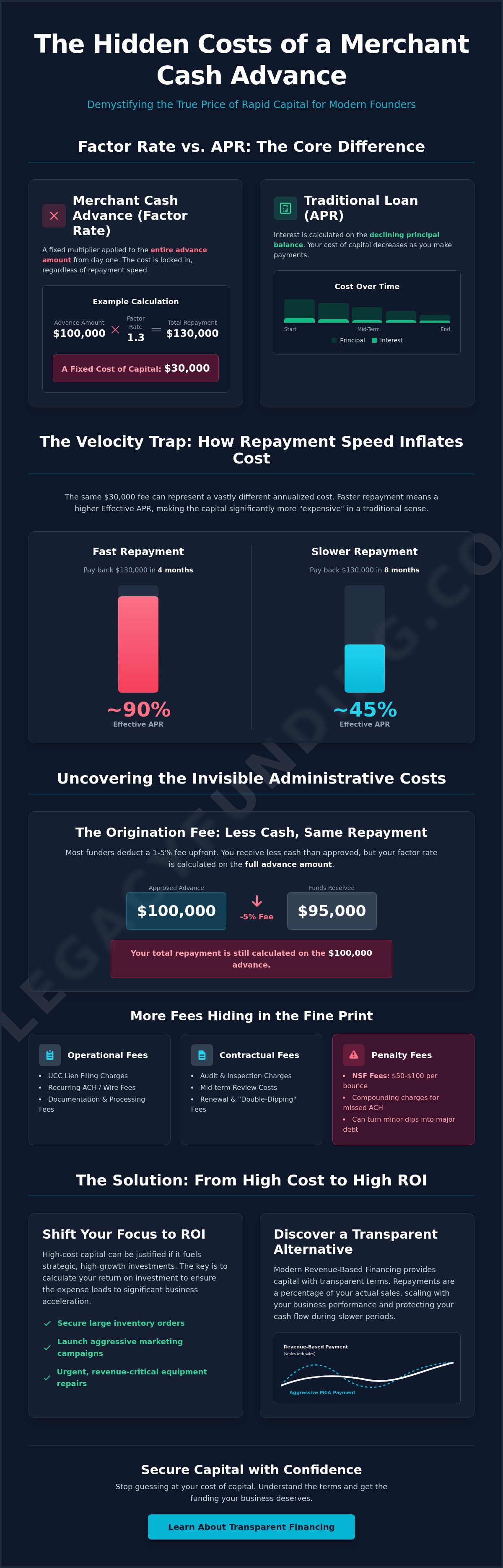
To understand the true price of capital, you must first look past the terminology. Traditional loans use interest rates that fluctuate with your balance. A Merchant Cash Advance does not. Instead, it uses a factor rate, which is a fixed multiplier applied to your total advance at the start. This distinction is vital because it changes how you calculate your return on investment. You aren't paying for the time you hold the money; you're paying a flat fee for the right to access it immediately.
Before diving into the math, it's helpful to understand the legal structure. What is a Merchant Cash Advance? Technically, it's a purchase of future receivables, not a loan. This classification allows providers to use factor rates, which bypass traditional usury laws and interest caps. A 1.2 factor rate might sound similar to a 20% interest rate, but the math tells a different story. Interest applies to a declining balance. As you pay it back, the cost decreases. A factor rate applies to the original amount. You pay the same fee on day one as you do on the final day. This lack of a declining balance is one of the primary reasons people ask what are the hidden costs of a merchant cash advance when comparing them to bank products.
The Math Behind the Multiplier
Imagine your business secures a $100,000 advance at a 1.3 factor rate. Your total repayment is $130,000. That $30,000 cost is locked in the moment you sign. You should also be aware of the "buy rate" versus the "upsell." The funder sets a base rate, but brokers often add points to that number to secure their commission. This upsell directly inflates your factor rate without adding any value to your business. Because the cost is fixed, early repayment rarely results in cost savings. You're committed to the full $130,000 regardless of how fast your sales grow.
Why APR is Still a Relevant Metric for Founders
Repayment speed, or velocity, dictates your effective APR. If you pay back that $30,000 in fees over four months, your annualized cost is significantly higher than if you paid it over eight months. Speed makes the capital "expensive" in a traditional sense. You must normalize these numbers to compare an MCA against a business line of credit or a term loan. Use the expected repayment window to calculate the APR. This framework allows you to see what are the hidden costs of a merchant cash advance in the context of your overall debt schedule. It turns a vague fee into a hard metric you can use to protect your margins.
The 'Invisible' Administrative and Operational Fees
The headline factor rate is only your starting point. To truly understand the capital's impact on your bottom line, you must account for the fees deducted before the funds even hit your account. Most funders charge an origination or underwriting fee that typically ranges from 1% to 5% of the total advance. If you secure a $100,000 advance with a 5% fee, you only receive $95,000. However, you're still responsible for paying the factor rate on the full $100,000. This immediate deduction effectively spikes your cost of capital from day one.
Operational costs continue throughout the life of the advance. Providers often file a Uniform Commercial Code (UCC) lien to secure their interest in your future sales. The cost of this filing, along with small recurring ACH or bank wire fees for daily pulls, can quietly erode your margins. While federal regulations for merchant cash advances provide a framework for business credit reporting, they don't always cap these administrative charges. These layers of friction are exactly what are the hidden costs of a merchant cash advance that founders often overlook during the excitement of an approval.
Contractual Fees Hiding in the Fine Print
Read your agreement for "documentation fees" or "processing charges." Some funders apply these as one-time hits, while others sneak them in as recurring monthly costs. You should also watch for audit and inspection fees. Some contracts allow the funder to charge you for a mid-term review of your financial records. Perhaps the most dangerous "hidden" cost is the Non-Sufficient Funds (NSF) fee. If a daily ACH withdrawal bounces because of a temporary cash flow dip, you could face charges of $50 to $100 per occurrence. These penalties compound quickly, turning a minor oversight into a major financial burden. If you're unsure about the specifics of your current contract, speak with a transparency expert to audit your terms.
The Hidden Cost of Renewals and Double-Dipping
The most expensive mistake a founder can make is "double-dipping" during a renewal. This happens when you refinance your advance before the original balance is paid off. Many funders will roll the remaining balance into a new advance and charge a fresh factor rate on the entire amount. You're effectively paying twice for the same capital. To avoid this trap, always negotiate for a "net add" structure. This ensures you only pay the factor rate on the new capital you're actually receiving. Demand a breakdown of the payoff amount versus the new funding to keep your growth profitable and your debt manageable.
The Cost of Velocity: How Repayment Speed Impacts Your Bottom Line
Velocity is the hidden variable in your capital equation. While you might focus on the factor rate, the speed at which you repay that capital determines your effective APR. If your business experiences a sudden surge in sales, your daily holdback increases. You pay the advance back faster. This sounds positive, but it actually makes the capital more expensive on an annualized basis. This acceleration is one of the most significant factors when founders ask what are the hidden costs of a merchant cash advance. You're essentially paying a premium for capital you only held for a fraction of the expected time.
Your holdback percentage—the slice of daily revenue diverted to the funder—must align with your gross margins. If your margin is 30% and your holdback is 20%, you only have 10% left to cover payroll, rent, and inventory. This creates a compounding opportunity cost. Every dollar diverted to a funder is a dollar removed from your growth engine. You lose the ability to buy bulk inventory at a discount or launch an aggressive ad campaign. This "lost growth" is a structural cost that never appears on a balance sheet but directly impacts your long-term valuation. To stay profitable, ensure your holdback never exceeds your net cash flow capacity.
Daily vs. Weekly Repayment Structures
Daily pulls create a constant psychological and operational drain. They require you to manage your bank balance with surgical precision every 24 hours. Weekly repayment structures offer more breathing room. They allow businesses with cyclical revenue—like restaurants or retail shops—to smooth out the peaks and valleys of their weekly sales. Align your repayment schedule with your industry's specific cycle. If your sales spike on weekends, a Monday or Tuesday weekly pull is far more sustainable than five separate daily hits. It's about maintaining a rhythm that doesn't disrupt your core operations.
The Reconciliation Clause: Your Operational Safety Net
A true merchant cash advance should be flexible. If your sales drop, your payments should drop proportionally. This is managed through a reconciliation clause. Many funders hide this process in the fine print or make it "optional" upon request. Don't leave your cash flow to chance. Demand a mandatory reconciliation clause in your contract. This ensures that if your revenue hits a seasonal slump, the funder must adjust your daily pull to reflect your actual sales. This protection is the ultimate defense against the cash flow disruptions that define what are the hidden costs of a merchant cash advance. It transforms a rigid obligation into a partnership that respects the reality of your business cycle.
Calculating ROI: When Does the Cost of Capital Make Sense?
Stop asking what the capital costs. Start asking what the capital earns. High-growth founders don't view financing as a liability; they view it as a precision tool. While you must account for what are the hidden costs of a merchant cash advance, you must also calculate the cost of inaction. Stalled growth, missed contracts, and equipment downtime often carry a price tag far higher than any factor rate. If the return on the deployed capital exceeds the total cost of the advance, the decision becomes a simple math problem rather than a financial risk.
Apply the "Margin Test" to every offer. If your profit margin on the new revenue generated by the advance is higher than the factor rate, the transaction is accretive to your business. You're trading a slice of future profit for immediate expansion. This framework moves you away from anxiety and toward strategic scaling. Use this decision matrix to determine your next move:
- Green Light: Bulk inventory purchases, mission-critical equipment repairs, or bridge funding for a secured contract.
- Red Light: Covering basic payroll, funding long-term R&D with slow returns, or paying off non-predatory debt.
The Inventory Buy Scenario
Consider a retail founder using a $50,000 advance to secure inventory at a significant discount. If a 1.25 factor rate creates a $12.5,000 cost, but the bulk purchase saves you $20,000 in immediate procurement costs, you've already cleared a $7,500 profit before making a single sale. The secret here is capital turnover speed. If you can flip that inventory in 60 days, the high velocity justifies the cost. You aren't just buying products; you're buying a competitive edge that your cash-strapped competitors can't touch.
Emergency Repairs and Revenue Preservation
Speed justifies cost when business continuity is at stake. A 48-hour facility shutdown can cost a manufacturing plant tens of thousands in lost production and late delivery penalties. In this context, a 24-hour MCA acts as an insurance policy. It preserves your reputation and your revenue stream. Smart founders also use this fast capital as a bridge. Use an MCA to solve the immediate crisis, then transition into a lower-cost, long-term solution like SBA loans or business lines of credit once the dust settles. This multi-step approach minimizes what are the hidden costs of a merchant cash advance while maximizing your operational agility.
Legacy Funding: Transparent Revenue-Based Financing for 2026
Traditional finance often feels like a black box. You've spent this guide uncovering what are the hidden costs of a merchant cash advance, from double-dipping traps to inflated broker commissions. Legacy Funding breaks that cycle. We position ourselves as the modern, transparent alternative to opaque funding structures. Our revenue-based financing aligns with your actual business growth metrics. This ensures your success and our support remain perfectly synchronized. We offer 24 to 48 hour funding speed without the bureaucratic friction of legacy banks. There are no hidden junk fees. There are no predatory structural traps. We offer a confident partnership designed for long-term impact and generational growth.
Founders deserve an ally that understands the speed of contemporary commerce. We've removed the gatekeepers. Our model focuses on your current performance and future trajectory rather than just your past obligations. This disruptive approach allows us to provide capital that fuels expansion without compromising your operational integrity. We speak the language of the modern founder. We focus on growth metrics, cash flow health, and the ultimate goal of business scaling. It's time to move past the outdated methods of traditional institutions and embrace a financial tool built for the 2026 economy.
Capital Beyond the Credit Score
Stop letting a FICO score dictate your company's future. Legacy Funding evaluates your business based on real-world cash flow and market potential. This empowers founders who are often overlooked by traditional financial institutions due to strict, outdated criteria. We believe your ability to scale is more important than a static credit number. Our reach is extensive, providing accessibility across the U.S., Puerto Rico, and Canada. We look at your growth trajectory to provide the capital you need to dominate your industry. Your potential is our primary metric.
The Secure Path to Growth
Scaling your business should be a logical, streamlined process. We use a simple triad to get you the resources you need: Apply, Approve, and Advance. This efficiency mirrors the fast-paced nature of the industries we serve. View your funding as a strategic lever for expansion rather than a last-resort safety net. When you have the right partner, capital becomes a tool for precision growth. You deserve terms that respect your margins and a process that respects your time. Secure your growth capital with transparent terms today.
Secure Your Financial Future with Total Clarity
Your business deserves capital that works as hard as you do. You've learned that mastering the math behind what are the hidden costs of a merchant cash advance is the only way to protect your margins. By decoding factor rates and auditing administrative fees, you've moved from confusion to total control. You now have the framework to justify capital through ROI and the insight to avoid velocity traps that drain your daily cash flow. Knowledge is your ultimate competitive advantage.
Legacy Funding is here to bridge the gap between where you are and where you're going. We provide a transparent alternative built on partnership rather than fine print. We offer 24 to 48 hour funding turnarounds and look at your cash flow potential rather than making credit-score-only decisions. You get transparent factor rates with no hidden fees and no double-dipping traps. It's time to fuel your expansion with an ally who values your growth as much as you do.
Apply for fast, transparent business funding in minutes. Your next level of scale is within reach. Let's build your legacy together.
Frequently Asked Questions
Is a merchant cash advance considered a loan?
No, a merchant cash advance is technically a purchase of future receivables. It's a commercial transaction where a provider buys a portion of your future sales at a discount. This legal distinction is why MCAs aren't subject to traditional usury laws or interest rate caps. It allows for the rapid funding and high approval rates that modern founders require.
How do I calculate the total cost of an MCA?
Multiply your total advance amount by the factor rate and then add any upfront administrative fees. If you receive a $100,000 advance at a 1.2 factor rate, your base repayment is $120,000. Adding a 3% origination fee brings your total cost to $123,000. This simple formula helps you identify what are the hidden costs of a merchant cash advance before you sign.
What is a typical factor rate in 2026?
Current factor rates in 2026 typically range from 1.1 to 1.5. Businesses with consistent revenue and credit scores above 600 often secure competitive rates between 1.10 and 1.29. Higher rates are common for companies with shorter operating histories or fluctuating sales. Your specific rate acts as a risk premium on the speed and accessibility of the capital.
Can a merchant cash advance provider take money from my personal account?
Generally, providers only withdraw from your business bank account. They're purchasing your company's future sales, not your personal assets. However, you must review your contract for personal guarantees or "Confessions of Judgment" clauses. These can create personal liability if the business fails to deliver on the receivables it sold to the funder.
What happens if my business sales drop significantly during repayment?
Your daily payments should decrease proportionally through a process called reconciliation. A true MCA is designed to mirror your sales volume. If your revenue hits a slump, you can request a reconciliation to adjust the daily pull to your actual sales percentage. This protection ensures the advance doesn't become a burden during seasonal dips.
Are there tax benefits to the fees associated with an MCA?
The difference between the advance amount and your total repayment is generally a deductible business expense. Since an MCA is a purchase of receivables at a discount, the "cost" is often treated as a necessary operational expenditure. You should consult with a CPA to ensure you're maximizing your deductions based on the specific structure of your agreement.
What is the difference between an origination fee and a factor rate?
The factor rate is a multiplier that determines your total repayment amount. The origination fee is an upfront administrative charge deducted from your initial wire. If you secure a $50,000 advance with a 5% origination fee, you'll receive $47,500. However, your repayment obligation is still calculated based on the full $50,000 amount plus the factor rate.
How can I avoid 'double-dipping' when I renew my funding?
Insist on a "net add" structure when you refinance or renew your advance. This ensures the factor rate only applies to the new capital being disbursed to your account. Never allow a funder to apply a fresh factor rate to your existing balance. Managing these renewals is a vital part of controlling what are the hidden costs of a merchant cash advance as you scale.