


UCC Filing Explained: What Every Business Owner Needs to Know in 2026
With a projected 6.0 million new business applications filed by the end of 2026, the race for capital is more crowded than ever. You might feel that a ucc filing on your record is a red flag that will freeze your credit or hand over the keys to your business assets. It's a common fear. Most founders view these legal notices as roadblocks to growth rather than the strategic tools they actually are. The truth is that transparency drives speed in modern finance.
This guide will strip away the bureaucratic jargon to show you how to master these filings, protect your credit, and use them to secure fast, growth-oriented funding. You'll learn how to leverage your assets without losing control of your vision. We'll break down the critical differences between UCC-1 and UCC-3 forms, explain the New York amendments effective June 5, 2026, and give you a clear roadmap to manage your filings while you scale. It's time to stop fearing the paperwork and start using it to fuel your expansion.
Key Takeaways
- Reframe the ucc filing as a professional transparency tool that signals active business growth rather than financial distress.
- Master the "first-in-line" priority rules to understand exactly how lenders view your collateral and your capacity for new debt.
- Identify the specific impacts on your Dun & Bradstreet and Experian reports to maintain a pristine business credit profile.
- Execute a streamlined checklist to audit your public records and remove expired or inaccurate filings through your Secretary of State.
- Unlock fast capital by focusing on cash flow metrics that allow for rapid funding even when existing filings are present.
What Is a UCC Filing? The Backbone of Modern Business Lending
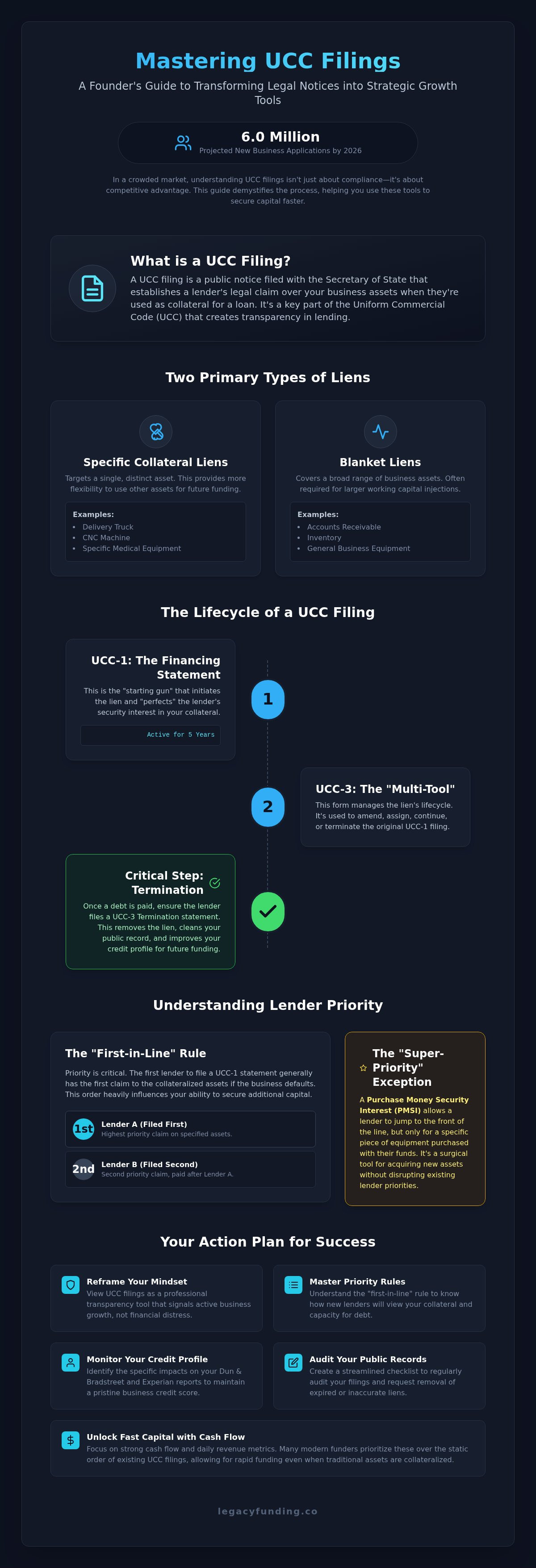
A ucc filing is a public notice that establishes a lender's legal claim over your business assets. It's a fundamental part of the Uniform Commercial Code (UCC). This legal framework ensures that commercial transactions remain consistent and predictable across state lines. Think of it as a professional broadcast. It tells other potential creditors exactly which assets are already pledged as collateral, preventing legal disputes before they start.
Your Secretary of State manages these records. By 2026, digital filing standards have reached a peak of efficiency. Most states have moved to fully automated systems that process a ucc filing in real-time. This modernization eliminates the bureaucratic lag found in legacy institutions. It allows savvy founders to leverage their assets for capital without waiting on postal services or manual data entry. The modern market moves in seconds; your filing process should too.
There are two primary types of liens you'll encounter during this process:
- Specific Collateral Liens: These target a distinct asset, such as a CNC machine, a delivery truck, or a specific piece of medical equipment.
- Blanket Liens: These cover a broad range of assets, including accounts receivable, inventory, and general equipment.
Knowing the difference helps you maintain control over your balance sheet while you scale. A specific lien gives you more flexibility to use other assets for future funding, while a blanket lien provides the high-level security often required for larger working capital injections.
The UCC-1 Financing Statement Explained
The UCC-1 is the starting gun for any secured business loan. It's the document that "perfects" a lender's interest in your collateral. Every UCC-1 includes three critical components: the debtor's information, the secured party's details, and a description of the collateral. Once filed, this statement remains active for five years. If the debt isn't settled or the filing isn't renewed within that window, the lender's priority can vanish. Don't let the legal jargon intimidate you; it's simply a placeholder for your financial commitment.
UCC-1 vs. UCC-3: Know the Difference
If the UCC-1 is the foundation, the UCC-3 is the multi-tool. A UCC-1 initiates the lien, but a UCC-3 manages its lifecycle. You'll see a UCC-3 used for amendments, assignments to new lenders, or full terminations. Tracking these is vital for your long-term growth. A common pitfall for growing businesses is leaving old filings active long after the debt is paid. Always verify that a UCC-3 termination statement is filed once you've cleared a balance. This keeps your public record clean and your credit profile healthy for the next stage of your expansion. Efficiency in your records mirrors efficiency in your operations.
How UCC Filings Work: Collateral, Priority, and the Filing Process
"Perfecting a security interest" sounds like legal theatre. In reality, it's just the process of making a lender's claim official. By filing a notice with the state, the lender stakes their claim. This public record ensures everyone knows who has the first right to your assets. It's about transparency and order in a fast-paced market. Without this step, a lender's claim is often invisible to others, which creates chaos in the credit markets.
Priority is the most critical concept for a scaling founder. The first lender to file usually gets paid first if a business faces liquidation. This "first-in-line" status dictates your ability to secure additional capital. If your first lender has a blanket lien, a second lender might hesitate to offer traditional terms. However, alternative lenders often look past this. They prioritize your cash flow and daily revenue over the static order of your public records. This approach allows for rapid expansion even when traditional banks say no. For a deeper look at these mechanics, check out this complete guide to UCC filings.
Understanding the difference between a blanket lien and a Purchase Money Security Interest (PMSI) gives you a competitive edge. A PMSI is a "super-priority" lien. It allows a lender to jump to the front of the line for a specific piece of equipment you just bought. It's a surgical tool for growth. In contrast, blanket liens are broader. They are common in revenue-based financing and MCAs because they secure the funding against the general health of the business rather than a single machine. If you're unsure how your current assets are positioned, you can speak with a consultant to audit your status.
What Counts as Collateral?
Collateral isn't just the machinery on your warehouse floor. It's split into tangible and intangible categories. Tangible assets include equipment, vehicles, and raw inventory. Intangible assets cover accounts receivable, intellectual property, and even your future sales. Most alternative funding providers use an "all-asset lien." This broad claim covers everything the business owns to maximize the speed and volume of your capital injection.
The Lifecycle of a Filing
The process moves fast. In 2026, most states process a digital ucc filing within a 24-hour window. Accuracy is paramount. A single typo in the debtor’s name or a missing space can render the entire filing ineffective. Once active, the lien lasts five years. To keep it alive, lenders must file a UCC-3 continuation statement within the six-month window before the expiration date. Commercial bankruptcies rose 49% in early 2026, making lenders more diligent about these renewals than ever before. Always conduct a search before your next application to ensure your record reflects your current debts.
The Impact of UCC Filings on Your Business Credit and Funding
A common misconception is that a ucc filing is a stain on your financial record. It isn't. Major credit bureaus like Dun & Bradstreet and Experian Business categorize these as public records, not negative payment events. To a savvy lender, a filing proves you have the collateral and the operational maturity to secure capital. It signals activity. It shows you're in the game. Transparency is your greatest asset when you're looking to scale rapidly.
Context matters. Traditional banks often balk when they see multiple filings, a practice known as stacking. They worry about their position in the repayment line. With commercial bankruptcies hitting a high in January 2026, legacy institutions have become even more risk-averse. They see multiple filings and see a red flag. We see an opportunity for Debt Consolidation or Reverse Consolidation. By grouping these obligations, you can reclaim your cash flow and simplify your balance sheet. Use your existing filings as leverage to negotiate better terms rather than letting them sit as passive records.
Will a UCC Filing Lower My Credit Score?
A filing alone won't tank your score. Bureaus distinguish between a legal notice of a lien and a failure to pay. Your payment history remains the dominant factor in your creditworthiness. Problems only arise when old, inactive records remain on file. Neglecting to terminate these "zombie filings" can accidentally suppress your credit capacity by making your business appear more leveraged than it truly is. Conduct a search every quarter to keep your profile accurate.
Getting Additional Funding with an Active UCC
You aren't locked out of the market just because a lien exists. One common strategy is a subordination agreement. This legal pivot allows a new lender to move to the front of the line for specific assets. It requires coordination, but it's a standard move for growth-minded firms. It ensures that your newest partner has the security they need to provide the capital you require.
At Legacy Funding, we look beyond the public record. We prioritize your current cash flow and revenue metrics over static filings. Our Revenue-Based Financing and Working Capital Loans are designed for speed, often delivering funds in 24 to 48 hours. We understand that a ucc filing is just one chapter of your financial story. If you're ready to move past the hurdles of traditional banking, our consultative approach helps you navigate these complexities without the friction. Focus on your growth metrics; let us handle the technicalities of the funding structure.
Managing and Removing UCC Filings: A Practical Checklist
Managing your public record is a non-negotiable part of scaling. A stale ucc filing can act as a hidden anchor on your growth. It blocks new capital and distorts your credit profile. Don't let administrative lag slow your momentum. Take control of your data with this systematic approach to record management. Efficiency in your filings leads to efficiency in your capital.
Start at the source. Visit your Secretary of State’s digital portal and perform a search under your exact legal business name. In 2026, fees for these searches vary by jurisdiction. For example, the fee for a UCC search at the Florida Secured Transaction Registry is $30.00. Knowledge is your first line of defense. Once you have the report, match every active record to an open debt on your ledger. If the balance is zero, the filing shouldn't be there.
Secure your UCC-3 termination statement immediately. This is the only document that officially kills a lien. Request it the moment your final payment clears. Most lenders are diligent, but paperwork can slip through the cracks. If a lender fails to file within 20 days of a written demand, they may be liable for damages. Be persistent. Your future funding depends on a clear record. If you find an unauthorized or expired filing, contact the state to initiate a dispute. Correcting errors today prevents hurdles tomorrow.
Dealing with "Zombie" Filings
Zombie filings are a common headache in 2026. Lenders merge, close, or simply lose track of their paperwork, leaving behind liens that haunt your credit. If your lender is unreachable, use an Information Statement. Formerly known as a Correction Statement, this allows you to add a public note to the record. It doesn't remove the filing, but it tells future partners that the debt is satisfied. If a former lender refuses to cooperate, legal counsel can help you force a termination. Keep your records lean and accurate.
Proactive Credit Management
A pristine record is a prerequisite for high-level moves like an SBA loan. Traditional institutions demand a spotless history. Maintaining a professional dialogue with your current lenders about security interests builds trust. It makes your next 48-hour funding round seamless. Don't wait until you need capital to check your status. If you need help auditing your current filings or consolidating debt, reach out to our advisors today. We specialize in navigating these complexities so you can focus on your vision.
Fast Funding Without the Friction: The Legacy Funding Advantage
Speed is the primary currency of 2026. While traditional banks get bogged down in the minutiae of a ucc filing, we focus on the momentum of your business. Our process is designed to remove the friction that stalls growth. We don't just see a legal record; we see a founder ready to scale. By streamlining the security process, we turn what used to be a weeks-long hurdle into a 24-hour sprint. Transparency is our baseline. There are no hidden liens, no bureaucratic "gotchas," and no wasted motion. You can complete our digital application in minutes and move straight to the funding phase.
Our "Cash Flow First" philosophy is what sets us apart from the competition. We understand that your public records only tell half the story. While a legacy institution might freeze at the sight of an existing lien, we look at your daily revenue and operational health. This perspective allows us to provide Working Capital Loans and Merchant Cash Advances to businesses that others overlook. We prioritize your actual performance over static credit reports. This approach ensures you get the capital you need when you need it most, regardless of what your current filings look like.
Tailored Capital for Rapid Growth
Your business doesn't fit into a box, and your funding shouldn't either. Our Revenue-Based Financing adapts to your daily sales, providing a flexible repayment structure that breathes with your business cycles. For those feeling the weight of multiple creditors, our expertise in Debt Consolidation and Reverse Consolidation is a total game-changer. We help you clean up your balance sheet, group your obligations, and reclaim your cash flow. Whether you need Equipment Financing for a new project or a Business Line of Credit for seasonal shifts, we provide the specific tools required for your expansion.
Your Partner in Financial Scaling
We act as a tech-forward financial ally for the modern founder. Our advisors guide you through every step of the application and the ucc filing process. We ensure you understand your rights and your records throughout the entire lifecycle of the loan. This partnership is built on the idea of generational success and long-term impact. We aren't just here for one round of funding; we're here to help you build a legacy. Apply in minutes and receive funds in as little as 24 hours. The modern key to growth is within your reach. Scale your business today with fast, flexible funding from Legacy Funding.
Fuel Your Next Phase of Growth
A ucc filing is not a signal of distress. It is a strategic marker of a business in motion. You've learned how to decode the legal jargon, protect your business credit, and manage your public records with surgical precision. By auditing your filings and understanding priority rules, you position your brand for high-level capital injections. Don't let old paperwork or "zombie" records dictate your future speed. Proactive management ensures your path to expansion remains clear of bureaucratic hurdles.
We specialize in Revenue-Based Financing and fast capital solutions that prioritize your current cash flow over static public records. Our simple, tech-forward application process removes the friction of traditional lending, allowing you to focus on your vision. We move at the speed of modern commerce, often delivering funds in as little as 24 to 48 hours. It's time to leverage your assets and build a generational legacy without the wait. Get the capital you need in 24 hours; apply with Legacy Funding now. Your next breakthrough is just one day away.
Frequently Asked Questions
Does a UCC filing mean I am going bankrupt?
A ucc filing does not indicate bankruptcy; it simply signals that a lender has a legal interest in your business assets. It is a standard transparency tool used in almost all secured commercial financing. Think of it as a public receipt for a loan rather than a sign of financial failure. Most active, growing businesses have at least one filing on their record at any given time.
How long does a UCC filing stay on my business credit report?
A filing typically remains active on your public record for five years from the date it was processed. If the lender doesn't file a continuation statement before that window closes, the filing expires automatically. Credit bureaus like Dun & Bradstreet may show historical filings for several years, so you must ensure they are marked as terminated once the debt is paid to maintain a pristine profile.
Can I sell equipment if there is a UCC filing on it?
You cannot sell equipment with an active lien without the express permission of the secured party. The filing perfects the lender's interest, meaning the claim follows the asset even if it changes hands. You must usually pay off the associated debt or obtain a partial release through a UCC-3 filing before the sale can be legally finalized.
What happens if a lender fails to file a UCC-3 termination statement?
If a lender neglects to file a termination after you've cleared the debt, they may be liable for any financial damages you suffer. You have the legal right to send a formal written demand for the termination. If they don't comply within 20 days, you can take legal action or file an Information Statement to alert future creditors that the debt is satisfied.
Is a UCC filing a personal guarantee?
No, a ucc filing is a claim against business assets, whereas a personal guarantee is a separate legal promise to pay the debt from your personal funds. While many lenders require both, they serve different functions. The filing secures the specific collateral; the guarantee secures your personal commitment to the repayment if the business cannot fulfill its obligations.
Can I have multiple UCC filings from different lenders at the same time?
You can absolutely have multiple filings on your record simultaneously. This is common when you use different lenders for equipment financing and working capital. The order of these filings determines priority, which is the legal sequence in which lenders get paid if the business assets are liquidated. Managing this sequence is key to maintaining your borrowing power.
How do I search for UCC filings against my own business?
You search for filings by visiting the Secretary of State’s website in the state where your business is incorporated. Most states offer a digital search portal where you enter your legal business name to see all active and historical records. Regular audits help you catch errors or expired records that might otherwise suppress your credit capacity or slow down your next funding round.
Why do alternative lenders use UCC filings instead of traditional collateral?
Alternative lenders use these filings because they prioritize speed and cash flow over physical real estate. A blanket lien allows a lender to secure a Revenue-Based Financing deal or MCA quickly without requiring a lengthy appraisal process. It's an efficient way to back a loan with the general health of your business operations rather than static property.