


The 2026 Guide to Business Loans for Minority Owned Businesses
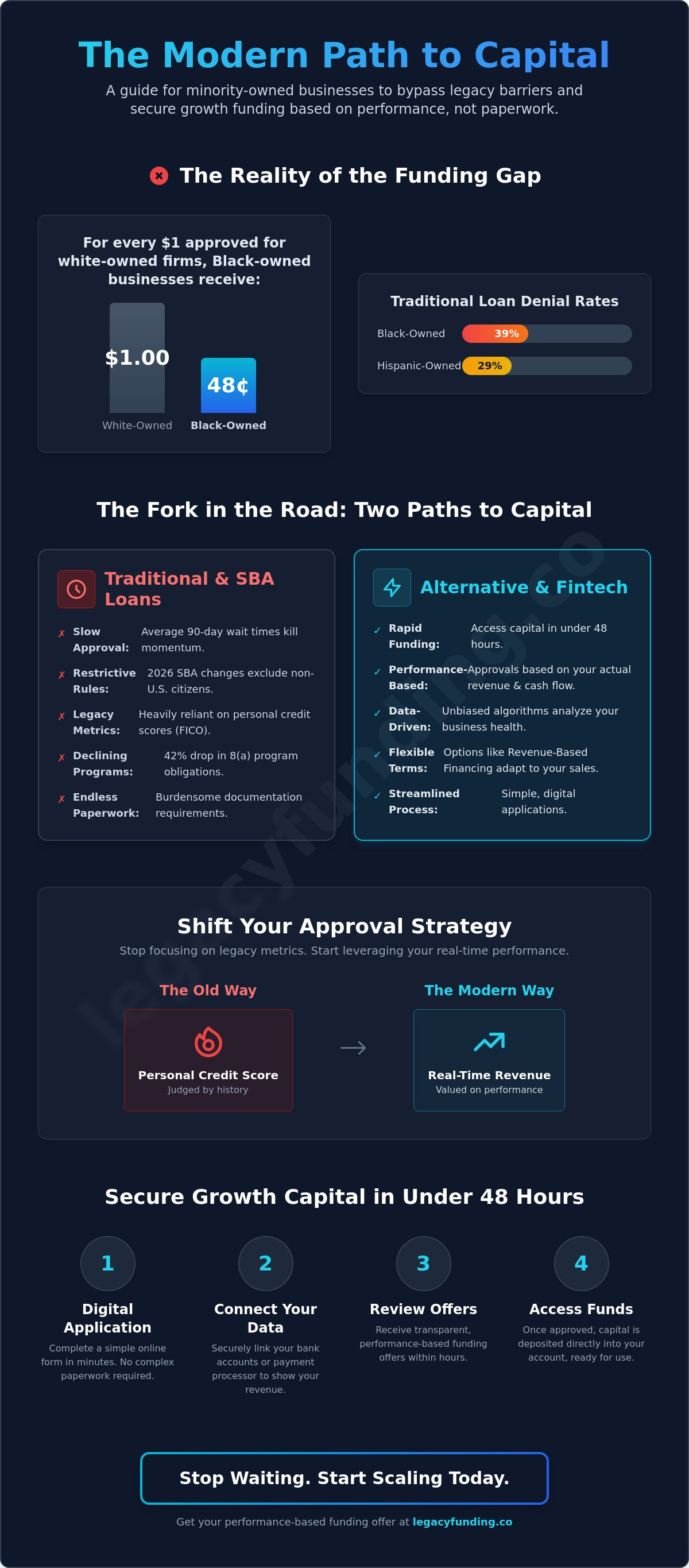
Black-owned businesses receive just 48 cents for every dollar approved for comparable white-owned firms. This stark disparity proves that the traditional path to a business loan for minority owned businesses is fundamentally broken. You've likely felt the weight of this gap through endless documentation requests and slow approval times that don't match the speed of your growth. It's frustrating to be judged by legacy metrics rather than the actual revenue your company generates every day.
You can bypass these institutional hurdles and secure the capital you need to scale right now. This guide reveals how to leverage performance-based financing to access capital in under 48 hours. We'll break down the critical 2026 SBA citizenship rule changes and the recent 42 percent cutback in 8(a) program obligations. Discover how to partner with a tech-forward ally that prioritizes your business metrics over your personal credit history. Stop waiting for legacy institutions to catch up and start driving your expansion today.
Key Takeaways
- Identify the specific 2026 regulatory shifts and systemic barriers that currently restrict access to traditional bank capital.
- Compare SBA programs with alternative revenue-based financing to secure the ideal business loan for minority owned businesses.
- Shift your approval strategy by prioritizing real-time business performance and cash flow over legacy personal credit requirements.
- Streamline your path to expansion with a digital application process designed to deliver growth capital in under 48 hours.
Overcoming the Funding Gap for Minority Entrepreneurs
Minority entrepreneurs are the engine of the 2026 economy. You launch businesses at a faster rate than any other demographic and drive innovation across every sector. Despite this massive economic impact, the financial system remains stuck in the past. Traditional banking is a legacy system. It's slow, rigid, and often ignores the reality of modern commerce. This institutional gatekeeping creates a massive obstacle when you need a business loan for minority owned businesses. We're here to change that narrative. This guide serves as your roadmap to bypass the red tape and secure the capital you deserve.
The Reality of the Minority Funding Gap
The numbers reveal a difficult truth. Black-owned firms face a 39 percent loan denial rate. Hispanic-owned businesses follow closely at 29 percent. These aren't just statistics; they represent missed opportunities for scaling and growth. When you examine the history of minority entrepreneurship in the United States, capital access has always been the primary barrier. Even when approved, Black-owned businesses receive just 48 cents for every dollar granted to comparable white-owned firms. Traditional lenders fail because they prioritize personal credit history over real-time business performance. Modern founders must shift their focus toward "capital readiness." This means organizing your bank statements and revenue data to prove your company's health, regardless of what a FICO score says.
Why 2026 is the Year of Alternative Capital
The landscape has shifted in your favor. Fintech has finally leveled the playing field for diverse owners. In June 2026, the Prime Rate sits at 6.75 percent, but traditional bank loans are harder to secure due to new SBA regulations that restrict eligibility. Modern alternative lending moves away from bias-driven decisions. It uses data-driven algorithms to analyze your actual cash flow. These performance-based funding models look at how much you're selling, not who you know or where you started. This shift allows you to secure a business loan for minority owned businesses based on your success. It's about speed, transparency, and results. You can now access the funds you need to scale without the friction of legacy institutions.
- Data-Driven Approvals: Algorithms focus on revenue, not just credit scores.
- Rapid Processing: Secure funding in 24 to 48 hours rather than months.
- Flexible Terms: Capital that scales alongside your sales volume.
You've built a resilient business. You deserve a financial ally who sees your potential, not just your paperwork. It's time to stop asking for permission from traditional banks and start leveraging the modern capital tools designed for your growth.
Exploring Your Funding Options: From SBA to Alternative Capital
Success in the 2026 economy requires more than just hard work. It requires the right financial instrument. Not every business loan for minority owned businesses serves the same purpose. You must match the capital to your specific objective. Long-term real estate projects require different structures than a sudden inventory opportunity. Choosing the wrong path can lead to stalled growth or unnecessary debt. We've broken down the primary options to help you navigate this complex landscape with confidence.
Traditional Federal and SBA Programs
SBA 7(a) and 504 loans remain the standard for low-interest debt. As of June 2026, the Prime Rate is 6.75 percent. For 7(a) loans over $250,000, you can expect rates around 9.0 percent APR. These are excellent for long-term stability, but the requirements have tightened. A critical regulation change on March 1, 2026, now requires all owners to be U.S. citizens. This effectively excludes green card holders from SBA eligibility. Additionally, the 8(a) Business Development Program has seen a 42 percent drop in government-wide obligations this year. While you can still find valuable SBA resources for minority-owned firms, the 90-day wait times often kill small business momentum. Community Development Financial Institutions (CDFIs) offer a more localized alternative, though their funding pools are frequently limited by geography.
High-Speed Alternative Financing Models
Speed is your ultimate competitive advantage. When traditional banks hesitate, modern fintech fills the gap. Revenue-Based Financing (RBF) is a powerful tool for businesses with consistent sales. Your payments fluctuate based on your monthly revenue, protecting your cash flow during slower periods. For immediate working capital, Merchant Cash Advances (MCAs) provide the fastest path to liquidity. These aren't traditional loans; they are purchases of your future sales. If you need a safety net for seasonal shifts, a Business Line of Credit offers flexible, ongoing access to funds. You only pay for what you use. This flexibility is vital for maintaining a business loan for minority owned businesses that scales alongside your success.
Don't overlook the power of your Minority Business Enterprise (MBE) certification. While the federal Small Disadvantaged Business contracting goal was recently reduced to 5 percent, many private corporations still maintain robust supplier diversity programs. Certification makes you a more attractive partner for these high-value contracts. Balancing federal programs with fast-acting alternative capital creates a resilient financial foundation. If you're ready to see which model aligns with your 2026 growth targets, connect with a specialist to review your options. We focus on your performance metrics to get you funded without the institutional friction.
Revenue vs. Credit: Breaking the Approval Barrier
Fear of rejection is the single greatest hurdle for many founders. Statistics show that 32 percent of Black-owned businesses and 21 percent of Hispanic-owned businesses don't apply for financing because they expect a "no." Most of this anxiety stems from personal credit scores. Traditional banks use a scorecard designed for a different era; if your FICO isn't perfect, they see a risk rather than an opportunity. When you're seeking a business loan for minority owned businesses, you need to know that your credit score is just one data point. It's not your entire story. Modern alternative lending flips the script by prioritizing your actual performance over a three-digit number.
Why Your Bank Statements Matter More Than Your FICO
Alternative lenders focus on the pulse of your company. They look at your bank statements to understand your daily deposits, transaction volume, and cash flow consistency. This analysis provides a more accurate picture of your ability to manage capital than a legacy credit report ever could. Technology now allows for real-time performance tracking, meaning your approval is based on how you're performing today, not a financial mistake from five years ago. This shift empowers you to use your daily revenue as your strongest asset. Remember these three pillars of modern approval:
- Revenue is proof: Your sales volume demonstrates market demand.
- Cash flow is king: Consistent deposits show operational health.
- Growth is the goal: Performance metrics predict your future scaling potential.
Alternative Metrics for Business Health
Beyond cash flow, modern lenders evaluate your "digital footprint" and industry stability. They look at your time in business and how well you manage your existing debt-to-income ratios. While some government initiatives, such as the Minority Business Revolving Loan Fund, provide more inclusive state-level support, private alternative lenders move even faster. They often utilize a "Purchase of Future Receivables" model. This isn't traditional debt; it's an advance based on the sales you haven't made yet. It's a non-debt funding option that keeps your balance sheet clean while providing the liquidity you need to seize a business loan for minority owned businesses. By leveraging your business data, you can secure approvals that legacy institutions would never even consider. Your revenue is your power; use it to break through the approval barrier and fund your next level of growth.
How to Secure Your Business Loan in 4 Steps
Speed is your primary competitive advantage. While traditional banks require a ten-step process and an exhaustive business plan, the modern path to a business loan for minority owned businesses is streamlined for the digital age. You don't have time for bureaucratic friction. You need a process that respects your schedule and prioritizes your results. By following these four steps, you can move from application to funding in as little as 24 hours.
Step 1: Organize Your Financial Data
Modern lenders prioritize your recent performance over your distant past. Before you apply, gather the last 4 to 6 months of your business bank statements in a digital format. Ensure you have your Tax ID (EIN) and a valid government ID ready for immediate upload. Providing clean, electronic data allows for near-instant AI-driven audits that verify your revenue consistency without the manual errors of traditional underwriting. This preparation ensures your file moves to the front of the line.
Step 2: Choose Your Funding Vehicle
Not all capital is created equal. You must decide whether Revenue-Based Financing (RBF), a Merchant Cash Advance (MCA), or a standard Term Loan fits your current ROI goals. Calculate the cost of capital against the cost of a missed opportunity; if waiting for a bank means losing a lucrative contract, the faster option is often the most profitable. Legacy Funding Advisors specializes in matching minority founders with the exact vehicle required for their specific growth stage. Focus on the total impact on your bottom line rather than just the interest rate.
Step 3: Submit and Verify
The application process takes less than 15 minutes when your data is ready. Once you submit your digital documentation, expect a brief verification call to confirm your funding requirements. This "funding call" is straightforward and focuses on your business health rather than your personal assets. Most alternative funding options are entirely "no-collateral," meaning you don't have to risk your home or personal savings to secure a business loan for minority owned businesses. This transparency removes the ambiguity common in legacy banking.
Step 4: Deploy and Scale
Once verified, funds are typically wired to your account within 24 to 48 hours. This rapid deployment allows you to pivot, hire, or purchase inventory immediately. You're building a generational legacy, and that requires a partner who moves at the speed of your ambition. Don't let a lack of liquidity hold your vision back. If you're ready to see how much capital your revenue can unlock, get your funding assessment today. We're ready to fuel your next stage of expansion.
Fast Capital for Minority-Owned Growth
Securing a business loan for minority owned businesses shouldn't feel like an uphill battle against a system designed to exclude you. You've already navigated the systemic funding gaps and the rigid documentation requirements of legacy banks. Now, you need a partner who moves at the speed of your ambition. Legacy Funding Advisors operates as your strategic ally. We bridge the gap between high-stakes finance and your aspirational reality. We don't just provide capital; we provide the fuel for your next stage of expansion.
Why Legacy Funding Advisors Understands Your Business
We view financial support as a generational endeavor. Our focus remains on building long-term impact and sustainable wealth within underserved communities. Unlike traditional institutions, we've stripped away the bureaucratic red tape that stalls momentum. We speak the language of the modern founder, focusing on your growth metrics and revenue health rather than outdated FICO scorecards. Our process is built on a simple, effective triad: we're fast, flexible, and fully invested in your success. This insider knowledge allows us to position your business for maximum scaling potential without the friction of traditional lending. You get the weight of professional financial expertise with the agility of a tech-forward ally.
Get Started: Your Growth Can’t Wait
Your business doesn't stop moving, and neither should your funding. Our streamlined online portal provides an immediate feedback loop that removes ambiguity from the application process. You can upload your digital documentation in minutes and receive a decision based on your actual performance. We prioritize transparency and security at every stage. You'll know exactly where you stand without the wait. Whether you're looking for Revenue-Based Financing or a Business Line of Credit, we ensure the capital fits your specific ROI targets. We serve entrepreneurs across the United States, Puerto Rico, and Canada, providing an industry-agnostic approach that welcomes diverse founders from every sector.
The funding gap is real, but it doesn't have to define your future. You have the revenue, the vision, and the drive to succeed. All you need is the right capital partner to unlock your full potential. Stop letting legacy hurdles dictate your growth rate. Scale your legacy today and secure the resources your company deserves. Apply for your minority business funding now and experience the difference of a partner who understands the modern SMB landscape. Your 24-48 hour window to funding starts with a single click.
Scale Your Vision for 2026
The funding landscape has shifted. Power has moved from institutional gatekeepers to performance-driven founders. By prioritizing your cash flow over legacy credit scores, you can bypass the friction that has historically stalled minority-owned growth. A business loan for minority owned businesses is now a tool of speed and efficiency rather than a source of bureaucratic frustration. You've learned how to organize your data, choose the right vehicle, and leverage your revenue as your greatest asset.
We're here to fuel that momentum across the United States, Puerto Rico, and Canada. Our revenue-based approvals focus on your results, providing access to capital in as little as 24 to 48 hours. You don't need perfect credit to build a perfect legacy. You just need a partner who understands the speed of modern commerce and the value of your daily sales. This is about more than just a transaction; it's about the long-term impact on your community and your family.
Stop waiting for permission to expand. Your business is ready for the next level, and the capital you need is within reach. Secure Your Business Funding in 24 Hours and start scaling today. Your future is built on the choices you make right now. Let's make it a powerful one.
Frequently Asked Questions
What is considered a minority-owned business for loan purposes?
A minority-owned business is typically defined as a company that's at least 51 percent owned, operated, and controlled by one or more individuals from groups such as Black, Hispanic, Native American, or Asian American backgrounds. For federal programs, these owners must be U.S. citizens or nationals. This is particularly important following the March 2026 SBA regulation change that requires 100 percent U.S. ownership for eligibility. Private lenders often follow these guidelines but may offer more flexibility for non-government products.
Can I get a business loan for a minority-owned business with bad credit?
You can absolutely secure a business loan for minority owned businesses even with a sub-prime personal credit score. Modern alternative lenders prioritize your real-time bank statements and daily cash flow over your FICO score. If your company demonstrates consistent revenue and a healthy deposit history, you're a strong candidate for performance-based capital. We focus on your business's ability to repay rather than dwelling on past credit challenges that don't reflect your current success.
How long does it take to get approved for a minority business loan?
Approval times vary drastically depending on the lender you choose. Traditional SBA loans often take 30 to 90 days to process because of heavy documentation requirements and legacy underwriting. Alternative lenders and tech-forward allies can provide approvals and funding in as little as 24 to 48 hours. If your growth depends on speed, digital-first platforms are your most efficient option for securing capital without the wait.
Do I need MBE certification to get a business loan?
You don't need Minority Business Enterprise (MBE) certification to qualify for most private sector loans or alternative financing. Certification is primarily useful for winning government contracts or accessing specific corporate supplier diversity programs. For standard working capital, revenue-based financing, or lines of credit, lenders focus on your financial metrics and revenue health rather than your official certification status. It's an asset for contracting, but not a requirement for capital.
What is the difference between a minority business grant and a loan?
The primary difference is repayment. A loan is borrowed capital that must be repaid with interest or fees over a set period. A grant is non-repayable funding, though these are increasingly rare in 2026 as federal focus shifts toward race-neutral, merit-based programs. While grants don't require repayment, they often come with restrictive spending rules. Loans provide more flexibility and a faster path to the liquidity needed for immediate scaling.
What are the typical requirements for revenue-based financing?
Lenders typically require your last 4 to 6 months of business bank statements and your Tax ID (EIN). They look for consistent monthly deposits and a clean banking history without frequent overdrafts. Most revenue-based models require at least $10,000 in monthly sales and a minimum of six months in business. This data-driven approach removes the need for the extensive, multi-year business plans required by legacy banks.
Are there specific loans for Black or Hispanic-owned businesses?
While few loans are restricted exclusively to one demographic, many mission-driven lenders like CDFIs focus on Black and Hispanic-owned firms in underserved areas. However, the most accessible business loan for minority owned businesses today is often demographic-agnostic. These products use algorithms to focus on your revenue data. This ensures bias-free lending decisions that prioritize your company's actual performance over any other factor.
How much funding can I qualify for based on my monthly revenue?
Most alternative lenders will offer between 100 percent and 200 percent of your average monthly revenue. If your business consistently generates $50,000 per month, you could potentially qualify for $50,000 to $100,000 in immediate capital. The exact amount depends on your industry stability and how much of your current cash flow is already committed to other obligations. It's a formula designed to ensure you get the capital you need without overextending.