


SBA Loan Eligibility for Felons: 2026 Funding Guide
Your past doesn't define your business's future. For years, a criminal record meant an automatic rejection from federal lenders, leaving talented founders locked out of the capital they needed to scale. You likely feel the weight of judgment or the anxiety of wasting weeks on an application destined for the shredder. It's time to clear the air. Recent federal shifts have completely rewritten the rules for sba loan eligibility for felons, making 2026 the most accessible year yet for second-chance entrepreneurs to secure the funding they deserve.
The SBA's May 2024 rule change removed the old barriers that once blocked applicants on parole or probation. Today, the focus has shifted from past mistakes to current performance. This guide provides the insider knowledge you need to navigate this new landscape with confidence. You'll learn which specific crimes remain ineligible, how to handle lender-level risk assessments, and where to find high-speed capital alternatives if the federal process feels too slow. Stop guessing and start building. Your path to financial independence is finally open.
Key Takeaways
- Leverage the 2024 Final Rule to navigate sba loan eligibility for felons and unlock federal capital once thought unreachable.
- Discover why full transparency on SBA Form 1919 is your strongest asset during the criminal justice review process.
- Pinpoint the specific financial crimes that still trigger rejections and learn how to pivot if you’re on the "hard no" list.
- Build a compelling Rehabilitation Portfolio that proves your business readiness and overrides traditional lender bias.
- Explore alternative funding routes like revenue-based financing for immediate capital that ignores your record and rewards your growth.
Breaking the Stigma: SBA Loan Eligibility for Felons in 2026
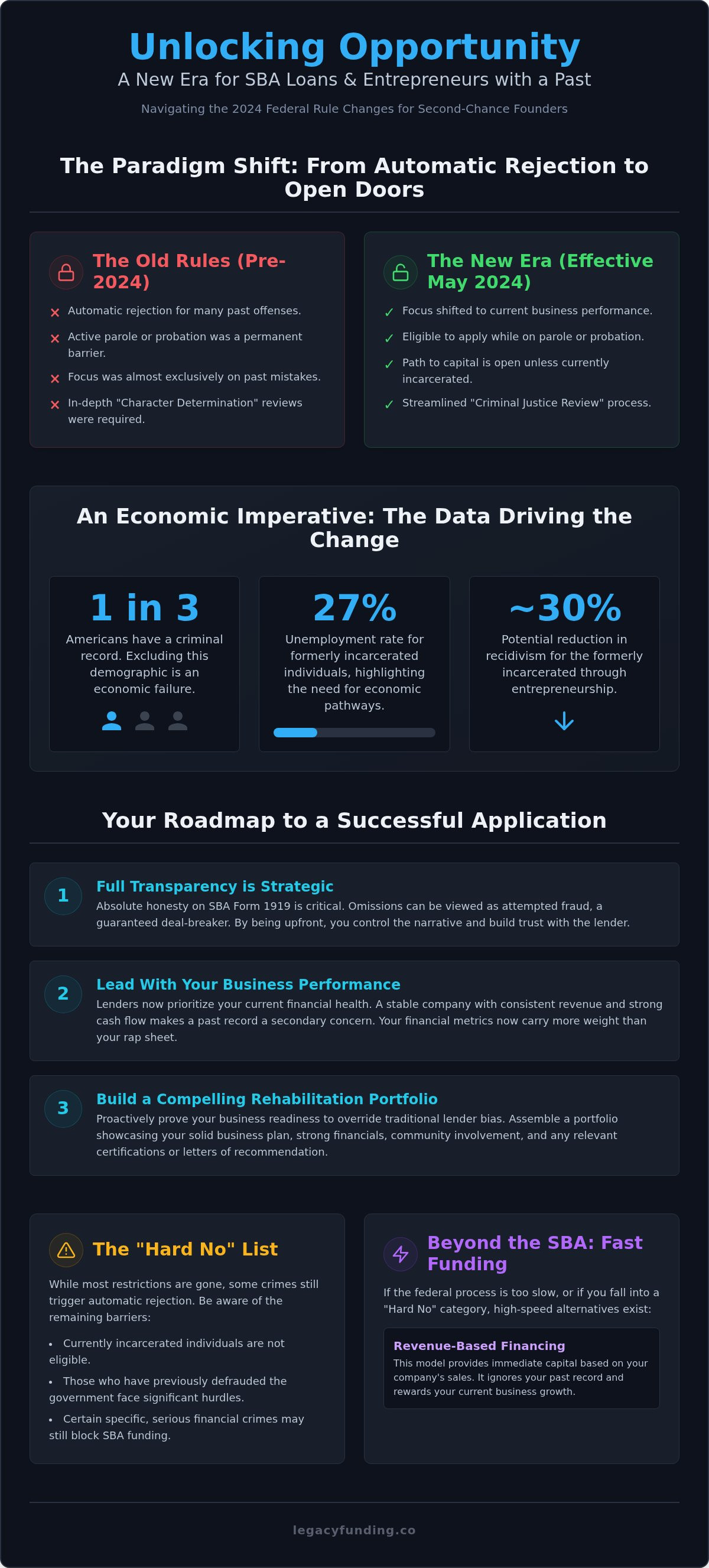
The era of automatic rejection is over. If you've been told that a criminal record is a permanent barrier to federal capital, you're working with outdated information. The 2024 Final Rule on Criminal Justice Reviews represents the most significant policy shift in decades. This landmark regulation, which became effective on May 30, 2024, fundamentally altered how the U.S. Small Business Administration (SBA) evaluates applicants. It moves the focus away from your past and onto your business's potential for growth. Understanding the new landscape of sba loan eligibility for felons is the first step toward scaling your enterprise without fear of judgment.
The SBA isn't just being lenient; it's being strategic. Federal data shows that entrepreneurship can reduce recidivism for unemployed, formerly incarcerated individuals by as much as 30%. By expanding access, the government is betting on your ability to create jobs, pay taxes, and stabilize your community. The old "automatic disqualification" myth is dead. Unless you are currently incarcerated or have defrauded the government, the door is officially open. Success is no longer reserved for those with a perfect background. It's available to anyone with a solid plan and the drive to execute.
The End of the Parole and Probation Barrier
Under the old regime, active supervision was a non-starter. If you were on parole or probation, you were invisible to federal lenders. The new rules change that. You are now eligible to apply even while under active supervision or deferred adjudication. This shift is a lifeline for entrepreneurs in the early stages of reentry. It allows you to focus on three critical growth areas:
- Secure working capital for daily operations and inventory.
- Purchase essential equipment to increase your production capacity.
- Hire talented staff to scale your local impact.
You don't have to wait years for your papers to clear to start building your legacy. The SBA has recognized that the transition period is when capital is most vital for long-term stability.
The 1 in 3 Statistic: You Are Not Alone
You belong in the SMB space. Roughly 33% of Americans have some form of criminal record. That's one in three potential founders who have historically been sidelined. The SBA recognizes that excluding this massive demographic is an economic failure, especially when the unemployment rate for formerly incarcerated individuals sits at 27%. The 2024 SBA Final Rule, which went into effect on May 30, 2024, specifically aims to create a "Safer America" by providing economic pathways. It removed most restrictions related to criminal history and even stripped these questions from the standard loan applications. You aren't a risk; you're a resource. Mastering sba loan eligibility for felons allows you to secure your funding, grow your revenue, and prove the doubters wrong.
Navigating the SBA’s Criminal Justice Review Process
Transparency isn't just a moral choice; it's a strategic one. When you apply for federal funding, the new rule will remove restrictions that previously triggered automatic denials for many. However, the application process still requires absolute honesty. While the SBA has removed several criminal history questions from its standard forms, individual lenders still perform their own due diligence. Omissions are often viewed as attempted fraud. Fraud is a guaranteed deal-breaker. By being upfront, you control the narrative. You position yourself as a rehabilitated leader rather than a liability.
The SBA now balances the risk of fraud with the opportunity for economic growth. Loan officers aren't just looking at your past; they're looking at your current business performance. They want to see a stable company that generates consistent revenue. If your cash flow is strong, your criminal record becomes a secondary concern. This shift in sba loan eligibility for felons means your financial metrics now carry more weight than your rap sheet. You have the chance to lead with your numbers.
What Happens During an SBA Background Check?
The transition from "Character Determination" to a streamlined "Criminal Justice Review" has simplified the process. The SBA no longer requires a deep dive into every minor infraction. However, they still cross-reference federal databases, including CAIVRS, to ensure you don't owe the government money. You should anticipate a "Scrutiny Delay." Even with the new rules, applications involving a criminal record may take longer to clear the lender's internal compliance check. Plan for this timeline. Don't wait until you're out of cash to start the process.
The Power of Case-by-Case Discretion
The SBA sets the floor, but the lender sets the ceiling. While the federal government says you are eligible, an individual bank might still say no based on their own risk tolerance. The final call often rests with the lender's underwriting team. To win them over, focus on three things: your business plan, your credit history, and your recent revenue. A "clean" business profile can effectively offset a "messy" personal past. If the traditional bank timeline feels too restrictive for your growth goals, you can speak with a consultant about faster, revenue-based alternatives. We specialize in looking at your deposits, not your history. This approach removes the friction from the funding process and puts capital in your hands when you need it most.
The "Hard No" List: Crimes That Still Block SBA Funding
While the 2024 regulatory shift lowered the drawbridge, certain gates remain locked. The U.S. government has transitioned from judging the "fact" of a criminal record to scrutinizing the "type" of offense. This distinction is vital for anyone assessing sba loan eligibility for felons in 2026. The SBA rule change for entrepreneurs with a record was designed to foster growth, not to ignore systemic financial risk. If your past involves a lapse in financial integrity, you face a steeper climb. Understanding these "hard no" categories saves you time and allows you to seek alternative capital without delay.
Financial crimes remain the ultimate red flags. Convictions for embezzlement, identity theft, or money laundering suggest a direct risk to the taxpayer-backed funds the agency guarantees. Federal lenders view these as "crimes of moral turpitude" that reflect poorly on your business's financial integrity. Additionally, any history of defrauding the government or defaulting on federal debt, such as student loans or previous SBA loans, will likely trigger an immediate rejection via the CAIVRS database. These records suggest you're a high-risk borrower who has previously failed to honor federal obligations.
Fraud, Dishonesty, and Financial Integrity
Integrity is the currency of federal lending. When you apply, the SBA’s fraud mitigation protocols scan for specific triggers. Identity theft and money laundering convictions are particularly difficult to overcome because they indicate a high risk of future financial misconduct. If your record shows you've previously misused funds or engaged in deceptive practices, lenders will hesitate to extend a government-backed guarantee. This isn't just about your past; it's about the security of the federal loan portfolio. Prepare to address these points directly if your record includes any financial dishonesty.
The "Currently Incarcerated" Rule
Your current legal status is a rigid boundary. You cannot apply for a loan from a correctional facility. The SBA maintains a strict "currently incarcerated" rule that disqualifies anyone serving a prison or jail sentence. However, the 2024 updates provide a path for those in transition. If you're residing in a halfway house or a community transition center, you're officially eligible to apply. This distinction recognizes the need for capital during the critical reentry phase. Note that specific exclusions remain for convictions involving sexual offenses or child pornography. These remain permanent deal-breakers under current federal guidelines regardless of your rehabilitation status.
Violent offenses fall into a gray area. While they aren't an automatic "hard no" under the new rules, they often trigger discretionary reviews by individual lenders. A history of violent crime may lead a bank to deny your application based on their own internal risk assessment. In these cases, your focus must shift to proving long-term stability and business success. If a federal guarantee isn't an option for your sba loan eligibility for felons, moving toward revenue-based funding allows you to bypass these subjective hurdles entirely.
Strengthening Your Application: Proving Rehabilitation
Preparation neutralizes prejudice. If your background check triggers a review, you need a "Rehabilitation Portfolio" that speaks louder than your record. This proactive approach is the most effective way to secure sba loan eligibility for felons in a competitive lending environment. Don't wait for a loan officer to ask questions. Hand them the answers before they even open your file. By presenting a professional package, you demonstrate the discipline and transparency required of a successful business owner.
Your business plan is your most powerful defense. It shifts the narrative from where you've been to where you're going. A high-quality plan shows that you understand your market, your margins, and your path to profitability. When a lender sees a Debt-Service Coverage Ratio (DSCR) of at least 1.10:1, as required for SBA small loans since March 1, 2026, they see a viable founder. They see a professional, not a past mistake. Focus on growth metrics to prove your business is a safe bet for federal backing.
The Rehabilitation Checklist
A strong portfolio includes specific evidence of your transition and professional growth. Gather these four essential documents to strengthen your case for sba loan eligibility for felons:
- Official Discharge Papers: Proof of completion for parole, probation, or supervised release.
- Professional Certifications: Diplomas or licenses earned since your conviction.
- Character References: Letters from community leaders, mentors, or business partners.
- Community Impact Records: Evidence of volunteer work or local leadership roles.
You should also include a "Letter of Explanation." Keep it brief. Take full responsibility for the past without over-sharing personal details. Focus 80% of the letter on your current business success and future goals. While the SBA discontinued the FICO SBSS score requirement for small loans in March 2026, your personal credit score still matters. It shows you handle financial obligations with integrity today.
Working with the Right SBA Lender
Not all lenders are created equal. While the SBA provides the guarantee, individual banks often have "internal overlays." These are extra rules that might be stricter than the federal guidelines. To find a partner, look toward Community Development Financial Institutions (CDFIs). These organizations are specifically designed to support underserved entrepreneurs and are often more receptive to your story of rehabilitation. Ask them directly if they have experience working with justice-involved founders before you submit a formal application.
If the traditional banking system feels too slow or restrictive, you have other options. You can apply for flexible capital here to bypass the bureaucratic hurdles of federal lending. We prioritize your current revenue and cash flow over your history. This allows you to secure the funding you need in 24 to 48 hours without the anxiety of a character review. Your business deserves to grow at the speed of your ambition, not the speed of a government background check.
Beyond the SBA: Fast Funding for Entrepreneurs with a Record
Timing is the silent killer of growth. While the 2024 regulatory shifts have expanded sba loan eligibility for felons, the federal clock still ticks at a bureaucratic pace. You might have the legal right to apply, but do you have three to six months to wait for an answer? For many justice-involved founders, the hurdle isn't just eligibility; it's the friction of the process itself. If your business needs to secure a contract, repair critical equipment, or stock up for a peak season today, you need a funding partner that moves at the speed of modern commerce.
Alternative capital provides a path that is fundamentally background-agnostic. Revenue-based financing and Merchant Cash Advances (MCAs) shift the focus from your personal history to your business's current performance. These models don't care about a mistake from a decade ago. They care about your daily deposits, your monthly revenue, and your growth trajectory. By leveraging your cash flow, you can bypass the character reviews and "scrutiny delays" that often plague federal applications. You aren't begging for a second chance; you're trading on your success.
Revenue-Based Financing vs. SBA Loans
The choice between federal and alternative capital often comes down to your immediate operational needs. SBA loans offer low rates but demand exhaustive documentation and months of patience. Revenue-based financing offers speed and flexibility. Consider these three critical factors when deciding which route fits your current situation:
- Speed of Execution: Secure your funding in 24 to 48 hours rather than waiting 90 days or more for a federal decision.
- Qualification Standards: Focus on consistent monthly revenue and cash flow metrics instead of credit scores or criminal background checks.
- Scaling Flexibility: Use a model where payments scale with your sales volume, ensuring your capital remains a tool for growth rather than a fixed burden.
If your business generates steady revenue, your sba loan eligibility for felons becomes a secondary concern. You have the leverage to choose a faster, more efficient path that respects your time and your talent.
Securing Your Legacy with Legacy Funding Advisors
Legacy Funding Advisors operates on a simple principle: we invest in your business's future, not your personal history. We understand that entrepreneurs with a record are often the most driven, resilient, and innovative leaders in the SMB space. Our application process is designed to remove the judgment and red tape found in legacy institutions. We provide national coverage and focus on your cash flow to deliver the working capital you need to scale. Don't let a slow-moving government agency dictate the pace of your expansion. Take control of your financial destiny and Get a fast funding decision from Legacy Funding today.
Secure Your Business Future Today
The landscape has shifted. The 2024 SBA rule change officially dismantled the barriers that once blocked justice-involved entrepreneurs from federal capital. You now have a clear path to sba loan eligibility for felons by focusing on your business performance rather than your past. By preparing a strong rehabilitation portfolio and leveraging modern lending standards, you can secure the resources needed to scale your legacy. Your criminal record is no longer a dead end; it's a hurdle you've already proven you can clear.
If the federal timeline is too slow for your growth goals, don't let bureaucracy stall your momentum. You deserve a partner who values your revenue more than your history. Legacy Funding Advisors offers a streamlined alternative that prioritizes your current cash flow. Our expert advisors provide funding in as little as 24 hours with an approval process based on your business's real-world success. Stop waiting for permission to expand. Apply for Fast, Background-Agnostic Funding with Legacy Funding and take the next step toward financial independence. Your future is waiting; let's build it together.
Frequently Asked Questions
Can I get an SBA loan if I am currently on probation or parole in 2026?
Yes, you are officially eligible to apply while on probation or parole. The SBA removed the active supervision barrier on May 30, 2024, to encourage economic reentry for justice-involved founders. While federal rules now allow this, individual banks may still apply their own risk assessments. You should be prepared to show consistent business revenue to prove your stability and overcome any lender-level hesitation.
Which felony convictions automatically disqualify me from an SBA loan?
Automatic disqualification is now limited to a few specific categories rather than a broad criminal record. You are ineligible if you are currently incarcerated or have a history of defrauding the government. Convictions for sexual offenses or child pornography also remain on the "hard no" list. For all other crimes, the decision rests on the lender's discretion and the current financial health of your business.
Does the SBA check my criminal record for every loan application?
Yes, federal lenders cross-reference multiple databases to verify your history during the underwriting process. They use systems like CAIVRS to check for defaults on federal debt and other background markers. While the SBA has simplified the criminal justice review process, they still perform due diligence to mitigate fraud. Total honesty on your application is vital to avoid a permanent rejection for misrepresentation.
How long do I have to wait after a conviction to apply for an SBA loan?
There is no longer a mandatory federal waiting period following a conviction. You can apply for sba loan eligibility for felons as soon as you are no longer incarcerated. This landmark change allows entrepreneurs in halfway houses or community transition centers to seek capital immediately. The focus has shifted from the date of your past mistake to the current strength of your business plan and cash flow.
What is the best alternative if I am denied an SBA loan due to my criminal record?
Revenue-based financing is the most effective alternative for founders with a record. This model ignores your criminal history and focuses entirely on your monthly sales volume and daily deposits. Since these lenders don't rely on federal guarantees, they can approve your funding in as little as 24 hours. It's a performance-based partnership that rewards your business's current success rather than penalizing your personal history.
Do I need to disclose a sealed or expunged record to the SBA?
You should follow the specific instructions on SBA Form 1919, but transparency is your safest strategic move. Even if a record is sealed, federal background checks often reveal the underlying data to the agency. Omissions are frequently interpreted as an attempt to defraud the government, which is an automatic disqualifier. Disclosing the record and providing proof of rehabilitation demonstrates the financial integrity lenders require for sba loan eligibility for felons.
Are there specific SBA lenders that are more felon-friendly than others?
Community Development Financial Institutions (CDFIs) are typically the most receptive partners for entrepreneurs with a record. These mission-driven lenders are designed to support underserved communities and often look beyond traditional background checks. While large national banks may maintain strict internal overlays, CDFIs prioritize local economic impact and individual rehabilitation. They are a strategic starting point for any founder seeking a federal guarantee.
Can a business partner’s felony record affect my SBA loan eligibility?
Yes, any partner with 20% or more ownership in the company must undergo the same background review. Their history will be evaluated under the same federal guidelines as yours. If a major stakeholder has a history of financial fraud or is currently incarcerated, it can jeopardize the entire application. Choose your partners carefully to ensure your business remains eligible for the capital it needs to scale.