


SBA Loan Denied: What Next? Your Guide to Fast Alternative Funding
Nearly half of all small business owners who apply for an SBA 7(a) loan walk away empty handed. If you are part of that 50 percent, you likely feel the weight of urgent cash flow needs and the frustration of wasted weeks. You are currently asking: sba loan denied what next? It is exhausting to face a rejection based on a rigid Debt Service Coverage Ratio below 1.25x or a credit score that doesn't tell your full story. You need a path forward that values your business's momentum over its paperwork.
This guide shows you how to bypass the red tape and secure capital in as little as 24 hours. You don't have to wait for a legacy institution to catch up to your speed. We will explore why the SBA said no, from the new 100 percent U.S. citizen ownership requirements to complex cash flow metrics. Then, we'll dive into high velocity alternatives like revenue based financing and working capital loans that prioritize your actual growth. It is time to stop waiting for a "yes" from the government and start building your own financial independence.
Key Takeaways
- Understand that an SBA denial is a critique of your traditional bankability, not a verdict on your business's future potential.
- Discover the strategic answer to sba loan denied what next by pivoting from bureaucratic delays to high-velocity alternative funding.
- Learn why your last four months of bank statements carry more weight than a legacy credit score in the modern lending landscape.
- Explore how revenue-based financing allows you to leverage consistent sales for immediate capital without the friction of traditional collateral.
- Stop the cycle of repetitive applications and identify the specific documentation needed to secure working capital in as little as 24 hours.
Decoding the SBA Denial: Why Traditional Lenders Say No
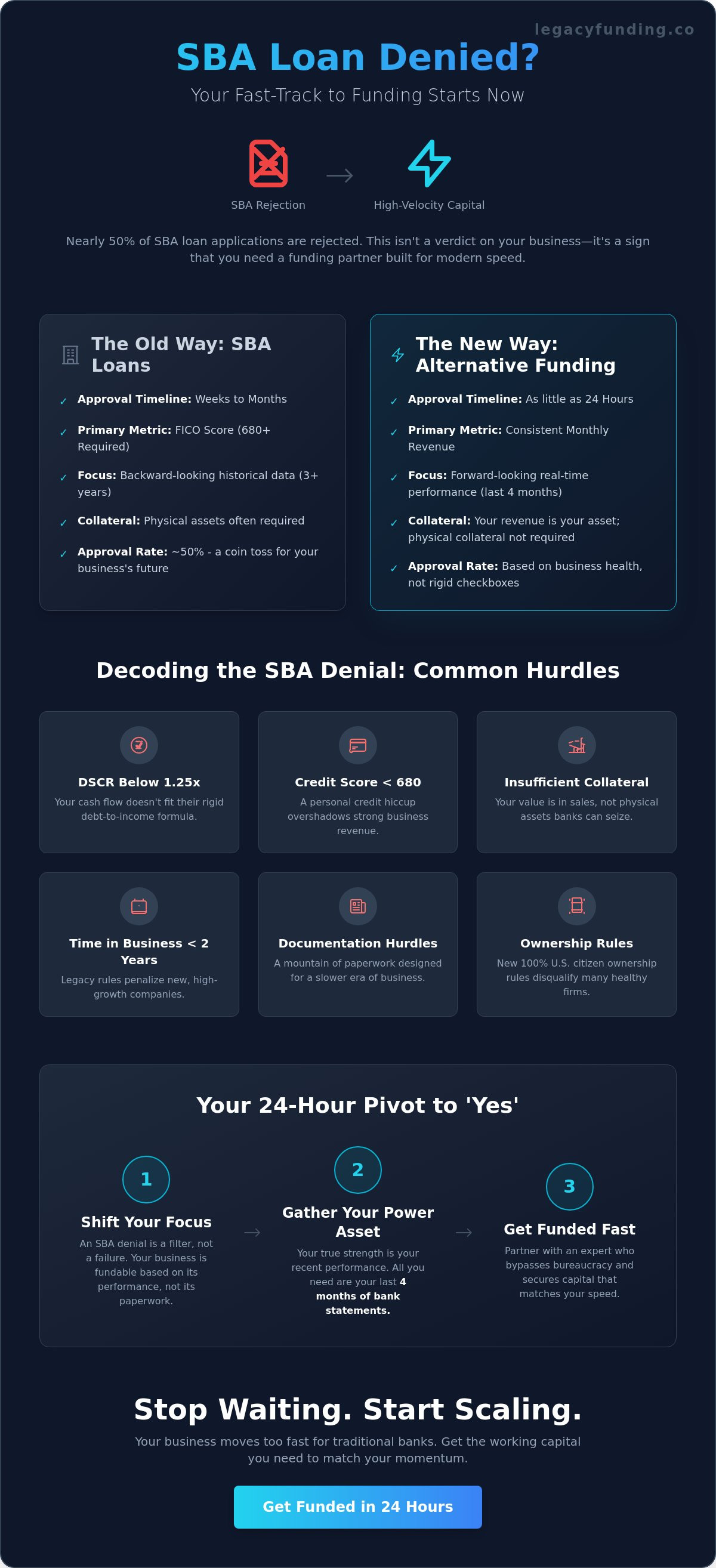
Receiving a denial letter from the SBA isn't a failure of your vision. It's a failure of the bank's rigid checklist. In 2026, approval rates for SBA 7(a) loans hover between 48% and 52%. This means nearly half of all applicants are left wondering: sba loan denied what next? When you receive an Adverse Action Notice, the lender is legally required to disclose exactly why they turned you down. This document isn't just a rejection; it's a map of the bureaucratic hurdles that traditional institutions simply cannot clear.
Banks prioritize "bankable" profiles over real-world business potential. They look for a specific Debt Service Coverage Ratio (DSCR), usually 1.25x or higher. If your cash flow is strong but your debt-to-income ratio is slightly off by their standards, you're out. These institutions operate on a binary system. You either fit the mold perfectly, or you don't fit at all. Gaining a deeper perspective on understanding business financing reveals that the SBA is just one narrow path in a much larger landscape of capital. If you are staring at a rejection letter and asking sba loan denied what next, you need to realize the game is rigged toward legacy assets.
The Credit Score vs. Business Health Trap
The SBA generally demands a FICO score of 680 or higher. This requirement creates a massive disconnect. Your business might be generating record revenue, but a personal credit hiccup from years ago can trigger an automatic "no." Traditional lenders fixate on historical data. They look backward at your personal financial history rather than forward at your daily cash flow. This obsession with the past ignores the momentum you've built. It treats a thriving enterprise like a personal liability rather than an asset.
Collateral and Documentation Hurdles
Insufficient collateral remains a primary reason for SBA rejection. Banks want physical assets to seize if things go wrong. If your value lies in intellectual property, high sales volume, or digital assets, you're often disqualified. Additionally, the documentation mountain is immense. A single inconsistent tax return or a business that hasn't hit the two-year "Time in Business" mark can lead to a technical denial. Effective March 1, 2026, the new 100% U.S. citizen ownership rule has also disqualified many healthy businesses. These rules are designed for a slower, older era of commerce. They aren't built for the speed of the modern founder.
Why Your Business Is Still Fundable (Even with a Denial)
An SBA rejection letter feels like a closed door, but it is actually a filter. It doesn't mean your business is failing. It means your business doesn't fit the narrow, risk-averse profile of a government-backed institution. Many founders fear that a denial blacklists them from the entire capital market. This is a myth. If you are stuck asking sba loan denied what next, understand that your funding journey has likely just moved from the slow lane to the high-velocity lane.
Traditional banks are obsessed with the past. They pore over three years of tax returns and personal credit histories. Alternative lenders, however, look at your future. They prioritize your current performance and your ability to generate revenue today. Your most valuable "funding-ready" assets aren't your house or your car. They are your consistent daily sales and your recurring revenue streams. While a bank sees a low credit score as a stop sign, an alternative partner sees strong monthly deposits as a green light.
The Power of Performance-Based Underwriting
Modern fintech has revolutionized how we assess business health. Instead of relying on static reports, performance-based underwriting uses real-time data to analyze your business's true trajectory. Revenue consistency proves your stability far better than a FICO score ever could. Performance-based lending is the modern alternative to legacy banking. By connecting directly to your sales data, these systems recognize the value in your growth metrics that a traditional loan officer might overlook entirely.
Overcoming the "Unfundable" Stigma
Certain sectors are often labeled "unfundable" by the SBA due to perceived risk or complex regulations. This includes everything from e-commerce startups to seasonal construction firms. A denial isn't a verdict on your viability; it is a pivot point. It forces you to move away from rigid debt structures and toward flexible capital that scales with you. Shift your mindset from being a "borrower" begging for a favor to a "partner" looking for fuel. You can connect with an expert advisor to identify which alternative funding path matches your specific revenue model. There is no reason to let a bureaucratic "no" stop your momentum when your bank statements tell a story of success. If you've been sba loan denied what next steps involve leveraging your actual performance to secure the cash you need.
SBA Alternatives: Shifting to Revenue-Based Financing
The SBA rejection letter isn't the end of your expansion; it's the start of a more efficient strategy. If you're asking sba loan denied what next, the answer lies in your own ledger. Revenue-based financing lets you leverage your future sales for immediate working capital. This market is exploding, valued at $15.86 billion in 2026, as founders move away from slow-moving bank debt. This is not a traditional loan. It is an investment in your business's current momentum. You trade a small portion of future sales for the cash you need today. This model removes the friction of personal collateral. You don't have to put your home on the line to secure your company's future.
Traditional SBA loans use compounding interest. In contrast, revenue-based models use factor rates. A factor rate is a fixed multiplier applied to the principal. This provides total transparency from day one. You know exactly what the total cost of capital will be before you sign. There are no shifting interest rates or hidden surprises. While SBA variable rates can reach up to 13.25% in May 2026, factor rates remain static. You pay for the capital you use without the worry of fluctuating market conditions.
Revenue-Based Financing vs. SBA Loans
The difference between legacy banking and modern fintech is measured in time and effort. If you've been sba loan denied what next steps should focus on these key advantages:
- Speed: SBA approvals often take 90 days or more. Revenue-based funding can hit your account in 48 hours.
- Documentation: Banks demand three years of tax returns and personal financial statements. We focus on your last three to four months of bank statements.
- Payment Flexibility: SBA loans have fixed monthly payments. Revenue-based financing adjusts with your sales volume. If you have a slow month, your payment decreases automatically.
Merchant Cash Advances (MCAs) for Instant Liquidity
A Merchant Cash Advance is a powerful tool for businesses with high daily transaction volumes. It's technically a purchase of your future credit card receivables. This distinction is vital. Since it isn't a loan, it doesn't carry the same rigid repayment structures as traditional debt. You aren't beholden to a rigid Debt Service Coverage Ratio (DSCR) of 1.25x, which is a primary reason the SBA denies applications.
Seasonal businesses thrive with MCAs. During peak months, you pay back more. During the off-season, the payment scales down. This protects your cash flow during lean times. Approval rates for MCAs are significantly higher than SBA loans because the focus is on your daily sales, not your historical credit score. If your business processes consistent daily transactions, you're already qualified for the liquidity you need. Stop waiting for a bureaucratic "yes" and start using your own success to fund your next level of growth.
The 48-Hour Pivot: Your Action Plan After an SBA Denial
Stop the cycle of rejection. Reapplying to the same institution using the same rigid criteria is a recipe for further delay. If you've been sba loan denied what next steps should involve a rapid transition to a performance-based model. While the SBA 7(a) approval rate remains stuck near 50 percent, the alternative market is built for speed. You don't have to wait six months to try again. You can pivot your strategy in less than two days.
Gather your last four months of business bank statements immediately. These documents are the primary fuel for alternative underwriting. They tell a story of current success that tax returns from two years ago simply cannot capture. By focusing on your recent revenue, you move from being a "risky borrower" to a "valuable partner." This shift in perspective is the key to unlocking the capital you need to scale.
Step 1: Audit Your Cash Flow
Your bank statements are your new resume. Review them for consistent deposit patterns and a healthy average daily balance. Modern lenders look for stability in your daily ledger. Eliminate any non-sufficient funds (NSF) issues before you apply; these are red flags for any automated underwriting system. Ensure your business bank account is strictly separate from your personal finances. Clear boundaries demonstrate the professional management that alternative lenders prioritize over a simple credit score.
Step 2: Choose Speed Over Bureaucracy
Identify a funding partner that specializes in fast-turnaround capital. Avoid "file shoppers" or brokers who blast your application to dozens of different lenders. This scattergun approach can damage your credit and lead to confusing, conflicting offers. Instead, look for direct access to working capital loans with transparent factor rates and clear repayment schedules. You want a partner that offers funding in as little as 24 to 48 hours. This allows you to seize growth opportunities that would vanish during a 90-day SBA review. Apply to a performance-based lender today to see your real market value. These institutions use real-time data to assess your business's health. They don't care about a DSCR below 1.25x if your current revenue is surging. Take control of your scaling journey and leave the red tape behind.
Scale Faster with Legacy Funding Advisors
Legacy Funding Advisors acts as a high-level consultant for your business scaling needs. We don't just provide capital; we provide a gateway to financial independence. Traditional institutions are bogged down by legacy systems that don't reflect the reality of digital commerce. We bridge that gap. If you are currently asking sba loan denied what next, it's time to work with a partner that values your business's momentum over its historical credit report. We focus on growth metrics that matter to modern founders.
Our team understands the high stakes of entrepreneurship. We don't sound like a distant corporate entity because we are personally invested in your growth. We share insider knowledge to position your business for rapid expansion. You've already built the momentum. We provide the fuel. Stop letting bureaucratic delays dictate your timeline. Move forward with a partner that understands the speed of contemporary commerce better than any legacy bank.
The Legacy Advantage: Funding in 24 to 48 Hours
Our process is designed for maximum efficiency. While banks take months to review a single file, we move at the speed of your business. We offer a 24 to 48 hour funding window for approved applicants. This rapid turnaround allows you to capitalize on inventory discounts, marketing surges, or urgent equipment needs without delay. Our reach is expansive, serving modern founders across the United States, Puerto Rico, and Canada.
We specialize in revenue-based financing because it aligns our success with yours. This isn't about creating a cycle of debt. It's about providing a tool for rapid scaling. We look at your current performance to determine your real market value. This approach removes the friction common in traditional banking. It puts the focus back on your expansion goals rather than your past financial obligations.
Simple Requirements, Major Impact
We've lowered the barrier to entry by simplifying the application process. You can apply in minutes and receive a decision in hours. Our requirements are straightforward and transparent:
- Focus on consistent monthly cash flow rather than rigid debt ratios.
- No requirement for personal collateral or pledging your home equity.
- Evaluation based on recent bank statements, not decade-old credit history.
- Transparent factor rates that provide clear repayment terms from day one.
Our relationship with you is one of confident partnership. We are here to help you bridge the gap between an SBA denial and your next major milestone. If you've been sba loan denied what next involves choosing a tech-forward financial ally that values results. We provide the resources you need to scale without the wait. Take the first step toward a simpler, faster funding experience today.
Get the capital you need today—apply to Legacy Funding Advisors and experience the difference of a results-oriented funding partner.
Take Control of Your Scaling Strategy
An SBA rejection is not a verdict on your business's future. It is a signal to shift your focus from bureaucratic debt to high-velocity capital. You have learned that your consistent revenue is a more powerful asset than a traditional credit score. By auditing your cash flow and choosing performance-based underwriting, you can bypass the 90-day waiting period entirely. Modern founders don't have time for legacy delays. You need resources that match your speed.
If you are still wondering about sba loan denied what next steps, the answer is to leverage your current momentum. You don't need to pledge personal collateral or wait for government approval. We deliver funding in as little as 24 to 48 hours to businesses across the U.S., Puerto Rico, and Canada. Our revenue-based focus ensures that you stay in the driver's seat of your expansion without the friction of traditional requirements. We prioritize your growth over your history.
Stop waiting for the bank and start growing, get funded in 24 hours. Your business is built for speed. It's time you had a financial partner that moves at the same pace. Your next level of growth is just a 48-hour pivot away. Build your legacy today.
Frequently Asked Questions
How long should I wait to apply for other funding after an SBA denial?
You don't need to wait at all. Unlike traditional banking, alternative lenders focus on your current cash flow rather than a cooling off period. You can apply for revenue based financing or a merchant cash advance the same day you receive your denial letter. Speed is your competitive advantage in a fast paced market.
Can I get a business loan with a credit score below 600?
Yes, you can secure capital even with a credit score below 600. Performance based lenders prioritize your monthly revenue and daily bank balances over your personal FICO score. If your business generates consistent sales, your credit history becomes a secondary factor. We value your business's momentum more than its historical data.
Does an SBA loan denial affect my credit score?
The denial itself does not lower your score, but the hard inquiry from the initial application process might. Most traditional banks perform a hard pull on your credit when you first apply. If you're wondering about sba loan denied what next, focus on alternative lenders that often use soft credit pulls for initial approvals to protect your score.
What is the fastest way to get business funding after being rejected by a bank?
Revenue based financing and merchant cash advances are the fastest paths to liquidity. These products are designed for rapid turnaround, often delivering funds in as little as 24 to 48 hours. By removing the need for physical collateral and extensive tax documentation, you can bypass the months of red tape typical of bank loans.
Is revenue based financing better than a traditional term loan?
It depends on your need for speed and payment flexibility. Revenue based financing is superior for businesses that need capital quickly and want payments that fluctuate with sales volume. Unlike a traditional term loan with fixed monthly costs, this model scales with your revenue. It provides the flexibility needed to manage seasonal dips or rapid growth spikes.
What documents do I need for a revenue based financing application?
You typically only need your last four months of business bank statements. We move away from the exhaustive documentation required by the SBA, such as three years of tax returns or detailed business plans. A valid government ID and a voided business check are usually the only other requirements to finalize your funding and get capital into your account.
Are merchant cash advances safe for my small business?
Yes, they are a transparent way to access capital when used strategically for growth. A merchant cash advance is a purchase of your future receivables at a discount. Because it isn't a traditional loan, there is no fixed interest rate; instead, you pay a clear factor rate. This structure protects your cash flow because payments decrease if your sales slow down.
What happens if my business revenue fluctuates after getting funding?
Your repayment schedule adjusts automatically to match your sales. If you've been sba loan denied what next steps should prioritize this specific flexibility. Revenue based financing and MCAs take a fixed percentage of your daily sales. If your revenue drops, the dollar amount you pay that day also drops. This ensures you never face a crushing fixed payment during a slow month.