


SBA Loan Application Process: The 2026 Blueprint to Get Funded
Stop treating your business like a hobby and start treating it like a legacy. Most founders spend over 90 days chasing paperwork only to hit a wall because they don't understand the sba loan application process from the inside out. You already know that traditional banks move at the speed of a glacier. It's exhausting to watch your growth stall while waiting for a loan officer to return a single email. We agree that the red tape feels designed to keep you small while your competitors scale.
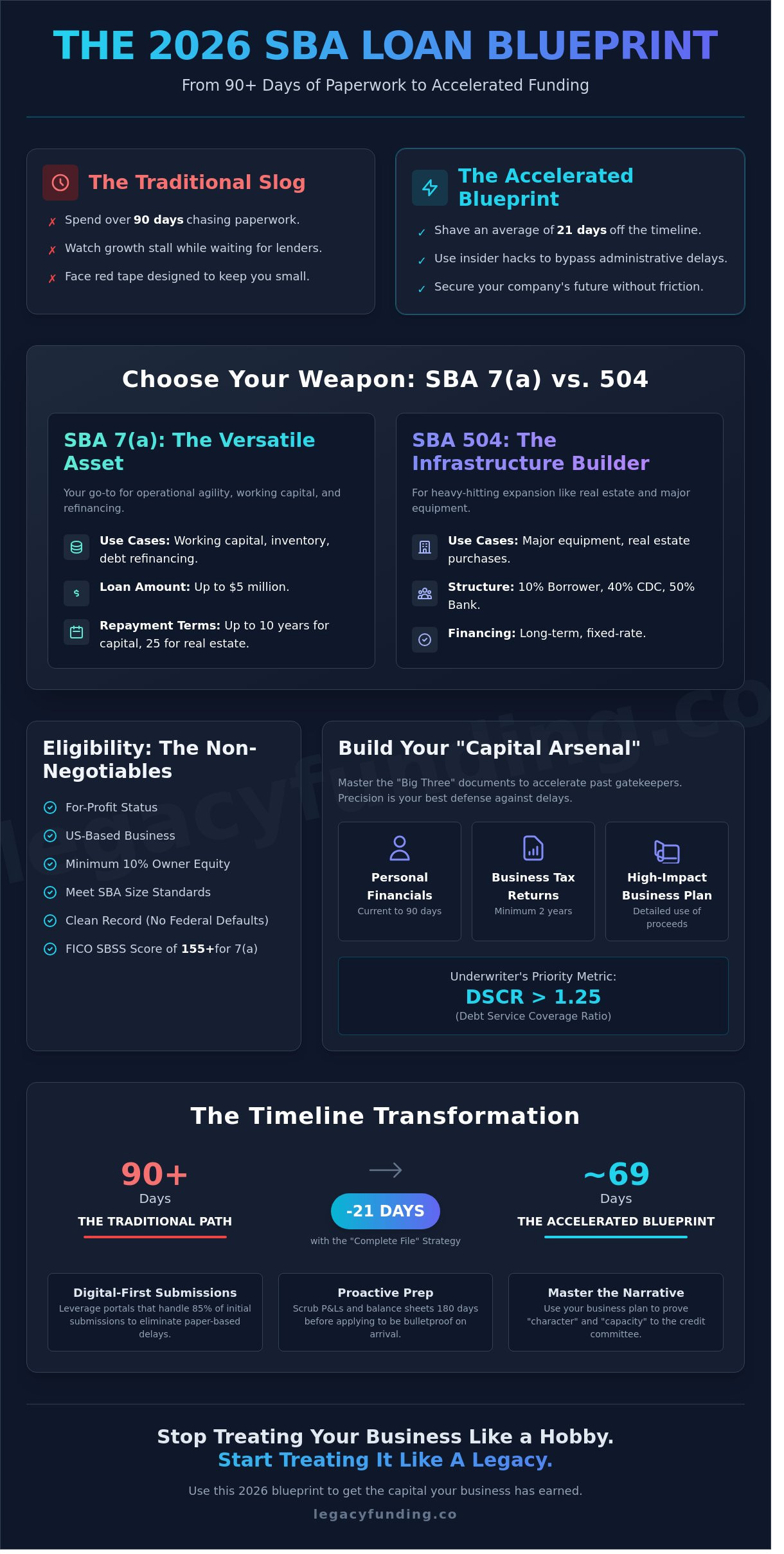
You deserve a clear path to expansion. This 2026 blueprint cuts through the noise to provide a streamlined, step-by-step guide that accelerates your path to capital. We'll show you how to shave 21 days off the standard approval timeline and exactly when to pivot to faster funding options. We're sharing the insider documentation hacks you need to Get Funded and secure your company's future without the typical friction. It is time to unlock the resources your business earned.
Key Takeaways
- Master the SBA partnership model to secure the gold standard of long-term leverage for your business growth.
- Build a "Capital Arsenal" using the Big Three documents to ensure your file accelerates past the gatekeepers.
- Navigate every stage of the sba loan application process with a blueprint designed to move you from lender match to funding faster.
- Cut weeks off your timeline by mastering the "Complete File" strategy to bypass red tape and administrative delays.
- Unlock high-octane alternatives for rapid scaling when your business opportunities can’t wait for a traditional 90-day cycle.
Decoding the SBA Loan Landscape: Is Your Business Ready?
Stop thinking of the government as your direct lender. The Small Business Administration (SBA) doesn't cut checks. They provide a federal guarantee that mitigates risk for private banks and credit unions. This partnership unlocks capital that traditional institutions often refuse to touch. By 2026, the sba loan application process has evolved into a digital-first ecosystem. Micro-loans under $50,000 now see approval windows 40% faster than they did in 2023. You must be a for-profit entity with a US presence and at least 10% equity to enter the arena. Secure your legacy by leveraging this government-backed power. Follow this blueprint to Get Funded.
The SBA 7(a) vs. 504: Choosing Your Weapon
The 7(a) program is your versatile asset. It handles working capital, inventory, and debt refinancing up to $5 million. Repayment terms reach 10 years for capital and 25 years for real estate. Use the 504 loan for heavy-hitting infrastructure. This program targets real estate and major equipment with fixed-rate, long-term financing. It typically requires 10% down from the borrower, 40% from a Certified Development Company, and 50% from a bank. Choose 7(a) for operational agility. Select 504 for generational brick-and-mortar expansion. Both options represent the gold standard for long-term business leverage.
Minimum Eligibility: The Non-Negotiables
You must satisfy the "credit elsewhere" rule. This requires showing you can't secure conventional financing on reasonable terms. Size standards are also absolute. The SBA uses NAICS codes to define "small" in your specific industry. Most manufacturing firms must have fewer than 500 employees. Retailers often need annual receipts under $40 million to qualify. Don't fall for the "No Hard Credit Pull" myth. While initial pre-qualification might be soft, the formal sba loan application process requires a comprehensive credit review. Expect a minimum FICO SBSS score of 155 for 7(a) approvals. Prepare your documents, prove your resilience, and Get Funded.
- For-Profit Status: Non-profits are generally ineligible for standard 7(a) and 504 programs.
- Reasonable Equity: You need skin in the game, usually 10% to 20% of the total project cost.
- Clean Record: No recent bankruptcies or defaults on federal debt, including student loans.
The 2026 landscape rewards speed and transparency. Digital portals now handle 85% of initial document submissions. This shift eliminates the red tape that previously stalled growth for months. Modern founders use these tools to accelerate their timeline. They don't wait for permission; they build the infrastructure for success. Position your business as a low-risk, high-growth entity to win the funding you deserve.
The SBA Documentation Blueprint: Building Your Capital Arsenal
Documentation is the ultimate filter. It either accelerates your path to capital or kills your deal on arrival. In the 2026 lending environment, underwriters don't just look for data; they look for precision. Mastering the sba loan application process starts with your "Big Three": Personal Financial Statements, Business Tax Returns, and a high-impact Business Plan. These documents represent your professional credibility in paper form.
Legacy founders don't wait for a lender's request to organize. They scrub their P&Ls and balance sheets 180 days before applying. This proactive approach ensures your financials are bulletproof before they reach a desk. Digital organization is your best defense against friction. Version control errors cause 15% of avoidable delays in the approval cycle. Use a centralized digital vault. Label every PDF with a specific date and category, such as "P&L_Q3_2025_Final," to keep the momentum high and the questions low.
Financial Statements That Win Underwriters Over
Underwriters prioritize the Debt Service Coverage Ratio (DSCR). Aim for a ratio of 1.25 or higher to signal total stability. While two years of tax returns remains the baseline for SBA loan programs, newer ventures can leverage strong interim data. Your financial snapshot must be current to the last 90 days. Outdated data suggests a lack of control; real-time data suggests a leader ready to scale. Accuracy here is the fastest way to Get Funded without the back-and-forth typical of traditional banks.
The Narrative: Why Your Business Plan Matters
Numbers provide the skeleton, but your narrative provides the muscle. Use your plan to prove "character" and "capacity" to the credit committee. Detail your management team's 10+ years of combined experience to mitigate perceived risk. Your "Use of Proceeds" section needs granular detail. Don't just ask for capital; show how $100,000 unlocks a 20% increase in production capacity by Q4. This level of detail transforms a simple request into a strategic growth roadmap. Once your documentation is ready, you can explore your funding options to see how your data translates into real-world leverage.
A complete sba loan application process relies on this documentation arsenal. When you present a clean, organized, and data-driven package, you move from a "maybe" to a "priority" in the lender's queue. Build your legacy on a foundation of facts, not just projections.
The 5-Stage SBA Application Process: From Submission to Funding
The sba loan application process is not a marathon; it is a series of strategic sprints. To Get Funded in 2026, you must navigate five distinct stages with precision. Your journey moves from the initial Lender Match to the Prequel (LOI), through the deep dive of Underwriting, into the SBA Portal, and finally to Closing. Each step requires a specific set of documents and a proactive mindset to maintain momentum.
Phase 1: Navigating Lender Match
Your choice of partner dictates your speed. Avoid standard banks that lack delegated authority. Instead, target Preferred Lender Program (PLP) institutions. These lenders make the final call on behalf of the government, which typically slashes 22 days off the standard approval timeline. They understand the nuances of the SBA 7(a) loan program and have the power to bypass the external SBA review of your credit box. Ask your potential lender three critical questions to ensure they are the right fit:
- How many loans did you close in my specific NAICS code last quarter?
- Is your underwriting team in-house or outsourced to a third party?
- What is your current pull-through rate from LOI to final funding?
Industry-specific experience is your greatest asset. If a lender does not understand the fluctuating margins of a 2026 tech startup or the capital requirements of a medical practice, they will misinterpret your cash flow and stall your growth. Choose a partner who speaks your language and moves at your pace.
Phase 2: Underwriting and the 'Waiting Room'
Underwriting is where your financial blueprint meets reality. As of January 2026, underwriters focus heavily on a 1.25x debt service coverage ratio. They will scrutinize your credit reliability, collateral coverage, and operational history. This stage is often called the "Waiting Room," but you cannot afford to be passive. Underwriters will "poke" at your file for three common reasons:
- Unexplained deposits exceeding $5,000 in your business accounts.
- Fluctuating net profit margins over the last 24 months of tax returns.
- Outstanding tax liens or undisclosed liabilities that appear on a background check.
Respond to every Additional Information Request (AIR) within 24 hours. High-speed responses signal professional competence and keep your file at the top of the stack. Once the underwriter clears the file, it moves to the SBA Portal for a final authorization number. This digital handshake is the last hurdle before you sign the closing documents and unlock your capital. Move fast, provide clarity, and secure the credit lines your business deserves to scale its legacy. The sba loan application process rewards the prepared founder.
How to Accelerate Your SBA Timeline and Bypass Red Tape
The biggest myth in business finance is that the SBA is a slow-moving mountain of paperwork. Traditional banks might take 90 days to close, but modern founders move faster. You can cut 21 days off your timeline by submitting a "Complete File" on day one. Internal data from 2025 shows that 90% of application stalls occur because of expired tax transcripts or a single missing signature on SBA Form 1919. Don't let a clerical error stall your expansion.
If you need capital under $500,000, leverage the SBA Express program. It offers a 36-hour turnaround on initial approval. This is the fastest route to unlock liquidity for inventory or equipment. A dedicated Funding Advisor acts as your shield during this time. They manage the bank's back-and-forth, translate technical requests, and ensure your sba loan application process stays on the fast track. They handle the friction so you can focus on your vision.
Common Bottlenecks and How to Smash Them
Stop waiting for the lender to request an appraisal. Order your third-party collateral valuation the moment you sign the letter of intent. Real estate deals often face a 21-day delay due to Phase I Environmental Reports. Order these in week one to stay ahead. Ensure your Certificate of Good Standing is dated within 30 days of your submission. These tactical wins remove the friction that kills most deals.
The Digital Advantage in 2026
Modern lending is data-driven and instantaneous. Use fintech integrations to sync your QuickBooks or bank feeds directly into the application. This eliminates the need for manual PDF uploads and prevents data entry errors. E-signatures are the 2026 standard for the sba loan application process; they turn a three-day mailing delay into a three-second click. The SBA One portal is a centralized digital interface that automates eligibility checks and slashes manual processing time for certified lenders. This technology ensures your file moves to the top of the stack.
Your business deserves a partner that understands the speed of modern commerce. We specialize in rapid capital injections with No Hard Credit Pull to protect your score. Build your business future today.
Get Funded and secure your capital blueprint here.Beyond SBA: Faster Funding Strategies for Rapid Scaling
The standard sba loan application process is a 90-day marathon. Market opportunities move significantly faster than government agencies. If a key competitor hits the market or a supplier offers a 30% discount for bulk cash buys, you cannot wait three months for a committee decision. You need high-octane capital. Revenue-Based Financing and Merchant Cash Advances (MCAs) offer the immediate liquidity required for rapid scaling. These tools prioritize your current cash flow over your personal credit history, providing a streamlined path to growth.
SBA loans demand a personal guarantee and extensive collateral that ties up your personal life. Alternative funding provides No Personal Guarantee options. This keeps your family's assets safe while you fuel your business expansion. Smart founders often employ a Hybrid Strategy to win. They secure an MCA to bridge the gap while their long-term sba loan application process moves forward in the background. You get the speed of alternative capital today and the lower interest rates of the SBA later. This strategy ensures you never lose momentum during the 12-week wait for federal funding.
When to Pivot: The Cost of Waiting vs. The Cost of Capital
Stop looking only at interest rates. Start looking at the ROI of missed opportunities. If a $200,000 investment today yields a $650,000 return by next quarter, waiting for a lower SBA rate is a losing strategy. The 4% you save in interest doesn't cover the $450,000 in lost revenue. Revenue-based models are perfect for businesses with seasonal ebbs and flows. Payments adjust based on your daily sales, protecting your bank balance during slow months. Legacy Funding offers a 24 to 48 hour approval process. This speed allows you to execute on deals before your competition even finishes their initial paperwork. In a fast-moving economy, the first person with the cash wins the contract.
Get Funded: Your Next Steps to Capital
Conduct a Funding Audit to determine which path fits your 2026 growth blueprint. You don't have to choose between speed and stability. You can have both. We help you evaluate your monthly recurring revenue and project your scaling needs to find the perfect capital mix. Take control of your financial destiny and bypass the traditional red tape that slows down your vision. Your business legacy shouldn't be defined by a bank's slow processing time. It should be defined by your ability to act. Unlock your business's potential and secure the leverage you deserve.
Claim Your 2026 Capital Advantage
Navigating the sba loan application process in today's market demands more than just paperwork; it requires a precise blueprint for rapid expansion. You've mastered the 5-stage submission strategy and learned how to build a capital arsenal that stands up to federal scrutiny. While traditional institutions often trap founders in 90-day waiting cycles, the modern entrepreneur knows that speed is a competitive asset. You don't have to let government red tape dictate your growth timeline. It's time to move from planning to execution.
Legacy Funding bridges the gap between your current balance sheet and your ultimate vision. We deliver funding in as little as 24 to 48 hours, ensuring your momentum never stalls. Our process is designed for the fast-paced SMB, offering no hard credit pull for initial offers. Our expert advisors provide the insider knowledge needed for national scaling, helping you bypass the friction of outdated banking models. You're not just looking for a loan; you're building a generational foundation.
Unlock Your Capital Blueprint—Get Funded with Legacy Today
The capital you need is within reach. Take the next step and secure the resources your business deserves.
Frequently Asked Questions
How long does the SBA loan application process actually take in 2026?
Expect the sba loan application process to take between 30 and 90 days from your initial submission to final funding. While SBA Express loans offer a 36-hour approval window, the full disbursement of capital often requires 30 days of rigorous documentation. Standard 7(a) loans typically hit your business account within 60 days. Prepare your financial stack early to accelerate this timeline and avoid the common 14-day delay caused by incomplete paperwork.
What is the minimum credit score required for an SBA loan?
You need a minimum FICO SBSS score of 155 to qualify for most 7(a) small loans under $350,000. For larger capital injections, lenders typically demand a personal credit score of 680 or higher. If your score sits below 640, 85% of traditional banks will likely reject the application immediately. Focus on your debt-to-income ratio to unlock better terms and faster approvals for your business.
Can I apply for an SBA loan if I have a Merchant Cash Advance (MCA) currently?
You can apply for an SBA loan with an active MCA, and many founders use this capital to refinance high-interest debt. Lenders require a Debt Service Coverage Ratio of at least 1.25x to ensure you can handle the new monthly payments. Consolidating a 30% APR cash advance into a 10% SBA loan can save your business $5,000 monthly in interest costs. This move preserves your cash flow and builds a sustainable financial legacy.
What are the most common reasons for an SBA loan application being denied?
Insufficient cash flow accounts for 25% of all SBA loan denials. Lenders scrutinize your ability to repay, so a debt coverage ratio below 1.15x is a deal-breaker. Other common hurdles include a personal credit score under 650 or a lack of collateral for loans exceeding $25,000. Ensure your 2025 tax returns show consistent profitability to prove your business has the legs to scale successfully.
Is a personal guarantee required for all SBA loans?
Every individual owning 20% or more of the business must provide an unconditional personal guarantee. This legal commitment ensures you're personally responsible for the debt if the business defaults. While this sounds high-stakes, it's the standard mechanism used to secure low 10% interest rates. It aligns your personal success with your company's growth, creating a powerful incentive to execute your 2026 blueprint and get funded.
How much does it cost to apply for an SBA loan?
Application fees are typically zero, but you'll encounter a guarantee fee ranging from 0% to 3.75% of the guaranteed portion. For a $500,000 loan, expect to pay approximately $11,000 in various closing costs and packaging fees. These costs are often rolled into the total loan amount, so you don't need significant upfront cash to start. Review the 2026 fee schedule to avoid surprises during the final signing phase.
What is the difference between an SBA loan and a traditional bank loan?
The primary difference lies in the government guarantee, which reduces lender risk and lowers your interest rate. Traditional bank loans often cap terms at 5 years, while the sba loan application process unlocks 10 to 25 year repayment windows. This extended timeline slashes your monthly overhead, allowing you to reinvest 15% more of your revenue back into scaling operations. It's the modern path to capital for savvy entrepreneurs.
Can I use an SBA loan for debt consolidation?
You can use SBA funds for debt consolidation if the new loan improves your monthly cash flow by at least 10%. This strategy is a primary way for entrepreneurs to swap toxic, high-interest debt for stable, long-term capital. Refinancing a $100,000 short-term bridge loan into a 10-year SBA term can reduce your daily payments to a manageable monthly figure. It's the ultimate move to protect your business and accelerate growth.