


SBA 7(a) vs 504 Loans: Which Funding Path Fuels Your Growth in 2026?
Choosing the wrong capital structure is the fastest way to anchor a scaling business to a sinking ship. As you weigh the pros and cons of sba 7(a) vs 504 loans, you aren't just looking for cash. You are choosing the strategic engine that will power your operations through 2026 and beyond. One path offers the ultimate flexibility for working capital; the other locks in long-term stability for major fixed assets.
You already know that traditional lending is a gauntlet of long approval times and complex eligibility requirements. It is exhausting to fight for funding while trying to run a company. We understand that your time is your most valuable asset. You need a partner who speaks the language of growth, not just financial obligations. We bridge the gap between high-stakes finance and your entrepreneurial aspirations.
This guide empowers you to master the critical differences between these programs and identify the exact strategy to scale. We will compare the 5.5% fixed rates of the 504 against the versatile 7(a) structure. You will learn how to minimize down payments, secure up to $5.5 million, and maintain 100% ownership while you expand. Let's build your roadmap to low-interest funding and generational impact.
Key Takeaways
- Understand how to navigate the sba 7(a) vs 504 loans landscape to select the specific capital engine that aligns with your 2026 growth objectives.
- Identify when to leverage the versatile 7(a) program for working capital and inventory needs to maintain high-velocity operational momentum.
- Discover how the 504 loan’s unique 10-50-40 structure provides a secure, fixed-rate foundation for major real estate and equipment acquisitions.
- Apply a strategic decision matrix to determine whether your business requires multi-purpose flexibility or a permanent, low-interest home for fixed assets.
- Learn how to bridge the gap between application and approval with modern funding solutions that ensure you never miss a market opportunity during the SBA wait.
Decoding the SBA Landscape: 7(a) vs. 504 Loans
The Small Business Administration doesn't write checks. They provide a safety net. This government guarantee encourages lenders to take risks they would otherwise avoid. It opens doors to capital that traditional institutions often keep locked. Understanding the nuances of SBA loan programs is the first step toward securing your company's future. Both the 7(a) and 504 programs offer lower down payments and longer repayment terms than conventional commercial debt. They are designed to preserve your cash flow while you scale. They empower you to grow without draining your reserves.
Universal Eligibility: Do You Qualify?
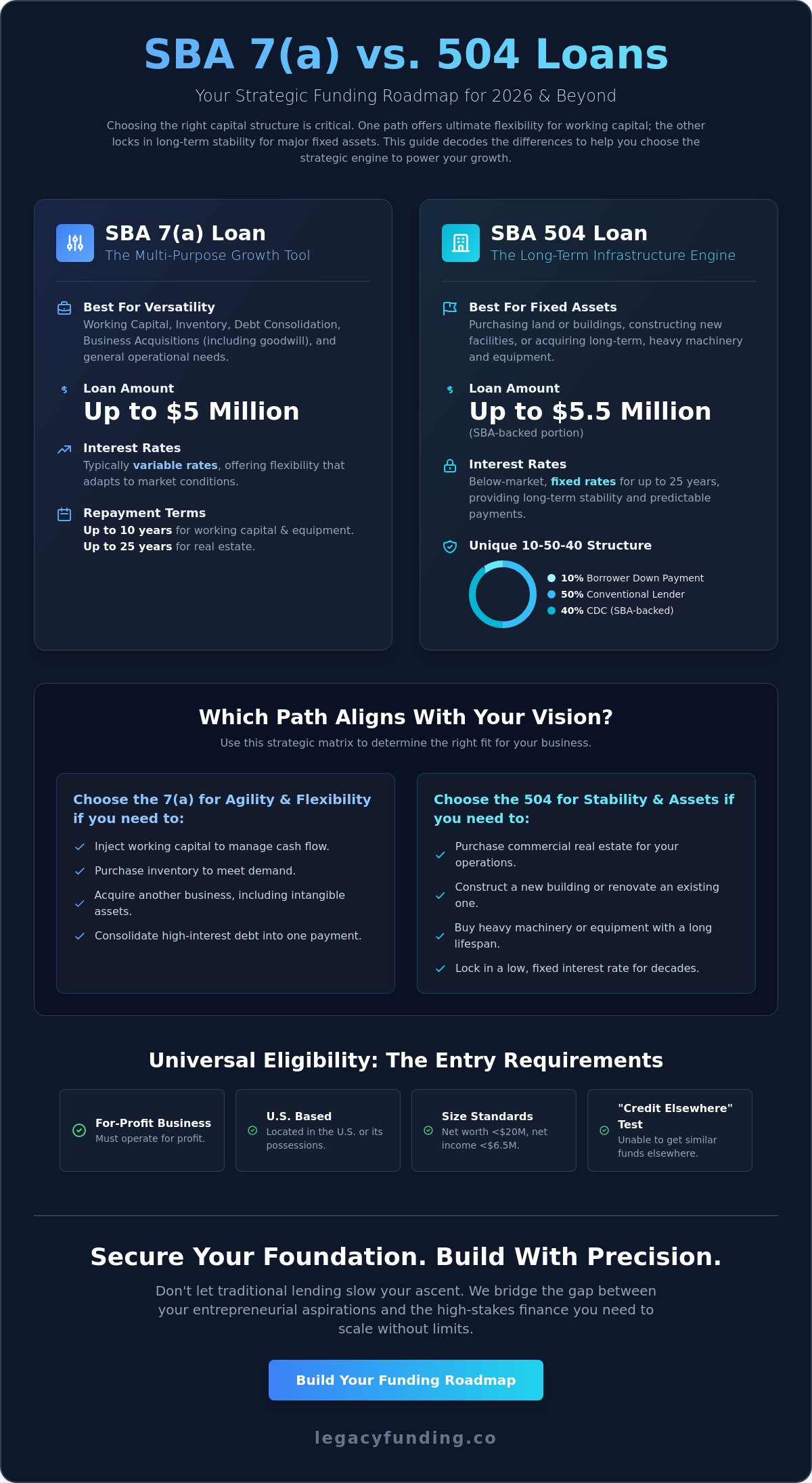
The barrier to entry is lower than you might think. Your business must operate for profit within the United States or its possessions. You also need to meet specific size standards. Currently, your company must have a tangible net worth under $20 million and an average net income under $6.5 million after taxes. There is one catch. You must pass the "Credit Elsewhere" test. This means you must demonstrate that you cannot obtain the requested funding through conventional channels on reasonable terms. It is not a sign of weakness. It is a prerequisite for government-backed support.
Why the Choice Defines Your Growth Trajectory
Speed and strategy go hand in hand. The decision between sba 7(a) vs 504 loans will dictate your financial flexibility for years. The 7(a) program acts as a Swiss Army Knife. Use it for working capital, inventory, or debt consolidation. It adapts to your immediate needs. In contrast, the 504 program is a real estate powerhouse. It is built for heavy lifting like purchasing land, constructing buildings, or buying massive equipment. Selecting the wrong program can lead to higher interest costs or restricted cash flow. This creates friction that can stall a promising expansion.
The 7(a) is the SBA's most popular offering for a reason. It provides up to $5 million with a versatility that matches the fast-paced nature of modern business. You can pivot, restock, and refinance under one umbrella. The 504 operates differently. It involves a three-way partnership between you, a conventional lender, and a Certified Development Company. This structure locks in low, fixed rates for up to 25 years. It is the gold standard for entrepreneurs who want to own their headquarters while keeping their liquid capital for growth. At Legacy Funding, we help you navigate this choice before you hit the paperwork wall. We ensure your capital structure supports your vision rather than hindering it. Secure your foundation. Build with precision. Scale without limits.
The SBA 7(a) Loan: Your Multi-Purpose Growth Tool
The SBA 7(a) program serves as the gold standard for versatile business financing. It is the agency's primary vehicle for delivering capital to entrepreneurs who need more than just a building. While other programs are rigid, the 7(a) adapts to your specific operational hurdles. You can secure up to $5 million to fuel almost any legitimate business purpose. This flexibility is why it remains the most popular choice for founders looking to scale quickly without sacrificing their equity. It is a powerful instrument for those who view capital as a strategic lever rather than just a debt obligation.
The repayment structure is designed to protect your monthly cash flow. You typically see terms up to 10 years for working capital, inventory, and equipment. If you use the funds for real estate, those terms can stretch to 25 years. This longevity is rare in the private market. It allows you to plan for the long term while keeping your immediate overhead manageable. If you are exploring the broader market, this comprehensive guide to business loans can help you see how the 7(a) stacks up against other institutional options. Understanding these mechanics is vital when weighing sba 7(a) vs 504 loans for your next move.
When to Choose the 7(a) Program
Speed and adaptability define the 7(a) advantage. It is the superior choice for business acquisitions, especially when a significant portion of the purchase price is "goodwill" or intangible assets. Traditional banks often shy away from these deals; the SBA 7(a) embraces them. It is also an elite tool for debt consolidation. You can roll high-interest short-term debt into a single, lower-interest monthly payment. This move immediately injects liquidity back into your operations. Seasonal businesses also find refuge here. It provides the necessary cushion to build inventory before your peak season hits, ensuring you never miss a sale due to empty shelves.
Understanding the Cost Structure
Transparency is the foundation of a good partnership. Interest rates for 7(a) loans are typically variable. They are tied to the Prime Rate plus a negotiated spread. While variable rates carry some market risk, they often provide lower entry costs than fixed-rate alternatives. Down payments are equally founder-friendly. You can often secure funding with as little as 10% down. This keeps your liquid cash available for daily operations and unexpected opportunities. Be prepared for the collateral requirements. The SBA generally requires a personal guarantee from anyone owning 20% or more of the business, alongside a lien on business assets. If you want to see how these requirements fit your specific balance sheet, connect with our team for a strategic review. We help you turn these technical requirements into a clear path for expansion.
The SBA 504 Loan: Financing Your Long-Term Infrastructure
The SBA 504 program is the ultimate tool for founders who want to stop paying a landlord and start building equity. It is a long-term, fixed-rate financing powerhouse designed specifically for major fixed assets. While the 7(a) provides operational agility, the 504 provides structural stability. The choice between sba 7(a) vs 504 loans often comes down to whether you are funding a process or a place. This program is the engine behind your physical expansion. It allows you to secure your company's future without depleting its cash reserves.
This program operates through a unique three-way partnership. You contribute a 10% down payment. A conventional lender covers 50% of the project. A Certified Development Company (CDC) provides the remaining 40% with a 100% SBA guarantee. This structure minimizes your out-of-pocket costs. It preserves your working capital for other growth initiatives. The CDC portion can reach up to $5.5 million for small manufacturers or energy-efficient projects. The total project size can be significantly larger. It is the most efficient way to leverage your capital for massive expansion.
The 504 is mission-oriented. It prioritizes job creation and community economic development. For every $75,000 borrowed, or $150,000 for small manufacturers, you generally must create or retain one job. This requirement aligns your success with the growth of your local economy. It turns your expansion into a community milestone. You aren't just buying a building; you are anchoring your business in the community.
Strategic Uses for the 504 Loan
Think big. Use this capital to purchase existing buildings, acquire land, or fund ground-up construction. It is perfect for long-term machinery and equipment with a lifespan of 10 years or more. You can also use it to modernize existing facilities. Upgrade your infrastructure to increase efficiency. Expand your capacity to meet rising demand. This is not for inventory or payroll. It is for the heavy lifting that defines your footprint. Use it to build the foundation of a generational business.
The Advantage of Fixed Rates
Stability is a competitive advantage. The 504 program allows you to lock in low interest rates for 10, 20, or 25 years. You eliminate the risk of market volatility. Your monthly payments become predictable. This makes long-term budgeting safe and simple. When comparing sba 7(a) vs 504 loans, savvy owners choose the 504 to build business wealth. You transform a monthly rent check into a long-term asset. You own your location. You control your future.
The Decision Matrix: Choosing the Right Path for Your Business
Selecting the right capital engine requires a cold, hard look at your 2026 balance sheet. When weighing sba 7(a) vs 504 loans, start with your primary objective. The 7(a) provides the liquid fuel for fast-moving operations. The 504 builds the permanent infrastructure your business will inhabit for decades. Interest rates create the biggest divide between these paths. Current 504 rates sit between 5.50% and 6.50% and are fixed for the life of the loan. In contrast, 7(a) rates are typically variable and currently range from 9.50% to 11.75%. This means your 7(a) payment could climb if the Prime Rate rises. Fees also differ significantly. The 7(a) guarantee fee can reach 3.75% of the guaranteed portion, while the 504 fee is usually 0.5% and often rolled into the total loan amount to preserve your cash.
Collateral requirements offer another point of divergence. Both programs typically start with a 10% down payment, but the 7(a) often reaches deeper into your assets. It may require a lien on your personal residence or other business holdings to secure the deal. The 504 is generally secured only by the asset being financed. This distinction allows you to keep your personal assets unencumbered while you scale. It's a strategic move for founders who want to separate their personal wealth from their business liabilities.
Head-to-Head: Use Case Scenarios
The choice of sba 7(a) vs 504 loans becomes clear when you look at real-world applications. Your specific goal dictates the program's utility:
- Buying an HVAC company: Choose the 7(a). It accounts for business value and "goodwill" that the 504 won't cover.
- Building a new warehouse: Choose the 504. The fixed rate and construction focus are tailor-made for ground-up projects.
- Refinancing a mortgage + cash for inventory: Choose the 7(a). It's the only option that blends real estate debt with working capital in a single package.
The Approval Timeline: Managing Expectations
Speed is often as important as the rate. The SBA 7(a) process usually spans 60 to 90 days. This timeline depends on your lender’s "Preferred" status and your own organization. The SBA 504 timeline is longer. It often takes 90 to 120 days or more due to the coordination required between your bank, a CDC, and the SBA. The average SBA wait time is a critical factor that can stall your momentum during a time-sensitive acquisition. If you need to move faster, apply for a strategic funding review to see how we can streamline your path to capital and ensure you don't miss a market opportunity.
Beyond the Approval: Scaling Faster with Modern Funding Partners
The decision between sba 7(a) vs 504 loans is only half the battle. The other half is surviving the calendar. Government-backed funding is notoriously slow. A 120 day wait can turn a hot acquisition into a missed opportunity. You cannot afford to let bureaucracy dictate your growth timeline. Legacy Funding acts as your strategic ally. We bridge the gap between your vision and your SBA approval. We provide the capital you need in 24 to 48 hours while the SBA processes your long term application.
We don't just offer debt. We consult on your total capital stack. This means looking at how different funding vehicles work together to maximize your leverage. You might use a short term injection to cover a down payment or an initial inventory surge. This prevents you from tapping into your vital operating reserves. Our goal is to ensure your business remains liquid and agile throughout the entire expansion process. We speak the language of the modern founder, focusing on growth metrics rather than just financial obligations.
The Power of the Capital Bridge
Momentum is fragile. If you need to secure a real estate deposit today, a Merchant Cash Advance (MCA) provides the immediate liquidity required to lock in the deal. You don't have to wait for the 504 underwriting to finish before you claim your territory. While you navigate the 4 month underwriting process for an SBA loan, Revenue-Based Financing keeps your operations moving. It fuels your growth during the transition. You can buy inventory, hire key staff, or launch a marketing blitz while your long term debt is being finalized. We help you move from fast, short term capital to the permanent stability of sba 7(a) vs 504 loans. This layered approach ensures your capital stack is always optimized for speed and safety.
Ready to Scale? Take the Next Step
Don't wait for a legacy bank to catch up to your ambition. Our process is built for the pace of 2026 commerce. Apply in minutes to see your immediate funding options. You will work with a savvy financial ally who understands the technical nuances of SBA programs and the power of alternative capital. We remove the friction from the application process. We provide clear, actionable steps that lower the barrier to entry. We are personally invested in your growth and your long term impact. This is more than a simple transaction. It is a partnership designed for business scaling. Secure Your Growth Capital with Legacy Funding Today and take control of your scaling journey.
Secure Your Capital Strategy for 2026
Scaling a business requires more than ambition. It requires the right financial engine. You now understand the strategic divide of sba 7(a) vs 504 loans. One offers the multi-purpose flexibility to consolidate debt and buy inventory. The other provides a fixed-rate foundation for your real estate and heavy equipment. Choosing correctly ensures your cash flow remains healthy while you build equity.
Don't let traditional banking timelines stall your progress. We provide tailored solutions for all credit profiles across the US and Canada. You can access funding in as little as 24 hours to bridge the gap while your long-term SBA application processes. This approach keeps your momentum high and your market position secure. We are here to consult on your total capital stack and remove the friction from your expansion.
Bridge the Gap and Fuel Your Growth, Apply for Funding Now. Your vision for a generational business is within reach. Let's build it together.
Frequently Asked Questions
Can I have both an SBA 7(a) and an SBA 504 loan at the same time?
Yes, you can hold both loans simultaneously to maximize your capital stack. Many founders use a 504 loan to secure a fixed-rate property while leveraging a 7(a) loan for operational flexibility. This combination provides the stability of ownership alongside the liquidity needed for inventory and payroll. It is a sophisticated strategy for businesses that are expanding their physical footprint while simultaneously scaling their daily output.
What is the minimum credit score required for SBA 7(a) vs 504 loans?
Most lenders look for a minimum credit score of 680 for both programs. While the SBA does not set a rigid floor, your personal and business credit history serves as a primary indicator of reliability. Higher scores often unlock better interest rates and smoother approval processes. If your score is lower, focus on building strong business revenue and providing robust collateral to offset the risk to the lender.
How much of a down payment is actually required for an SBA loan in 2026?
You can typically expect a minimum down payment of 10% for most projects in 2026. Certain scenarios, such as new business startups or special-purpose properties, may require 15% or 20%. This low entry barrier preserves your liquid capital for rapid expansion. When comparing sba 7(a) vs 504 loans, both programs remain significantly more accessible than conventional commercial loans that often demand 25% or more from the borrower.
Can SBA 504 loans be used for working capital or inventory?
No, 504 loans are strictly for major fixed assets like real estate and heavy machinery. You cannot use these funds for inventory, payroll, or marketing. If you need liquidity for daily operations, the 7(a) program or a business line of credit is the appropriate tool. Matching the right loan to your specific asset type prevents costly structural errors in your financing and ensures compliance with SBA regulations.
What happens if I want to pay off my SBA loan early?
Prepayment penalties apply to both programs but follow different schedules. For 7(a) loans with terms of 15 years or more, penalties typically last for the first three years. For 504 loans, the penalty period is often 10 years. Review these terms carefully if you anticipate a rapid exit or refinancing in the near future. Understanding these exit costs is vital for your long-term strategic planning and capital management.
Is the SBA 7(a) variable rate capped?
Yes, the SBA sets maximum spreads over the Prime Rate to protect borrowers from excessive interest. The specific cap depends on your loan amount and the current base rate. While the rate is variable, these regulatory limits prevent lenders from charging predatory interest. This structure ensures that your sba 7(a) vs 504 loans comparison remains grounded in fair market practices even during volatile economic periods in 2026.
Do I need to provide a personal guarantee for both loan types?
Yes, any individual owning 20% or more of the business must provide a personal guarantee. This requirement is universal across both the 7(a) and 504 programs. It aligns your personal commitment with the success of the project. This guarantee provides the security lenders need to offer the low interest rates and long terms associated with SBA financing. It is a standard component of high-level business funding.
How do I find a Certified Development Company (CDC) for a 504 loan?
You can find a CDC through the SBA’s local office directory or by asking your commercial lender for a referral. CDCs are non-profit corporations certified by the SBA to promote community economic development. They act as your primary partner for the 40% portion of the 504 loan. Selecting a CDC with deep experience in your specific industry can accelerate the coordination between the bank and the SBA during underwriting.