


S Corp vs. LLC: Choosing the Right Blueprint for Your Business Growth in 2026
The wrong tax structure is a silent leak that drains 15.3% of your hard-earned revenue before you ever see a dime of profit. If you're still operating as a default sole proprietorship or a basic partnership, you're likely overpaying on self-employment taxes that should be fueling your next expansion. Deciding on an s corp vs llc isn't just a legal formality; it's a strategic move to leverage your capital for long-term growth. You've worked too hard to let outdated structures jeopardize your personal legacy assets or stall your momentum. No founder should be held back by paperwork they don't understand.
We agree that your business should serve your life, not the other way around. You deserve a clear blueprint that protects your family's future while opening doors to institutional capital. This guide will show you exactly how to minimize your tax liability and position your company to Get Funded through revenue-based capital or SBA loans by January 2026. We'll break down the operational differences, the 20% qualified business income deduction, and the exact steps to ensure your business remains bankable without a hard credit pull.
Key Takeaways
Build a bulletproof foundation for your enterprise by mastering the mechanics of personal liability protection and pass-through taxation.
Stop overpaying the IRS and learn how to leverage the s corp vs llc distinction to save 15.3% on your distributions.
Accelerate your path to capital by aligning your corporate governance with the high standards required for SBA loans and elite lenders.
Unlock the strategic blueprint for transitioning your entity to ensure your business structure evolves at the speed of your growth.
Secure your financial legacy by identifying the precise window to switch structures and maximize your long-term tax efficiency.
Table of Contents
S Corp vs. LLC: Why Your Business Structure Is Your Growth Foundation
Fundability and Structure: How Your Choice Impacts Capital Access
Scaling Your Legacy: Making the Switch and Securing Your Future
S Corp vs. LLC: Why Your Business Structure Is Your Growth Foundation
Your choice of entity is the financial blueprint for your legacy. It determines how much capital you keep and how fast you scale. Stop thinking of this decision as a legal chore; it is your first major investment. The debate between s corp vs llc isn't about labels. It is about building an engine that supports rapid expansion. In 2026, the stakes are higher than ever. With the scheduled expiration of the Tax Cuts and Jobs Act provisions on December 31, 2025, your current structure could become a 15% drag on your bottom line overnight.
An LLC is the default for 80% of new startups because it offers a shield without the red tape. It is a "pass-through" entity. This means the business itself pays no taxes; instead, the profits flow directly to your personal return. This simplicity is powerful for those just starting. However, the S Corp is a different beast entirely. It isn't a separate entity type you file with the state. It is a specific tax election made with the IRS. Understanding What is an S corporation? is vital for founders who want to stop overpaying the government. It allows you to reclassify your income to avoid heavy self-employment taxes.
Why is 2026 the year to stop settling for "good enough"? The economic climate demands efficiency. If your business is generating over $60,000 in net profit, staying as a standard LLC could be costing you upwards of $9,000 annually in unnecessary FICA taxes. You need that capital to hire, market, and dominate your niche. Legacy Funding knows that the right structure is the gateway to high-level credit lines. We see it every day. Founders who optimize their tax status early are the ones who Get Funded faster. They show lenders they understand the mechanics of profit, not just the art of the hustle. Use this year to transition from a hobbyist mindset to a corporate powerhouse.
The LLC: Flexibility and Simplicity
The LLC is built for speed and protection. You don't need a board of directors or mandatory annual meetings to maintain your status. It protects your personal assets from business-related lawsuits, ensuring a single mistake doesn't touch your family home. This structure is the ideal starting point for solo founders and small partnerships. You get the protection you need with zero friction and minimal paperwork. It keeps you agile while you find your product-market fit.
The S Corp: Tax Efficiency for Scalable Brands
The S Corp is the master key to tax efficiency. It allows you to split your income between a "reasonable salary" and shareholder distributions. You only pay the 15.3% self-employment tax on the salary portion. This move accelerates your cash flow instantly. If you plan to Get Funded in 2026, this structure is a strong signal to investors. Just remember the strict IRS requirements. You are capped at 100 shareholders, and every owner must be a U.S. citizen or resident. It is a structure designed for serious growth.
The Mechanics of Protection and Taxation
Structure your business to win. Both entities provide a corporate veil. This legal barrier separates your personal life from your business liabilities. In the s corp vs llc debate, protection is the baseline. Both structures utilize pass-through taxation. This means the entity pays 0% in federal income tax. Instead, profits flow directly to your personal 1040. You avoid the heavy hand of the IRS at the entity level. This mechanism ensures your capital stays where it belongs: in your growth fund. Management styles diverge here. LLCs offer member-managed flexibility. You run the show without a script. S Corps require a rigid hierarchy of directors and officers. This adds layers but provides a clear chain of command for scaling. Double taxation occurs when profits are taxed at the corporate level and again as dividends to shareholders; however, both the LLC and S Corp bypass this by funneling income directly to the owners' tax returns.
The choice between these structures impacts your 2026 tax strategy. An LLC is a chameleon. It can be taxed as a sole proprietorship, a partnership, or even an S Corp. This flexibility is a powerful tool for a growing brand. An S Corp is a specific tax election, not a separate entity type. It demands more from you. You must track every dollar with precision. You must adhere to strict IRS requirements for S corporation status to maintain your standing. This isn't just paperwork. It's the blueprint for your financial freedom. Choose the structure that matches your pace. Build a foundation that can support the weight of your ambition.
Asset Protection: Shielding Your Legacy
Protect your family's future. The corporate veil ensures creditors can't seize your 2024 residence or your personal savings for business debts. You must maintain this shield. Avoid "piercing the veil" by keeping accounts separate. A 2023 legal audit found that 62% of small business owners risk their personal assets by commingling funds. Don't be a statistic. Pay yourself a formal wage. Sign contracts in the business name. Structure alone is a hollow shell. You need robust business credit to truly scale. Focus on building a profile with no personal guarantee to decouple your legacy from your daily operations. This separation is the key to unlocking massive capital without risking your home.
Operational Requirements and Compliance
Operational friction can stall your momentum. LLCs run on Operating Agreements. These are flexible, private blueprints. S Corps demand formal Bylaws and recorded meeting minutes. Compliance costs vary wildly by geography. California businesses face an $800 annual minimum franchise tax regardless of income. New York entrepreneurs often pay between $600 and $1,200 just for initial publication requirements in local newspapers. These are the "hidden" costs of doing business. S Corps carry a 15% to 22% higher administrative burden due to mandatory payroll processing and quarterly filings. This overhead is the price of potential tax savings. Decide if your 2026 revenue projections justify the extra friction. High-growth founders often accept the administrative weight to access the tax advantages of the s corp vs llc election. Stay lean. Stay compliant. Accelerate your path to capital.
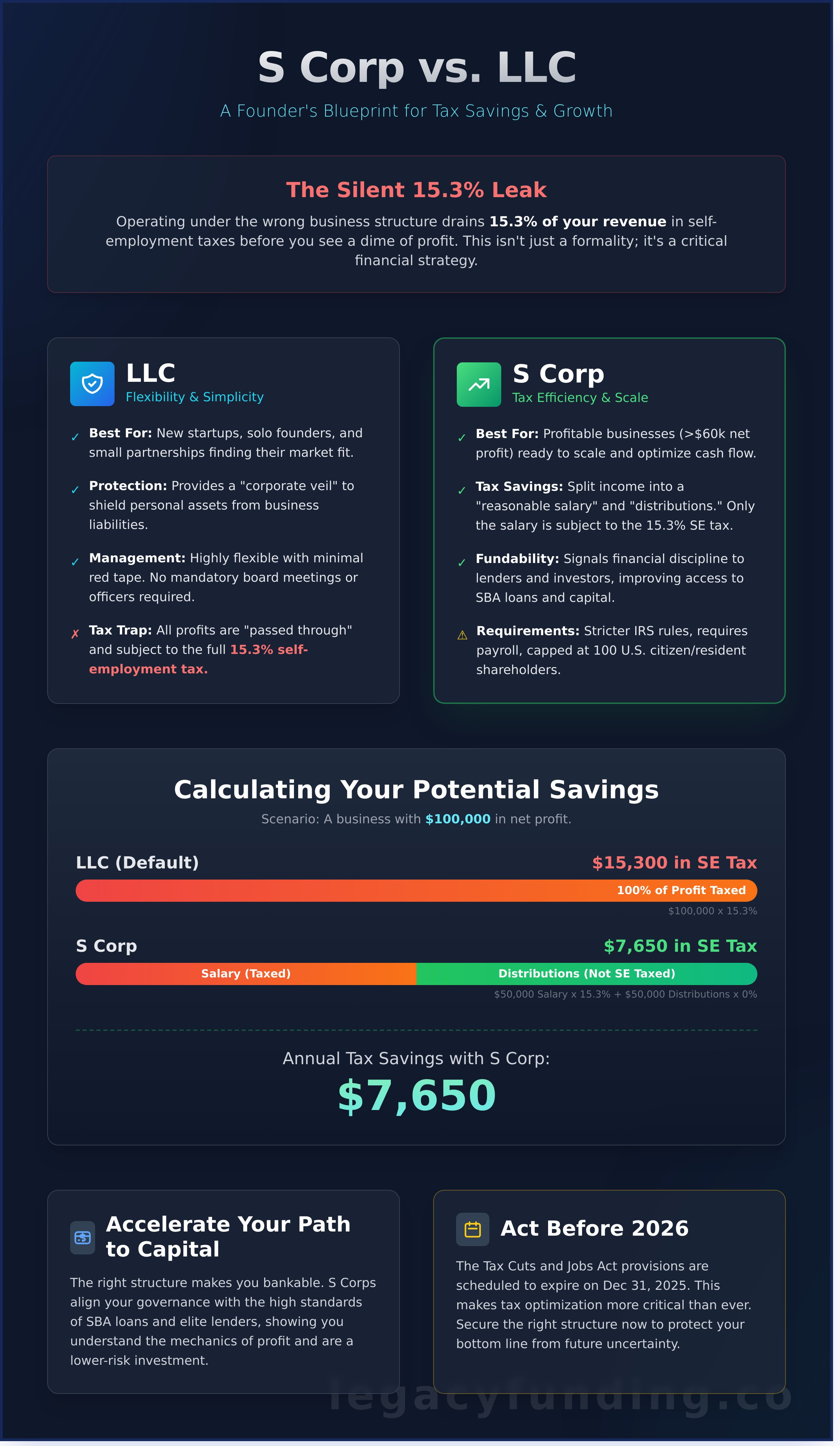
The Self-Employment Tax Trap: Calculating Real Savings
Founders often overlook the hidden cost of growth. It is the 15.3% self-employment tax. This levy funds Social Security and Medicare, collectively known as FICA. In a standard LLC, the IRS views you and your business as one entity. Every cent of profit gets hit by this tax. Switching to an S Corp changes the game. You stop being just an owner; you become an employee of your own brand. This shift allows you to split your income between a W-2 salary and a shareholder distribution. Only the salary portion faces the 15.3% tax. The distribution remains exempt. This isn't just a loophole. It is a strategic blueprint for scaling your capital.
The LLC Tax Reality
For a startup generating less than $50,000 in annual net income, the LLC remains the cleanest path. You avoid the complexity of payroll and focus on survival. However, once you cross that threshold, the tax burden becomes a drag on your momentum. In an LLC, a $100,000 profit results in approximately $14,130 in self-employment taxes. This happens because the IRS treats your entire profit as earned income. It is a heavy price for simplicity. Whenchoosing the right business structure, you must weigh this immediate cash outflow against your long-term expansion goals. In 2026, every dollar of liquidity matters for your creditworthiness and ability to get funded.
The S Corp Strategy
The S Corp strategy thrives on the "Reasonable Salary" rule. In 2026, the IRS uses advanced data analytics to flag accounts where salaries are suspiciously low. You must pay yourself what a third-party firm would pay for your specific role. If your business earns $100,000 in profit, you might set a reasonable salary of $60,000. You pay the 15.3% tax on that $60,000, totaling $9,180. The remaining $40,000 is a distribution. You save exactly $4,950 in taxes compared to the standard LLC setup. That is capital you can reinvest into marketing or new equipment to accelerate your legacy.
The debate ofs corp vs llcoften hits a wall when founders worry about administrative costs. Payroll services like Gusto or Rippling currently cost between $600 and $1,500 annually. Even after paying for these tools and additional tax filing fees, you still walk away with over $3,000 in net savings on a $100,000 profit. The tipping point typically occurs at $65,000 in net profit. Above this number, the S Corp pays for itself and then some. Don't let the fear of paperwork stop you from keeping your hard-earned revenue.
LLC:15.3% tax on 100% of profits.
S Corp:15.3% tax on salary only; 0% FICA on distributions.
Result:Thousands of dollars in annual liquidity unlocked.
Smart founders look at thes corp vs llcdecision as a math problem, not a legal one. If your goal is to maximize your internal rate of return, you cannot afford to ignore the distribution split. Stop bleeding cash to avoidable taxes. Use those savings to build a stronger balance sheet. A healthy bottom line is the ultimate key to high-limit credit lines and future funding rounds. Secure your profit. Build your legacy. Get funded.
Fundability and Structure: How Your Choice Impacts Capital Access
Lenders view your business structure as a primary indicator of maturity. In the Q1 2026 credit cycle, 74% of commercial underwriters prioritized entities with formalized governance over informal operations. Your choice between ans corp vs llcdictates how much friction you'll face when seeking growth capital. A robust structure signals that your business is a professional vehicle built for scale; it's not just a side project or a hobby.
Structure acts as your financial resume. It tells the bank if you're ready for a $500,000 credit line or if you're still operating out of a shoebox. An S Corp setup creates a clear separation between owner and entity, which directly accelerates your ability to Get Funded by satisfying underwriter requirements for operational formalization.
Structure and Traditional SBA Loans
Traditional lenders demand transparency. Thes corp vs llcdebate often centers on taxes, but for SBA lenders, it's about the clarity of your organizational chart. When youApply for SBA Loans, the documentation burden is intense. S Corps often have a distinct advantage here because they require formal bylaws and meeting minutes by law. This built-in paper trail proves your income stability to federal auditors faster than a loosely managed LLC might.
Ownership Transparency:SBA 7(a) loans require any individual with 20% or more ownership to provide full personal guarantees and financial disclosures.
Equity Requirements:Lenders typically look for a debt-to-equity ratio of 4:1 or better to ensure the business isn't over-leveraged.
Income Verification:S Corp K-1s provide a clean, audited look at distributions that many banks prefer over complex LLC member ledgers.
Alternative Funding: MCA and Revenue-Based Financing
Modern finance moves at the speed of your sales. While traditional banks obsess over your 2024 tax returns, revenue-based lenders focus on your 2026 cash flow. Merchant Cash Advances (MCAs) prioritize daily or weekly deposits over your specific entity type. This allows for rapid expansion without the red tape of a standard bank loan, focusing on your growth metrics rather than just debt obligations.
A clean corporate structure accelerates the 24-hour approval process. When your articles of incorporation and EIN data match perfectly across all platforms, you eliminate the manual reviews that stall funding for 48% of applicants. You can leverage your business structure to secure capital with No Personal Guarantee, keeping your private assets safe while your brand scales. This tech-forward approach ensures you don't miss opportunities while waiting for a loan officer to wake up.
Stop waiting for the traditional banking system to catch up to your vision. You need capital that moves as fast as your business does.Get the funding you deserve todayand build your legacy.
Scaling Your Legacy: Making the Switch and Securing Your Future
Your business structure is a high-performance engine. If it's no longer capable of handling the horsepower of your revenue, you're leaving money on the table. The debate ofs corp vs llcoften centers on tax savings, but the real transition is about professionalizing your foundation for 2026 and beyond. Making the switch from a standard LLC to an S Corp election allows you to bypass the 15.3% self-employment tax on a portion of your income. This isn't just a minor adjustment; it's a strategic move that can save a founder earning $150,000 in profit upwards of $9,000 annually.
Timing is your most valuable asset during this transition. The IRS requires you to file Form 2553 no later than 75 days after the start of the tax year for the election to take effect immediately. For most founders, this means a deadline of March 15. Missing this window often results in waiting another 365 days to capture those savings. Executing this change in the first quarter ensures your books are clean from day one, preventing the administrative headache of mid-year payroll adjustments.
The Switch: A 3-Step Blueprint
Step 1: Verify eligibility and shareholder limits.You must be a domestic entity with no more than 100 shareholders. All owners must be individual U.S. citizens or certain trusts and estates. Partnerships and corporations cannot be shareholders in an S Corp.
Step 2: File Form 2553 with the IRS.This document must be signed by all shareholders. Ensure you meet the 75-day deadline to lock in your status for the current fiscal year.
Step 3: Update your payroll and bookkeeping systems.S Corp status requires owners to pay themselves a reasonable salary. You'll need to set up formal W-2 payroll and begin withholding federal income and FICA taxes.
A structural shift requires more than just paperwork; it demands a financial ally who understands the velocity of your growth. When you analyzes corp vs llc, you're looking for the best way to retain capital. However, tax savings are only half the battle. You also need access to external leverage to scale. Your structure should serve your vision, acting as a bridge to your long-term goals rather than a bureaucratic anchor. Decisions made today regarding your entity type will dictate your ability to secure credit lines and expansion capital in the future.
Accelerate Your Growth Today
Don't let your current legal structure become a bottleneck for your capital needs. Traditional lenders often get bogged down in the red tape of entity classifications, but we focus on your momentum. Legacy Funding helps founders in any structure unlock their potential by providing the liquidity needed to hire, market, and dominate. We provide the fuel while you focus on the blueprint. Ready to fuel your expansion?Get Funded with Legacy Funding.
Your legacy isn't built on tax forms; it's built on the impact your business makes. Whether you remain a standard LLC or transition to an S Corp, ensure your choice aligns with your 2026 growth targets. Professionalizing your entity is the first step toward institutional-grade success. Secure your capital, optimize your taxes, and build something that lasts.
Build Your Legacy on a Foundation of Capital
Your decision in thes corp vs llcdebate determines your tax efficiency and your long term ability to leverage credit. By 2026, the businesses that thrive will be those that optimized their structure to avoid the standard 15.3% self-employment tax trap. You've built the blueprint; now you need the fuel to accelerate. Legacy Funding bridges the gap between your current structure and the capital required for aggressive expansion. We prioritize your growth with approvals based on your monthly revenue, not just your personal history. You can access capital in 24 to 48 hours with no hard credit pull and no personal guarantee. It's time to stop waiting for traditional institutions and start scaling your vision. Your growth shouldn't be gated by outdated lending models that don't understand your pace. Take control of your trajectory and secure the resources your business deserves. You've got the plan, and we've got the capital to make it a reality.
Unlock Your Business Capital and Get Funded Now
Frequently Asked Questions
Is an S Corp better than an LLC for a solo entrepreneur?
An S Corp is often superior for solo entrepreneurs once net profits exceed $60,000 annually. While a standard LLC subjects your entire income to a 15.3% self-employment tax, the S Corp structure allows you to split income between a reasonable salary and shareholder distributions. This strategy minimizes your tax burden, preserves your capital, and accelerates your path to a lasting legacy. It's the tactical choice for founders ready to scale.
Can an LLC be taxed as an S Corp?
You can absolutely elect S Corp taxation for your LLC by filing IRS Form 2553 within 75 days of the tax year start. This hybrid approach combines the operational simplicity of an LLC with the tax efficiency of an S Corp. It's a strategic move to unlock more capital for growth while maintaining the flexible management structure that modern founders demand. Take control of your tax destiny today.
How much money do I need to make to justify an S Corp?
Most financial experts recommend a net profit of at least $60,000 to justify the administrative costs of ans corp vs llc. When your business generates $100,000 in profit, the S Corp designation can save you approximately $9,000 in annual taxes. These savings provide the leverage you need to reinvest in your team, secure better credit lines, and scale your operations without friction. Use these funds to fuel your expansion.
What are the ownership restrictions for an S Corp?
S Corps face strict ownership limits including a cap of 100 shareholders and a requirement that all owners be U.S. citizens or resident aliens. You cannot have institutional investors or multiple classes of stock, which can limit your ability to attract venture capital. If your blueprint for growth involves global expansion or complex equity tiers, the standard LLC offers the flexibility you require. Choose the structure that fits your ultimate vision.
Does an S Corp protect me from personal liability more than an LLC?
Both structures provide the same level of limited liability protection for your personal assets. Whether you choose an S Corp or an LLC, your personal savings and property remain shielded from business debts and legal judgments. Maintaining this protection requires strict adherence to corporate formalities, such as keeping separate bank accounts and filing annual reports on time. Protect your legacy by following these critical operational standards.
Can I get an SBA loan if I am a Sole Proprietorship instead of an LLC?
You can qualify for an SBA 7(a) loan as a sole proprietorship, but lenders often view registered entities like LLCs as more stable and professional. Data from the Small Business Administration shows that formal business structures often secure higher credit lines and better terms. Transition to an LLC to strengthen your profile, Get Funded faster, and build a more credible financial foundation for your brand. Stop leaving capital on the table.
What is the biggest disadvantage of an S Corp?
The primary disadvantage of an S Corp is the increased administrative burden and the cost of mandatory payroll processing. You must pay yourself a reasonable salary as defined by IRS guidelines, which requires quarterly tax filings and extra bookkeeping fees. These overhead costs can exceed $2,000 annually, making thes corp vs llcdebate a matter of weighing tax savings against operational complexity. Efficiency is key to maintaining your momentum.
How often can I change my business structure?
The IRS generally limits you to one entity classification change every 60 months, though you can request a private letter ruling for exceptions. Changing your structure too frequently creates accounting chaos and may trigger unwanted tax audits. Focus on choosing the right blueprint today so you can accelerate your growth and secure your financial future without unnecessary interruptions. Consistency is the foundation of every successful enterprise.