


Revenue Based Financing for Startups: Scale Faster Without Giving Up Equity
What if the fastest way to scale your company didn't involve selling a single percentage of your cap table? Most founders assume that rapid growth requires a choice between the slow bureaucracy of traditional banks or the permanent equity drain of venture capital. You've likely felt the pressure of high-stakes personal guarantees or the frustration of waiting weeks for a loan decision. It's time to consider a smarter alternative. Revenue based financing for startups allows you to leverage your actual performance to unlock capital without sacrificing ownership or risking your personal credit.
We understand that in a global market projected to reach $15.86 billion by late 2026, speed is your greatest competitive advantage. You need a partner who values your growth metrics over your collateral. This guide shows you how to secure funding in under 48 hours and maintain 100% control of your vision. You'll discover how AI-driven underwriting is replacing outdated credit checks and why flexible repayments that scale with your monthly revenue are the key to sustainable expansion. Let's explore how to fuel your next stage of growth on your own terms.
Key Takeaways
- Learn how to fuel rapid expansion without surrendering equity, board seats, or personal assets.
- Understand the variable repayment model that aligns your financial obligations with your actual monthly performance.
- Discover why revenue based financing for startups provides a faster, more flexible alternative to venture capital and traditional bank debt.
- Identify the core revenue metrics and growth trends that lenders prioritize during the data-driven underwriting process.
- See how to compress your funding timeline to 24-48 hours and maintain 100% ownership of your company's future.
Scaling Without Sacrifice: Why Startups Choose Revenue-Based Financing
Scaling a business usually demands a painful trade-off. You either spend years bootstrapping with limited resources or you sell a piece of your soul to venture capitalists. Revenue-based financing disrupts this binary choice. It provides a performance-linked capital injection that scales directly with your success. Instead of judging your potential by a credit score or physical collateral, this model focuses on your gross receipts. It's a fundamental shift from credit-based to revenue-based underwriting.
Traditional institutions look backward at what you own. Modern revenue based financing for startups looks forward at what you're earning. If your business shows consistent monthly revenue, you're a candidate. It's about data, not just debt. Founders choose this path because it's non-dilutive. You keep your equity. You keep your board seats. You keep your vision. This is especially vital for companies in the growth stage. You've found product-market fit and have predictable income. Now you just need fuel for the fire.
The Problem with Traditional Startup Capital
Bank loans are often a dead end for early-stage companies. Rejection rates stay high because startups lack the three-year track record or heavy assets banks demand. On the flip side, venture capital rounds are expensive in the long run. They strip you of future upside and force you into a growth at all costs mentality. RBF acts as the perfect bridge. It gives you venture-level speed without the venture-level sacrifice. It bridges the gap between slow-burn bootstrapping and the high-pressure equity treadmill.
The Core Advantage: Funding That Matches Your Pace
Revenue based financing for startups is a strategic tool designed to scale proven business models without adding rigid overhead. Unlike traditional debt, there's no fixed monthly payment that might crush you during a slow month. There are no personal guarantees that put your home at risk. You repay a small percentage of your sales. When you win, you pay more. When things lean out, your obligations shrink. This flexibility ensures you stay in the driver's seat of your own company while accessing the capital needed to dominate your market.
Decoding the Mechanics: How Revenue-Based Funding Operates in 2026
Modern revenue based financing for startups operates on a simple, transparent exchange. You receive upfront capital today in return for a fixed percentage of your future gross receipts. This isn't a traditional loan with a rigid monthly bill. It's a performance-linked arrangement where the funder's success is tied directly to your own. Because the underwriting is data-driven, the process bypasses the bureaucratic hurdles that slow down traditional banks. You get the capital you need to scale, and the funder gets a share of the growth they helped facilitate.
The beauty of this model lies in its flexibility. Traditional term loans hit you with compounding interest that can spiral if growth slows down. In contrast, revenue based financing for startups uses a flat fee or multiple. You know exactly what the total cost will be on day one. This predictable structure allows you to look Beyond VC and debt toward a more sustainable way to fuel your operations. If you're ready to see how these mechanics apply to your specific numbers, you can connect with our team for a customized growth plan.
The Revenue Share Percentage
Your repayment is dictated by a "revenue share" percentage, typically ranging between 2% and 20% of your monthly sales. This percentage is determined by your historical growth, risk profile, and industry sector. It creates a "variable repayment" model that protects your cash flow. When sales are booming, you pay more and clear the obligation faster. When you face a lean month, your payment automatically drops. Most providers use automated remittances, pulling the agreed percentage directly from your payment processor or bank account to keep the process friction-free.
Understanding the Repayment Cap
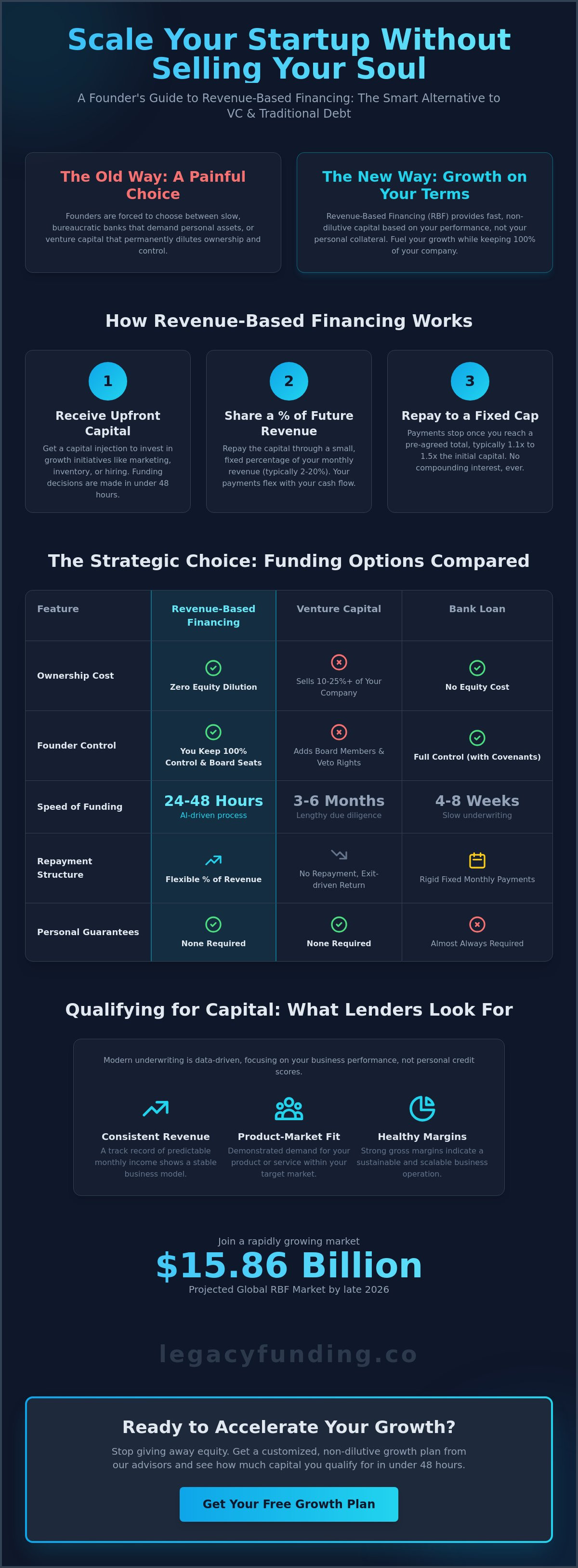
The total amount you'll ever pay back is governed by a repayment cap, often called a multiple. This cap usually sits between 1.1x and 1.5x of the initial investment. For example, if you receive a $100,000 advance with a 1.2x cap, your total repayment is fixed at $120,000. There is no maturity date and no hidden interest. Once you reach that $120,000 ceiling, the contract is complete. This structure aligns interests perfectly; the funder wants you to grow as fast as possible so they can receive their fixed return sooner, while you maintain full control of your equity throughout the journey.
The Strategic Choice: Revenue-Based Financing vs. VC and Debt
Choosing your capital stack is the most critical decision you'll make this quarter. It determines your speed, your stress levels, and ultimately, your ownership. While venture capital and bank loans are the traditional paths, revenue based financing for startups has emerged as a high-performance alternative. It's not just a way to get cash; it's a strategic move to preserve your sovereignty while fueling growth. To make the right choice, you must evaluate three core pillars: speed to capital, total cost of ownership, and operational control.
Many founders ask if RBF is more expensive than a bank loan. On a purely mathematical basis, the flat fee might look higher than a low-interest SBA rate. However, that's the wrong metric. You must weigh the cost of capital against the value of speed and preserved equity. A bank loan that takes three months to approve and requires your home as collateral is incredibly expensive in terms of risk and lost opportunity. RBF allows you to capture market share today using your own momentum as leverage. It's about the long-term impact on your cap table.
RBF vs. Venture Capital: Control vs. Cash
The venture capital process is a marathon. It often involves six months of pitching, due diligence, and legal wrangling. By the time the check hits your account, you've likely surrendered 20% or more of your company. You've also gained a board of directors that may prioritize an exit strategy over your long-term vision. In contrast, RBF can land in your account in under 48 hours. It's a tool for sustainable scaling. You keep 100% of your equity and 100% of the decision-making power. It's capital that works for you, not the other way around.
RBF vs. Traditional Bank Debt: Flexibility vs. Rigidity
Traditional bank debt is a rigid instrument. It demands fixed monthly payments regardless of your cash flow. If you have a slow month, the bank doesn't care; the bill is still due. Most bank loans also require high-pressure personal guarantees or physical collateral. revenue based financing for startups flips this script. Repayments are a flexible percentage of your actual sales. If revenue dips, your payment dips. Underwriters care more about your Stripe, Shopify, or QuickBooks data than your personal credit score. This data-driven approach removes the friction and personal risk inherent in legacy banking.
Qualifying for Capital: Key Metrics That Move the Needle
Traditional banks ask for three years of tax returns and a 50-page business plan. Modern funders ask for an API key. This shift defines the new era of revenue based financing for startups. The application process is no longer a subjective interrogation by a loan officer. It's a data-driven assessment of your real-time performance. Underwriters prioritize your gross revenue trends over your net profit margins. If you're reinvesting every dollar into customer acquisition to dominate your niche, traditional lenders see a lack of "profitability." We see a scaling machine ready for fuel.
The "quality" of your revenue is just as important as the quantity. Funders look for predictability. Recurring revenue models, like SaaS subscriptions, are the gold standard because they provide a clear window into future performance. However, high-velocity transactional revenue from e-commerce or professional services is also highly attractive. The goal is to prove that for every dollar of capital injected, your revenue will grow proportionally. Ready to see if your metrics hit the mark? Submit your data for a 48-hour review to lock in your growth capital.
The Data-Driven Application
The speed of 2026 underwriting relies on seamless API integrations. By securely connecting your bank accounts and payment processors like Stripe or Shopify, you provide an unvarnished view of your business health. This eliminates the need for manual paperwork and human error. Funders focus on three primary metrics: consistent monthly revenue, low churn rates, and positive month-over-month growth. This use of "alternative data" allows for approvals based on your current momentum rather than a personal credit score from five years ago.
When is Your Startup Ready?
Timing is everything. To qualify for revenue based financing for startups, you generally need to move past the "idea" phase. Most providers require a minimum viable revenue threshold, typically between $10,000 and $25,000 in monthly sales. Pre-revenue startups aren't a fit for this model because the repayment mechanism depends on existing cash flow. To prepare for a successful application, ensure your financial data is organized and accessible. Use this quick checklist to gauge your readiness:
- Verifiable History: At least six months of consistent revenue through a business bank account.
- Clean Integration: Your accounting software and payment processors must be up to date.
- Growth Plan: A clear strategy for how the capital will directly increase your gross receipts.
If you meet these benchmarks, you're no longer a "risky" startup in the eyes of the modern financial market. You're a high-growth asset. Use that leverage to secure the capital you need without giving up the equity you've worked so hard to build.
Accelerating Your Growth with Legacy Funding Advisors
Legacy Funding Advisors acts as the essential bridge between your current performance and your future scale. We don't just provide capital; we provide momentum. While legacy institutions remain stuck in the past, we operate at the speed of modern commerce. Our model for revenue based financing for startups is built on the belief that your data tells a better story than your personal credit history. We look at your growth, your grit, and your gross receipts to unlock the funds you need to dominate your market. This isn't a simple transaction. It's a strategic alliance designed to keep you in control while you accelerate.
We understand the high stakes of entrepreneurship. You've built something valuable, and you shouldn't have to sell a piece of it just to keep moving. Our partnership-driven approach means we win when you win. We don't act like a distant corporate entity; we act like a high-level consultant invested in your trajectory. By focusing on your growth metrics rather than just your obligations, we provide the financial independence you need to build a lasting legacy.
The Legacy Advantage: Speed and Transparency
The modern founder doesn't have weeks to wait for a committee decision. We've compressed the funding window to 24-48 hours from approval to bank account. This speed is a competitive weapon. It allows you to hire key talent, launch new campaigns, or purchase inventory exactly when the market demands it. We prioritize transparency above all else. You get clear terms. You get upfront multiples. Our reach extends across the U.S., Puerto Rico, and Canada, ensuring that geography is never a barrier to your expansion.
Take the Next Step Toward Financial Independence
Our application process is engineered for the busy founder who values efficiency over bureaucracy. There are no stacks of paper to sign or endless meetings to attend. We use secure integrations to analyze your business health instantly. This friction-free approach is why revenue based financing for startups has become the preferred choice for founders who refuse to slow down. We focus on the long-term impact of our support, framing every funding round as a step toward your generational success.
Stop letting outdated banking requirements hold your vision hostage. Financial independence starts with choosing a partner who speaks your language. Whether you need immediate revenue-based capital or are looking for longer-term SBA loans, we have the suite of products to fuel every stage of your journey. The era of sacrificing equity for growth is over. It's time to leverage your own success to build your legacy. Apply for fast business funding and secure your capital today and experience a partnership designed for the modern entrepreneur. Your growth can't wait for the old guard to catch up. Take the lead today.
Secure Your Capital and Own Your Future
Scaling a business doesn't require a compromise on your vision or your cap table. You've seen how revenue based financing for startups provides the agility of venture capital without the permanent cost of equity. By focusing on your real-time cash flow rather than outdated credit scores, you unlock a funding model that breathes with your business. It's capital designed for the modern founder who values momentum over bureaucracy. We deliver funds in as little as 24 hours to businesses across the U.S., Puerto Rico, and Canada. This speed allows you to seize market opportunities while they're still fresh.
You deserve a partner who understands that growth is a generational endeavor. Stop waiting for legacy institutions to catch up to your pace. Our process removes the friction that slows down traditional lending, giving you the freedom to scale on your own terms. Take control of your trajectory and secure the resources your business has earned. Get funded in 24-48 hours—apply for revenue-based financing now. Your vision is too important to be sidelined by rigid bank requirements. Let's build your legacy together.
Frequently Asked Questions
How is revenue-based financing different from a merchant cash advance?
Revenue-based financing is generally structured as a loan or investment based on your total gross revenue, whereas a merchant cash advance specifically involves the purchase of future credit card sales. RBF is often more suitable for B2B or SaaS companies that receive payments through various channels like ACH or wire transfers. It typically offers longer repayment windows and more comprehensive terms tailored for high-growth tech companies rather than retail businesses.
Does revenue-based financing require a personal guarantee or collateral?
No, most agreements do not require you to pledge personal assets like your home or provide a high-pressure personal guarantee. The funding is secured by the strength of your future revenue streams rather than physical collateral. This structure significantly reduces your personal risk. It allows you to focus entirely on scaling your operations without the fear of losing personal property if the market shifts unexpectedly.
What is the typical cost or "multiple" for startup revenue funding?
The cost is structured as a fixed repayment cap or a total multiple of the initial amount provided. You'll know the exact total cost on day one because it doesn't involve compounding interest or hidden maintenance fees. This flat-fee approach ensures your cost of capital remains predictable throughout the life of the agreement. It's a transparent way to fund growth while keeping your long-term financial planning accurate and simple.
Can I still raise venture capital if I have an RBF agreement in place?
Yes, you can absolutely raise venture capital while utilizing revenue based financing for startups. Many founders use this capital to reach key milestones that justify a much higher valuation during their next equity round. Because RBF is non-dilutive and doesn't require a board seat, it's often viewed by VCs as a smart way to bridge the gap between funding stages without giving up more ownership.
What happens if my startup has a slow month or seasonal dip in sales?
Your repayment amount automatically decreases during lean months. Since you pay a fixed percentage of your actual monthly revenue, the dollar amount you remit scales down when your sales dip. This built-in flexibility protects your cash flow and ensures the funding never becomes a burden during seasonal transitions. It aligns the funder's interests with your own; we only succeed when your revenue is flowing.
How fast can I actually receive the funds once I apply?
The process is built for the speed of modern commerce, often delivering funds in as little as 24 to 48 hours. By using secure API integrations to analyze your real-time performance data, we bypass the weeks of manual review required by traditional institutions. This rapid turnaround allows you to seize time-sensitive market opportunities or solve urgent inventory needs without the typical bureaucratic delays found at a bank.
Is my credit score a factor in getting approved for RBF?
Your personal credit score is far less important than your business's revenue performance and growth trends. Underwriters prioritize verifiable data from your bank accounts and payment processors to determine eligibility. While we may review your credit history, the primary focus is on your ability to generate consistent, high-quality revenue. We value your business's current momentum and future potential over an outdated personal credit metric.
What are the most common uses for revenue-based funding in a startup?
Founders frequently use revenue based financing for startups for activities that provide a clear return on investment. This includes scaling digital marketing campaigns, purchasing bulk inventory, or hiring essential sales and engineering talent. It's the ideal fuel for any initiative that directly drives top-line growth. Because the capital is flexible and fast, it's perfect for capturing market share exactly when the opportunity arises.