


Is Business Debt Consolidation a Good Idea? A Strategic Guide for Founders
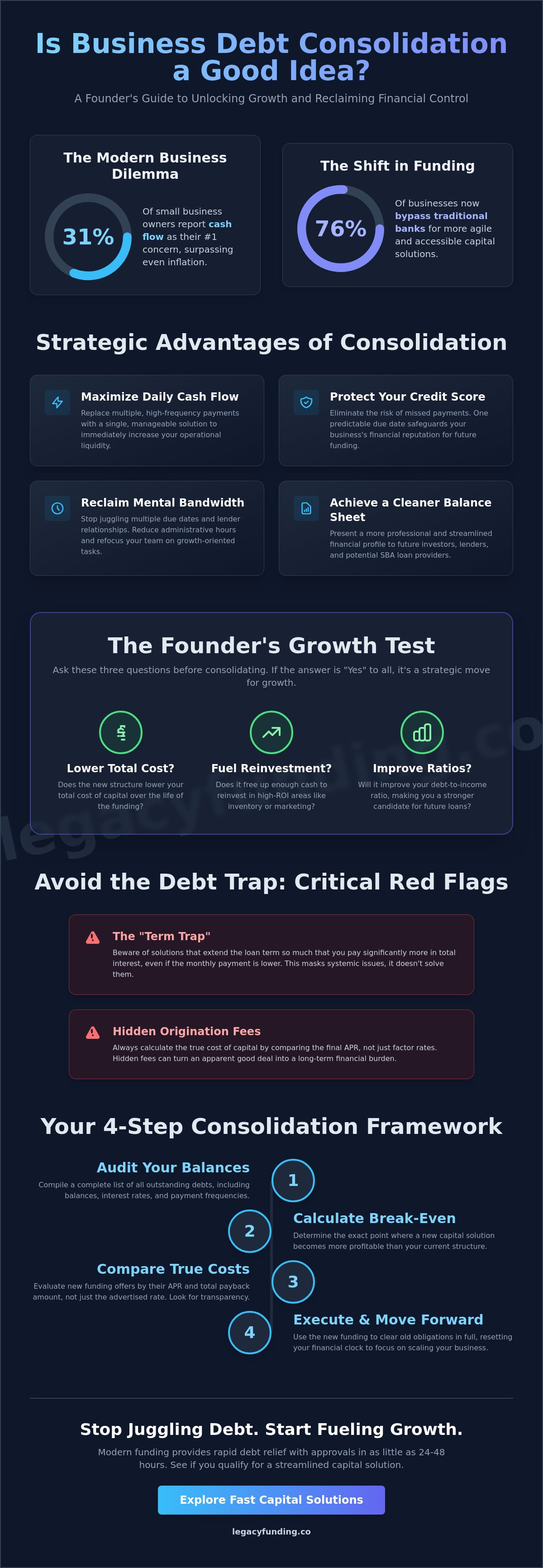
Cash flow has officially surpassed inflation as the top concern for 31% of small business owners. If you're currently drowning in daily micro-payments or struggling to decode complex factor rates, you've likely asked: is business debt consolidation a good idea? It's a high-stakes question for any founder. Traditional banks are failing to keep up, which is why over 76% of businesses now bypass legacy institutions for more agile capital.
You want to stop managing debt and start managing growth. Stagnant cash flow isn't just a financial metric; it's a ceiling on your ambition. This guide will show you exactly how to break through that ceiling and determine if consolidating is your key to financial independence or a potential trap. We'll break down how to secure one manageable payment, unlock immediate capital, and clear old obligations so you can finally move at the speed of modern commerce.
Key Takeaways
- Learn how to replace multiple high-frequency payments with a single solution that maximizes your daily operational liquidity.
- Discover why asking is business debt consolidation a good idea depends on your ability to reclaim mental bandwidth and protect your credit score.
- Identify critical red flags like the "Term Trap" and hidden origination fees that can turn a consolidation move into a long-term burden.
- Master a four-step framework to audit your outstanding balances and calculate the exact break-even point for new capital.
- Explore how modern funding alternatives provide rapid debt relief with approval windows as short as 24 to 48 hours.
Evaluating Business Debt Consolidation: Is It the Right Move for Your Growth?
Business debt consolidation isn't just a financial cleanup; it's a strategic pivot. It is the replacement of multiple high-frequency payments with a single, streamlined capital solution. To understand what debt consolidation is in a corporate context, you have to look at cash flow velocity. The primary objective is simple: maximize your daily operational liquidity. You aren't just moving numbers around a spreadsheet. You're buying back your time, your focus, and your ability to scale. Modern founders recognize that traditional, sluggish banking methods are outdated. They seek a tech-forward financial ally instead.
So, is business debt consolidation a good idea? The answer depends entirely on your net cash flow. If the new structure increases your available capital immediately, it's a win. "Good" consolidation fuels expansion. It acts as the bridge to your next stage of scaling. Conversely, "bad" consolidation merely masks systemic losses or deep-seated operational inefficiencies. Don't use a new loan to hide a failing business model. Use it to supercharge a successful one. This move should be about growth metrics, not just meeting financial obligations.
The Core Mechanics of Consolidation
One new funding round clears your slate. It pays off existing creditors in full, effectively resetting your financial clock and removing the friction of multiple lenders. You move away from unpredictable, variable daily withdrawals that drain your operating account before your team even starts work. You shift into predictable, manageable structures that respect your business cycle. This transition requires a sharp eye. You must compare factor rates and APRs side-by-side. Look for a unified comparison that reveals the true cost of each dollar. This clarity is the foundation of a modern financial strategy. It's about moving from a reactive state to a proactive one.
The 'Growth Test' for Founders
Before you sign, run the growth test. Ask three hard questions. First, does this move lower your total cost of capital over the life of the loan? Second, does it free up enough cash to reinvest in high-ROI areas like inventory or aggressive marketing? Finally, will it improve your debt-to-income ratio? A cleaner balance sheet today makes you a stronger candidate for SBA eligibility or larger term loans tomorrow. If you can't check these boxes, you're just delaying the inevitable. If you can, you're paving the way for a generational legacy. Speed, accessibility, and transparency are your new benchmarks for success.
When you consolidate correctly, you eliminate the "payment juggle" that keeps you up at night. You replace confusion with clarity. You replace stagnation with momentum. If is business debt consolidation a good idea is the question, the growth test provides your answer. Focus on the metrics that matter and choose a partner that understands the speed of contemporary commerce.
The Strategic Advantages: Why Consolidation Powers Business Scaling
Stop viewing debt consolidation as a defensive retreat. For the modern founder, it's an offensive maneuver designed to fuel rapid expansion. Consolidation allows you to unlock immediate working capital that was previously trapped in high-interest, high-frequency repayments. By rolling multiple obligations into a single structure, you present a cleaner balance sheet to future investors and lending partners. This professional financial profile is essential when you're ready to graduate to government-backed options like SBA 7(a) loans. When your financials are streamlined, the market treats you as a serious contender for larger capital injections.
Many entrepreneurs find themselves at a crossroads, asking is business debt consolidation a good idea when their current repayment schedule begins to dictate their daily operations. The answer lies in your ability to protect your most valuable asset: your business credit score. Consolidation ensures no deadlines are missed by replacing a dozen fragmented dates with one predictable milestone. You aren't just saving money on potential late fees. You're safeguarding your reputation and ensuring your future access to low-cost capital remains wide open. Focus on the long-term impact of a unified strategy rather than the short-term fix of fragmented funding.
Operational Efficiency and Focus
Stop managing ten different due dates. Start managing one business. Every hour your team spends on complex bank reconciliations for micro-payments is an hour stolen from growth-oriented analysis. Consolidation reduces this accounting overhead instantly. It also eliminates the risk of 'stacking' penalties, which often occur when multiple lenders trigger automated fees during a brief dip in revenue. Streamline your process. Simplify your life. Secure your future. By removing the friction of administrative debt management, you reclaim the mental bandwidth needed to innovate and lead. Efficiency is the hallmark of a scaling enterprise.
Cash Flow Velocity
Daily micro-payments stifle intra-month growth. They pull capital out of your business before it has a chance to work for you. Cash flow velocity is the speed at which capital cycles through your business to generate profit. Shifting to monthly or bi-weekly payments aligns your debt obligations with your actual inventory cycles. This creates a rhythmic pulse of efficiency that keeps more cash in your account for longer periods. You gain the liquidity needed to buy inventory in bulk, launch aggressive marketing campaigns, or hire key talent exactly when the opportunity arises. If you're ready to stop the cycle of fragmentation and accelerate your growth, connect with a consultant to explore your consolidation options. Move at the speed of modern commerce and leave legacy debt structures behind.
When to Be Cautious: Avoiding the 'Debt Trap' of Poor Consolidation
Consolidation isn't a magic wand; it's a financial tool. If used incorrectly, it becomes a weight. You must watch for the 'Term Trap' where lower monthly payments hide a massive increase in total interest. Extending a one-year obligation into a five-year term might give you breathing room today, but it can double your total cost of capital. You're effectively trading your future profit for current comfort. Always audit the hidden origination fees. These costs can eat 3% to 5% of your total capital before it ever hits your bank account. If the fees outweigh the interest savings, the math doesn't work.
Founders often struggle with the question: is business debt consolidation a good idea when it requires pledging collateral? Shifting from unsecured Merchant Cash Advances (MCAs) to a secured term loan changes your risk profile. You are moving from debt tied to future sales to debt tied to your hard assets. If your revenue dips, your equipment or real estate is now on the line. While weighing the strategic advantages of consolidation, you must also consider the risk of re-borrowing. Taking on new debt before your consolidation loan is significantly paid down creates a toxic cycle of 'stacking' that leads straight to insolvency.
The Reality of Reverse Consolidation
Reverse consolidation is a tactical move designed for businesses with high-frequency daily withdrawals. In this structure, a provider pays your existing daily payments for you. In return, you make a single, lower weekly or monthly payment to that provider. This is often superior to a traditional payoff when your current lenders have aggressive prepayment penalties. It allows you to fix your cash flow immediately without triggering 'double-dip' interest costs. It keeps your relationships with existing creditors intact while you regain control of your operating account. It's a savvy, tech-forward alternative to traditional refinancing.
Hidden Costs to Audit
Before signing any new agreement, conduct a rigorous audit of your current and future obligations. Transparency is your best defense against predatory structures. Look for these specific red flags:
- Prepayment Penalties: Check if your current high-interest debt requires you to pay the full factor rate even if you settle early.
- Closing Costs: Documentation and processing fees should be clearly stated, not buried in the fine print of the contract.
- The Double-Dip Risk: Ensure the new lender isn't charging interest on the interest already baked into your old loans.
If you find yourself asking is business debt consolidation a good idea, let the data decide. A modern financial ally will show you the math upfront. If a lender avoids these questions, they aren't a partner; they're a hurdle. Protect your business by demanding clarity at every step of the process.
The 4-Step Framework for a Successful Debt Consolidation Strategy
Strategy without execution is just a dream. You need a data-driven framework to answer the question: is business debt consolidation a good idea for your specific situation? Founders often fail because they move too slowly or choose the wrong funding vehicle. This four-step process removes the guesswork. It turns a complex financial burden into a streamlined growth engine. Audit your load. Calculate your savings. Compare your options. Execute with precision.
Auditing Your Current Debt Load
Build a master sheet today. List every outstanding balance, payment frequency, and remaining term. You must differentiate between toxic debt and strategic debt. Toxic debt includes aggressive daily withdrawals that cripple your agility. Strategic debt carries lower long-term costs and predictable schedules. Verify every personal guarantee attached to your business obligations. Knowing where you stand is the first step toward financial independence. It's about clarity, not just survival.
- List everything: Include MCA factor rates, loan APRs, and maturity dates.
- Identify risk: Highlight any debt that requires a personal guarantee or collateral.
- Calculate impact: Note the total daily or weekly drain on your operating account.
Choosing the Right Funding Vehicle
Not all capital is created equal. Revenue-Based Financing is often the ideal choice for high-volume businesses needing to clear multiple MCAs quickly. It scales with your sales, providing flexibility that traditional loans lack. If you need a short-term bridge, Working Capital Loans provide the necessary speed to stop the bleeding. While SBA loans remain the gold standard for interest rates, they're frequently too slow for urgent consolidation. Traditional banks can take months. Modern founders need solutions in days, not weeks.
Determine your 'break-even' point before committing. If the new capital injection doesn't clear your old debt while lowering your total daily burden, it's not the right move. Once you find the right fit, move fast. Applying with a provider that values speed prevents 'payment overlap.' This is the dangerous window where you're stuck paying both old and new creditors simultaneously. Efficiency is your best defense against stagnant growth. If you're still asking is business debt consolidation a good idea for your current balance sheet, let the data provide the answer. Reclaim your cash flow and consult with a funding specialist to map out your exit strategy from high-frequency debt.
Legacy Funding Advisors: Fast Capital Solutions to Streamline Your Business Debt
Traditional institutions often treat growth like a liability. They bury you in paperwork and wait weeks to offer a decision. By then, the daily withdrawal drain has already caused irreparable damage to your liquidity. Legacy Funding Advisors operates differently. We understand that in contemporary commerce, speed is your greatest competitive advantage. If you've been asking is business debt consolidation a good idea, the answer is only 'yes' if you can execute the move before your cash flow dries up. We provide the rapid debt relief you need to stop managing crises and start managing your future. Move fast. Secure your capital. Reclaim your focus.
We prioritize your cash flow health over a single credit score number. A business is more than a report; it's a living entity with real-world momentum. Our approach focuses on growth metrics and your ability to scale. We remove the friction found in legacy banking. We replace it with a streamlined process designed for the modern founder. Take control of your business's financial legacy today by choosing a partner that values your time as much as your vision. We aren't just a lender. We're Legacy Funding Advisors—your gateway to financial independence and business scaling.
Why Founders Choose Us for Consolidation
Stop the bleed immediately. We fund in hours, not weeks. This rapid turnaround prevents the 'payment overlap' that often sinks consolidation attempts. Our flexibility extends across various industries throughout the U.S. and Puerto Rico. We don't use bureaucratic jargon or hide behind complex terms. We offer growth-oriented capital with total transparency. Secure your funding. Clear your obligations. Expand your reach. Our process is built for efficiency because we know your business doesn't sleep.
- Speed: Receive approval and funding within a 24-48 hour window.
- Focus: We evaluate your revenue trends rather than just your historical credit data.
- Transparency: Clear terms that allow you to calculate your ROI with confidence.
Ready to Clear the Path for Scaling?
The application process is simple because your time is valuable. You don't need a tech-forward financial ally just for the numbers; you need one to navigate the high-stakes world of finance with you. Legacy Funding Advisors acts as a consultant personally invested in your growth. By consolidating with us, you aren't just paying off debt. You're investing in a generational endeavor. Clear the path. Scale your operations. Build your legacy. We understand the speed of modern commerce better than any legacy institution.
If you're ready to prove that is business debt consolidation a good idea for your growth trajectory, we're ready to fund it. Don't let outdated methods dictate your speed. Apply for Business Debt Consolidation Funding today and unlock the cash flow your business deserves. Your future shouldn't be held hostage by yesterday's obligations.
Reclaim Your Momentum and Scale Your Vision
Deciding if is business debt consolidation a good idea for your firm requires looking beyond simple interest rates. It is about the velocity of your capital and the freedom to pivot when the market demands speed. By applying the strategic frameworks discussed, you move away from the payment juggle and toward a unified, growth-centric financial structure. This transition protects your credit profile and ensures your daily revenue stays where it belongs; reinvested in your operations to fuel rapid expansion.
Legacy Funding Advisors stands ready as your tech-forward financial ally. We deliver funds within a 24-48 hour window, focusing on your current cash flow health instead of legacy credit metrics. We empower small businesses across the U.S. and Puerto Rico to break free from high-frequency debt and clear the path for generational scaling. Your ambition shouldn't be limited by outdated banking models that prioritize bureaucracy over business results. End the cycle of stagnation and start building your future today.
Streamline Your Debt and Fuel Your Growth—Apply Now
Frequently Asked Questions
Will business debt consolidation hurt my credit score?
Consolidation often leads to a higher credit score over time. You might see a minor, temporary dip from a hard credit inquiry during the application phase. However, replacing multiple high-utilization accounts with a single structured loan improves your debt-to-income ratio. It also ensures you never miss a deadline due to payment confusion. Consistency is the key to long-term financial health and professional credibility.
How fast can I get funds to consolidate my business debt?
Modern alternative lenders can provide funding in as little as 24 to 48 hours. Traditional banks typically require weeks or even months for the same process. Speed is essential to prevent payment overlap and stop the drain on your operating account. If you're asking is business debt consolidation a good idea, the answer often depends on how quickly you can stop the daily withdrawal bleed.
What types of business debt can be consolidated into a single loan?
You can consolidate almost any high-frequency business obligation. This includes Merchant Cash Advances (MCAs), short-term working capital loans, and high-interest lines of credit. Even equipment financing or term loans can be rolled into a single solution. The goal is to replace fragmented, expensive debt with a unified capital structure that respects your cash flow and supports rapid scaling.
Is consolidation better than a Merchant Cash Advance (MCA) stack?
Consolidation is a far superior strategy to stacking. MCA stacking often leads to a death spiral of daily withdrawals that exceed your revenue. Consolidation stops this cycle by paying off those multiple advances in full. It replaces them with one manageable payment. This move restores your liquidity and allows you to focus on growth metrics rather than survival.
Do I need collateral to qualify for a business debt consolidation loan?
Not necessarily. Many modern funding vehicles, such as Revenue-Based Financing, are unsecured. They focus on your business performance and sales history rather than physical assets. While SBA loans or traditional bank products usually require collateral, alternative lenders provide a path for founders who don't want to pledge equipment or real estate. Speed and accessibility are the hallmarks of modern lending.
What is the difference between debt consolidation and reverse consolidation?
Debt consolidation pays off your existing creditors in full immediately. Reverse consolidation is a tactical move where a provider gives you funds to cover your daily payments as they come due. You then make a single, lower payment to that provider. It's often used when existing loans have high prepayment penalties that make a total payoff too expensive for your current cash flow.
Can I consolidate my business debt if I have a low credit score?
Yes, you can. Many alternative lenders prioritize your monthly revenue and cash flow health over a traditional credit score number. If your business shows consistent sales and growth potential, you can qualify for consolidation funding. Determining if is business debt consolidation a good idea for you relies more on your future cash flow velocity than your past credit history.
Are there tax benefits to consolidating business debt?
The interest paid on a business consolidation loan is typically a tax-deductible business expense. This can lower your overall tax liability at the end of the year. While you should always consult with a qualified CPA, streamlining your debt often provides a clearer audit trail for your financial records. Efficiency in your books leads to efficiency in your long-term expansion.