

Invoice Factoring vs. Line of Credit: Choose the Right Path to Capital in 2026
The obvious choice isn't always the right one. When cash is tight and growth is waiting, most founders instinctively reach for a business line of credit, assuming it's the safest, most flexible path forward. But that assumption could be costing you weeks of lost momentum and leaving real capital locked inside your own unpaid invoices.
You already know the frustration. Customers take 60, 90, sometimes 120 days to pay. Banks want two years of financials, pristine credit, and collateral you'd rather not pledge. By the time approval comes through, the opportunity has moved on without you. That's not a funding problem. That's a speed problem.
The debate around invoice factoring vs line of credit isn't really about interest rates or fee structures. It's about how fast your business converts its existing assets into working capital, and which tool is actually built for the way you operate right now. In this guide, you'll get a clear, side-by-side breakdown of both options, including how each one impacts your cash flow, your balance sheet, and your ability to scale without friction. By the end, you'll know exactly which path fits your business and how to move forward with confidence.
Key Takeaways
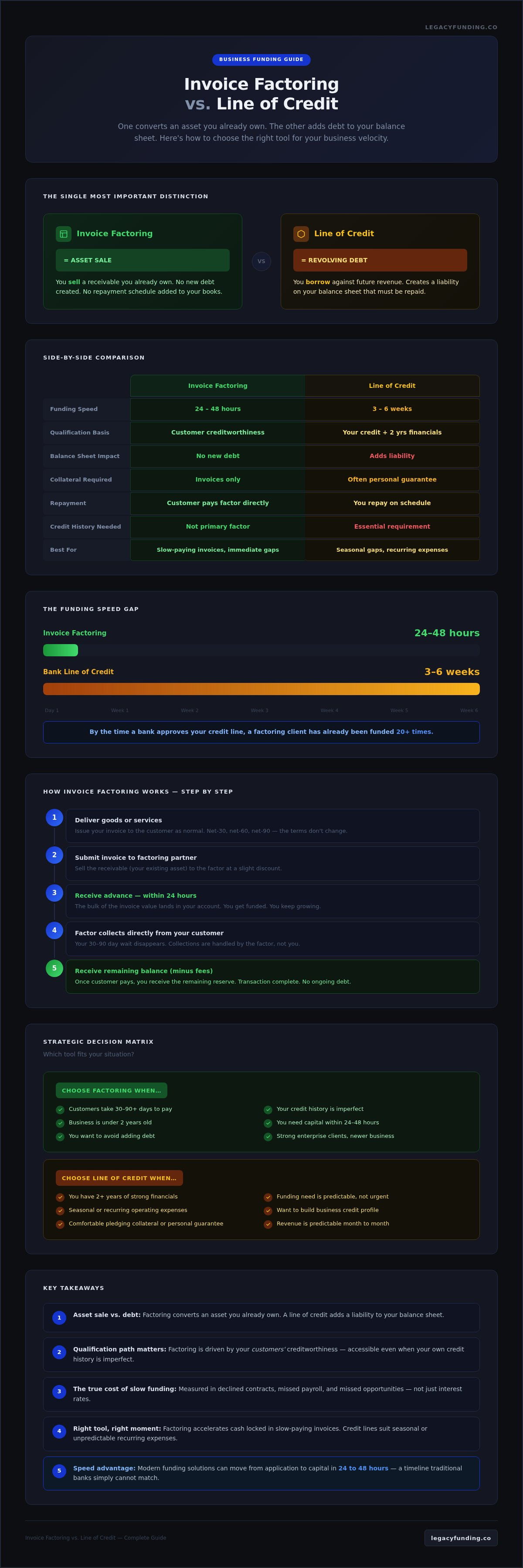
- Understanding the core difference in invoice factoring vs line of credit comes down to one critical distinction: factoring converts an asset you already own, while a line of credit adds debt to your balance sheet.
- Your qualification path matters as much as the funding itself — factoring is driven by your customers' creditworthiness, making it accessible even when your own credit history is imperfect.
- The true cost of slow funding isn't measured in interest rates — it's measured in declined contracts, missed payroll, and growth opportunities that don't wait for bank approvals.
- There is a strategic moment for each tool: factoring accelerates cash flow locked in slow-paying invoices, while a line of credit is better suited for seasonal gaps or unpredictable operating expenses.
- Modern capital solutions like those offered by Legacy Funding Advisors can move from application to funding in 24 to 48 hours — a timeline traditional institutions simply cannot match.
Invoice Factoring vs. Line of Credit: Defining Your Funding Fast Track
Here's the distinction that changes everything: one of these tools sells an asset you already own, and the other adds a liability to your balance sheet. That single difference shapes your cash flow, your creditworthiness, and your ability to move fast when opportunity appears.
Invoice factoring is not a loan. When you factor an invoice, you're selling a receivable, a legally recognized asset, to a third-party funding partner at a slight discount in exchange for immediate cash. No new debt is created. No repayment schedule is added to your books. The transaction is complete the moment your customer pays the factor directly. A business line of credit works differently. It's a revolving credit facility, a predetermined pool of capital that your lender extends based on your creditworthiness, collateral, and financial history. You draw what you need, repay it, and draw again. The flexibility is real, but so is the debt.
Think of it this way: factoring converts the past into present capital. You've already done the work, delivered the goods, issued the invoice. Factoring simply accelerates the collection. A line of credit, by contrast, borrows against your future revenue, requiring your business to generate enough cash flow tomorrow to cover what you're spending today.
This distinction matters enormously for modern small and mid-sized businesses tired of navigating restrictive bank covenants, personal guarantees, and approval timelines that stretch into weeks or months. Traditional lenders evaluate your entire financial history. Factoring partners evaluate the creditworthiness of your customers. That's a fundamentally different qualification conversation.
How Invoice Factoring Unlocks Trapped Revenue
Your unpaid invoices aren't just paperwork. They're capital sitting idle. Invoice factoring converts those receivables into working cash, often within 24 hours of submission. The 30, 60, or 90-day payment cycle your customers operate on stops being your problem. Your factoring partner advances the bulk of the invoice value upfront, then handles collections directly. You get funded. You get time back. You keep growing.
How a Business Line of Credit Provides Scalable Flexibility
A business line of credit gives you on-demand access to capital without reapplying each time you need funds. You pay interest only on what you draw, not the full credit limit. Used consistently and repaid on time, it actively builds your business credit profile, which strengthens your borrowing capacity over time. It's a long-game tool designed for predictable, recurring capital needs rather than immediate cash flow gaps.
Understanding the invoice factoring vs line of credit distinction at this structural level, asset sale versus revolving debt, is the foundation for every smart capital decision that follows.
Direct Comparison: Which Model Fits Your Business Velocity?
Speed isn't just a convenience. For a growing business, it's a competitive advantage. The invoice factoring vs line of credit debate looks very different when you stop comparing fee structures on paper and start measuring how each tool actually performs under real operating conditions.
Start with qualification. A business line of credit runs your credit score, your time in business, your revenue history, and often your personal financials through a full underwriting process. Invoice factoring takes a different path entirely. The underwriting centers on your customers, specifically their payment history and creditworthiness. If you're a newer business, or one that's navigated a rough patch, that distinction is the difference between getting funded and getting declined.
Here's what that looks like in practice. A staffing firm with strong enterprise clients but only 18 months of operating history would likely hit a wall with most bank lenders. That same firm could qualify for invoice factoring because its receivables are backed by creditworthy corporate customers. The business's age becomes irrelevant. The customer's payment reliability becomes everything.
The speed gap is equally significant. Traditional bank lines of credit typically take three to six weeks from application to approval, and that's assuming your documentation is complete. Alternative funding solutions like those offered by Legacy Funding Advisors move from application to funded capital in 24 to 48 hours. When a vendor discount expires in 72 hours or a contract requires immediate mobilization, that timeline isn't a minor advantage. It's the entire game.
Collateral Requirements and Personal Guarantees
Invoice factoring uses the invoice itself as the primary collateral. The receivable is the asset. Nothing more is pledged. A business line of credit frequently requires a blanket lien on business assets, and many lenders attach a personal guarantee, meaning your personal financial exposure is real. Before signing any credit agreement, assess that risk clearly. Pledging personal assets to bridge a short-term cash flow gap is a trade-off that deserves serious scrutiny.
The True Cost of Capital: Fees vs. Interest
A factor rate is the discount taken from the face value of an invoice in exchange for immediate funding. Factoring fees typically range from one to five percent of the invoice value, and the effective cost scales with how long your customer takes to pay. A line of credit charges interest only on drawn balances, but the full cost picture includes origination fees, annual fees, and draw fees that can push the effective APR well above the stated rate.
Neither option is universally cheaper. The right question is which cost structure aligns with your actual cash cycle. If you want to model both scenarios against your specific invoices, connect with a Legacy Funding Advisors specialist for a straightforward, no-pressure comparison built around your numbers.
Strategic Decision Matrix: When to Factor and When to Draw
Choosing between invoice factoring vs line of credit isn't a matter of which option is better in the abstract. It's about which tool fits your specific cash flow pattern right now. Get that match right and capital becomes a growth engine. Get it wrong and you're paying for flexibility you don't need or waiting on approvals for capital you already earned.
The decision framework is simpler than most founders expect. Factor when your growth is being throttled by slow-paying customers you trust. Draw when you're managing predictable, recurring costs against seasonal revenue swings. The trigger isn't the interest rate. It's the nature of the gap.
Here's a practical breakdown of when each tool earns its place:
- Choose factoring when you've landed a large contract, delivered the work, and can't wait 60 to 90 days for payment while your next project needs funding today.
- Choose factoring when you're scaling rapidly and need to convert completed work into capital without adding long-term debt to your balance sheet.
- Choose a line of credit when your business runs lean in Q1 and Q3 but needs consistent payroll coverage regardless of revenue timing.
- Choose a line of credit when an unexpected equipment failure or emergency expense surfaces and you need a fast, pre-approved draw rather than a new application.
The two tools aren't mutually exclusive, either. Sophisticated operators use both: factoring to accelerate receivables during growth sprints, and a revolving credit facility as a backstop for operating expenses that don't tie to specific invoices.
Industry-Specific Use Cases for Factoring
Manufacturing and staffing agencies are built for factoring. Both industries carry large receivable volumes, long payment cycles, and high weekly operating costs, specifically payroll and materials, that can't wait for a net-60 customer to settle up. A staffing agency placing 200 contractors doesn't have the luxury of a six-week bank approval window. It needs Friday's payroll funded now. Factoring delivers that without requiring an in-house credit department to chase collections. The factor handles it. The business keeps moving. Newer companies in these sectors also gain a distinct advantage: their qualification is anchored to their customers' creditworthiness, not their own limited operating history.
Strategic Advantages of Revolving Credit
A business line of credit earns its value in three specific scenarios: maintaining a liquidity buffer for unpredictable expenses, capturing supplier discounts that require bulk purchasing power, and supporting inventory or equipment investments that generate returns over time rather than immediately. It's a long-game asset. Used consistently and repaid on schedule, it builds the credit profile that opens larger facilities down the road. That compounding effect is real, but only if the draw is disciplined and the repayment is reliable.
The strategic question isn't which tool costs less on paper. It's which one removes the specific friction standing between your business and its next stage of growth.
Overcoming the #1 Objection: Is Factoring Too Expensive?
Cost is the first objection. It's rarely the right one. When founders hear that factoring fees run one to five percent of invoice value, the instinct is to compare that number against a bank's stated interest rate and declare factoring the loser. That comparison ignores the most expensive line item on your P&L: the revenue you never captured because your capital was too slow.
Factoring isn't a last resort. It's a precision tool. The businesses that use it strategically aren't paying a penalty for poor credit. They're buying speed, and speed has a measurable return.
There's also a supplier angle that rarely gets discussed. Many vendors offer early payment discounts, typically two percent for payment within ten days versus net-30 terms. Factor your receivables, pay suppliers early, and that discount offsets a meaningful portion of your factoring fee. The math often works in your favor before you've even counted the growth upside.
One more cost to price in: the hidden cost of waiting. A traditional bank rejection doesn't arrive instantly. It arrives 30 days after you submitted your application, assembled your documents, and held your breath. That month isn't free. It costs you payroll flexibility, vendor relationships, and contracts that moved on to a competitor who could mobilize faster. In the invoice factoring vs line of credit comparison, that waiting period is a real expense that never shows up on a fee schedule.
Demand transparency from any funding partner. Ask specifically about maintenance fees, lockbox fees, and minimum volume requirements. Reputable factoring partners make their fee structure simple and visible. If a contract requires three readings and a spreadsheet to decode, that's a signal worth heeding.
Calculating the Opportunity Cost of Capital
Opportunity cost is the profit you forfeit by choosing one path over another. For a growing SMB, it's the single most underestimated number in the business. Consider this: a factoring fee on a large invoice secures the working capital needed to accept a new contract with a $50,000 profit margin. The fee isn't a cost. It's a $50,000 unlock. Contrast that with waiting weeks for a bank decision that may end in a decline, and the math becomes unavoidable. Capital that arrives after the opportunity has closed costs everything.
Debt vs. Dilution: Why Factoring Beats Giving Up Equity
When cash is tight, some founders consider equity financing, trading ownership for capital. Factoring eliminates that trade-off entirely. You retain 100 percent of your business while accessing immediate working capital. No equity partners. No board seats. No long-term claim on your upside. In the invoice factoring vs line of credit debate, factoring stands apart as the only tool that fuels expansion without adding debt to your balance sheet or diluting the ownership you've built.
If you want a straight, honest look at what factoring would actually cost against your specific invoices, connect with a Legacy Funding Advisors specialist and get a clear comparison built around your numbers, not industry averages.
Legacy Funding: The Modern Alternative to Slow Financial Institutions
Traditional banks weren't built for the speed of modern commerce. Their approval timelines, documentation requirements, and credit-first underwriting models reflect an era when businesses could afford to wait. Most can't. Legacy Funding Advisors was built around a different premise: that capital should move as fast as the opportunities it's meant to capture.
The invoice factoring vs line of credit decision matters far less if the institution you're working with takes six weeks to process either one. Speed is the differentiator. Legacy Funding Advisors moves from application to funded capital in 24 to 48 hours, not as a marketing promise, but as a structural feature of how the process is designed.
The qualification model reflects that same philosophy. Where traditional lenders scrutinize years of tax returns and balance sheets, Legacy Funding Advisors evaluates your current cash flow. Recent bank statements tell the real story of how your business operates today. Past setbacks don't automatically close the door. What your business is doing right now does.
The 24-Hour Approval Blueprint
The application process strips away the friction that slows most funding decisions. Documentation requirements center on recent bank statements rather than exhaustive financial histories. A streamlined digital portal keeps the process moving without back-and-forth delays. Submit today. Get a decision today. Get funded tomorrow. That's the rhythm the process is built around, and it's a direct answer to the approval timelines that traditional institutions can't match.
Tailored Capital for Every Stage of Growth
No two businesses have identical capital needs, and a single product rarely fits every growth stage. Legacy Funding Advisors offers a full suite of solutions designed to meet businesses where they are:
- Revenue-Based Financing for businesses with consistent revenue but limited collateral
- Merchant Cash Advances for fast, flexible capital tied to future receivables
- Business Lines of Credit for revolving access to operating capital
- Working Capital Loans and SBA support for businesses ready to scale with structured financing
- Invoice Factoring, Equipment Financing, and Term Loans matched to specific operational needs
Coverage extends nationally across the US, Canada, and Puerto Rico. The goal isn't a single transaction. It's a long-term partnership built around your business's growth trajectory and the generational impact you're working to create.
The right capital, structured correctly, doesn't just solve today's cash flow problem. It builds the foundation for what comes next. Secure your business funding in 24 hours with Legacy Funding Advisors and find out exactly which solution fits where your business is headed.
Your Next Move Is Already Funded
The invoice factoring vs line of credit decision comes down to one honest question: what kind of gap are you actually trying to close? If slow-paying customers are throttling growth you've already earned, factoring converts those receivables into working capital today. If you need a flexible buffer for predictable operating costs, a revolving credit line earns its place. The smartest operators don't pick sides; they match the tool to the moment.
What shouldn't slow you down is the funding process itself. Legacy Funding Advisors approves and funds businesses in 24 to 48 hours, using a simple, cash-flow-based review that works for businesses across the US and Canada, regardless of credit history.
You've already done the work. You've already delivered. The capital to keep growing shouldn't be sitting in a bank's approval queue for weeks.
Connect with a Legacy Funding Advisors specialist today and get a clear, no-pressure look at exactly which solution fits your business right now. Growth doesn't wait, and neither should you.
Frequently Asked Questions: Invoice Factoring vs. Line of Credit
Is invoice factoring considered a loan?
No. Invoice factoring is not a loan. It's the sale of a receivable asset you already own. When you factor an invoice, you're transferring ownership of that invoice to a funding partner in exchange for immediate cash, typically a percentage of the invoice's face value. No debt is created, no repayment schedule is attached, and nothing new appears as a liability on your balance sheet.
This distinction matters practically, not just technically. Because factoring doesn't add debt, it doesn't affect your debt-to-income ratio or trigger loan covenants. For businesses managing existing credit facilities, that separation can be strategically valuable.
Can I have both an invoice factoring facility and a business line of credit?
Yes, and many growth-stage businesses use both simultaneously. Factoring handles the receivables side, converting completed work into immediate capital. A revolving credit line covers predictable operating expenses that don't tie to specific invoices, like payroll, rent, or recurring software costs. The two tools solve different problems and don't inherently conflict with each other.
The main consideration is your factoring agreement's terms. Some factoring contracts include a first-lien position on receivables, which could affect how a lender structures a concurrent credit facility. Review both agreements carefully, and ask each funding partner directly about compatibility before signing.
What is the minimum credit score required for a line of credit in 2026?
Requirements vary significantly by lender type. Traditional bank lines of credit typically look for business credit scores above 680, along with two or more years of operating history and documented revenue. Alternative lenders generally apply more flexible thresholds, with some approving applicants in the 580 to 620 range when cash flow and revenue trends are strong.
The more important takeaway in the invoice factoring vs line of credit comparison is that factoring sidesteps the credit score question almost entirely. Qualification is driven by your customers' creditworthiness, not yours. If your credit profile is imperfect but your clients are reliable payers, factoring is often the faster, more accessible path.
How quickly can I get funded through invoice factoring vs. a bank?
The gap is substantial. Traditional bank lines of credit typically take three to six weeks from application to approval, assuming complete documentation and no underwriting complications. Invoice factoring through a modern funding partner moves considerably faster. Legacy Funding Advisors, for example, moves from application to funded capital in 24 to 48 hours, built around a streamlined process that evaluates current cash flow rather than years of financial history.
For businesses responding to time-sensitive contracts, vendor deadlines, or payroll obligations, that speed difference isn't a minor convenience. It's often the deciding factor between capturing an opportunity and watching it close.
Does invoice factoring notify my customers that I am selling their invoices?
It depends on the type of factoring arrangement. Notification factoring, the most common structure, does inform your customers that their invoice has been assigned to a factor and that payment should be directed to the factoring company. Non-notification factoring keeps the arrangement private, with payments still flowing through your business accounts, though this structure is less common and typically carries different fee terms.
For most B2B businesses, customer notification isn't the relationship issue founders fear. Invoice factoring is a standard, widely understood practice in industries like staffing, manufacturing, and logistics. Discussing it transparently with key clients often generates less friction than expected.
What are the typical fees for invoice factoring compared to interest rates on a line of credit?
Factoring fees are typically expressed as a percentage of the invoice face value rather than an annual interest rate. Rates generally range from one to five percent of the invoice amount, with the actual cost depending on your customer's payment speed, invoice volume, and the specific agreement terms. The longer a customer takes to pay, the more time-based fees can accumulate.
Business lines of credit charge interest only on drawn balances, but the full cost picture includes origination fees, annual maintenance fees, and sometimes draw fees that raise the effective rate above the headline number. Neither structure is universally cheaper. The right comparison is always built around your specific invoice volumes, payment cycles, and how frequently you'd draw on a credit line. A Legacy Funding Advisors specialist can model both scenarios against your actual numbers.
Will a line of credit help me build my business credit score?
Yes, if it's managed consistently. A business line of credit that's drawn responsibly and repaid on schedule gets reported to business credit bureaus, which strengthens your credit profile over time. That compounding effect is one of the genuine long-term advantages of revolving credit over other funding tools. The caveat is discipline: late payments or maxed-out utilization can damage the same score you're trying to build.
Invoice factoring doesn't directly build business credit in the same way, since it's an asset sale rather than a credit product. But it frees up cash flow that lets you pay existing obligations on time, which indirectly supports a healthier credit profile.
What happens if my customer doesn't pay an invoice I've already factored?
The answer depends on whether your factoring agreement is recourse or non-recourse. Under recourse factoring, if your customer fails to pay within the agreed window, the unpaid amount is charged back to your business. You're responsible for repurchasing the invoice or covering the shortfall. This is the more common structure and typically comes with lower fees.
Non-recourse factoring transfers the credit risk to the factor if your customer becomes insolvent or bankrupt. It doesn't protect against payment disputes or invoice rejections, which are often excluded from coverage. Before signing any factoring agreement, confirm exactly which non-payment scenarios are covered and which remain your responsibility. Reputable partners make this language clear upfront.