


Invoice Factoring vs. Business Line of Credit: Choosing Your Growth Engine in 2026
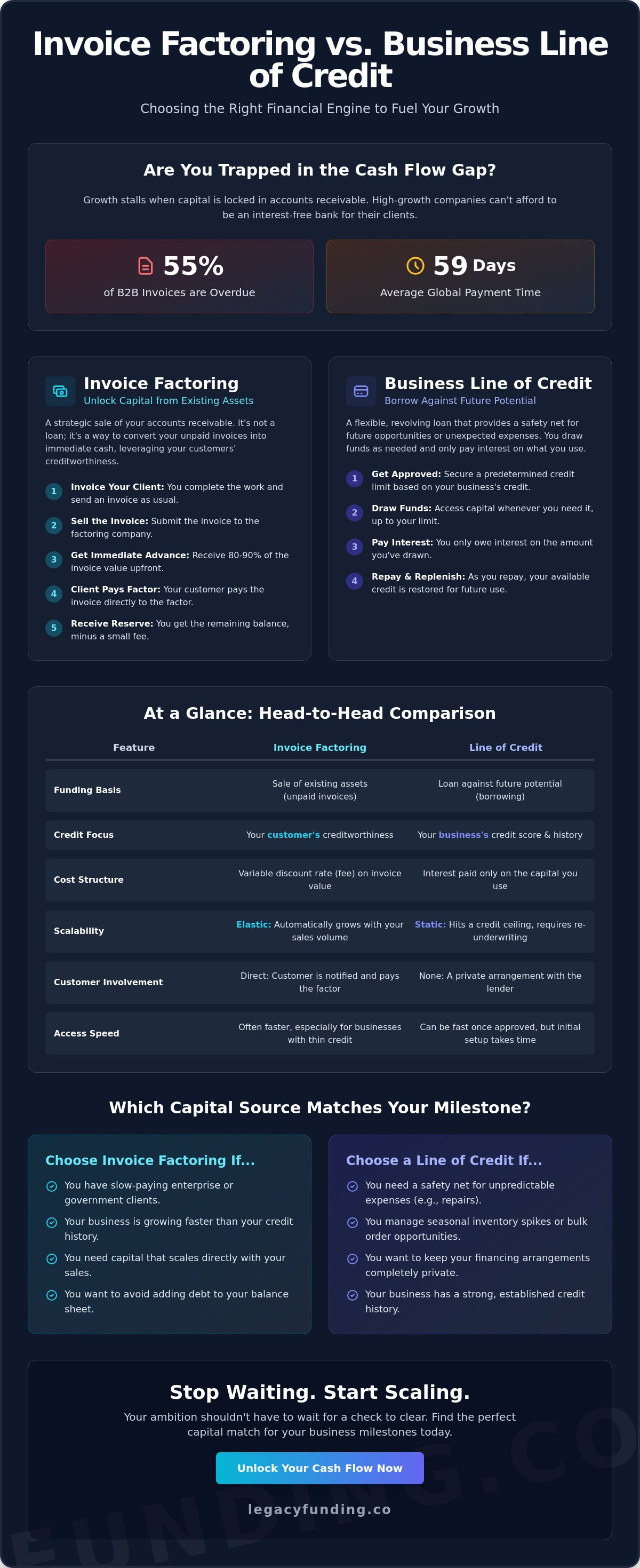
With 55% of B2B invoices currently overdue, are you running a high-growth company or an interest-free bank for your clients? It is a brutal reality when the average global payment takes 59 days to arrive. You shouldn't have to miss out on bulk inventory discounts or delay a critical hire just because capital is locked in your accounts receivable. Understanding the nuances of invoice factoring vs business line of credit is the first step toward reclaiming your momentum. You need a financial engine that moves as fast as your ambition.
You have worked hard to build a reputation and a loyal client list. You deserve a partner that values your potential over old-school bureaucratic hurdles. We will show you how to unlock the fastest path to scaling by comparing these two powerful funding tools. This guide breaks down the real-world costs, the shifting risk profiles of 2026, and the strategic advantages of each model. Stop waiting for permission to grow. Learn which engine will drive your business to its next milestone. Secure your cash flow, optimize your operations, and fund your future today.
Key Takeaways
- Determine if your growth requires unlocking capital from existing invoices or borrowing against future potential to bridge the cash flow gap.
- Understand how to leverage your customers' credit strength to secure funding, even if your own business credit is still developing.
- Evaluate the cost impact of invoice factoring vs business line of credit by comparing variable discount rates to fixed interest structures.
- Identify the perfect capital match for your business milestones, whether you are managing seasonal inventory or scaling with slow-paying enterprise clients.
- Learn how modern alternatives like Revenue-Based Financing provide a flexible bridge between traditional debt and rapid expansion.
The Cash Flow Crossroads: Why Timing Dictates Your Funding Choice
Growth doesn't happen in a vacuum; it happens in the gaps between your effort and your reward. The "Cash Flow Gap" is the silent killer of ambitious firms. It is the distance between the day you deliver a service and the day the check clears. In the high-velocity market of 2026, speed is the ultimate competitive advantage. You cannot afford to wait 60 days for capital you have already earned. This is where the debate of invoice factoring vs business line of credit begins. One is a strategic sale of your existing assets. The other is a flexible reservoir of future potential.
Choosing the right engine depends on your timing. Stop acting like an interest-free bank for your clients. If you are sitting on a pile of unpaid invoices, you are stalling your own expansion. Invoice factoring allows you to sell those receivables for immediate liquidity. Conversely, a business line of credit provides a revolving safety net for future opportunities or unexpected hurdles. Both solve the cash flow crisis, but they do so using entirely different financial architectures. Evaluate the long-term impact of invoice factoring vs business line of credit before committing to a single path.
The Anatomy of Invoice Factoring
Factoring is not a loan. It is a purchase of your accounts receivable. This three-party agreement involves you, your customer, and the factoring company. When you factor an invoice, you receive an "advance rate," typically between 80% and 90% of the total value. The remaining balance is held in a "reserve account" until your customer pays. Once the invoice is settled, you receive the reserve, minus a small fee. Understanding the mechanics of factoring is vital because it shifts the focus from your credit score to the creditworthiness of your clients. It turns your balance sheet into a liquid growth engine without adding new debt to your books.
The Architecture of a Business Line of Credit
A business line of credit operates with a different logic. It is a revolving facility that gives you access to a predetermined credit limit. You draw what you need, repay it, and the funds become available again. You only pay interest on the capital you actually use. This makes it an ideal tool for unpredictable expenses like emergency payroll, seasonal inventory spikes, or equipment repairs. It offers a level of control and discretion that factoring cannot match. You decide when to tap into the funds without involving your customers in the transaction. It is a tool for the proactive founder who wants a safety net ready before the next big opportunity arrives.
The Mechanics of Capital: How Factoring and Lines of Credit Move Your Money
Speed is the currency of modern commerce. While both tools bridge the cash flow gap, they move money through your business at different velocities. Factoring often clears the path faster for founders with thin credit profiles or high growth rates. This is because the funding source prioritizes your customers' payment history over your own balance sheet. When comparing funding options, you must look at scalability. Factoring is elastic. As your sales volume expands, your access to capital grows automatically. A line of credit is static. You eventually hit a credit ceiling that requires a manual increase and a new round of underwriting.
The "control" factor also separates these two engines. In the invoice factoring vs business line of credit debate, transparency is key. Factoring involves your customers directly, as they redirect payments to the funding partner. A line of credit remains a private arrangement between you and the lender. This distinction dictates how you manage your professional relationships. If you want to keep your financing behind the scenes, the line of credit offers that discretion. If you prefer to outsource the administrative burden of collections, factoring provides a built-in accounts receivable team. If you are ready to explore which structure fits your workflow, connect with our team for a tailored analysis.
The Factoring Workflow: From Invoice to Deposit
The process starts the moment you generate an invoice for completed work. The factor verifies the invoice and transfers an initial advance, usually 80% to 90% of the total value, into your account. A "Notice of Assignment" is sent to your customer, instructing them to pay the factor directly. This is a standard professional procedure in industries like logistics and manufacturing. Once your customer pays the full amount, the factor releases the remaining "reserve" to you, minus a small service fee. It is a complete settlement of that specific asset.
Managing a Line of Credit: Drawdowns and Repayment
Managing a line of credit feels more like using a high-limit business card. You access funds on-demand via a digital dashboard or a linked account. You draw only what you need to cover immediate costs like payroll or inventory. Repayment structures vary, typically requiring weekly or monthly installments. Some lenders may require a "resting" period, where you bring the balance to zero for a short time. This proves your business can operate independently of the credit line and maintains your standing for future draws.
Side-by-Side Comparison: Cost, Control, and Credit Impact
Numbers define your trajectory. In the battle of invoice factoring vs business line of credit, the primary difference lies in how you treat your balance sheet. Factoring is an asset conversion; you are simply accelerating a payment you've already earned. A line of credit is a liability; you are creating a debt that must be serviced. This choice affects your ability to secure future funding and your overall financial flexibility. If you plan to sell your company or seek venture capital, an asset-light balance sheet is often more attractive than one weighed down by revolving debt.
The True Cost of Capital
Factoring costs are usually expressed as "factor rates" or discount fees. These fees are deducted directly from the invoice total. While a 3% fee sounds negligible, it can represent a higher effective cost than traditional debt if your turnover is rapid. A line of credit typically involves an APR, origination fees, and ongoing maintenance charges. You must calculate the "all-in" cost of each. Factoring is often more expensive but more accessible, while a line of credit offers lower rates for those with established credit histories. For many, the higher cost of factoring is a fair trade for the lack of debt and the speed of approval.
Impact on Your Business Credit and Reputation
Using working capital solutions like factoring can actually strengthen your credit score. It gives you the cash to pay suppliers early, which improves your trade references and helps you secure better terms from vendors. Conversely, a line of credit requires careful management. High utilization rates can negatively impact your credit score, making you appear overextended to other lenders. You must also consider the "social" cost. In 2026, most enterprise clients view factoring as a sophisticated cash flow strategy. It's no longer the red flag it once was. It shows you're actively managing your liquidity to support their projects.
Collateral and Risk
Factoring is primarily secured by the invoices themselves. A line of credit often demands more. You may need to provide a personal guarantee or a blanket lien on all business equipment and assets. This puts your personal wealth at risk if the business hits a snag. Factoring keeps the risk contained to the specific transaction. It allows you to scale without betting the entire farm on a single line of credit. It's the difference between selling a product and signing a mortgage. Choose the path that protects your legacy while fueling your growth.
The Strategic Decision Matrix: Which Capital Source Matches Your Milestone?
Choosing between invoice factoring vs business line of credit is not about finding a "better" product. It is about matching the right financial tool to your specific business milestone. Your capital needs change as you scale. A startup chasing its first enterprise contract requires a different engine than an established firm preparing for a seasonal peak. Every dollar you deploy should have a clear purpose and a measurable return. Do not pick a funding source based on habit. Pick it based on your next move.
If you are experiencing a surge in sales but your cash is trapped in a 59-day payment cycle, you are in the "Payroll Trap." Your success is actually starving your operations. In this scenario, factoring is the clear winner. It provides immediate liquidity based on your sales volume. If you are a newer business with strong contracts but a limited credit history, factoring allows you to leverage your customers' reputation to fund your own. It bypasses the traditional credit hurdles that stop most founders in their tracks.
A business line of credit serves a different strategic purpose. It is the ideal "Safety Net" for an established company with predictable cash flow. Use it to handle an "Inventory Spike" or an emergency equipment repair. If you can buy bulk materials at a 10% discount by paying upfront, the interest on a line of credit is a small price to pay for the increased margin. It offers the discretion and flexibility that high-level founders demand. Ready to fuel your next milestone? Apply for a customized funding strategy and stop leaving your growth to chance.
Scenario-Based Funding: Matching Tool to Task
Focus on the opportunity cost of your capital. If the cost of a missed deal is higher than the cost of funding, you must move fast. Factoring is a lifesaver for service-based businesses where payroll cannot wait for a slow-paying client. It turns your accounts receivable into a revolving door of cash. Use a line of credit when you need to bridge a gap that isn't tied to a specific invoice. It is your best defense against the unexpected, from sudden tax liabilities to vital infrastructure upgrades. Manage your cash, don't let it manage you.
The Founders Checklist: 5 Questions to Ask Before Signing
- Is my cash flow problem caused by sales volume or payment timing? If you have the sales but not the cash, factor. If you lack the sales, seek a line of credit.
- How much control am I willing to cede over my AR process? Factoring involves your clients; a line of credit is private.
- Does my business have the credit profile to secure a competitive LOC? Be honest about your score and your history.
- What is the specific ROI on the funds I am about to draw? Never borrow or sell assets without a plan for that capital.
- Can my current infrastructure handle the reporting requirements? Ensure your team is ready for the administrative side of the invoice factoring vs business line of credit choice.
Scaling with Confidence: Why Legacy Funding Advisors is Your Modern Financial Ally
Traditional institutions move at the speed of bureaucracy. In the modern economy, slow capital is dead capital. You can't afford to wait weeks for a committee to review your potential while your competitors seize the market. Legacy Funding Advisors acts as the bridge between time-tested financial tools and the rapid speed of contemporary commerce. We don't just see a three-digit credit score. We see your cash flow, your client list, and your trajectory. Whether you are weighing invoice factoring vs business line of credit or seeking a more bespoke solution, you need a partner that understands the high stakes of entrepreneurship.
Our approach is built on transparency and momentum. We recognize that your business is a generational endeavor, not a series of isolated transactions. By focusing on growth metrics rather than just financial obligations, we provide the liquidity you need to outpace the competition. Most traditional lenders are stuck in the past. Legacy Funding Advisors provides a 24-48 hour funding window because we know that opportunity doesn't wait for a bank to open its doors. Secure your future with capital that matches your ambition and respects your time. We are here to remove the friction from your financial life.
Beyond Factoring: The Power of Revenue-Based Financing
Sometimes the choice of invoice factoring vs business line of credit doesn't perfectly fit your specific business model. This is where Revenue-Based Financing (RBF) changes the game. RBF offers the immediate speed of factoring with the flexible repayment structure of a line of credit. It is often the superior choice for high-velocity SMBs that need to scale without the rigid constraints of traditional debt. At Legacy Funding Advisors, we tailor these solutions to your specific industry. We ensure your capital structure supports your expansion rather than hindering it. It is about providing the right tool for the right milestone at the right time.
Secure Your Legacy: The Impact of Smart Capital
Funding is more than a deposit; it is a commitment to your long-term impact. We have removed the bureaucratic hurdles that slow down most founders. Our process is streamlined, efficient, and designed for results. You have worked too hard to let a temporary lack of resources cap your potential. Take control of your financial independence and build a business that lasts for decades. Ready to fuel your next growth phase? Apply for funding in minutes. Stop settling for legacy limitations. Start building your modern legacy today. Your growth engine is ready; you just need to turn the key.
Fuel Your Business Evolution Today
Success in 2026 requires more than hard work; it requires a strategic alignment of your capital. You now understand that the choice of invoice factoring vs business line of credit is a decision between immediate asset liquidity and revolving flexibility. One clears the path for rapid sales expansion while the other provides a vital safety net for operational shifts. Stop allowing slow-paying clients to dictate your pace. Your growth belongs to you, not your accounts receivable ledger.
Legacy Funding Advisors provides the modern alternative to traditional roadblocks. We prioritize your cash flow and potential over rigid, outdated metrics. Our process delivers results with funding in 24-48 hours and cash-flow focused approvals that ignore traditional bureaucratic hurdles. It's time to build your generational impact with a partner that moves at the speed of your ambition. Empower your business with fast, flexible funding from Legacy Funding Advisors today. Your next milestone is waiting. Take the first step and secure the capital your vision deserves.
Frequently Asked Questions
What is the main difference between invoice factoring and a business line of credit?
The primary distinction lies in the nature of the capital; factoring is an asset sale while a line of credit is a debt liability. When you factor, you sell your accounts receivable to a third party to gain immediate liquidity. A business line of credit is a revolving loan that you draw from and repay with interest. Factoring depends on your customers' creditworthiness, whereas a line of credit relies on your own business credit score and financial history.
Is invoice factoring considered debt on my business balance sheet?
No, invoice factoring is not classified as debt because it is the purchase of an asset. Since you are selling your receivables rather than borrowing against them, the transaction does not appear as a loan on your balance sheet. This keep your debt-to-equity ratio clean, which is a major advantage for founders who want to maintain a strong financial profile for future equity investors or traditional lenders.
Which is cheaper: factoring invoices or a business line of credit?
A business line of credit typically offers a lower annualized percentage rate (APR) for established businesses with excellent credit scores. Factoring fees usually range from 1% to 5% per month, which can result in a higher effective cost. However, you must weigh the price against the value of outsourced collections and the speed of access. For many high-growth firms, the cost of invoice factoring vs business line of credit is secondary to the speed of the capital.
Can I have both an invoice factoring agreement and a business line of credit at the same time?
Yes, you can utilize both, but it requires a formal intercreditor agreement between the two lenders. Most line of credit providers take a blanket lien on all business assets, including your accounts receivable. To factor invoices simultaneously, the bank must agree to subordinate its interest in those specific receivables to the factoring company. This setup is common for complex, fast-growing enterprises that need multiple layers of liquidity to fuel expansion.
Will my customers know if I am using an invoice factoring service?
Yes, your customers will be notified because they must redirect their payments to the factoring company. This is handled through a standard "Notice of Assignment" sent to their accounts payable department. In 2026, this is a recognized and professional business practice used by thousands of companies across logistics, manufacturing, and staffing. It signals that your business is proactively managing its cash flow to ensure consistent service delivery and operational stability.
How quickly can I get funds from a business line of credit compared to factoring?
Factoring typically provides faster initial access to capital, often within 24 to 48 hours of verification. Setting up a traditional business line of credit can take several weeks due to rigorous bank underwriting and documentation requirements. Once a line is established, you can draw funds almost instantly. However, for a business needing immediate relief from the 59-day average global payment delay, factoring is the more responsive engine for rapid liquidity.
Does invoice factoring require a personal guarantee?
Factoring often does not require a personal guarantee, especially in non-recourse agreements where the factor assumes the risk of customer insolvency. Because the funding is secured by the value of the invoice itself, the lender focuses on the asset rather than your personal wealth. In contrast, a business line of credit almost always requires a personal guarantee from the business owners. This makes factoring a lower-risk option for founders who want to protect their personal assets.
What happens if my customer doesn’t pay the factored invoice?
The outcome depends on whether your agreement is recourse or non-recourse. In a recourse agreement, which accounts for 80% of the U.S. market, you must buy back the invoice or swap it for a fresh one if the customer fails to pay. In a non-recourse agreement, the factoring company absorbs the loss if the non-payment is due to the customer’s financial insolvency. Always clarify these terms to understand your liability when evaluating invoice factoring vs business line of credit.