


How to Prepare a Business Loan Proposal: The 2026 Guide to Fast Funding
The 40-page business plan is officially dead. In 2026, modern funding isn't about traditional fluff; it's about proving your revenue momentum to lenders who move as fast as you do. Understanding how to prepare a business loan proposal in this new landscape is the difference between stagnant growth and immediate expansion. You likely know the frustration of waiting weeks for big banks to scrutinize a credit score while they ignore your actual business potential. It's time to stop jumping through bureaucratic hoops and start using a system designed for the modern founder.
We'll show you how to cut through the noise and position your company as a high-growth asset. You deserve a financial partner that values your results over your paperwork. By mastering this streamlined approach, you can move from a stack of documents to a funding approval within 48 hours. This guide previews the essential metrics lenders crave, the simplified documentation requirements of the current landscape, and the specific steps to secure capital that scales directly with your revenue. Let's build the foundation for your next stage of growth and secure the capital you need to lead your industry.
Key Takeaways
- Shift your focus from long-form business plans to a data-driven narrative that highlights your revenue momentum and financial health.
- Master how to prepare a business loan proposal that emphasizes consistent cash flow to secure approvals even without a perfect credit score.
- Craft a high-impact, one-page executive summary designed to capture immediate attention from modern alternative lenders.
- Use our 24-hour checklist to aggregate essential bank statements and financial reports for a streamlined, approval-ready funding package.
- Position your business to bypass traditional banking bureaucracy and access capital that scales directly with your monthly revenue.
What Is a Business Loan Proposal and Why Does It Matter in 2026?
A business loan proposal is your strategic narrative. It translates your company's financial health into a language lenders understand. In 2026, this document is no longer a 40-page creative writing project. It's a precise, data-backed proof of concept. Modern lenders have replaced long-form prose with real-time revenue metrics. They want to see where you are today, not where you hope to be in five years. Your proposal acts as a bridge between your current operations and your future scaling goals.
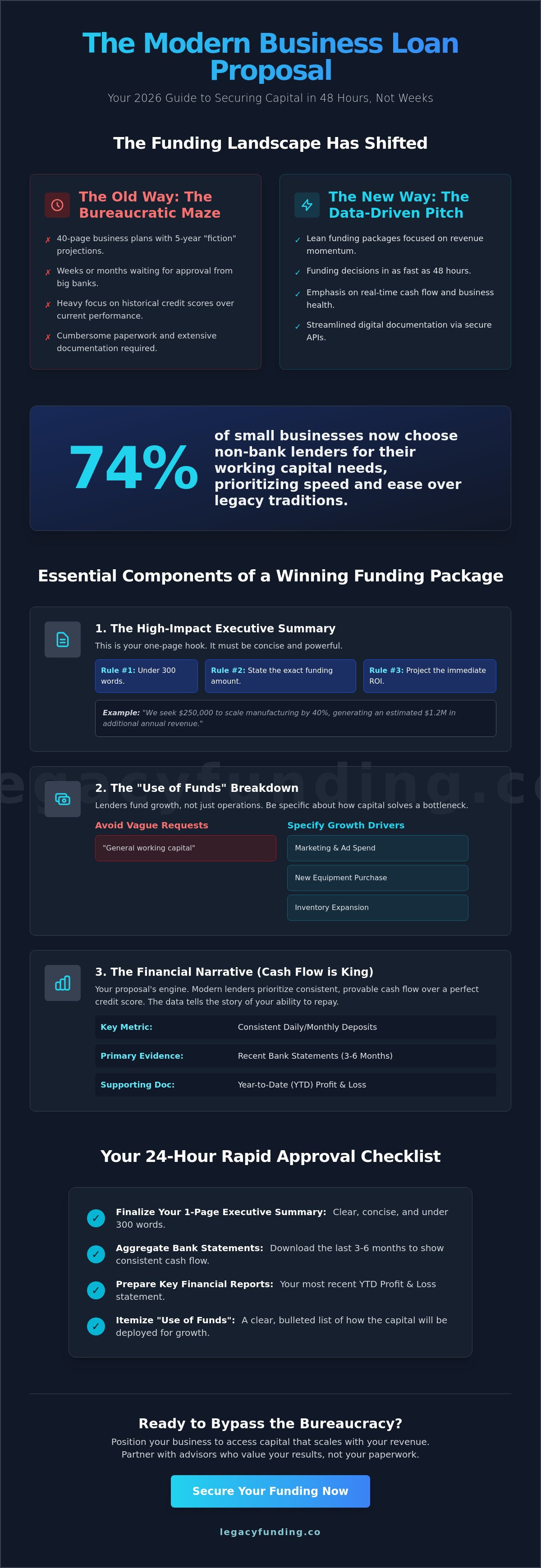
Learning how to prepare a business loan proposal that hits these marks is critical for speed. Industry data indicates that 74% of small businesses now choose non-bank lenders for their working capital needs. These founders prioritize speed and ease over legacy institution traditions. A well-constructed package reduces perceived risk immediately. It tells the lender you're a sophisticated operator who understands your numbers. When the data is clean and the story is clear, you accelerate the approval clock. You move from "under review" to "funded" while your competitors are still fixing typos in their table of contents.
The Shift from Business Plans to Funding Packages
Traditional 5-year projections are largely viewed as fiction by modern fintech firms. The 2026 lending environment favors digital integration. Lenders now use secure APIs to view your actual bank activity and cash flow patterns. This real-time visibility has turned the static business plan into a living funding package. At Legacy Funding Advisors, we prioritize your current momentum over historical perfection. We look at your recent revenue as a more accurate predictor of success than a decade-old credit score. This shift allows us to provide capital that matches the actual pace of your operations without the bureaucratic weight of the past.
Traditional vs. Alternative Proposals
Your choice of format depends on your specific goals. A traditional Business loan request for an SBA 7(a) loan still requires extensive documentation. You'll need personal financial statements, tax returns, and detailed ownership records. This is a slow-burn process designed for long-term debt. Conversely, alternative lenders utilize a "Speed-First" model. This is ideal for revenue-based financing or Merchant Cash Advances. These proposals focus on your daily or monthly deposit volume. They require minimal paperwork and prioritize rapid access to working capital. Identifying how to prepare a business loan proposal for the right lender ensures you don't waste time on requirements that don't apply to your funding needs.
Essential Components of a Winning Funding Package
Winning proposals are lean, punchy, and aggressive. They skip the fluff found in traditional bank applications. When you learn how to prepare a business loan proposal for a 2026 lender, you focus on four pillars: the hook, the story, the logic, and the legality. Modern lenders process thousands of applications monthly. They don't want a novel; they want a high-level briefing that proves your business is a safe bet for rapid expansion. This package isn't just a list of requests. It's a professional presentation of your company's trajectory and your ability to manage capital effectively.
Crafting the Executive Summary
Your executive summary is the most critical page. It must be under 300 words. Start with a single sentence defining your unique value proposition and growth trajectory. State the exact funding amount you need and project the ROI. For example: "We are seeking $250,000 to scale our manufacturing output by 40%, generating an estimated $1.2M in additional annual revenue." This clarity respects the lender's time and signals professional competence. If you can't summarize your needs in three paragraphs, you aren't ready to borrow.
The "Use of Funds" Breakdown
Lenders hate vague requests. Avoid terms like "general working capital" whenever possible. Instead, categorize expenses into growth-drivers versus operations. Marketing, new equipment, and inventory are growth-drivers. Payroll and rent are operations. Explain how this capital infusion solves a specific bottleneck. If you need Equipment Financing to double production, lead with that fact. If you're unsure how to categorize your specific needs, you can consult with our funding team to refine your strategy before submitting.
The financial narrative moves beyond the balance sheet to tell a story of growth. Highlight your Year-to-Date (YTD) profit and loss statements. Show how your cash flow comfortably covers potential debt service. In the 2026 landscape, lenders also look for compliance with recent regulations. Ensure your proposal reflects the Corporate Transparency Act requirements. You'll need to be prepared to report individuals who own 25% or more of the company to FinCEN. For those seeking SBA 7(a) loans, remember that as of March 1, 2026, businesses must be 100% owned by U.S. citizens. Including these details upfront shows you've done your homework. It reduces the friction of the underwriting process and positions you as a savvy, low-risk partner. Mastering how to prepare a business loan proposal means anticipating these requirements before they become hurdles.
Prioritizing Cash Flow: The Engine of Your Proposal
The biggest myth in commercial lending is that a perfect credit score is the only gateway to capital. While traditional institutions obsess over your personal history, modern alternative lenders care about your business's current performance. Understanding how to prepare a business loan proposal in 2026 requires a shift in focus. You must position your cash flow as the primary engine of your request. Revenue consistency proves you can handle debt service today. It shows you have the liquidity to manage daily operations while scaling. If your bank statements show steady, predictable deposits, your credit score becomes a secondary detail.
Lenders use your Debt-to-Income (DTI) ratio to gauge risk. They want to see that your monthly revenue comfortably outpaces your existing obligations. High-growth companies often prioritize expansion over immediate net profit. This is a common strategy in the tech and service sectors. Your proposal should highlight your ability to generate cash, even if your bottom line is temporarily suppressed by aggressive reinvestment. We look for a healthy coverage ratio where your available cash easily absorbs new payment obligations without straining your daily operations.
Proving Revenue Momentum
Your primary evidence consists of the last 3 to 6 months of business bank statements. These documents provide a transparent view of your revenue momentum. Don't hide seasonal trends. Instead, highlight them and explain how you manage your cash cushion during slower periods. Showcase customer diversity to prove you aren't reliant on a single contract. A broad client base reduces revenue-concentration risk. This diversity makes your proposal significantly more attractive to underwriters who fear the loss of a major client could sink your ability to repay.
Why Cash Flow Is the New Credit
This is the core logic behind Revenue-Based Financing and Merchant Cash Advances. These products are designed for the speed of modern commerce. At Legacy Funding Advisors, we look at the pulse of your business rather than just a static credit score. We value your daily deposit volume and transaction history. Before you submit, clean up your bank statements. Avoid overdrafts and non-sufficient funds (NSF) notices at all costs. Keep your personal and business expenses strictly separate. This level of organization demonstrates professional discipline. It makes the decision easy for the lender. Mastering how to prepare a business loan proposal means proving that your business is a high-velocity revenue machine capable of supporting immediate capital infusion.
The 24-Hour Preparation Checklist for Rapid Approval
Speed is your greatest asset. While legacy institutions provide week-long timelines for preparation, modern funding requires a 24-hour mentality. Mastering how to prepare a business loan proposal means having your digital house in order before you even open an application. This checklist removes the guesswork and positions you for a decision in hours, not weeks. Stop waiting for permission to grow. Follow these five steps to build an approval-ready package today.
- Aggregate bank statements: Collect the last 4 months of business bank statements in PDF format.
- Update financials: Generate a fresh Year-to-Date (YTD) Profit & Loss and Balance Sheet from your accounting software.
- Locate tax returns: Have your most recent business tax return ready for verification purposes.
- Summarize the need: Draft a 3-sentence summary of your immediate funding need and the expected revenue impact.
- Verify ownership: Ensure your business ID and ownership percentages are documented to meet Corporate Transparency Act requirements.
Digital Documentation Standards
Clear, searchable PDFs are the industry standard for 2026. Scanned photos or blurry screenshots trigger manual reviews and inevitably slow down the process. Organize your files in a secure cloud folder for instant sharing. Include every single page of your bank statements. Even blank pages serve as proof of a complete document. This level of precision signals that you are a serious, high-level operator. It builds immediate trust with the underwriting team.
Reviewing for Red Flags
Before you hit submit, scan your statements for excessive non-sufficient funds (NSF) notices. More than five in a month can be a deal-breaker for many alternative lenders. Verify that your business is in good standing with the Secretary of State. Finally, ensure your requested amount aligns with your monthly gross revenue. Most Working Capital Loans or Merchant Cash Advances are sized based on your average monthly deposits. If you're ready to move now, get started with our expedited review process to secure your capital.
Consistency is key. Every document in your package must tell the same story. If your tax returns show one reality and your YTD financials show another, underwriters will pause. By following this 24-hour prep guide, you remove the friction that kills deals. This is how to prepare a business loan proposal that wins in a fast-paced market. You've done the work to build the revenue; now do the work to document it correctly. Your future growth depends on this level of professional discipline.
Partner with Legacy Funding Advisors for Modern Capital Solutions
Traditional institutions are built on friction. They thrive on delays, endless paperwork, and rigid criteria that often ignore the speed of 2026 commerce. Legacy Funding Advisors is the alternative. We operate at the pace of your business. You've mastered how to prepare a business loan proposal; now you deserve a partner who respects that preparation. Our approach replaces bureaucratic hurdles with a streamlined, tech-forward process. We don't just provide capital. We provide a gateway to financial independence and generational impact.
Speed is our signature. While legacy banks take weeks to review a single file, we focus on rapid deployment to ensure you can seize market opportunities before they vanish. We prioritize your current revenue momentum and cash flow over historical credit scores. This is a partnership built on your potential. We act as a high-level consultant invested in your growth. Whether you need Working Capital Loans, Revenue-Based Financing, or Equipment Financing, we align our solutions with your specific scaling journey.
Our Streamlined Application Process
Our intake process is designed for the modern founder. Our online form takes minutes, not hours. We use advanced technology to analyze your data and provide tailored capital solutions instantly. There are no hidden fees or complex requirements. We move you from proposal to "funds in bank" in record time. This lack of friction ensures you spend less time on documentation and more time on execution. We speak the language of growth metrics, focusing on your ability to scale rather than just your financial obligations. Our system is bold, transparent, and built to remove the barriers to entry found in legacy institutions.
Ready to Scale Your Business?
The time for planning has passed. It's time to execute. Stop letting onerous documentation requirements or fear of rejection hold your vision back. We serve a wide range of industries and credit profiles because we believe in business potential. Your revenue is your best asset; let it work for you. Secure the capital that scales with your ambition and join the thousands of founders who have chosen a faster path to success. Knowing how to prepare a business loan proposal is the first step. Taking action is the second. Get Started with Legacy Funding Advisors Today and fuel your next stage of growth.
Take Control of Your Business Scaling Today
You now possess the blueprint for modern capital acquisition. Mastering how to prepare a business loan proposal is no longer about satisfying ancient banking rituals. It's about presenting your revenue momentum with clarity and speed. By focusing on consistent cash flow and maintaining a digital-ready documentation package, you've removed the friction that stalls most applications. You're ready to bypass the bureaucracy and secure the resources your vision demands. This isn't just about debt; it's about fuel for your next major expansion.
The 2026 lending environment rewards the prepared founder. Don't let your growth plans sit on a shelf while legacy institutions move at a snail's pace. We specialize in rapid deployment, offering funding in 24-48 hours with minimal paperwork requirements. Our underwriting process prioritizes your actual cash flow rather than just a static credit score. This is your moment to transition from planning to execution. Apply for Fast Business Funding in Minutes and partner with a team that values your results as much as you do. Your next stage of growth starts right now.
Frequently Asked Questions
How long should a business loan proposal be?
A modern business loan proposal should be concise, ideally spanning two to five pages for the core narrative. Lenders in 2026 prioritize high-impact data over lengthy prose. Your package should include a punchy executive summary and clear financial tables. Avoid the 40-page traditional business plan. Focus on delivering the essential facts that prove your revenue momentum and your immediate ability to scale.
What is the most important part of a loan proposal?
The executive summary is the most critical component because it sets the tone for the entire request. It must clearly state your funding needs, projected ROI, and unique value proposition. Underwriters often decide whether to proceed based on this single page. Pair this with strong cash flow data. Proving you have consistent deposits is the fastest way to build trust and secure an approval.
Can I get a business loan without a formal business plan?
You can absolutely secure funding without a 50-page formal business plan, particularly through alternative lending channels. Products like Revenue-Based Financing or Merchant Cash Advances focus on your actual bank performance rather than hypothetical projections. While you still need to know how to prepare a business loan proposal, the focus shifts to real-time revenue data. Your bank statements often act as your "plan" by proving your business's viability.
Do I need a perfect credit score for a business loan proposal?
A perfect credit score isn't a requirement for many modern funding solutions. While traditional banks remain rigid, alternative lenders prioritize your business's cash flow and revenue consistency. We look at the health of your daily deposits and your Debt-to-Income ratio. If your business demonstrates strong momentum, a marginal credit score won't stop you from accessing the working capital you need to grow.
How much detail do I need to provide about the use of funds?
Provide enough detail to categorize your expenses into growth-drivers versus operational costs. Avoid vague descriptions like "general expenses." Instead, specify if the capital will go toward inventory, marketing, or equipment. Lenders want to see that the funds will generate a return. Clear categorization demonstrates professional discipline and helps underwriters understand how the capital infusion will solve specific bottlenecks in your operations.
What financial statements are mandatory for a loan proposal?
You must provide a Year-to-Date (YTD) Profit and Loss statement, a current Balance Sheet, and the last four months of business bank statements. These documents are non-negotiable for any legitimate funding request. They provide a transparent view of your financial health and debt-service capacity. Ensure these files are clear, searchable PDFs. This level of organization prevents delays and keeps your application moving through the approval process.
How can I make my loan proposal stand out to lenders?
Make your proposal stand out by leading with a clear ROI narrative. Show exactly how the capital will increase your revenue. Use precise data points and avoid fluff. When you understand how to prepare a business loan proposal with a focus on speed and accuracy, you signal that you're a high-level operator. Presenting your documentation in a clean, digital format builds immediate credibility and trust with the lender.