


How to Pay Off a Merchant Cash Advance Faster: 2026 Exit Strategies
The daily ACH draw isn't a permanent weight on your business; it's a strategic challenge you can solve right now. You likely feel the pressure of cash flow depleting every morning before your team even starts their shift. If you are searching for how to pay off a merchant cash advance faster, you're already thinking like a founder ready for the next level of scale. High factor rates reaching up to 1.55 can stifle momentum, but they don't have to define your financial future.
We know that the 2025 shift in SBA refinancing rules changed the landscape for many entrepreneurs. This guide provides the professional blueprint to master your repayment, reduce immediate pressure, and secure lower-cost funding. You'll learn how to leverage revenue-based financing, explore debt consolidation, and build a clear path toward traditional term loans or business lines of credit. It's time to stop managing daily draws and start fueling your vision with smarter capital.
Key Takeaways
- Identify the strategic mechanics of factor rates to transform your repayment from a burden into a bridge for future scaling.
- Implement immediate revenue-boosting tactics, such as auditing receivables and incentivizing early customer payments, to increase daily volume.
- Learn how to pay off a merchant cash advance faster by refinancing into structured revenue-based financing or a stable monthly term loan.
- Avoid the catastrophic stacking trap by recognizing the red flags of predatory second-position offers before they compromise your cash flow.
- Develop a long-term capital strategy that prioritizes sustainable growth and generational impact over short-term financial cycles.
The Strategic Logic of Accelerating Your Merchant Cash Advance
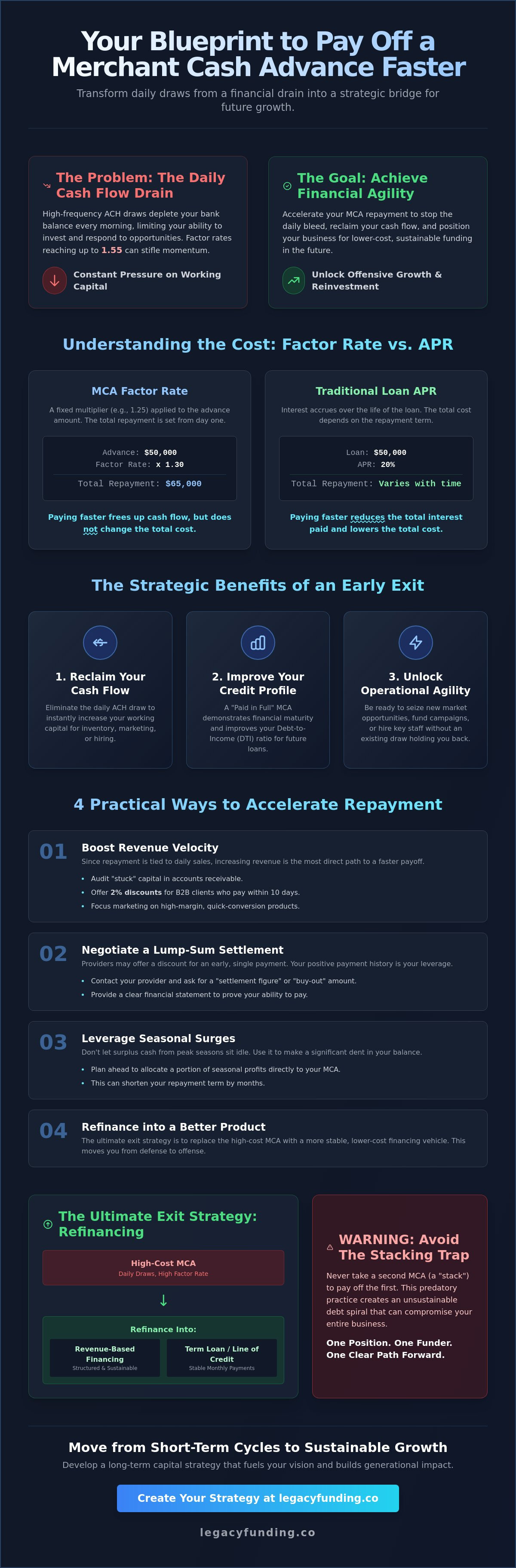
Understanding what a merchant cash advance is helps you recognize it as a purchase of future sales rather than a traditional loan. Unlike a term loan where interest accrues over time, an MCA uses a factor rate. This multiplier, typically between 1.10 and 1.55 in 2026, creates a fixed total repayment amount from day one. You might wonder why you should focus on how to pay off a merchant cash advance faster if the total cost doesn't change. The answer lies in your daily liquidity and operational momentum.
High-frequency draws deplete your bank balance every morning. This constant drain limits your ability to respond to market shifts or unexpected inventory needs. Clearing this obligation isn't just about the dollar amount; it's about reclaiming your cash flow. When you eliminate the daily ACH draw, you instantly increase your working capital for reinvestment. You move from defensive survival to offensive growth. Speed is your greatest ally in restoring the financial health of your business.
Fixed Costs vs. Cash Flow Freedom
Factor rates differ from APR because they don't fluctuate based on time. If you pay off a 1.20 factor rate advance in three months instead of six, you still pay the same total. However, the opportunity cost of those daily payments is immense. Capital tied up in an MCA cannot fund new marketing campaigns or hire key staff. Accelerated repayment unlocks operational agility by stopping the daily bleed of your primary revenue source. It gives you the freedom to allocate your own money where it matters most.
Improving Your Credit Profile for 2026 Funding
Your "Paid in Full" status is a powerful signal to the 2026 lending market. While MCAs don't always report to traditional bureaus like a term loan, successful completion improves your internal credit history with funding partners. It demonstrates your business can handle high-velocity capital. This improves your debt-to-income (DTI) ratio, which is a critical metric for future SBA loan eligibility or securing a business line of credit. Clearing an MCA early proves you have the cash flow strength to graduate to lower-cost, structured financing. It transforms your business from a high-risk applicant into a prime candidate for institutional capital. Consider these benefits of an early exit:
- Immediate DTI Relief: Lowering your total debt obligations makes you more attractive to traditional banks.
- Enhanced Trust: Proving you can clear high-cost capital quickly signals financial maturity.
- Strategic Readiness: You're positioned to jump on new opportunities without an existing draw holding you back.
Don't view the MCA as a permanent fixture. View it as a temporary bridge. The faster you cross it, the sooner you can access the generational wealth-building tools that define successful entrepreneurship.
4 Practical Ways to Speed Up Your MCA Repayment
Acceleration requires a tactical shift in how you manage your daily operations. If you want to know how to pay off a merchant cash advance faster, you must focus on increasing the velocity of your incoming revenue. Since most MCA agreements are tied to a percentage of your daily sales, higher revenue naturally leads to a faster exit. Start by auditing your current receivables. Identify "stuck" capital, those invoices sitting at 30 or 60 days, and convert them into immediate liquidity. Every dollar you pull forward reduces the duration of your high-frequency draws.
Optimizing Daily Revenue Velocity
Drive immediate cash flow by implementing "early bird" discounts for your B2B clients. Offering a 2% discount for payments made within 10 days can trigger a surge in daily volume. Simultaneously, review your merchant processing setup. Ensure there are no technical delays in settlement that keep funds out of your account. Direct your marketing efforts toward high-margin products that offer immediate cash conversion. This strategy ensures that every sale maximizes the percentage going toward your payoff without sacrificing your operational bottom line.
Effective management of these high-cost advances often involves direct communication with your provider. Many funders are open to a "buy-out" or a "settlement figure" if you can offer a lump sum payment. This is particularly effective during peak seasons. If your business experiences a seasonal surge, don't let the surplus sit idle. Apply that excess revenue directly to the remaining balance to crush the debt months ahead of schedule.
Negotiating Prepayment Incentives
Approach your provider with a clear financial statement that proves your ability to pay a lump sum. Ask for a specific settlement figure that reduces the total factor rate. Your positive payment history is a powerful bargaining chip; use it to request a fee reduction in exchange for an early exit. Providers value certainty and liquidity just as much as you do. Proposing a win-win scenario can save you thousands in total costs while freeing your business for future scaling. If you're unsure how to structure these conversations, you can speak with a strategic advisor to review your options.
Speed is a choice. By focusing on revenue velocity and aggressive negotiation, you reclaim control over your financial destiny. Move quickly. Act decisively. Transition your business away from daily draws toward sustainable, long-term wealth.
Refinancing: The Ultimate Exit Strategy for High-Cost Advances
Refinancing is the strategic graduation your business needs to move from survival to scale. While operational tweaks provide temporary relief, structural changes to your debt offer the most significant impact. If you're investigating how to pay off a merchant cash advance faster, a well-timed refinance can slash your daily overhead and restore your operational breathing room. This isn't just about moving debt around; it's about reclaiming your cash flow statement. You must identify instruments that offer lower total costs and more predictable repayment schedules.
The 2026 lending environment has evolved. Since the 2025 shift in SBA regulations removed traditional SBA loans as a direct refinancing option for MCA debt, founders must look toward private credit and cash-flow-based alternatives. Identifying the right "break-even" point is critical. You must calculate the remaining factor amount on your current advances and compare it to the total cost of the new funding. When the cash flow savings exceed the cost of the new instrument, the move is not just logical; it's essential for your survival.
Transitioning to Revenue-Based Financing
Revenue-Based Financing (RBF) serves as a modern bridge between high-cost advances and traditional bank loans. Unlike a fixed daily draw that hits your account regardless of sales volume, RBF aligns your payments with a set percentage of your actual monthly revenue. This creates a natural safety net for your business. If sales dip, your payment drops accordingly. You transition from a rigid, high-pressure obligation to a variable cost that breathes with your business. It's a smarter, more founder-friendly approach to capital that prioritizes your growth metrics over simple collections.
The Role of Debt Consolidation
Debt consolidation is the ultimate tool for businesses that have accidentally entered a stacking cycle. By using a single Term Loan or a structured Debt Consolidation plan, you can buy out multiple high-frequency advances at once. This replaces chaotic, multi-provider draws with one manageable payment. The impact on your balance sheet is immediate. You reduce administrative friction, lower your total cost of capital, and restore your ability to plan for long-term growth. To secure this transition, you need to prepare specific documentation to prove your improved business health:
- Detailed Bank Statements: Provide the last six months of activity to show consistent revenue.
- Updated P&L Statements: Demonstrate your current profitability and operational efficiency.
- Comprehensive Debt Schedule: List every current obligation to show a clear path to total payoff.
Gathering these materials signals financial maturity to new lenders. It proves your business has outgrown the need for high-cost advances and is ready for institutional-grade funding. Stop reacting to daily draws. Start building a sustainable financial foundation that supports your long-term vision.
Avoiding the Stacking Trap: What Not to Do
Stacking is the quickest path to business insolvency. It happens when you take a second or third advance before the first is cleared. Predatory lenders often market these as "second position" offers, promising quick liquidity to cover your existing draws. In reality, you're just accelerating a debt spiral. If you want to know how to pay off a merchant cash advance faster, the first rule is to stop adding new ones. You cannot outrun high-frequency draws by layering more daily payments on top of them. It's a mathematical impossibility that leads to a default rate as high as 40 to 60 percent for stacked businesses in 2026.
Establish a strict "no-stacking" policy for your operations immediately. A single merchant cash advance is a tool; multiple advances are a trap. When you stack, you lose the ability to forecast your cash flow. Your bank account becomes a pass-through for lenders rather than a reservoir for your business growth. Focus on clearing your current obligation before seeking more capital. Decisive founders prioritize the long-term impact of their financial decisions over the short-term relief of a predatory deposit.
Identifying the Signs of a Debt Spiral
Monitor your "Total Daily Remittance" as a percentage of your gross revenue. If your daily draws exceed 20 percent of your typical morning deposits, you're in the danger zone. Watch for the urge to take new debt specifically to pay off old debt. This is the primary indicator of a failing capital structure. Monitor your bank balance for "negative days" where an MCA draw triggers an overdraft. These are red flags that your current funding is no longer supporting your growth but is instead actively dismantling your business.
Alternatives to Taking a Second MCA
Look for sustainable alternatives that don't require daily ACH draws. If you need short-term liquidity, explore a Business Line of Credit. This gives you access to funds on demand without the high-frequency pressure of an advance. Consider Invoice Factoring to unlock capital already tied up in your unpaid receivables. This isn't new debt; it's simply pulling your own money forward. You can also leverage Equipment Financing to use your existing assets as collateral for structured, monthly capital. These options provide the breathing room you need to scale without the suffocating daily draw of a stacked advance. If you feel trapped by multiple draws, apply for a consolidation strategy to regain control of your revenue.
Your business deserves a foundation built on logic, not desperation. Avoid the stacking trap. Choose transparency and structure over the false promise of "fast" second-position cash. Protect your cash flow to protect your legacy.
Partnering with Legacy Funding Advisors for Sustainable Growth
Transitioning from high-frequency draws to structured capital requires more than just a new loan; it requires a strategic alliance. Legacy Funding Advisors specializes in helping founders move away from the daily pressure of merchant cash advances. We provide the insider knowledge and technical expertise needed to rewrite your financial narrative. If you are determined to learn how to pay off a merchant cash advance faster, our team acts as your high-level consultant to streamline the process. We don't just offer capital; we offer a gateway to financial independence and business scaling.
Our process is built for the speed of modern commerce. We provide a fast, 24-hour approval process for growth capital, ensuring you don't miss market opportunities while waiting on bureaucratic hurdles. We analyze your business through the lens of potential and cash flow rather than just a stagnant credit score. This results-oriented approach has allowed us to support businesses across the United States, Puerto Rico, and Canada. We are personally invested in your scaling journey, serving as a tech-forward ally that understands the modern founder's struggle better than legacy institutions.
Custom Capital Solutions Beyond the Advance
We offer a diverse suite of professional funding products designed to replace high-cost debt with sustainable structures. Our range of SBA loans and term loans provide the monthly stability your cash flow statement needs to thrive. We conduct a deep analysis of your revenue patterns to ensure every repayment plan is sustainable and growth-oriented. By moving your debt into a structured term loan, you reduce administrative friction and lower your total cost of capital. This isn't a one-size-fits-all approach; it's a tailored financial strategy designed for generational impact rather than a simple transaction.
Your Road Map to Financial Independence
Applying for a Legacy Funding consolidation plan is the first step toward reclaiming your operational agility. Our streamlined application removes the traditional barriers to entry, focusing on your business metrics and future growth potential. We move you quickly from the pain of daily draws to the relief of a clear, monthly repayment schedule. This transparency allows you to focus on what matters most: scaling your vision and increasing your profit margins. Stop managing daily obligations and start fueling your expansion with a partner who understands your pace. Secure your business’s future with Legacy Funding Advisors and start your transition to lower-cost, high-impact capital today.
Reclaim Your Revenue and Scale with Confidence
Managing a merchant cash advance requires a decisive transition from defensive survival to offensive scaling. You've identified that increasing revenue velocity and strictly avoiding the stacking trap are the primary pillars of financial health. Most importantly, you now possess a strategic blueprint for how to pay off a merchant cash advance faster by graduating to structured term loans or revenue-based financing. This shift doesn't just clear debt; it restores your daily cash flow and allows you to focus on the growth metrics that define your success.
Legacy Funding Advisors provides the professional expertise to guide this critical transition. We offer comprehensive national service across the US and Canada with a specific focus on your business's actual cash flow rather than just a credit score. Our streamlined process ensures a 24-48 hour funding turnaround to secure your exit and fuel your next chapter. Get a custom exit strategy and funding plan from Legacy Funding Advisors. Your business legacy deserves a foundation of sustainable, high-impact capital. Take control of your financial future today and build the scalable enterprise you envisioned.
Frequently Asked Questions
Can I really save money by paying off my merchant cash advance early?
You save money primarily by reclaiming your daily cash flow and avoiding the long-term drain on your liquidity. While factor rates are fixed, meaning you technically owe the full amount from day one, some funders offer a buy-out discount for early settlement. Reclaiming your revenue allows you to reinvest in growth rather than servicing debt. This is a key part of how to pay off a merchant cash advance faster while protecting your operational bottom line.
What is a prepayment discount and how do I ask for one?
A prepayment discount is a negotiated reduction in the total fee you owe. To secure one, request a settlement figure from your provider. Present a clear financial case showing you have the lump sum available right now. Many providers prefer the immediate liquidity of a buy-out over the risk of future daily draws. Actively negotiating this can significantly lower your total cost of capital and speed up your exit.
Is refinancing an MCA into a term loan possible with a low credit score?
Refinancing is absolutely possible even if your credit score isn't perfect. Modern lenders in 2026 prioritize your business's revenue consistency and daily bank balances over traditional FICO scores. If you show strong, steady cash flow for at least six months, you can often qualify for a structured term loan. This allows you to graduate from high-frequency advances to a more sustainable, monthly repayment schedule that supports long-term scaling.
What happens if I can’t keep up with the daily draws of my MCA?
You should immediately request a reconciliation if your revenue drops and you can't meet the draws. MCAs are legally designed to adjust based on your actual sales volume. Ignoring the draw leads to negative days and potential default. Proactive communication protects your business reputation and keeps the door open for future refinancing options. It's the first step in regaining control before your cash flow reaches a breaking point.
How does debt consolidation work for multiple merchant cash advances?
Debt consolidation replaces multiple daily draws with a single, structured payment. A new lender pays off your existing advances in full, leaving you with one balance. This process simplifies your accounting and usually reduces your total daily or weekly remittance. It's the most effective strategy for founders who need to know how to pay off a merchant cash advance faster while restoring their operational agility and focus.
Will paying off my MCA faster help me get an SBA loan in the future?
Yes, clearing your advances early signals financial strength to SBA lenders. It improves your debt-to-income ratio, which is a critical metric for SBA loan eligibility. By showing you can successfully manage and exit high-cost capital, you position your business as a lower-risk candidate. This makes it easier to access the low-interest, long-term funding required for generational growth and scaling your vision.
What is the difference between an MCA and Revenue-Based Financing?
The main difference lies in payment flexibility. An MCA usually takes a fixed daily or weekly amount from your bank account based on an estimate of sales. Revenue-Based Financing (RBF) adjusts your payments based on a fixed percentage of your actual monthly sales. If your revenue drops, your RBF payment drops too. This makes RBF a much safer and more scalable alternative for businesses with fluctuating income.
Is it ever a good idea to take a second merchant cash advance (stacking)?
Taking a second advance is almost never a strategic move. It creates a mathematical debt trap where your daily draws eventually exceed your daily deposits. Stacking leads to a debt spiral that can dismantle years of business growth in just a few months. Instead of taking a second advance, look for a business line of credit or invoice factoring. These alternatives provide liquidity without the destructive pressure of multiple high-frequency draws.