


How to Manage Multiple Cash Advances: A Strategic Guide for SMBs
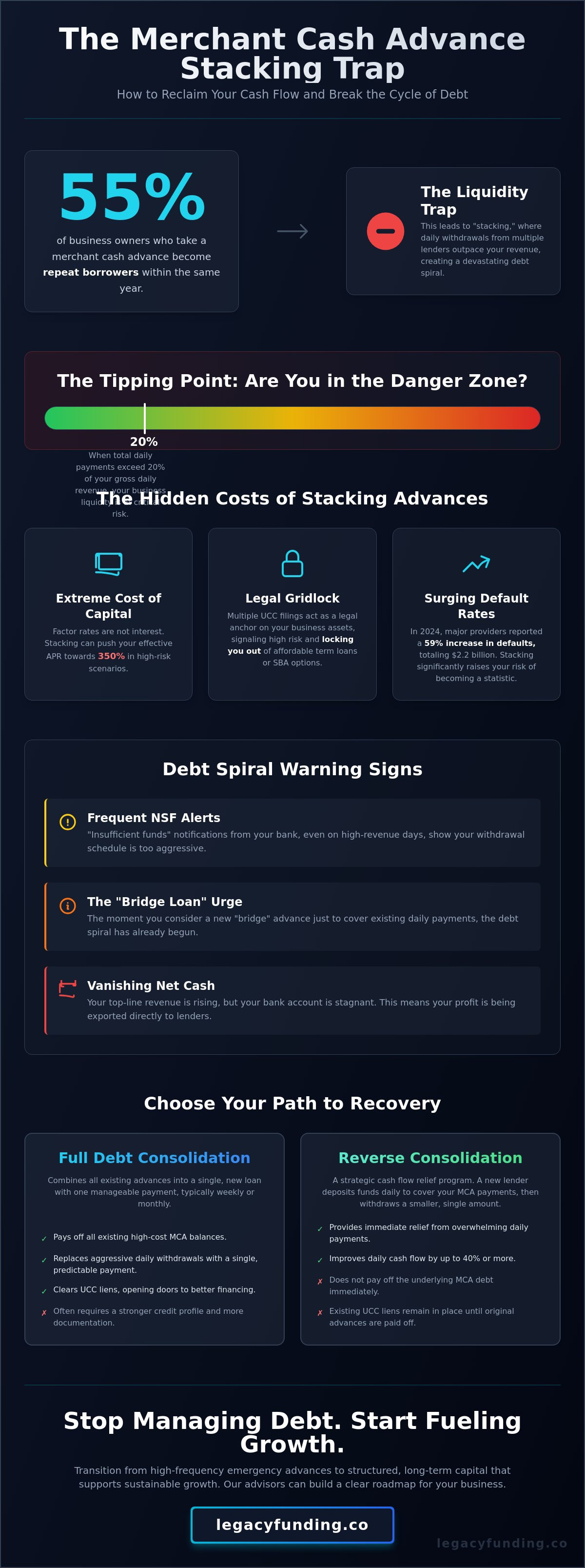
Data shows that 55% of business owners who secure a merchant cash advance become repeat borrowers within the same year. This often leads to the high-stakes pressure of stacking, where daily withdrawals from several lenders begin to outpace your actual revenue. If you feel like your profit margins are being swallowed by high factor rates and aggressive collection tactics, you're facing a common hurdle. It's a revenue-alignment mismatch that requires a strategic shift. Learning how to manage multiple cash advances is the first step toward reclaiming your financial independence.
You need a partner who understands the speed of modern commerce and the reality of scaling. We've built this guide to provide the professional frameworks necessary to stop the liquidity drain and regain control. You'll learn how to transition from fragmented, high-frequency debt to a single, manageable monthly payment. We'll break down the mechanics of reverse consolidation and debt restructuring to give you clearer visibility into your total obligations. Stop managing debt and start fueling your next phase of growth with these proven strategies.
Key Takeaways
- Identify the mechanics of the liquidity trap by performing a comprehensive debt audit of every active lender and withdrawal amount.
- Master how to manage multiple cash advances by choosing between full debt consolidation and the strategic cash flow relief of reverse consolidation.
- Learn the professional process for requesting a formal reconciliation based on actual revenue drops to lower payments before a crisis hits.
- Re-calculate your daily break-even point to ensure high factor rates aren't quietly eroding your total profit margins.
- Build a clear roadmap to transition from high-frequency emergency advances to structured, long-term working capital that supports sustainable growth.
Understanding the Impact of Stacked Merchant Cash Advances
Stacking is the accumulation of multiple revenue-based advances. It's a high-stakes gamble that often leads to a liquidity trap. This occurs when daily ACH withdrawals from several lenders simultaneously drain your operating account. While a Merchant cash advance provides immediate speed, stacking them creates a friction-filled financial environment. The spiral effect is simple but devastating: you take new debt specifically to cover the daily fees of existing advances.
Identify your tipping point immediately. When your total daily payments exceed 20% of your gross daily revenue, your business enters the danger zone. At this stage, your liquidity is effectively dead. You're no longer scaling; you're surviving. Knowing how to manage multiple cash advances requires recognizing this threshold before the spiral becomes irreversible. In 2024, major providers reported a 59% increase in defaults, totaling $2.2 billion. This statistic highlights the reality of the liquidity trap. You must break the cycle before your business becomes part of that metric.
The Hidden Costs of Multiple Advances
Stacking doesn't just increase your debt; it compounds your cost of capital. Factor rates are not interest rates. They are fixed multipliers applied to the total advance amount upfront. When you stack, you pay these high rates on overlapping capital. This can push your effective APR toward the 350% mark seen in high-risk scenarios. Beyond the cost, multiple UCC filings act as a legal anchor. These liens complicate your financial standing and signal high risk to traditional institutions. This legal gridlock often locks you out of affordable term loans or SBA options, even when your revenue is strong.
Identifying the Debt Spiral Warning Signs
Don't wait for a total collapse to take action. Proactive founders watch for specific red flags that indicate a loss of control. Understanding how to manage multiple cash advances starts with total transparency regarding your daily numbers.
- Frequent NSF Alerts: If your bank balance triggers "insufficient funds" notifications even on high-revenue days, your withdrawal schedule is too aggressive.
- The Bridge Loan Urge: The moment you consider a new "bridge" advance to cover existing payments, the spiral has begun.
- Vanishing Net Cash: Analyze the gap between gross revenue and net operating cash. If your top-line revenue is rising but your bank account is stagnant, your profit is being exported to lenders.
Analyze your books with a consultant's eye. If your daily withdrawals are killing your ability to buy inventory or meet payroll, the debt has become the driver of your business rather than the fuel. Focus on restructuring and regaining your visibility today to protect your long-term growth.
3 Immediate Steps to Stabilize Your Daily Cash Flow
Stabilizing a business under the weight of multiple advances isn't about intuition; it's about precise financial engineering. You must shift from a defensive posture to an offensive one by controlling the variables you can still influence. If you're wondering how to manage multiple cash advances without losing your business, the answer starts with radical transparency. Stop the guesswork and start the audit. Math doesn't lie, and your data will show you the path forward.
Step 1: The Comprehensive Debt Audit
You cannot fix what you haven't measured. Open a spreadsheet and list every active funding source. This audit must include the current balance, the original factor rate, and the exact daily withdrawal amount. Differentiate between fixed ACH withdrawals and "split-funding" arrangements where the lender takes a percentage of daily credit card sales. Split-funding is often more flexible during slow periods, whereas fixed ACH withdrawals are rigid and dangerous when revenue dips. Check your contracts for the remaining term length. Identifying which advance will be paid off first allows you to see the light at the end of the tunnel. Understanding these mechanics helps you spot the dangers of predatory MCA providers who rely on your lack of clarity to keep you in a cycle of debt.
Step 2: Cash Flow Triage and Revenue Tracking
Implement a daily ledger to track every dollar entering and leaving your account in real-time. Calculate your "Daily Break-Even" point. This is the amount of gross revenue you must generate every single day just to cover your operating expenses and financing withdrawals. If your daily withdrawals exceed 20% of your gross revenue, as discussed in our previous section, you must act. Cut non-essential overhead immediately. Every dollar saved in utilities, subscriptions, or discretionary spending is a dollar of liquidity preserved. Focus your sales efforts exclusively on high-margin products or services that provide the fastest cash conversion cycle. This isn't the time for long-term projects; it's the time for immediate cash inflow.
Finally, isolate your capital. Open a separate "repayment" account. Transfer your daily debt obligations into this account every morning. This leaves your primary operating account clear for payroll and inventory. It prevents you from accidentally spending money that is already spoken for. Prioritize your communication with lenders based on their UCC filing dates. The first lender to file often has the most leverage, but they may also be the most willing to negotiate if it prevents a default. If the math still isn't adding up, it might be time to speak with a restructuring specialist to explore your options. Learning how to manage multiple cash advances is a skill that will define your success as a founder in this high-speed market.
Consolidation vs. Reverse Consolidation: Which Fits Your Business?
Choosing the right restructuring path is a strategic pivot. It requires more than just a new injection of capital. It requires a fundamental shift in how you handle daily obligations. When you're deciding how to manage multiple cash advances, you'll likely face two primary paths: standard debt consolidation and reverse consolidation. Both serve different stages of business recovery. One offers a clean slate. The other provides immediate breathing room while you work through existing contracts. Your choice depends on your current credit profile and your immediate liquidity needs.
Consolidation is a total payoff. A new lender provides a single lump sum that closes out every existing advance on your books. This transforms multiple daily withdrawals into one manageable weekly or monthly payment. Reverse consolidation is different. The provider doesn't pay off your old lenders directly. Instead, they deposit funds into your account every week. These funds are specifically designed to cover your daily ACH withdrawals from other lenders. You then pay the reverse consolidation provider back on a weekly schedule. It's a liquidity bridge that stops the daily drain without requiring a massive upfront buyout.
When to Choose Standard MCA Consolidation
Standard consolidation is the ideal move for businesses with a credit score of 700 or higher and improving profit margins. Lenders look for stability. If you can show consistent revenue and a rising credit score, you can often secure a term loan or a larger revenue-based advance with a lower factor rate, perhaps in the 1.15 to 1.25 range. This simplifies your balance sheet and removes the chaotic "stacked" look that scares off traditional banks. While the SBA no longer permits the use of its loans to refinance MCA debt as of June 2025, a clean balance sheet through consolidation makes you a much stronger candidate for future SBA working capital once your current obligations are cleared.
The Mechanics of Reverse Consolidation
Reverse consolidation is a savvy tool for high-revenue businesses that don't yet have the credit score to qualify for a full buyout. If you're stuck with factor rates between 1.35 and 1.50, a reverse consolidation provider acts as your financial ally. They deposit enough capital into your account each week to offset your daily withdrawals. This effectively lowers your weekly payment amount by 25% to 50% immediately. The risk is high; you must have the discipline to use that deposited capital only for its intended purpose. It's a strategic "breathing room" tool. It allows you to focus on growth metrics while the provider manages the heavy lifting of your daily repayment schedule. Learning how to manage multiple cash advances through this method keeps your business operational when traditional consolidation isn't an option.
Professional Strategies to Negotiate and Restructure Debt
Negotiation is a power move. It requires a shift from a defensive posture to a proactive strategy. Most founders wait until a payment bounces to speak with their lenders. This is a mistake. Proactive communication preserves your leverage and protects your business reputation. Reach out 10 to 14 days before you expect a liquidity crunch. When you take the lead, you position yourself as a partner rather than a risk. Learning how to manage multiple cash advances involves mastering the art of the professional pivot.
Start by preparing a formal hardship letter. This document must be concise and data-driven. It should outline your current revenue challenges while clearly demonstrating the long-term viability of your business. Lenders don't want a default; they want their capital back. By showing a clear path to recovery, you make it easier for them to say yes to a temporary restructure. Professionalism replaces panic. Data replaces excuses. This approach builds the trust necessary to secure more favorable terms during a difficult cycle.
Requesting a Revenue Reconciliation
Check your contracts for a reconciliation clause immediately. This is a vital legal right in many revenue-based funding agreements. Because Merchant Cash Advances are not legally loans, the daily payment must fluctuate based on your actual sales volume. If your revenue drops, your payment should drop proportionally. Submit your bank statements as evidence of this dip. Requesting a reconciliation is not asking for a favor; it's enforcing the terms of the agreement. Enforcing this clause is a fundamental step in how to manage multiple cash advances effectively during seasonal lulls or market shifts.
The Risks of Strategic Default
Ignore the dangerous advice found on public forums. Closing your bank account or "account hopping" to avoid ACH withdrawals is a violation of contract. It leads directly to litigation and aggressive collection tactics. Lenders will use UCC-1 filings to place liens on your assets, which can instantly freeze your ability to process credit cards. This creates a total operational standstill. Instead of hiding, find a professional advisor to mediate. A savvy ally can often negotiate a settlement or a structured repayment plan that avoids the courtroom. If you need an expert to lead these high-stakes negotiations, connect with our restructuring team today to explore your options. Protect your business credit and your future borrowing capacity by choosing transparency over evasion.
Transitioning to Long-Term Capital with Legacy Funding Advisors
Managing the liquidity trap is a temporary fix. True business scaling requires a permanent exit from the cycle of emergency funding. At Legacy Funding Advisors, we prioritize your long-term business health over simple transaction volume. We don't just provide capital; we provide a roadmap. If you've been struggling with how to manage multiple cash advances, you know that daily withdrawals are a drain on your focus. Our goal is to shift that focus back to your revenue growth. We look beyond your past credit score to analyze your future potential. This revenue-based approach allows us to find solutions where traditional banks often see only risk.
The transition from emergency MCAs to structured working capital is a deliberate process. It requires moving from high-frequency, high-cost debt to financing that aligns with your cash flow cycle. We act as your savvy, tech-forward financial ally. We understand the speed of modern commerce better than legacy institutions. Our process is designed to be accessible and transparent. We remove the friction of traditional borrowing so you can move quickly. Take the first step today with a no-obligation consultation. We'll help you map a clear exit strategy from stacked debt and position your business for generational impact. Learning how to manage multiple cash advances is easier when you have a partner who understands the high stakes of scaling.
Tailored Funding Solutions for Every Stage
Your capital stack should be as unique as your business model. We offer a diverse range of products to ensure you have the right tool for every growth phase. This includes SBA loans, equipment financing, and flexible business lines of credit. Legacy Funding Advisors specializes in helping founders restructure existing obligations into manageable growth capital. Our 24-48 hour approval process for qualified applicants ensures you don't lose momentum. Whether you need to buy new machinery or consolidate debt, we provide the speed and weight necessary for rapid expansion. We move at the pace of your ambition.
Your Path to Financial Independence Starts Here
Stop reacting to daily bank balance alerts. Start executing a monthly growth strategy. Moving toward financial independence means reclaiming your time and your profit margins. When we handle the capital logistics, you are free to focus on scaling your operations and increasing your market share. Legacy Funding Advisors bridges the gap between high-stakes finance and your entrepreneurial reality. It's time to trade the stress of daily withdrawals for the stability of a structured plan. Ready to simplify your payments? Speak with a Legacy Funding Advisors specialist today. Let's build a sustainable future for your business together.
Take Command of Your Cash Flow Today
You've identified the liquidity trap and audited your daily withdrawals. Now, it's time to execute your exit strategy. Choosing between a full buyout or strategic reverse consolidation is the pivot that protects your margins. Real visibility into your total debt is the only way to move from emergency mode to a sustainable monthly strategy. Mastering how to manage multiple cash advances requires the right ally at your side.
We focus on your current cash flow and future growth potential rather than just past credit scores. Our team provides expert guidance on debt restructuring to help you regain control immediately. With funding available in as little as 24 hours, you can stop the daily drain and start building for the long term. Don't let aggressive lenders dictate your pace. Take the lead, restructure your obligations, and reclaim your liquidity. Secure a more manageable future for your business, contact us now. Your next phase of growth is waiting.
Frequently Asked Questions
Can I consolidate multiple merchant cash advances into one payment?
Yes, you can. Consolidation is a primary tool for founders who need to simplify their financial obligations. By securing a single term loan or a larger revenue-based advance, you clear all active liens. This transition restores your daily cash flow and provides a clearer path to sustainable scaling.
What is the difference between MCA consolidation and reverse consolidation?
MCA consolidation involves a new lender paying off your existing advances in full to leave you with one payment. Reverse consolidation is a cash flow strategy where a provider deposits funds into your account weekly to cover your daily payments to other lenders. One is a total debt buyout; the other is a strategic liquidity bridge.
Will managing multiple advances hurt my business credit score?
Stacking multiple advances often creates a high-risk profile that traditional institutions avoid. Frequent bank inquiries and multiple UCC-1 filings suggest a lack of financial stability. Understanding how to manage multiple cash advances through structured restructuring is essential for protecting your future borrowing capacity and creditworthiness.
What happens if I can't make my daily cash advance payments?
Missing payments triggers aggressive collection tactics and potential legal action. Lenders may move to enforce UCC liens or freeze your merchant processing account. You should request a formal revenue reconciliation before a default occurs to adjust your payments based on your actual sales volume.
How do I know if I'm 'stacked' too deep with advances?
You've reached a dangerous tipping point when your total daily payments exceed 20% of your gross daily revenue. If you're taking out new advances specifically to cover the daily fees of old ones, you're in a debt spiral. Perform a total debt audit immediately to measure your actual liquidity levels.
Can I negotiate a lower factor rate with my existing lenders?
You generally cannot change the fixed factor rate once a contract is signed. However, you can negotiate the daily withdrawal amount. If your revenue has decreased, many providers are legally required to reconcile your payments to match a specific percentage of your current sales.
Is it possible to get an SBA loan to pay off multiple MCAs?
No, this is no longer a viable option for small businesses. The SBA updated its guidelines in June 2025 to officially exclude MCA refinancing from its loan programs. You must use private consolidation or restructuring strategies to clear these high-cost obligations before you can qualify for SBA capital.
How does revenue-based financing differ from a traditional bank loan?
Revenue-based financing is the purchase of future sales at a discount, not a legal loan. It offers approval rates around 84%, which is significantly higher than traditional banks that have tightened standards for three consecutive years. Payments are designed to fluctuate with your revenue, providing a flexible alternative to rigid bank installments.