


How to Increase Your Business Line of Credit: The Insider Scaling Guide
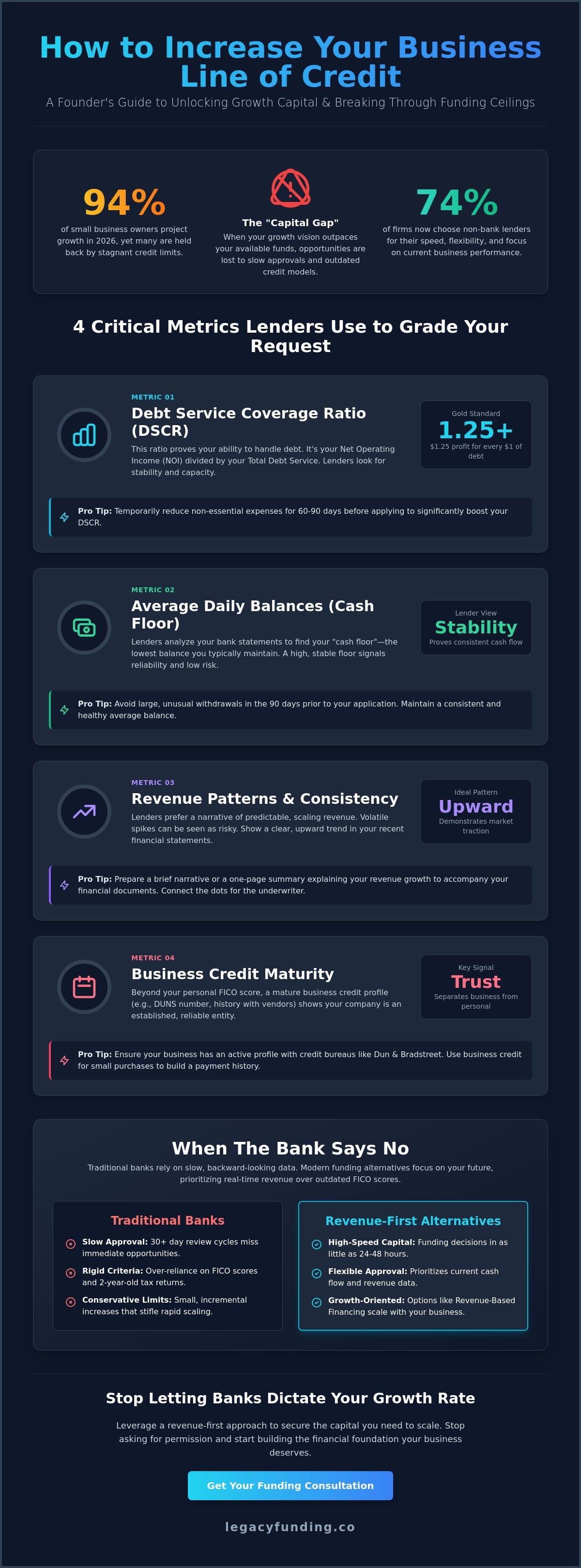
Your current credit limit isn't a final verdict on your business's worth; it's a reflection of the data you share. Many founders feel trapped by rigid spending caps during their most critical growth phases. You know the frustration of watching a massive opportunity slip away because of a slow bank approval cycle or a denial based on an outdated FICO score. With 94% of small business owners projecting growth in 2026, you can't afford to let a stagnant limit hold you back. You're likely searching for exactly how to increase my business line of credit without the bureaucratic friction of a traditional bank.
Mastering your borrowing power is about shifting from a passive applicant to a proactive strategist. We'll show you the specific steps to expand your capital access and fuel your next scaling phase. You'll learn how to optimize your cash flow reporting, break through current ceilings, and explore alternative funding options that look beyond your personal credit score. We'll also examine the modern shift where 74% of firms now choose non-bank lenders for their speed and flexibility. It's time to stop asking for permission and start building the financial foundation your business deserves.
Key Takeaways
- Identify why your current limit is stalling your expansion and how to fix the "Capital Gap" effectively.
- Learn the specific data points lenders prioritize so you can master how to increase my business line of credit through better reporting.
- Discover the optimal timing and documentation strategies to ensure your request moves through the approval cycle without friction.
- Explore high-speed alternatives like revenue-based financing and the "stacking" strategy for when traditional banks move too slowly.
- Leverage a revenue-first approach to secure capital in as little as 24 to 48 hours, bypassing rigid FICO-based denials.
Why Your Current Credit Limit is a Growth Bottleneck
A low credit limit is a leash on your business's potential. It creates a "Capital Gap" where your vision for expansion exceeds your accessible funds. If you've ever had to turn down a bulk inventory discount or delay a marketing blitz because of a spending cap, you've felt this friction. Understanding how to increase my business line of credit is essential for any founder who refuses to let a bank's conservative algorithm dictate their growth rate. Your limit shouldn't just cover your overhead; it should provide the fuel for your next major move.
Traditional lenders often view a business line of credit through a lens of risk mitigation rather than opportunity. They prefer small, incremental increases based on historical tax returns that are often two years out of date. This creates a "Growth Trap." You need more capital to generate more revenue, but the bank won't give you more capital until that revenue is already on the books. It's a circular logic that favors stagnant companies over scaling ones. Beyond the missed opportunities, low limits also hurt your credit profile. High utilization on a small line makes your business look over-leveraged, even if your cash flow is strong.
There is also a hidden operational cost to low limits. Frequent, small draws require more administrative oversight and often trigger more transaction fees. A larger, single limit provides the breathing room to execute large-scale strategies without constant micro-management of your available balance. It allows you to focus on growth metrics rather than just financial obligations.
The Velocity of Growth vs. The Slowness of Banks
Modern commerce moves at a 24-hour pace. Banks, however, still operate on 30-day review cycles. This mismatch is dangerous. When a prime opportunity appears, you need to act instantly. Traditional banks focus on where your business was last year; they rarely account for where it's going next month. This reliance on backward-looking data is why many founders seek faster, more flexible alternatives that prioritize current cash flow over historical averages. You can't scale a 2026 business with a 2024 credit limit.
Understanding Your Current Utilization
Your credit utilization ratio is a major factor in limit approvals. Lenders generally prefer to see you using less than 30% of your total limit. If you're constantly maxed out, it signals financial stress rather than healthy growth. To combat this, try "cycling" your limit. Make frequent payments to bring the balance down before drawing again. This demonstrates high repayment capacity and proves you can handle a much larger facility without defaulting. It shows the lender you're a high-velocity borrower who needs more room to run.
4 Critical Metrics Lenders Use to Grade Your Increase Request
Traditional banks often fixate on a 700 FICO score as the ultimate gatekeeper. This narrow view ignores the operational reality of your business. If you want to know how to increase my business line of credit, you must master the metrics that prove your repayment capacity beyond a personal credit score. Lenders aren't just looking at your past. They're stress-testing your future. To secure a higher limit, you need to present a narrative backed by hard data that suggests stability and scalability.
Lenders prioritize four specific areas when evaluating your request: your debt coverage, your cash floor, your revenue patterns, and your business credit maturity. While a strong personal score helps, these business-centric metrics provide the weight necessary to expand capital and move into higher credit tiers. If your current bank remains rigid despite your strong performance, it might be time to speak with a consultant about more flexible, revenue-first options.
Optimizing Your Debt Service Coverage Ratio
The Debt Service Coverage Ratio (DSCR) is the math behind your ability to pay. Lenders calculate this by taking your Net Operating Income and dividing it by your Total Debt Service. A ratio of 1.25 or higher is the gold standard. This means you have $1.25 in profit for every $1.00 of debt. To "pad" this ratio before an application, consider auditng your discretionary spending. Temporarily reducing non-essential expenses for 60 to 90 days can significantly improve your NOI, making your increase request much more attractive to underwriters.
The Power of Average Daily Balances
Your bank account's "floor" matters more than its "ceiling." Lenders typically review the last 90 days of bank statements to find your average daily balance. An ending balance of $50,000 looks great on paper, but if your account dipped to $500 mid-month, you're viewed as high-risk. Focus on maintaining a higher low point. This consistency builds trust. It proves you have the liquidity to handle interest and principal payments even during slow weeks. Ending balance is a vanity metric; average balance is the reality of your liquidity.
Revenue consistency and business credit age round out the evaluation. Lenders look for stability, not just high-water marks. They prefer a business earning a steady $40,000 monthly over one that earns $100,000 one month and $5,000 the next. Additionally, your business credit age—specifically your Paydex score—allows you to decouple your personal life from your company's growth. Building this history is a long-term play for generational impact.
Tactical Steps to Request Your Credit Limit Increase
Requesting an increase is a strategic negotiation. It isn't a plea for help; it's an invitation for a partner to participate in your success. When you understand how to increase my business line of credit, you stop viewing the bank as an obstacle and start seeing them as a tool. Success depends on your ability to frame the request as a calculated investment. Lenders want to see that more capital will directly lead to more revenue, not just cover a temporary cash shortfall. You must demonstrate that you are a high-velocity borrower with a clear plan for every dollar.
Preparation is the difference between a quick approval and a frustrating denial. While traditional institutions focus on historical tax returns, modern fintech lenders and SBA funding programs are increasingly looking at real-time performance data. You need to present a narrative that highlights your current momentum. If your bank remains stuck in a bureaucratic cycle, it may be time to shift your focus to more agile financing partners who value speed and clarity.
The Perfect Timing for an Increase
Timing is everything. You should submit your request immediately after a record-breaking quarter when your financials are at their peak. This provides the strongest possible evidence of growth. Follow the "6-Month Rule" by waiting at least half a year between requests. Asking too frequently triggers red flags and suggests financial instability. Most importantly, avoid the "Desperation Signal." Never ask for an increase when your balance is at $0 or when you've just maxed out your line. Lenders want to see that you have a cushion, not that you're gasping for air.
Building Your Increase Proposal
Ditch the generic application and build a "Growth Pitch." This includes a simple "Use of Funds" statement that links the capital to a specific ROI. If you have future contracts or signed purchase orders, present them as informal collateral. It proves the revenue is already on the horizon. For example, your pitch might state: "This $50k increase will facilitate a $200k inventory purchase with a 40% margin." This level of specificity removes ambiguity. It shows the underwriter exactly how the debt will be serviced and how the business will scale.
Don't be afraid to negotiate terms. If a lender is hesitant about the total amount, you can often trade a slightly higher interest rate for a significantly higher limit. In a high-growth phase, the cost of capital is often less important than the availability of capital. Secure the room you need to run, then focus on optimizing the rates once your new revenue milestones are hit. This proactive approach builds trust and positions you as a savvy, tech-forward founder who understands the high-stakes world of finance.
When the Bank Says No: Alternative Strategies to Expand Capital
A "no" from your bank is often just a symptom of their outdated risk models. They operate on a delay. You operate in real-time. When you're researching how to increase my business line of credit, you might hit a wall with traditional lenders who can't see past your FICO score. This is where alternative strategies become your competitive advantage. You don't always need to replace your current line. Often, the smartest move is to supplement it with faster, more flexible capital that doesn't rely on legacy approval cycles.
Success in scaling requires a diverse capital stack. You need options that move as fast as your sales team. If your current lender isn't providing the ceiling you need, it's time to explore alternative funding pathways that prioritize your revenue over your history. Stop waiting for a bank to catch up to your growth. Build a financing strategy that supports your next phase today.
Revenue-Based Financing as a Bridge
Revenue-Based Financing (RBF) is the modern founder's secret weapon. Unlike a bank that demands years of tax returns, RBF lenders focus on your consistent sales data. They look at your daily or weekly deposits to determine your capacity. This makes it an ideal bridge for high-growth companies that need to move faster than a three week bank review cycle. While a bank might take a month to consider a limit increase, RBF can put capital in your account within 24 hours. It's a tool designed for momentum. It allows you to capture a deal today rather than waiting for a committee's approval tomorrow.
The Stacking Strategy: Managing Multiple Funding Sources
Stacking is the tactical use of multiple funding products to maximize your leverage. You might keep your existing business line of credit for predictable overhead like rent and payroll. Meanwhile, you can use a Merchant Cash Advance (MCA) to fund a specific, high-margin project or a bulk inventory purchase. This keeps your primary line open for emergencies. It's about matching the right financial tool to the right business need. Use these specific tools for specific outcomes:
- Merchant Cash Advances: Perfect for rapid inventory turns and short-term opportunities.
- Invoice Factoring: Ideal for turning accounts receivable into immediate cash without waiting 60 days for client payments.
- Reverse Consolidation: A strategic move to streamline multiple payments and protect your daily cash flow.
Maintaining your total debt-to-revenue health is critical when using multiple products. Always monitor your "cash floor" to ensure your daily operations remain smooth while you scale. By using these alternatives, you break the dependency on a single lender and build a more resilient, tech-forward financial foundation.
Scale Faster with Legacy Funding Advisors’ Revenue-First Approach
Traditional institutions treat your company like a static entry on a ledger. They ignore your daily momentum and fixate on historical data that often misses the full picture of your success. At Legacy Funding Advisors, we believe your revenue is the ultimate proof of your potential. If you've been searching for how to increase my business line of credit only to be met with rigid FICO-based denials, our revenue-first approach is the solution. We prioritize your current cash flow over your personal credit history. This allows you to bypass the bureaucratic hurdles that stall contemporary commerce.
Our funding window moves at the speed of your business. While legacy institutions take weeks to review a single request, we provide approvals and funding within 24 to 48 hours. We offer a suite of tailored capital solutions designed for rapid scaling. Whether you need Merchant Cash Advances for inventory, SBA Loans for long-term stability, or Working Capital Loans for seasonal surges, we provide the specific tools required for your growth phase. Our process is transparent, efficient, and entirely devoid of the friction found in traditional finance.
Funding Built for Modern Founders
We serve small and medium-sized businesses across the United States. Our model is built on confident partnership. We don't just lend capital; we invest in your long-term impact. We understand that scaling is a generational endeavor. By lowering the barrier to entry, we empower founders to secure the resources they need without the typical bank delays. You can get your custom funding offer in under 24 hours and start executing your expansion strategy immediately.
The Legacy Advantage: Speed and Transparency
The Legacy Advantage is defined by a simple triad: fast approval, flexible terms, and a growth-focused mindset. Our revenue-based models frequently provide more capital than traditional lines because we look at your actual performance. We see the growth metrics that banks ignore. This disruptive approach ensures you aren't held back by outdated lending standards. It's time to move beyond the limitations of legacy systems. Secure the capital your business deserves today and fuel your next chapter with a partner who understands the high stakes of entrepreneurship.
Take Command of Your Capital Strategy
You've learned that your credit limit isn't a fixed ceiling; it's a variable you can actively influence. By mastering metrics like your average daily balance and timing your request after peak performance quarters, you now hold the blueprint for how to increase my business line of credit. Don't let a bank's conservative risk model dictate your growth trajectory or force you to miss high-velocity opportunities. Your business deserves a financial foundation that matches its ambition and moves at the speed of your sales team.
If traditional lenders move too slowly for your expansion plans, pivot to a partner that understands the speed of modern commerce. We prioritize your real-time cash flow over stagnant credit scores. You can access essential capital without the burden of collateral requirements. Our streamlined process ensures funds are delivered in as little as 24 to 48 hours. It's time to stop waiting for permission and start fueling your scaling phase with a partner invested in your long-term success.
Apply for fast, revenue-based funding in minutes and secure the liquidity your business deserves. Your next major milestone is within reach. Let's build your legacy together.
Frequently Asked Questions
How often can I ask for a business credit line increase?
You should generally wait at least six months between requests to avoid appearing over-leveraged to your lender. Banks and online partners want to see a consistent history of repayment and stable growth before expanding your limit further. Requesting an increase too frequently can trigger multiple hard inquiries on your credit report and signal financial distress. Focus on building a strong track record of utilization and timely payments during this interval to strengthen your next application.
Will requesting a higher credit limit hurt my credit score?
A formal request often requires a hard credit inquiry, which can cause a small and temporary dip in your score. However, a higher limit eventually improves your business credit health by lowering your overall credit utilization ratio. As long as you don't increase your spending proportionally to the new limit, your score will likely rise over time. The long-term benefits of increased capital access and a stronger credit profile usually outweigh the minor impact of an initial inquiry.
What is the minimum FICO score for a significant line increase?
Traditional banks typically require a personal FICO score of 700 or higher for substantial limit increases. If your score is below this threshold, you may find more success with online lenders who often accept scores in the 600 to 650 range. These alternative partners prioritize your real-time revenue and daily cash flow metrics over a single credit number. Improving your score remains a valuable long-term strategy for eventually securing the most competitive interest rates in the market.
Can I have two business lines of credit at the same time?
You can absolutely hold multiple business lines of credit simultaneously, a strategy often referred to as stacking. This approach allows you to diversify your capital sources and secure different terms for varied business needs. You might use one line for short-term inventory and another for long-term operational expenses. Ensure your total debt-to-revenue ratio remains healthy to avoid over-leveraging your business and complicating your daily cash flow management during your next scaling phase.
What documents do I need to provide for a limit increase?
Expect to provide the last three to six months of business bank statements, your most recent tax returns, and an updated profit and loss statement. Modern lenders also value a "Use of Funds" statement that outlines how the additional capital will generate a clear return on investment. Providing signed contracts or pending purchase orders can also act as powerful proof of upcoming revenue. These documents make it much easier for underwriters to approve your request for how to increase my business line of credit.
How long does it take for a credit limit increase to be approved?
Approval times vary significantly between traditional banks and modern fintech lenders. A traditional bank review typically takes two to four weeks as they navigate bureaucratic committees and manual underwriting. In contrast, online platforms often provide decisions within 24 to 48 hours by using automated cash flow analysis. If your business moves at a fast pace, choosing a partner that prioritizes speed ensures you don't miss time-sensitive growth opportunities while waiting on a legacy institution.
What should I do if my bank denies my increase request?
First, request a specific reason for the denial to identify if the issue is your credit score, revenue consistency, or debt-to-income ratio. Use this feedback to optimize your financial reporting over the next few months. If your bank remains rigid, pivot to alternative strategies like revenue-based financing or a merchant cash advance. These options focus on your current sales momentum rather than the strict historical data that often leads to bank rejections during peak growth seasons.
Does increasing my revenue automatically increase my credit limit?
Higher revenue does not automatically trigger a limit increase, but it is the strongest evidence you can present during a formal request. Most lenders require an application to evaluate your new financial standing and adjust your borrowing power accordingly. When you show a clear upward trend in deposits, you prove your capacity to service larger debt obligations. Mastering how to increase my business line of credit involves proactively highlighting these revenue milestones to your lending partner rather than waiting for them to notice.