


How to Get Out of a Merchant Cash Advance: The 2026 Business Owner’s Blueprint
Your daily payment isn't just a line item; it's a structural leak that 43% of small business owners identified as their primary barrier to scaling in 2024. You likely took that first advance to seize a specific opportunity, but the cycle of stacking and aggressive collection tactics has turned your cash flow into a ghost. It's frustrating to watch your hard-earned revenue vanish before you even open the doors for the day. You're searching for how to get out of a merchant cash advance because you're ready to stop surviving and start building a real legacy.
This 2026 blueprint provides the strategic framework you need to reclaim your margins. You'll learn how to break the MCA debt cycle and transition your business to sustainable, growth-oriented capital without the stress of a hard credit pull. We'll show you how to consolidate high-interest debt into predictable monthly payments that protect your business credit. Unlock your leverage, accelerate your growth, and secure your future. It's time to get funded on your own terms.
Key Takeaways
- Decode the high-cost mechanics of factor rates and understand why your MCA is a purchase of future receivables rather than a traditional loan.
- Invoke the "Reconciliation Clause" through professional negotiation to legally realign your payment obligations with your actual business revenue.
- Implement a proven 5-step blueprint on how to get out of a merchant cash advance and permanently halt the destructive cycle of debt stacking.
- Compare consolidation and refinancing paths to collapse multiple daily debits into one efficient, manageable capital structure.
- Shift your strategy from short-term debt relief to long-term legacy building by unlocking flexible, growth-oriented capital solutions.
The Anatomy of the Merchant Cash Advance Cycle
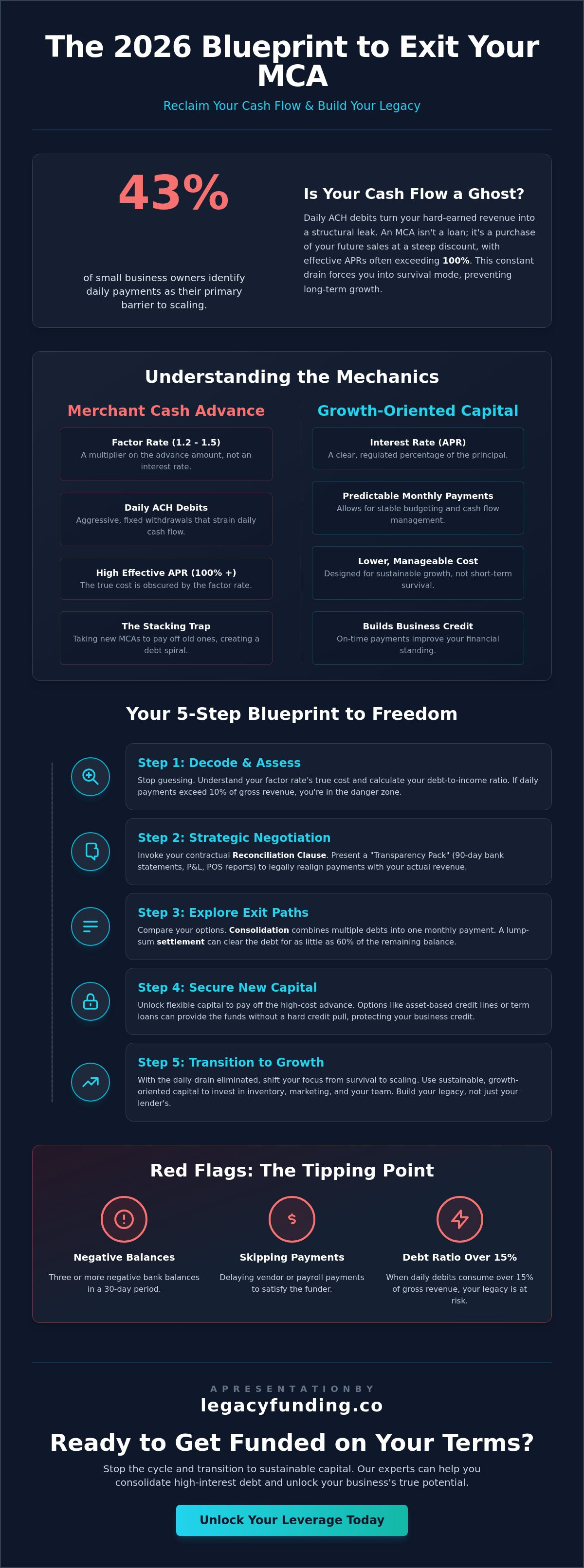
A Merchant Cash Advance is not a loan. It is a commercial transaction where you sell a portion of your future sales at a steep discount. Funders provide immediate capital in exchange for a fixed percentage of your daily credit card receipts or bank deposits. This distinction is critical because it allows funders to bypass usury laws that cap interest rates on traditional business loans. You aren't paying interest; you are fulfilling a purchase agreement.
The cost of this capital is measured by a factor rate, typically ranging from 1.2 to 1.5. A 1.4 factor rate means you owe $140,000 for every $100,000 you receive. When compressed into a six month repayment window, that 40% premium translates to an effective APR often exceeding 100%. Daily ACH debits begin almost immediately, stripping away the cash reserves needed for payroll and inventory. This constant drain limits your operational agility and forces you to focus on daily survival rather than long term scaling.
The "Stacking Trap" occurs when a business takes a second or third advance to cover the daily payments of the first. By 2026, automated underwriting has made stacking faster and more dangerous. Each new layer of debt increases the total daily debit, eventually consuming 20% or more of your gross daily revenue. Understanding how to get out of a merchant cash advance starts with recognizing that you cannot borrow your way out of a cash flow deficit.
Why Traditional Exit Strategies Often Fail
Asking a funder for a payment holiday rarely yields results. These companies rely on automated ACH systems designed for speed, not empathy. In 2026, while Confessions of Judgment (COJ) are legally restricted in most jurisdictions, funders still utilize aggressive UCC liens to freeze your business accounts. Simple revenue growth is rarely enough. If your profit margin is 15% but your capital costs 40%, you are losing money on every dollar you earn.
The Tipping Point: When to Seek an Exit
Identify the red flags before the crisis becomes terminal. If you have seen three negative bank balances in a 30 day period, you have reached the tipping point. Other warning signs include skipping vendor payments to satisfy the funder or taking "bridge" loans that offer no long term relief. A healthy debt-to-income ratio for revenue-based funding should never exceed 10% of gross daily receipts. When it hits 15%, your legacy is at risk. Transitioning to a professional blueprint allows you to prioritize stability over short term cash injections. Focus on growth metrics that matter. Stop the cycle and protect your business future today.
Strategic Negotiation: How to Approach Your MCA Funder
Negotiation is a high-stakes chess match. It requires a cold, analytical approach rather than an emotional plea. Funders are not your enemies; they are risk managers looking at a spreadsheet. They prefer a structured settlement over a total default because a 100% loss is a failure for their underwriters. Recent FTC enforcement against predatory MCA providers in January 2022 has shifted the power dynamic back toward the business owner. Use this leverage to protect your legacy. Professionalism wins where desperation fails. Present your case with data, not drama.
Invoking the Reconciliation Clause
The reconciliation clause is your built-in protection. It ensures your payments reflect your actual sales volume. If your revenue dips by 20%, your daily remittance must decrease proportionally. This isn't a favor; it's a contractual right. To invoke it, present a Transparency Pack to your funder. This pack must include specific evidence of your slowdown:
- Last 90 days of verified bank statements.
- A year-to-date Profit and Loss (P&L) statement.
- Daily point-of-sale (POS) reports showing transaction volume.
Use a "Good Faith" payment strategy to keep the account in good standing while you talk. Even a reduced daily payment proves you aren't a flight risk. This is a critical step in learning how to get out of a merchant cash advance without triggering aggressive collection tactics.
The Art of the Lump-Sum Settlement
Speed is a currency. A funder will often accept 60% of the remaining balance today rather than chasing 100% over the next 12 months. This math works in their favor because it eliminates future risk and frees up their capital for new deals. You can source this buyout capital from non-dilutive sources like asset-based credit lines. This allows you to bypass the high-cost daily pulls that drain your working capital.
Once the settlement is reached, demand a Release of Lien. This ensures the UCC-1 filing is removed from your business profile within 30 days. Removing this lien is vital for your ability to reclaim your financial freedom and scale your operations. You want to move toward a future where you can Get Funded on your own terms. Our goal is to help you reach a position where you can access capital with no hard credit pull and no personal guarantee required. This is how to get out of a merchant cash advance and stay out for good.
MCA Consolidation vs. Refinancing: Choosing Your Exit Path
Stop the bleeding and reclaim your revenue. You have two primary levers to pull when learning how to get out of a merchant cash advance. Consolidation groups your debt, while refinancing replaces it. Both strategies provide a clear blueprint for financial recovery. Consolidation simplifies your daily operations. It turns 22 monthly debits into one manageable payment. This restores your focus to growth rather than daily bank balances. Refinancing offers a deeper structural fix. You secure a lower-cost loan to kill the high-cost advance entirely. Modern 2026 refinancing products prioritize your security. They offer a No Personal Guarantee structure. This protects your home and family assets while you scale. Get Funded without risking your legacy.
- Consolidation: Merges multiple positions into one payment to stabilize daily cash flow.
- Refinancing: Replaces high-factor debt with a long-term, lower-interest loan.
- Security: Leverages assets without requiring a hard credit pull in many initial stages.
Reverse Consolidation: The Cash Flow Lifeline
Reverse consolidation acts as a strategic bridge for businesses suffocating under multiple daily payments. The new funder deposits your exact daily payment amount into your business account every week. You then pay the funder a smaller, extended payment over a longer duration. This strategy is 85% more effective for construction, medical, and seasonal retail industries where cash flow fluctuates. Beware the interest on interest trap. This occurs when you pay new fees on the total balance of your existing debt, including the original factor fees. Review your contracts to ensure you are not compounding your costs. Use this tool to breathe, then move toward a permanent exit. Get Funded with a plan that preserves your margins.
SBA Loans and Term Loans as Refinancing Tools
The 2026 SBA 7(a) guidelines offer a permanent path for debt replacement. You must demonstrate a 10% improvement in monthly cash flow to qualify for debt refinancing under current SBA rules. A 10-year term loan is the ultimate clean slate for an MCA-heavy business. It stretches your obligations and can lower your monthly overhead by up to 60%. Transitioning to bank-rate products typically requires a 680 FICO score and two years of profitable tax returns. If you meet these benchmarks, you can how to get out of a merchant cash advance by moving into traditional credit lines. Unlock this capital to move from survival to generational expansion. This is how you build a business that lasts.
The 5-Step Blueprint to Get Out of a Merchant Cash Advance
Stopping the cycle of high-interest debt requires more than just a new loan. It demands a tactical shift in how you manage your capital. Use this blueprint to reclaim your cash flow and secure your company's future. Learning how to get out of a merchant cash advance starts with visibility and ends with a sustainable capital structure.
Step 1 & 2: Stopping the Bleeding
Audit your current debt load immediately. You cannot fix what you don't measure. Create a debt schedule to track every active position. Include the lender name, the original advance amount, the factor rate, the remaining balance, and the daily remittance amount. Check your state's UCC-1 filings to see which lenders have placed liens on your business assets. This clarity is your first weapon.
Debt Stacking is the primary cause of SMB insolvency. It happens when you take a second or third advance to pay off the first, shrinking your margins to zero. Identify predatory offers before they land in your bank account. These typically arrive via high-pressure "renewal" phone calls or unsolicited emails promising 24-hour funding without bank statements. If an offer has a factor rate above 1.45 or requires you to hide information from your current lenders, refuse it. Stop the stacking cycle to protect your remaining liquidity.
Step 3 & 4: Securing the Solution
Analyze your cash flow to find your "break-even" payment. Use the Add-Back method to calculate your true EBITDA. Take your current net income and add back the interest, factor fees, and processing charges paid to your MCA providers over the last 12 months. This number represents your business's actual earning power without the weight of predatory debt. It's the key to proving your viability to a new funding partner.
When you approach Legacy Funding, don't just show us your debt; show us your legacy. Present your business as a growth-ready asset that just needs a better capital structure. We look for the "why" behind your success. We provide a path to how to get out of a merchant cash advance by focusing on your revenue potential. Speed is critical in an exit scenario. We prioritize a 24 to 48 hour approval window to ensure you can transition into a consolidation or buyout plan before your next daily draw hits. This rapid response prevents further cash depletion.
Step 5: Implement a Revenue-First Budget
Once you secure a buyout or consolidation, you must change your habits. Implement a Revenue-First budget. Allocate 10% of every deposit into a dedicated emergency capital reserve. This buffer ensures you never have to rely on high-cost advances again. Use your new, lower monthly payments to reinvest in your core operations and accelerate your scaling efforts.
Stop the daily withdrawals and reclaim your profit margins today. Contact Legacy Funding to explore your MCA exit strategy.
Unlocking Future Growth: Transitioning to Sustainable Capital
Learning how to get out of a merchant cash advance is the first step toward reclaiming your cash flow. But stopping the bleeding isn't enough. You need a capital strategy that fuels acceleration. Shift your mindset from survival to leverage. In 2026, the distinction between debt and growth capital defines which brands dominate their niche. Stop looking for a way out and start looking for a way up. You've fought hard to build your business; now it's time to fund it with precision.
Why Revenue-Based Financing is the Modern Alternative
Legacy Funding’s Revenue-Based Financing (RBF) products represent the next evolution of business capital. Traditional MCAs use rigid daily debits that drain your accounts regardless of performance. RBF aligns with your success. You pay more when revenue peaks and less when it dips. It’s a partnership, not a trap. This success-aligned model ensures your debt service never outpaces your ability to pay. It creates a breathing room that traditional lenders simply don't offer.
- Dynamic payments: Your remittances mirror your actual sales volume, protecting your bank balance during slow weeks.
- Performance-based: Approval focuses on your 2026 growth metrics rather than outdated credit models.
- Flexibility: RBF provides the speed of an MCA without the structural risks of a fixed daily draw.
Our 2026 RBF suite offers the liquidity you need to seize opportunities. It removes the friction of traditional banking while avoiding the "death spiral" of predatory daily draws. It’s a modern solution for the modern founder who values speed and sustainability. We focus on your trajectory, not just your history.
Building Your Financial Legacy
True entrepreneurs don't just pay bills; they build assets. Working capital should scale your operations, not just plug holes. A strategic Line of Credit serves as a permanent safety net. It ensures you never have to search for how to get out of a merchant cash advance again. This is about building a blueprint for generational growth that survives market shifts. When you have access to revolving capital, you move from a defensive posture to an offensive one.
Use your new capital strategy to achieve measurable results:
- Acquire inventory at bulk discounts to increase your gross margins by 15% or more.
- Launch aggressive marketing campaigns that target a 4:1 return on ad spend.
- Hire top tier talent to automate your daily operations and free up your time for high level strategy.
Legacy Funding prioritizes your speed and transparency. We offer funding options with No Personal Guarantee and No Hard Credit Pull to protect your personal financial standing while you grow your empire. Don't let a bad deal define your company's future. Schedule a free capital consultation today to assess your exit options and unlock your potential. It’s time to Get Funded the right way.
Take Control of Your Business Legacy
Breaking the cycle of high-interest daily debits isn't just a financial move; it's a strategic pivot for your company's survival. You've mastered the blueprint for negotiation and recognized the power of strategic consolidation. Now, you must act. Understanding how to get out of a merchant cash advance is the first step toward reclaiming your margins and accelerating your growth. In 2026, the speed of commerce demands a financial partner who moves as fast as your market does.
Legacy Funding provides the modern alternative to restrictive traditional lending. We focus on your cash flow, not just your credit scores. Our process is designed for maximum efficiency. We offer an initial consultation with no hard credit pull and can have funds available in 24 to 48 hours. Stop managing debt and start scaling your vision with capital that works for you. You deserve a partner who values your trajectory over your history. Unlock your business’s potential and get funded with a sustainable capital blueprint today.
Your future is waiting. Let's build it together.
Frequently Asked Questions
Can I legally stop payments on a merchant cash advance?
You cannot legally stop payments without facing immediate litigation and asset seizure. Merchant cash advances are structured as the sale of future receivables, meaning you've already sold those funds to the funder. Stopping the daily ACH draw triggers a breach of contract. In states like New York, this allows funders to execute a Confession of Judgment and freeze your business bank accounts within 72 hours.
What happens if I default on an MCA with a personal guarantee?
Defaulting allows the funder to pursue your personal assets to satisfy the business debt. If you signed a personal guarantee, your savings, vehicles, and real estate are at risk. Data from the American Fair Credit Council shows that 90% of MCA contracts include these aggressive clauses. Protect your legacy by negotiating a payoff or consolidation before a default ruins your personal financial standing.
Is MCA debt consolidation the same as a debt settlement?
No, debt consolidation involves taking one new loan to pay off multiple advances, while settlement involves negotiating to pay less than the total balance. Consolidation streamlines your daily draws into a single, manageable monthly payment. Learn how to get out of a merchant cash advance by choosing consolidation to preserve your business relationships and maintain the cash flow needed to scale your operations.
How does a UCC-1 lien affect my ability to get a new business loan?
A UCC-1 lien signals to other lenders that your business assets are already pledged as collateral, which typically disqualifies you from traditional bank financing. Most Tier 1 lenders require a first-position lien to approve a loan. If an MCA funder filed a UCC-1, you'll need to satisfy that debt or obtain a subordination agreement. This filing remains on your public record for five years.
How much does it cost to get out of an MCA early?
Most MCA contracts require you to pay the full "fixed amount" regardless of when you exit the deal. Unlike traditional loans where you save on interest through early repayment, MCAs use factor rates that lock in the total cost. If your contract specifies a $50,000 total payback, you'll likely pay that entire sum even if you exit six months early. Always check for specific prepayment penalty clauses.
Will getting out of an MCA hurt my business credit score?
Exiting an MCA through a structured payoff or consolidation actually strengthens your credit profile over the long term. While the initial credit inquiry might cause a minor dip, reducing your debt-to-income ratio is a massive win. According to Experian, 35% of your business credit score depends on payment history. Resolving these obligations ensures you remain eligible to Get Funded for future expansion projects.
What is the difference between an MCA and Revenue-Based Financing?
The primary difference lies in the repayment flexibility and the impact on your daily cash flow. MCAs often demand fixed daily withdrawals, while revenue-based financing adjusts your payments based on a percentage of actual monthly sales. This distinction is vital when learning how to get out of a merchant cash advance. Revenue-based models provide breathing room during slow months, whereas MCAs drain your reserves regardless of performance.
How long does the MCA exit process typically take?
A professional MCA exit through consolidation or refinancing typically takes 7 to 14 business days. Your speed in providing bank statements and current payoff letters determines the final timeline. Once you submit your documentation, a savvy financial ally can often secure a term loan to clear your existing balances within 48 hours of approval. This rapid transition stops the daily drain on your working capital immediately.