


How to Choose a Revenue-Based Financing Partner: A Strategic Guide for 2026
Your equity is your most valuable asset, yet many founders treat it like a bargaining chip the moment they need growth capital. In a global market projected to reach $15.86 billion in 2026, mastering how to choose a revenue based financing partner is the difference between scaling with confidence and falling into a debt trap. You don't have to settle for the bureaucratic sludge of legacy banks or the predatory "factor rate" stacking that erodes your margins. True financial independence requires a partner that values your cash flow as much as you do.
We understand the frustration of waiting weeks for a bank approval only to be met with a "no" or a demand for personal collateral. This guide empowers you to secure capital within 24 to 48 hours while retaining 100% of your equity. You'll learn to cut through the noise of opaque fee structures and identify allies who align with your specific revenue fluctuations. We'll preview the critical 2026 regulatory shifts, break down the truth about effective APR versus factor rates, and highlight the red flags that separate strategic consultants from aggressive lenders. It is time to fund your growth on your own terms.
Key Takeaways
- Shift your mindset from viewing capital as a liability to seeing it as a strategic purchase of future receivables that fuels immediate expansion.
- Master the art of how to choose a revenue based financing partner by distinguishing between direct lenders and brokers to ensure transparency on every deal.
- Calculate the Total Cost of Capital to uncover the real price of your funding and avoid the confusion of factor rates.
- Protect your business autonomy by recognizing red flags like high-pressure sales tactics and a lack of industry-specific knowledge.
- Accelerate your scaling process with a funding ally that can deliver capital within 24 to 48 hours based on your future growth metrics.
Why Your Revenue-Based Financing Partner Is More Than a Source of Capital
Think of capital as oxygen for your scaling business. It shouldn't be a weight that slows you down. It should be the propellant that pushes you forward. Revenue-based financing (RBF) isn't a traditional debt instrument. It's a strategic purchase of your future receivables. You aren't taking on a liability that requires personal collateral or a lien on your home. You are selling a small slice of future sales for the cash you need right now. This mindset shift is critical for any founder. You are trading a portion of future revenue for immediate, high-impact growth potential.
Strategic alignment is the core of this model. When you evaluate how to choose a revenue based financing partner, you're looking for a partner whose repayment structure mirrors your specific cash flow. If your business has a slow month, your payment adjusts downward automatically. This flexibility is a lifesaver for companies in sectors like healthcare, professional services, or construction where billing cycles are often unpredictable. You get the capital you need without the stress of fixed monthly payments that don't care about your actual bank balance. It turns your financing into a variable expense rather than a fixed burden.
The Equity vs. Revenue-Based Financing Debate
Founders in 2026 are moving away from the heavy dilution of venture capital. Giving up 10% or 15% of your company might seem like a simple trade today, but it's the most expensive capital you'll ever take. That equity represents a massive loss in your eventual exit value and a permanent loss of control. RBF uses a clear, predictable factor rate. You know the total cost of capital before you sign. You retain 100% of your equity. You keep your autonomy. You remain the sole pilot of your business's destiny while fueling your engine with non-dilutive funds.
The Role of Speed in Modern Business Scaling
Speed is the new currency of commerce. A 24-hour funding window can be the difference between winning a major contract and watching it go to a competitor. Traditional institutions are bogged down by red tape and outdated underwriting. They move at a glacial pace. Slow capital has a high hidden cost; it's the cost of missed opportunities. Imagine a sudden demand spike for your product or a flash sale opportunity from a supplier. You need inventory immediately. RBF provides that liquidity in a fraction of the time. Learning how to choose a revenue based financing partner means prioritizing a source that understands the urgency of modern scaling. You need a partner that moves at the speed of your opportunities, not the speed of a loan committee.
Direct Lenders vs. Brokers: Navigating the RBF Landscape
The lending landscape is crowded. Knowing how to choose a revenue based financing partner starts with a simple question: Who is actually funding the deal? You'll encounter two main players: direct lenders and brokers. A direct lender provides the capital from their own balance sheet. They hold the paper. A broker is a middleman. They gather your data and shop it around to various sources. This distinction isn't just semantics. It dictates your speed, your cost, and your relationship.
Transparency is your shield. Ask your point of contact point-blank if they are the direct funding source. If they hesitate, you're likely talking to a broker. Direct communication leads to faster results. When you speak directly to an underwriter, you cut out the translation errors that happen through a middleman. This is how 48-hour funding becomes a reality. It's about efficiency. If your revenue dips next month, you don't want to play telephone with a broker. You want to call the person who signed the check. If you're ready to speak with a direct ally about your growth, reach out to our team for a transparent assessment.
The process of tapping RBF requires clarity on both sides of the table. Working with a direct partner removes the hidden layer of brokerage commissions. This often results in lower overall fees for your business. You get direct access to decision-makers. You build a history that makes renewals seamless. Consistency matters when you're scaling at pace. You need a partner who is personally invested in your trajectory, not just a transaction.
The Advantages of Direct Funding Partnerships
Direct access is power. You aren't a file number; you're a partner. Underwriters look at the story behind your numbers. Direct funding eliminates the "success fee" often tacked on by brokers. You also benefit from a unified renewal process. When you need more capital, the person who knows your history is already on the line. It's a cleaner, faster, and more professional way to manage your cash flow.
When a Broker Might Make Sense (And the Risks Involved)
Brokers can help if you have highly complex needs involving multiple funding products simultaneously. However, the risks are real. Aggressive brokers may prioritize their commission over your business health. They might engage in "information shopping." This means sending your sensitive financial data to dozens of lenders at once. It hurts your credibility. It makes you look desperate. When considering how to choose a revenue based financing partner, always vet your source. Focus on quality over quantity when seeking a long-term ally.
Evaluating Financial Mechanics: Beyond the Factor Rate
Numbers don't lie, but they can be obscured. When you're determining how to choose a revenue based financing partner, you must look past the initial offer and dissect the underlying math. A factor rate is a fixed multiplier applied to your principal. If you receive $100,000 at a 1.2 factor rate, you owe $120,000. It doesn't compound like traditional interest; however, it also doesn't decrease if you pay it back early. This is why the Total Cost of Capital (TCC) is your most honest metric. It reveals exactly how many cents of every dollar earned are going back to your partner. For a medical practice or a construction firm, this clarity prevents cash flow strangulation during lean months.
Repayment caps and holdback percentages are the levers that control your daily operations. A holdback is the percentage of daily sales diverted to the lender. If this percentage is too high, you won't have enough left to cover payroll or materials. Always negotiate a cap that protects your working capital. Beware the "Renewal Trap." Some lenders push you to take more money before you've paid off the first advance. This stacking of factor rates can quickly lead to a debt spiral that consumes your profit margins. A strategic partner wants you to grow, not just stay in debt.
Comparing RBF to Traditional Term Loans and MCAs
While a Merchant Cash Advance (MCA) often demands fixed daily draws regardless of sales, Revenue-Based Financing (RBF) fluctuates with your actual sales volume. This makes RBF far more forgiving during seasonal downturns or supply chain delays. The flexibility of RBF ensures that your financing scales with you, not against you.
| Metric for $100k Advance | RBF (1.2 Factor Rate) | Traditional Term Loan (15% APR) |
|---|---|---|
| Total Repayment | $120,000 | ~$108,000 (1 Year) |
| Payment Structure | Flexible % of Revenue | Fixed Monthly Payment |
| Collateral Required | None | High (Assets/Personal) |
| Approval Speed | 24 to 48 Hours | 30 to 90 Days |
The Transparency Test: Reading the Fine Print
Transparency is a hallmark of a high-quality ally. If the term sheet is longer than two pages, they might be hiding something. Identifying hidden origination, closing, or "maintenance" fees is essential to understanding your true cost. Demand a "reconciliation" clause. This is your legal right to adjust payments if your revenue drops. A partner who refuses to reconcile is a predator, not an ally. High-level consultants provide one-page summaries that highlight every fee from the start. This level of clarity is a non-negotiable part of how to choose a revenue based financing partner in 2026.
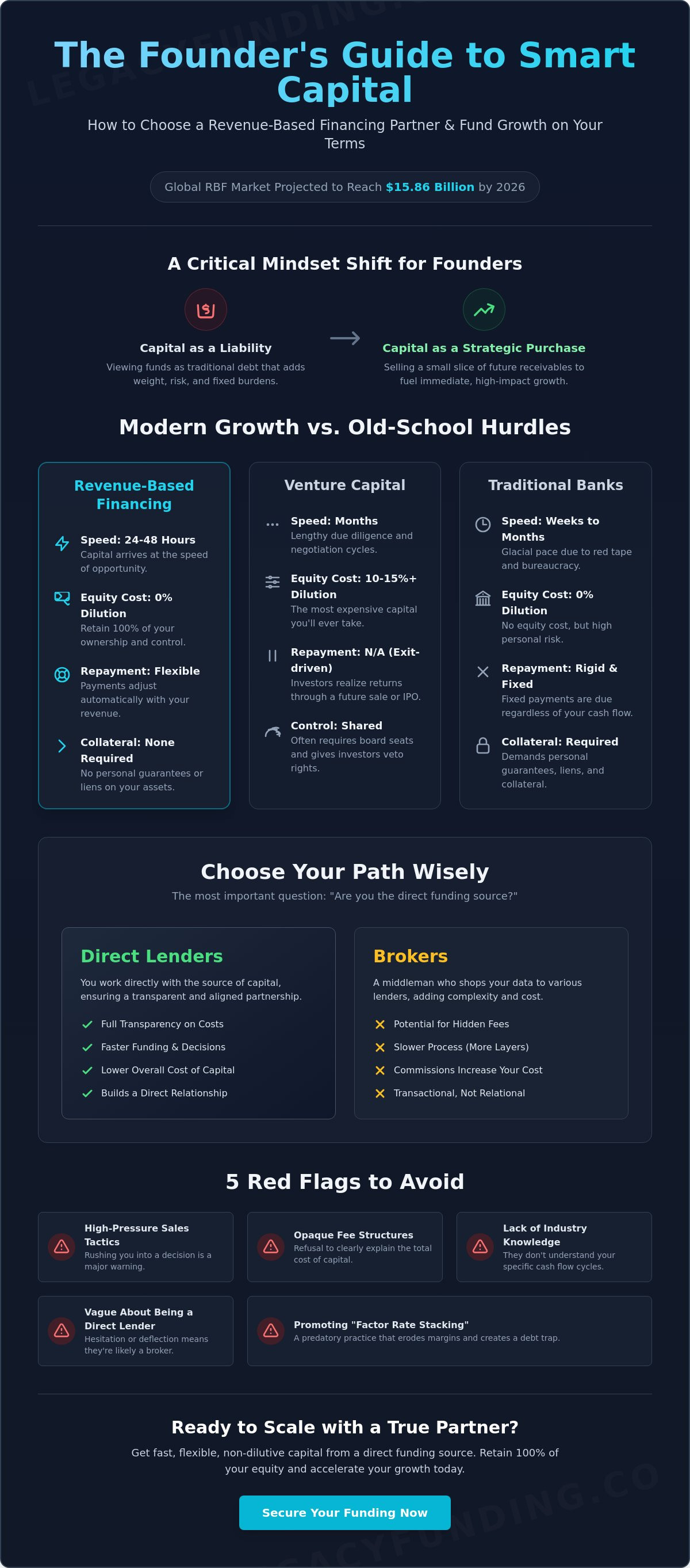
5 Red Flags to Watch for When Choosing a Partner
Choosing the wrong partner is more than a mistake; it's a strategic setback. Identifying how to choose a revenue based financing partner involves spotting the warning signs before you sign the term sheet. Don't let a fast-talking salesperson dictate your financial future. Your intuition is your first line of defense. If the deal feels rushed, it probably is. Professional consultants provide space for you to model the capital's impact on your margins. They don't set artificial deadlines to force a signature. They prioritize your long-term stability over their monthly quota.
Watch for these specific indicators of a predatory relationship:
- Aggressive Sales Tactics: High-pressure calls and demands for a signature within hours are hallmarks of a transaction-focused broker, not a growth partner.
- Lack of Industry Specialization: A partner who treats a medical practice like a SaaS startup doesn't understand your specific cash flow cycles or billing delays.
- Vague Fee Structures: If they cannot provide a clear "Total Dollars Out" figure on a single page, they are likely hiding maintenance or closing fees.
- Poor Online Reputation: Look past the star rating on Trustpilot. Read the negative reviews to find patterns of aggressive collection or sudden changes in terms.
- No Clear Renewal Path: Strategic capital isn't a one-and-done transaction. If they can't explain how subsequent funding rounds work, they aren't planning for your future.
The Danger of "Stacking" and Excessive Renewals
Stacking is a silent killer for small businesses. It occurs when a lender encourages you to take a second or third advance before the first is retired. This creates a cycle of debt where your revenue is merely servicing interest. Be especially wary of "Reverse Consolidation." This tactic often masks astronomical fees by rolling multiple advances into one larger payment. Always ask about early payoff discounts. A true ally rewards your success by lowering the total cost of capital when you pay back early. If you want a partner who values your business health over a quick commission, reach out to us for a transparent assessment.
Assessing the "Cash Flow First" Underwriting Model
Traditional institutions look backward at tax returns and personal credit scores. When you are learning how to choose a revenue based financing partner, look for those who prioritize your future performance. Modern RBF partners use tech-forward tools like Plaid to integrate with your bank feeds in real-time. This "Cash Flow First" approach allows them to offer better terms based on your actual business health. It moves the conversation from financial obligations to growth metrics. This data-driven model is how savvy founders secure capital in 24 to 48 hours without the friction of legacy banking. Demand a partner that uses data to empower you, not just to find reasons for a denial.
Scaling with Legacy Funding Advisors: Fast, Flexible, and Focused
Legacy Funding Advisors represents a departure from the rigid, backward-looking models of traditional finance. Most institutions judge your future potential by your past mistakes. We do the opposite. We focus on your current cash flow and your upcoming opportunities. This forward-looking perspective is the cornerstone of the Legacy Difference. When you are deciding how to choose a revenue based financing partner, you need an ally that sees the trajectory of your business, not just the data points in your rearview mirror. We don't just provide capital; we provide a bridge to your next stage of growth.
Our commitment to speed is absolute. We understand that in industries like construction or healthcare, a delay of even a few days can cost you a contract or a critical supplier discount. That is why our 24 to 48-hour funding promise isn't just a goal; it's our standard operating procedure. We move at the speed of your business. We strip away the bureaucratic friction that slows down traditional banks. You get the capital you need precisely when it can do the most good. It's about accessibility, transparency, and results.
Our Simple 3-Step Application Process
Efficiency is built into every stage of our workflow. We have designed a process that respects your time and protects your focus. Follow these three clear steps to secure your growth capital:
- Step 1: Complete our streamlined digital application. Our secure systems perform a real-time cash flow analysis without the need for stacks of paperwork.
- Step 2: Review your transparent offer. We provide clear factor rates and a total cost of capital breakdown. There are no hidden fees or closing costs to worry about.
- Step 3: Receive your funds. Once approved, the capital is deposited into your account within 24 to 48 hours.
Beyond the Initial Advance: A Long-Term Funding Ally
A single transaction does not build a legacy. We position ourselves as your long-term financial consultant. Our team helps you navigate the complex world of commercial finance to find the right product for your current stage. Whether you need an SBA loan for long-term stability, a business line of credit for ongoing expenses, or debt consolidation to simplify your overhead, we provide the expert guidance you deserve. Mastering how to choose a revenue based financing partner means finding a team that prioritizes your generational success over a quick deal. We are here to help you scale, pivot, and dominate your market. Apply for fast business funding today with Legacy Funding Advisors and experience the power of a true partnership.
Own Your Growth and Protect Your Equity
Scaling your business shouldn't mean selling your soul or your equity. You now have the strategic blueprint to navigate the 2026 funding landscape with precision. Focus on the total cost of capital rather than the initial factor rate. Prioritize direct relationships over the noise of aggressive brokers. Mastering how to choose a revenue based financing partner ensures you remain the sole pilot of your enterprise while fueling your engine with non-dilutive capital.
Legacy Funding Advisors replaces bureaucratic friction with speed, accessibility, and transparency. We evaluate your business based on real-time cash flow metrics, not just personal credit scores. Whether you're operating in the U.S., Puerto Rico, or Canada, our process delivers the liquidity you need when opportunities strike. We deliver funds within 24 to 48 hours so you can stay focused on building your brand. Don't let traditional institutions slow your momentum.
Get a custom funding offer in 24 hours
The future of your business is built on the decisions you make today. Choose a partner that values your autonomy as much as you do. Let's build your legacy together.
Frequently Asked Questions
What is the main difference between revenue-based financing and a merchant cash advance?
Revenue-based financing is designed for businesses with predictable monthly revenue and involves a strategic purchase of your future total sales. Merchant cash advances specifically target your future credit card transactions and are often geared toward retail or restaurant models. RBF typically offers more founder-friendly terms and greater flexibility for professional services or tech companies compared to the high-cost daily draws associated with MCAs.
How much does revenue-based financing typically cost in 2026?
The cost of capital is determined by a factor rate rather than a traditional compounding interest rate. In 2026, industry data shows that factor rates typically range between 1.1x and 1.5x depending on your risk profile and the stability of your recurring revenue. You should always calculate your total cost of capital to understand exactly how many cents of every dollar earned will go toward your repayment.
Can I qualify for revenue-based financing if I have a low credit score?
You can qualify for funding even with a low personal credit score because underwriting focuses on your business's actual performance. RBF partners prioritize your monthly revenue consistency and cash flow health over your personal FICO score. This approach empowers founders who have high-performing businesses but may lack a perfect personal credit history to access the capital they need to scale.
How quickly can I receive funds from an RBF partner?
You can typically receive funds in your account within 24 to 48 hours of your initial application. The process is built for speed; digital integrations allow partners to verify your bank data and revenue metrics instantly. This rapid access to capital is a primary reason why learning how to choose a revenue based financing partner is vital for seizing time-sensitive growth opportunities.
Will choosing a revenue-based financing partner affect my business credit?
Choosing an RBF partner usually does not impact your personal or business credit score because it is not a traditional debt instrument. Most providers avoid hard credit pulls that would lower your score during the application phase. While it doesn't function like a standard loan, maintaining a strong relationship with a partner can demonstrate your business's ability to manage capital effectively.
Is revenue-based financing better than a traditional bank loan for small businesses?
RBF is often superior for businesses that need speed and lack traditional collateral or a long history with legacy banks. Traditional bank loans require months of paperwork and often demand a personal guarantee or a lien on your assets. RBF provides a faster, non-dilutive alternative that scales with your sales without the bureaucratic friction or equity loss associated with traditional funding.
What happens to my payments if my business revenue decreases for a month?
Your payments decrease automatically if your revenue drops because the repayment is a fixed percentage of your actual sales. This built-in flexibility ensures that your financing never becomes a strangulating burden during seasonal lulls or unexpected market shifts. It creates a true partnership where your funding ally only succeeds when your business is generating revenue.
What are the typical eligibility requirements for revenue-based funding?
Eligibility depends on your monthly revenue and time in business rather than your personal assets. Most partners require at least six months of operational history and consistent monthly revenue of $10,000 or more. Knowing how to choose a revenue based financing partner involves finding one that uses real-time data feeds to verify your growth metrics quickly and accurately.