


How to Calculate Working Capital Needs: A Founder’s Blueprint for 2026
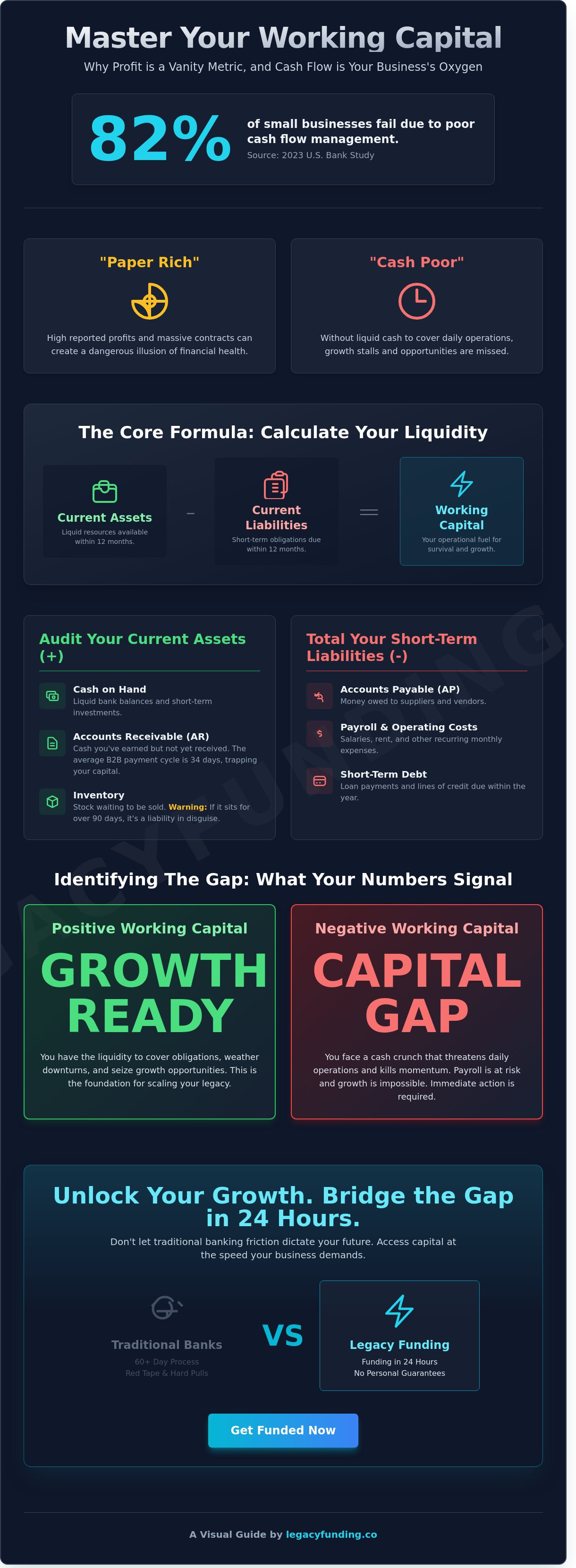
Profit is a vanity metric, but cash flow is your business's oxygen. A 2023 study by U.S. Bank revealed that 82% of small businesses fail specifically because of poor cash flow management. Learning how to calculate working capital needs isn't just a financial chore; it's the foundation of your 2026 growth blueprint. You've likely felt the anxiety of a looming payroll or the frustration of watching a competitor grab market share because your capital was tied up in unpaid invoices.
We agree that being paper rich while struggling to fund inventory is an exhausting way to run a company. You deserve a clear path to liquidity that doesn't involve waiting 60 days for a traditional bank's permission. This guide promises to deliver the exact formulas you need to quantify your requirements and bridge the gap between your current assets and your scaling goals. We'll master the math, identify the levers that accelerate your cash cycle, and show you how to Get Funded with the speed your legacy demands. It's time to trade confusion for a concrete strategy that fuels your expansion without the friction of personal guarantees or hard credit pulls.
Key Takeaways
- Identify why liquidity is the true lifeblood of your operations and why profit alone won't sustain your 2026 growth.
- Master the essential blueprint for how to calculate working capital needs to ensure your current assets always outpace your liabilities.
- Discover how the Cash Conversion Cycle dictates your operating requirements and learn to turn speed into a competitive advantage.
- Recognize the warning signs of a capital gap and shift your mindset from managing debt to leveraging strategic investment.
- Bridge your funding gap in 24 hours with modern, high-speed alternatives that bypass traditional banking red tape.
Understanding Working Capital as Your Business Fuel
Working capital is the lifeblood of your daily operations. It’s the pulse of your business. Without it, even the most innovative companies stall before they ever reach the finish line. In the volatile market of 2026, profit does not equal liquidity. You can have a record-breaking sales month and still find your bank account empty. This gap between revenue and available cash is where many founders lose their footing. Knowing how to calculate working capital needs is the first step toward building a lasting legacy.
Overtrading is a specific risk that catches aggressive entrepreneurs off guard. It happens when you grow faster than your cash allows. You secure a massive contract, hire ten new employees, and buy bulk inventory. Then you realize the client pays on a 90-day cycle. You've run out of fuel mid-sprint. It’s a silent killer; according to 2024 industry data, cash flow mismanagement contributes to 82% of small business failures. Treat your capital as a tool for leverage. It isn't just about survival; it’s about having the dry powder to strike when an opportunity appears. This is how you transition from a small-scale operator to a market leader.
The Difference Between Survival and Scaling
Operational working capital keeps your doors open. It covers the basics: payroll, rent, and recurring software fees. Growth capital is the strategic layer on top. It’s the money used to unlock new territories or launch product lines. Traditional banks often fail to see the potential in your cash flow. They get bogged down in red tape and historical data. Modern business moves at the speed of light. You need a partner who values momentum. Speed is the ultimate currency in modern finance. If you can't access capital in 24 hours, you’re already behind the curve.
- Operational Capital: Sustains the status quo.
- Growth Capital: Accelerates market acquisition.
- Legacy Funding Advisors: Bridges the gap between your vision and your reality.
Why Your Current Metrics Might Be Lying
Your balance sheet can be a trap. It shows what you own and what you owe, but it ignores the friction of time. Understanding Working Capital requires a deep dive into your timing gaps. If your receivables are lagging while your payables are due, you have a capital deficit. This is why learning how to calculate working capital needs is non-negotiable for founders who want to scale. Working capital is the net value derived from subtracting your current liabilities from your current assets. Get Funded, secure your cash flow, and stop letting timing gaps dictate your growth trajectory.
The Core Formula: Calculating Your Current Working Capital
Calculating your liquidity isn't just a standard accounting exercise. It's a survival metric for your business. The math is straightforward. Subtract your short-term debts from your liquid assets. This specific result dictates your ability to scale without hitting a wall. The Core Formula for Working Capital provides the necessary baseline for this assessment. Understanding how to calculate working capital needs allows you to identify exactly where your cash is trapped. A positive result means you're ready to invest and build your legacy. A negative result signals a potential cash crunch that could stall your growth and threaten your operations.
Step 1: Audit Your Current Assets
Assets are the fuel for your daily operations. You must look beyond the balance in your checking account to see the full picture. Start with these three pillars:
- Inventory valuation: Old stock is a weight on your capital. If inventory sits for more than 90 days, it's no longer an asset; it's a liability in disguise. Value it realistically to avoid overestimating your strength.
- Accounts Receivable: This is the hidden cash you've already earned. In 2023, the average B2B payment cycle stretched to 34 days. Speeding this up through better terms or automation unlocks immediate liquidity.
- Cash on hand: Include your liquid bank balances and short-term investments that you can convert to cash within 12 months.
Step 2: Total Your Short-Term Obligations
Obligations represent the weight on your momentum. You need a clear view of what's leaving the building in the next year. Founders often miss the small details that compound into major hurdles. Focus on these critical areas:
- Accounts Payable: Manage your vendor relationships without draining your reserves. While you want to keep vendors happy, paying too early can restrict your ability to pivot when opportunities arise.
- Fixed Obligations: Account for upcoming payroll, quarterly taxes, and short-term debt repayments. These are non-negotiable and hit your bottom line every month.
- Accrued Expenses: These are costs like utilities, insurance, or commissions that you've incurred but haven't been billed for yet. A 15% miscalculation here can derail your entire monthly budget.
Once you master these numbers, you'll know exactly how to calculate working capital needs for your specific industry. If the gap between your assets and liabilities is too narrow, you need to unlock more leverage to protect your business's future. Don't let a temporary cash gap stop you from reaching your next milestone. Every dollar you reclaim from your balance sheet is a dollar you can use to accelerate your growth.
Determining Your Working Capital Requirement (WCR)
Standard accounting formulas often miss the nuance of your daily operations. The Working Capital Requirement (WCR) provides the operational precision you need to scale. It focuses strictly on operating assets and operating liabilities. Learning how to calculate working capital needs through this lens prevents you from overestimating your true liquidity. This metric bridges the gap between your initial cash outlay for inventory and the moment revenue hits your bank account. It is the most accurate way to measure the pulse of your business health.
The Cash Conversion Cycle Blueprint
Your Cash Conversion Cycle (CCC) is the heartbeat of your enterprise. It measures the exact number of days it takes to turn inventory into liquid cash. If your inventory sits for 42 days and your clients take 60 days to pay, you're carrying 102 days of financial risk. Slow-paying clients act as a lead weight on your ability to pivot. They trap your wealth in their balance sheets. You must shorten this cycle to unlock internal capital. Implement these three strategies to accelerate your cash flow:
- Digitize your invoicing to eliminate mailing and processing delays.
- Negotiate 45-day terms with suppliers to better match your sales cycle.
- Offer 2% discounts for payments received within 10 days.
Shortening your cycle by just 12 days can provide the leverage needed to fund a new product line without external debt. Speed is your greatest asset in a competitive market. It's the difference between stagnation and market leadership.
Adjusting for Growth and Seasonality
Static calculations fail in dynamic environments. As we move toward 2026, market shifts demand more flexible funding strategies. A 30% spike in sales requires a proportional increase in your capital buffer to handle fulfillment costs. Startups often operate on thin margins and high burn rates. Legacy businesses require capital for massive scale and market dominance. Prepare a 6-month forecast that accounts for these shifts. How to calculate working capital needs for the future involves planning for your best-case growth scenario, not just your current baseline.
Maintain a 20% capital reserve to protect against supply chain volatility. This ensures you never miss an opportunity due to a temporary cash shortage. Our modern approach bypasses the friction of traditional banking. We focus on your growth metrics rather than just your debt obligations. Don't wait for a seasonal dip to seek support. Secure your future with a partner that understands speed. Get Funded today and build your legacy with No Hard Credit Pull.
Identifying the Gap: When Your Numbers Signal a Need
Numbers provide the blueprint for your expansion. A capital gap isn't a sign of failure; it's a signal that your ambition has outpaced your current liquidity. Recognizing this gap early prevents a cash crunch from becoming a crisis. Most founders view funding as debt, but elite entrepreneurs see it as a strategic investment. When you know how to calculate working capital needs, you stop guessing and start scaling.
The biggest mistake you can make is waiting for customers to pay. This "wait and see" approach is a growth killer. If your accounts receivable turnover sits at 45 days while your payroll and vendor obligations hit every 15 days, you have a 30-day structural void. Closing this gap with outside capital allows you to maintain momentum without draining your personal reserves. Stop waiting for the mail and start driving the market.
The Cost of Waiting vs. The Cost of Capital
Waiting for cash flow to catch up has a hidden price tag. Missed opportunities often cost more than the interest on a credit line. Having immediate liquidity allows you to dominate your niche by moving faster than the competition. Consider these advantages:
- Vendor Leverage: Negotiate a 2% discount on a $100,000 inventory order by paying upfront rather than net-30.
- Bulk Purchasing: Secure raw materials at 2023 prices before inflation or supply chain shifts drive costs higher.
- Market Speed: The 25% profit margin gained from fulfilling a massive surprise contract immediately far outweighs the 1.15 factor rate of a quick-access MCA.
Signs Your Business Is Ready for an Injection
Your balance sheet tells a story. If your receivables are at an all-time high but your bank balance is at a record low, you are "asset rich and cash poor." This is the prime moment to Get Funded. You need an injection when you have to turn down a $250,000 contract because you lack the $50,000 required for initial labor and equipment. Revenue-based financing acts as the bridge that connects your current capacity to your future potential.
Legacy Funding provides the tools to bridge these gaps without the friction of traditional banking. We offer a streamlined path to capital with No Personal Guarantee and No Hard Credit Pull. We focus on your revenue and your results, not just your history. Secure the capital you need to protect your legacy and accelerate your trajectory today.
Ready to bridge the gap and scale your operations? Get Funded now and unlock your growth potential.
Unlock Your Growth: Bridge the Capital Gap in 24 Hours
You've done the heavy lifting. You've learned how to calculate working capital needs and identified the exact numbers required to keep your operations fluid. But a calculation on a spreadsheet doesn't pay vendors or cover payroll. Traditional banks move at a glacial pace, often forcing founders to wait 60 to 90 days for a decision. Legacy Funding disrupts this outdated cycle. We act as the modern alternative, providing the capital you need in as little as 24 hours.
We leverage Revenue-Based Financing and Merchant Cash Advances to bypass the friction of old-school lending. Our process focuses on your business performance, not just your history. We eliminate the stress of the "hard credit pull" that lowers your score. We remove the "personal guarantee" that puts your family home at risk. You get the liquidity you need without the baggage of traditional debt.
The Legacy Funding Advantage
We value your daily cash flow over a static credit score. Our 24-to-48-hour approval blueprint is designed specifically for fast-moving founders who need to move at the speed of the market. Whether you are operating in the US, Puerto Rico, or Canada, we provide tailored solutions that fit your specific industry requirements. We look at the strength of your sales, the consistency of your deposits, and the potential of your vision. Our goal is to empower your growth, not hinder it with restrictive covenants.
- Speed: Receive funding in your account within one business day.
- Accessibility: No hard credit pulls and no personal guarantees required.
- Flexibility: Funding amounts scale based on your actual revenue performance.
Next Steps: From Calculation to Capital
The path from your initial assessment to active capital is shorter than you think. Our application process is entirely digital and requires zero physical paperwork. You've already determined how to calculate working capital needs for your current cycle; now you can use that data to fuel your 2026 expansion. Secure the inventory you need for next season or hire the specialized talent your competitors are chasing. Don't let a lack of liquidity stall your momentum.
Your business deserves a partner that understands the grit required to scale. We provide the leverage you need to secure your market position and build something that lasts. Stop waiting for a bank to validate your potential. Take control of your financial future today and ensure your business legacy remains intact. Get Funded Today and accelerate your journey toward financial freedom.
Fuel Your 2026 Growth Strategy
Mastering how to calculate working capital needs is the difference between surviving and scaling. By 2026, founders who leverage the WCR formula will navigate market volatility with total precision. You've identified the gap between your current assets and liabilities. Now, you must bridge it. Traditional banks move slowly, but your business moves at the speed of light. Don't let a temporary capital shortage stall your momentum or compromise your long term vision. You need a partner that understands the high stakes of modern commerce. Legacy Funding delivers capital in 24 to 48 hours. We require no hard credit pull and no personal guarantee. This is your blueprint for building a lasting empire. Stop waiting for traditional bank approvals and start accelerating your progress today. We provide the leverage while you provide the innovation. Your business deserves a financial ally that values speed as much as you do.
Unlock your growth capital and Get Funded in 24 hours
Build your legacy with confidence.
Frequently Asked Questions
What is the simplest formula to calculate working capital needs?
To calculate working capital needs, subtract your current liabilities from your current assets to reveal your available liquidity. This simple formula serves as the primary blueprint for understanding your business's immediate financial health. If your balance sheet shows $100,000 in cash and accounts receivable against $60,000 in short term debts, your working capital is $40,000. Master how to calculate working capital needs to accelerate your growth and bridge any operational gaps efficiently.
How much working capital should a small business have in 2026?
Aim for a current ratio between 1.2 and 2.0 to ensure your business remains resilient in 2026. Maintaining this buffer allows you to weather market fluctuations and capitalize on sudden opportunities. According to U.S. Small Business Administration guidelines, having 90 days of operating cash on hand is a standard safety net for modern founders. Secure your legacy by keeping these metrics optimized for rapid scaling and long term stability.
Can I get a working capital loan with a low credit score?
You can secure funding with a low credit score by leveraging revenue-based financing models. We focus on your monthly sales performance rather than just a FICO score. Many alternative lenders offer a No Hard Credit Pull approach to protect your rating while you access capital. This shift allows entrepreneurs with scores as low as 500 to unlock the resources needed to bridge their cash flow gaps and accelerate their scaling efforts.
What happens if my working capital is negative?
Negative working capital means your current liabilities exceed your current assets, which signals a potential liquidity crisis. This imbalance suggests you cannot meet your upcoming financial obligations using only your liquid resources. Research from the JPMorgan Chase Institute shows that the median small business holds only 27 days of cash buffer. Act quickly to restructure debt or inject capital to prevent operational stalls and protect your business reputation before your cash reserves hit zero.
How does revenue-based financing differ from a traditional bank loan?
Revenue-based financing aligns your repayments with your monthly sales volume, while traditional bank loans require fixed monthly installments. This flexibility ensures your cash flow remains stable during slow months. Unlike banks that demand 3 years of tax returns, this modern blueprint prioritizes your real time growth metrics. Traditional bank approval rates for small businesses hovered near 14 percent in early 2024. Get Funded based on your actual performance to accelerate your expansion.
Is a personal guarantee required for a working capital advance?
A personal guarantee is not required for many modern working capital advances. We offer solutions with No Personal Guarantee to ensure your personal assets remain protected while you scale your enterprise. According to industry data from 2023, nearly 40 percent of alternative lenders now provide options without requiring personal collateral. This reduces your risk and lowers the barrier to entry for founders. Choose a partner that understands the speed of commerce.
How quickly can I receive funds to cover my working capital gap?
You can receive funds to cover your working capital gap in as little as 24 to 48 hours. Our streamlined digital application removes the red tape that slows down traditional institutions. Once you provide your last 3 months of bank statements, the approval process moves at the speed of your business. Stop waiting weeks for a bank's decision and unlock the capital you need to maintain momentum and capture market share today.
Does calculating working capital include long-term debt?
Calculating working capital does not include the total value of long term debt, but it must include the portion due within the next 12 months. This specific figure is categorized as a current liability on your balance sheet. Understanding how to calculate working capital needs requires a sharp focus on short term obligations to ensure your daily operations stay funded. Focus on these immediate metrics to build a sustainable financial legacy that lasts for generations.