

How to Avoid Business Loan Scams: The Founder’s Guide to Secure Funding
What if that "instant approval" notification is actually a blueprint for a data breach? Scammers exploit the high-stakes pressure of entrepreneurship, betting that your need for speed will outweigh your due diligence. You likely feel the weight of constant spam calls and the valid fear of losing hard-earned capital to upfront fees. It is a frustrating barrier to the growth you have worked so hard to achieve.
You need a partner who values your business’s future as much as you do. This guide teaches you exactly how to avoid business loan scams by arming you with the insider knowledge required to spot predatory tactics. We will analyze the impact of the May 1, 2026 CFPB Section 1071 rule on lender transparency and provide a clear framework for vetting any funding partner. Stop guessing and start scaling. Learn to protect your sensitive data, recognize legitimate rates like the current 6.75% prime rate, and Get Funded with the security your legacy deserves.
Key Takeaways
- Identify "guaranteed approval" traps and high-pressure sales tactics designed to force emotional, rushed decisions.
- Master how to avoid business loan scams by recognizing ghost brokers and refusing to pay upfront fees to "unlock" capital.
- Deploy a 5-point vetting checklist to verify physical corporate addresses and validate lender reputations through the Better Business Bureau.
- Protect your business sensitive data by ignoring unsolicited offers and using only secure, dedicated portals for document uploads.
- Unlock the blueprint for secure growth through transparent alternatives like revenue-based financing that prioritize your business’s legacy.
Spotting the Red Flags: How to Identify Business Loan Scams Early
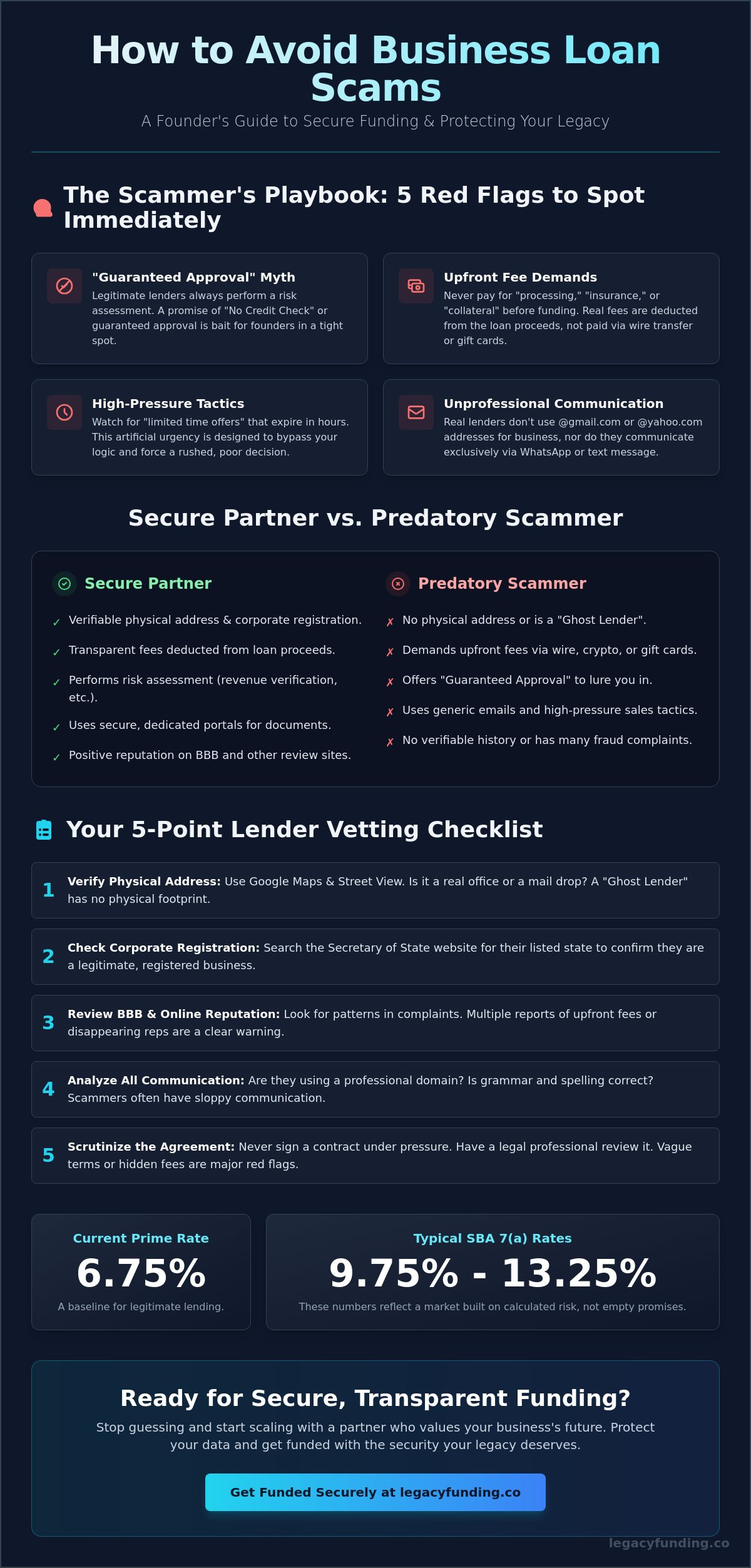
Scammers hunt for founders in a hurry. They leverage your ambition against you, betting that your need for capital will override your instincts. Knowing how to avoid business loan scams starts with recognizing that legitimate capital always follows a set protocol. If an offer feels too good to be true, it likely is. Real lenders don't hide behind generic Gmail accounts or communicate exclusively via WhatsApp. They have physical footprints, verifiable corporate registrations, and transparent fee structures that don't involve "upfront insurance costs."
Protecting your business requires a baseline in understanding bank fraud and the specific tactics used to siphon your sensitive data. Many scammers pose as "Ghost Lenders" with no physical office or digital history. They disappear the moment you pay an "upfront processing fee." Legitimate providers, including those offering revenue-based financing or term loans, deduct their fees from the loan proceeds. They never ask for a wire transfer or gift cards to "unlock" your capital.
The 'Guaranteed Approval' Myth
Legitimate lenders always perform a risk assessment. As of May 2026, the prime rate sits at 6.75%, and variable SBA 7(a) rates range from 9.75% to 13.25%. These numbers reflect a financial market built on calculated risk. Scammers ignore these metrics, promising "Guaranteed Approval" regardless of your credit history or business performance. They use "No Credit Check" as bait for founders in tight spots. While modern lenders often prioritize a "No Hard Credit Pull" approach to protect your score, they still verify your revenue. A "guarantee" without verification is a hallmark of a scam.
Pressure Tactics and Artificial Urgency
Watch for the "limited time offer" that expires in hours. This artificial urgency is designed to bypass your logic and force a rushed decision. Legitimate fast funding moves quickly but never forces a signature without a reasonable review period. If a caller demands your bank login credentials or pushes you to sign a contract you haven't read, stop. They want to bypass your due diligence. A secure funding blueprint relies on transparency, not coercion. Take the time to vet the partner before you commit your business's future. Use these indicators to stay safe:
- Upfront Fees: Never pay a fee before you receive your funding.
- Generic Emails: Professionals don't use @gmail.com or @yahoo.com for business.
- Missing Physical Address: If they don't have a verifiable office, they aren't a real lender.
- High-Pressure Sales: Legitimate consultants don't use threats or 24-hour ultimatums.
Stay vigilant so you can protect your data and Get Funded with a partner who values your long-term success.
Scammers don't just lie. They manufacture a false sense of security to bypass your intuition. Learning how to avoid business loan scams requires you to look past the professional-looking PDFs and focus on the transaction mechanics. One of the most prevalent threats is the Upfront Fee Scam. These criminals use technical-sounding aliases like "Processing Collateral" or "Application Insurance" to demand payment before you see a single dollar. Legitimate lenders always deduct origination fees from the actual loan proceeds. They never ask for a wire transfer, crypto payment, or a prepaid card to "unlock" your capital. Reviewing the latest SBA fraud alerts confirms that these requests are immediate indicators of criminal activity.The Anatomy of an Upfront Fee Scam
The "Advance Fee" trap is a calculated play on your desire for speed. Scammers might claim your credit score requires a "security deposit" or that a new May 2026 regulation mandates a "compliance fee." These are fabrications. In a legitimate funding environment, you only pay for capital once you have it. If a lender asks for money to cover "due diligence" before providing an offer, walk away. This is a primary way founders lose thousands before realizing the loan never existed. Secure your capital without the risk by sticking to lenders who prioritize transparency over upfront costs.
Broker Fraud and Data Selling
Middlemen pose another significant risk to your business’s future. "Ghost Brokers" operate without licenses or official lender agreements. They act as data harvesters, collecting your sensitive financial documents only to sell them to predatory lenders. This often leads to "stacking" or "double-funding" without your knowledge. In these scenarios, brokers trick you into taking multiple high-interest positions simultaneously, such as two merchant cash advances at once. This crushes your cash flow and puts your entire operation at risk.
Legitimate brokers are transparent about their lending partners. They provide clear blueprints for your growth rather than hiding behind generic email domains. They also respect your data privacy. While the Homebuyers Privacy Protection Act of March 2026 limits "trigger leads" for mortgages, the business lending space is still flooded with unsolicited calls. If you receive a "Get Funded" offer from someone you didn't contact, they likely bought your data. Always verify the broker's reputation before sharing your tax returns. If you have concerns about an offer you've received, speak with a transparent advisor to vet the opportunity. Protecting your data is just as important as securing your capital.
Vetting Your Lender: A 5-Point Verification Checklist
Don't let a polished website mask predatory intent. Vetting your lender is the ultimate defensive maneuver for your business’s future. Knowing how to avoid business loan scams means moving beyond surface-level impressions and conducting a rigorous audit of your potential partner. Legitimate alternative lenders operate with a level of openness that scammers simply cannot replicate. Use this 5-point checklist to verify the legitimacy of any offer before you share sensitive data or sign a contract.
- Verify physical location: Confirm the business address and corporate registration in their home state. Scammers often use virtual mailboxes or fake suites to hide their true identity.
- Analyze the digital trail: Check the domain age and LinkedIn presence. A website younger than 6 months is a high-risk indicator for "Ghost Brokers" looking for a quick score.
- Audit merchant feedback: Check the Better Business Bureau (BBB) and Trustpilot for real reviews. Look for patterns of hidden fees or sudden contract changes rather than just the star rating.
- Demand a cost breakdown: Ask for the total cost of capital, including all fees and the factor rate. If they hesitate to provide a written quote, walk away immediately.
- Confirm data security: Ensure their application portal uses bank-level encryption. Your financial data is your most valuable asset; protect it with the same intensity you use to grow your revenue.
The Digital Reputation Audit
A legitimate lender builds a digital legacy over years, not weeks. Use the BBB to spot recurring complaints about hidden fees or "bait and switch" tactics. If a company has dozens of 5-star reviews all posted within the same 48-hour window, they are likely fabricated. Real entrepreneurs provide specific details about their funding journey. Look for mentions of the "No Hard Credit Pull" process or the speed of the "Get Funded" timeline. If the digital footprint feels shallow or repetitive, it is a major red flag that you are dealing with a temporary setup designed to vanish.
The Transparency Test
Test your potential partner by asking direct questions. Ask: "What is the total cost of capital including all fees?" A legitimate lender provides a clear repayment blueprint immediately. They don't hide debt obligations behind motivational jargon or vague promises. They understand that as a founder, you need to calculate your ROI with precision to scale effectively. Transparency is the baseline for any funding partnership. If a lender cannot explain their revenue-based financing model or term loan structure in plain English, they aren't a partner; they're a liability. Choose a lender that accelerates your growth through honesty, not ambiguity.
Protecting Your Data: How to Handle Unsolicited Funding Offers
Your phone rings 15 times a day with "pre-approved" offers. This is not a coincidence; it is the result of a visible digital footprint that scammers actively exploit. These predators scrape public records to target founders who are scaling quickly. Establishing a strict data protocol is the first step in learning how to avoid business loan scams. If you did not initiate the contact, do not provide the data. Legitimate partners respect your privacy and protect your credit score from the start. They prioritize a "No Hard Credit Pull" approach during the initial consultation. This keeps your credit profile clean while you explore capital options to leverage your growth.
Data hygiene is your first line of defense. Scammers often use "trigger leads" generated when you apply for credit or when a new UCC-1 filing appears in public records. By implementing a dedicated business email for state filings and a separate line for public registries, you reduce your visibility to bad actors. You must treat your financial data with the same intensity you use to protect your intellectual property. A secure funding blueprint relies on controlled access and verified communication channels.
Secure Document Handling
Stop emailing your tax returns and bank statements as attachments. Email is a playground for data interceptors. Legitimate lenders provide secure, encrypted portals for all financial uploads. Look for the "HTTPS" lock icon and dedicated data rooms that ensure end-to-end encryption. Never provide your bank login credentials to an unverified third-party site. This is a common phishing tactic designed to drain accounts rather than fund them. Real transparency means the lender explains exactly how your data is stored and who has access to it. If the upload process feels unprofessional or "clunky," it likely lacks the security required to protect your legacy.
Managing Your Business Digital Footprint
Scammers find you through public UCC filings and state registries. When you secure a working capital loan or equipment financing, the filing becomes a beacon for predatory "ghost brokers." While the Homebuyers Privacy Protection Act of March 2026 limited mortgage trigger leads, the business lending space remains a high-target zone for data harvesters. You must actively manage your visibility. Monitor your credit reports for unauthorized inquiries and audit your recent applications regularly. If you suspect a breach, freeze your business credit immediately and notify your primary financial institution.
Choosing the right partner means choosing security. You deserve a blueprint for growth that does not compromise your sensitive information. Legitimate revenue-based financing should accelerate your business, not expose it to fraud. If you are tired of the spam and want a secure, professional assessment of your options, apply through our secure portal to see your funding potential without the risk. Protect your legacy by controlling who has access to your numbers. Get Funded on your terms, with a partner who values your privacy as much as your profit.
Secure Funding: Why Transparency is the Ultimate Legacy
Securing capital is the engine of your expansion. It should never be a gamble. While understanding how to avoid business loan scams provides you with a necessary defense, the ultimate goal is to find an offensive strategy that fuels your growth. Scammers thrive in the shadows of complexity. Legitimate funding partners thrive in the light of transparency. You deserve a financial ally that values your business's long-term health more than a one-time fee. By choosing a partner that provides a clear blueprint for your capital, you move from a position of vulnerability to one of absolute leverage.
Modern entrepreneurship moves too fast for traditional red tape. Predatory lenders use this speed as a weapon, but a professional advisor uses it as a tool. Transparent revenue-based financing offers a secure alternative to the high-risk traps hidden in the market. In May 2026, online lenders are offering term loans with rates ranging from 14% to 36%. A legitimate partner will not hide these numbers; they will explain how this capital accelerates your specific growth metrics. They focus on your cash flow and your future, not just your past credit mistakes.
The Legacy Advantage
We believe your business is a generational endeavor. Our funding model is designed to respect that vision. We focus on your current revenue performance rather than obsessing over a three-digit credit score. This approach allows you to access the capital you need without the friction of traditional banking. Our commitment to your security is total. We provide a streamlined process that prioritizes your peace of mind:
- No Personal Guarantee: Protect your personal assets while you scale your corporate entity.
- No Hard Credit Pull: Explore your funding options without damaging your credit profile.
- Rapid Deployment: Secure your capital in as little as 24 hours through a vetted, encrypted portal.
Your Path to Growth Starts Here
The transition from avoiding fraud to building a financial legacy requires a change in perspective. You have the tools to spot the red flags and the knowledge to protect your data. Now, it is time to take the next step. Don't let the fear of predatory tactics stall your momentum. Leverage the expertise of advisors who are personally invested in your scaling journey. You can Unlock your business potential with a secure funding plan from Legacy Funding Advisors.
Stop reacting to spam and start directing your financial future. Choose a partner that offers speed without the risk and capital without the compromise. It is time to Get Funded. It is time to build your legacy with confidence.
Secure Your Capital and Scale Your Legacy
You now hold the blueprint to protect your business from predatory actors. By implementing the 5-point vetting checklist and enforcing strict data hygiene, you've mastered how to avoid business loan scams that target ambitious founders. You recognize that legitimate capital follows a transparent path where clear cost breakdowns are the standard. Don't let the noise of unsolicited spam calls distract you from your goal of rapid expansion. You've learned to identify the ghost brokers and upfront fee traps that threaten your cash flow.
It's time to transition from defense to offense. Secure the leverage you need with a partner who respects your data and your time. We provide the speed of modern fintech with the integrity of a high-level consultant. Get Funded today with a transparent partner who puts your business first. Our process features a No Hard Credit Pull and requires No Personal Guarantee. We deliver secure funding in 24-48 hours so you can stop worrying about fraud and start scaling your empire. Your legacy is waiting. Unlock it now.
Frequently Asked Questions
What is the most common business loan scam in 2026?
The most frequent threat in 2026 is the "Ghost Broker" data-harvesting scheme. These actors pose as high-level consultants to collect your tax returns and bank statements, only to sell your data to predatory lenders. Understanding how to avoid business loan scams involves ignoring any offer that guarantees approval before reviewing your actual revenue. These scammers often exploit "trigger leads" generated the moment you apply for credit elsewhere.
Can a legitimate business lender ask for an upfront fee?
No, a legitimate lender will never ask you to pay an out-of-pocket fee to "unlock" your capital. Standard costs like origination or underwriting fees are always deducted from the final loan proceeds. If a caller demands a wire transfer or prepaid card for "application insurance" or "processing collateral," it is a fraud. This is a non-negotiable rule for anyone researching how to avoid business loan scams in the current market.
How can I tell if a business loan broker is fraudulent?
Fraudulent brokers usually lack a physical corporate address and communicate through generic domains like @gmail.com. Check their digital footprint; a website younger than 6 months is a major red flag. Legitimate brokers are transparent about their lending partners and provide a clear blueprint for your repayment. If they refuse to provide a written breakdown of the total cost of capital, terminate the conversation immediately.
What should I do if I already gave my bank info to a scammer?
Contact your financial institution immediately to freeze your accounts and issue new credentials. You should also monitor your business credit report for unauthorized UCC-1 filings that could signal "stacking" fraud. Change all passwords for your accounting software and any portals where you store sensitive data. Reporting the incident to your local authorities and the FBI’s IC3 portal can help prevent further damage to your legacy.
Are all merchant cash advances (MCAs) considered scams?
Merchant cash advances are legitimate financial tools designed for speed and accessibility. In 2026, standard factor rates for these products typically range from 1.10 to 1.50. They are not scams when the provider is transparent about the daily or weekly remittance structure. The problem arises when ghost brokers hide the total debt obligation or push you into multiple positions that crush your cash flow.
How do I report a business loan scam to the authorities?
File a formal complaint with the Federal Trade Commission (FTC) and the SBA Office of Inspector General. For cyber-related fraud, use the official IC3.gov portal to alert federal investigators. Providing specific details, such as the scammer's phone number and email headers, helps authorities track these criminal networks. Prompt reporting is the best way to protect other founders from falling into the same trap.
Why do I keep getting so many unsolicited business loan calls?
You are receiving these calls because scammers scrape public records, including state registries and UCC filings. Data brokers sell these "trigger leads" to predatory sales floors within minutes of a public filing appearing. While the March 2026 Homebuyers Privacy Protection Act limited mortgage trigger leads, the business sector remains an open target. Use a dedicated business line to filter these high-pressure solicitations.
Is it safe to provide my SSN or EIN on a loan application?
It is only safe when using a secure, encrypted portal with a vetted funding partner. Legitimate lenders require this information to perform a "No Hard Credit Pull" soft inquiry, which protects your score while verifying your identity. Always verify the website has an active HTTPS certificate before uploading any identifiers. Never provide your SSN over the phone to an unsolicited caller, regardless of how professional they sound.