


How Does Invoice Factoring Work? The 2026 Founder’s Guide to Liquidity
Your business is growing, but your bank account remains stagnant because your best clients take 90 days to pay. What if you could stop acting as a free bank for your customers and start using your own earned revenue to scale today? Understanding how does invoice factoring work is the difference between missing a massive growth opportunity and having the liquidity to seize it. It's not a loan; it's the strategic acceleration of your capital.
You know the frustration of watching receivables pile up while payroll looms and traditional banks demand years of history you don't have yet. We're here to change that narrative. This guide promises to show you how to convert unpaid invoices into working capital in as little as 24 hours. We'll break down the 2026 liquidity landscape, explain the mechanics of advance rates, and provide a clear roadmap to keep your balance sheet debt-free. Apply the right strategy, approve your own growth, and accelerate your path to financial independence.
Key Takeaways
- Escape the liquidity trap by turning your earned revenue into immediate working capital instead of waiting on Net-90 terms.
- Learn exactly how does invoice factoring work to bridge the gap between issuing an invoice and receiving the cash you need to scale.
- Navigate the critical differences between recourse and non-recourse factoring to shield your balance sheet from bad debt.
- Secure funding based on your customers' creditworthiness, allowing you to bypass the restrictive requirements of legacy banking institutions.
- Adopt a tech-forward approach to liquidity that prioritizes speed and transparency through a simplified application process.
The Liquidity Trap: Why Traditional Net Terms Are Stalling Your Growth
Many founders fall into a dangerous trap: they're profitable on paper but broke in the bank. Net-30, 60, or even 90-day payment terms act as a hidden tax on your growth. While you wait for a Fortune 500 client to process a check, your business stands still. You miss bulk inventory discounts. You delay key hires. You experience the crushing anxiety of a payroll deadline that doesn't care about your pending receivables. This is the profitability paradox. You've done the work and earned the revenue, but that capital is locked in a digital waiting room. Every day that money sits in your accounts receivable is a day it isn't working for you.
Traditional banks often make this crisis worse. As of early 2026, the US credit environment has seen a structural tightening, with legacy institutions maintaining restrictive lending standards. These banks apply immense scrutiny to your personal FICO score or your "short" business history rather than the quality of your clients. They see a two-year-old company as a risk, completely ignoring the millions in guaranteed revenue sitting in your ledger. This disconnect forces B2B companies into a cycle of stagnation. You have the demand, but you lack the liquidity to fulfill it. The opportunity cost of waiting for clients to pay their bills isn't just a line item; it's the difference between scaling your empire and merely surviving the quarter.
The 2026 Speed Gap
Modern commerce moves at the speed of light, but B2B payments still crawl at a snail's pace. Founders are moving away from legacy banking because those institutions are built for a slower, analog era. We're seeing a massive shift from debt-based thinking to asset-acceleration. You shouldn't have to borrow money to access capital you've already earned. Understanding how does invoice factoring work is the first step toward bridging this gap and reclaiming your momentum. Stop letting your clients' accounting departments dictate your growth schedule. It's time to align your cash flow with the actual speed of your operations.
Factoring as a Strategic Tool
Think of this as a strategic asset sale rather than a traditional bank loan. In the world of Factoring (finance), you aren't adding a new liability to your balance sheet. You're selling a current asset for immediate liquidity. This process cleans up your books by removing the uncertainty of aging receivables. It provides the high-octane fuel needed for rapid inventory expansion or sudden payroll scaling. Instead of begging a bank for a line of credit, you're accelerating your own earned revenue. This is the modern key to business scaling. It turns a stagnant invoice into a growth engine in as little as 24 hours. Apply the logic of speed, approve your own expansion, and accelerate your path to market leadership.
The Mechanics of Momentum: How Invoice Factoring Works
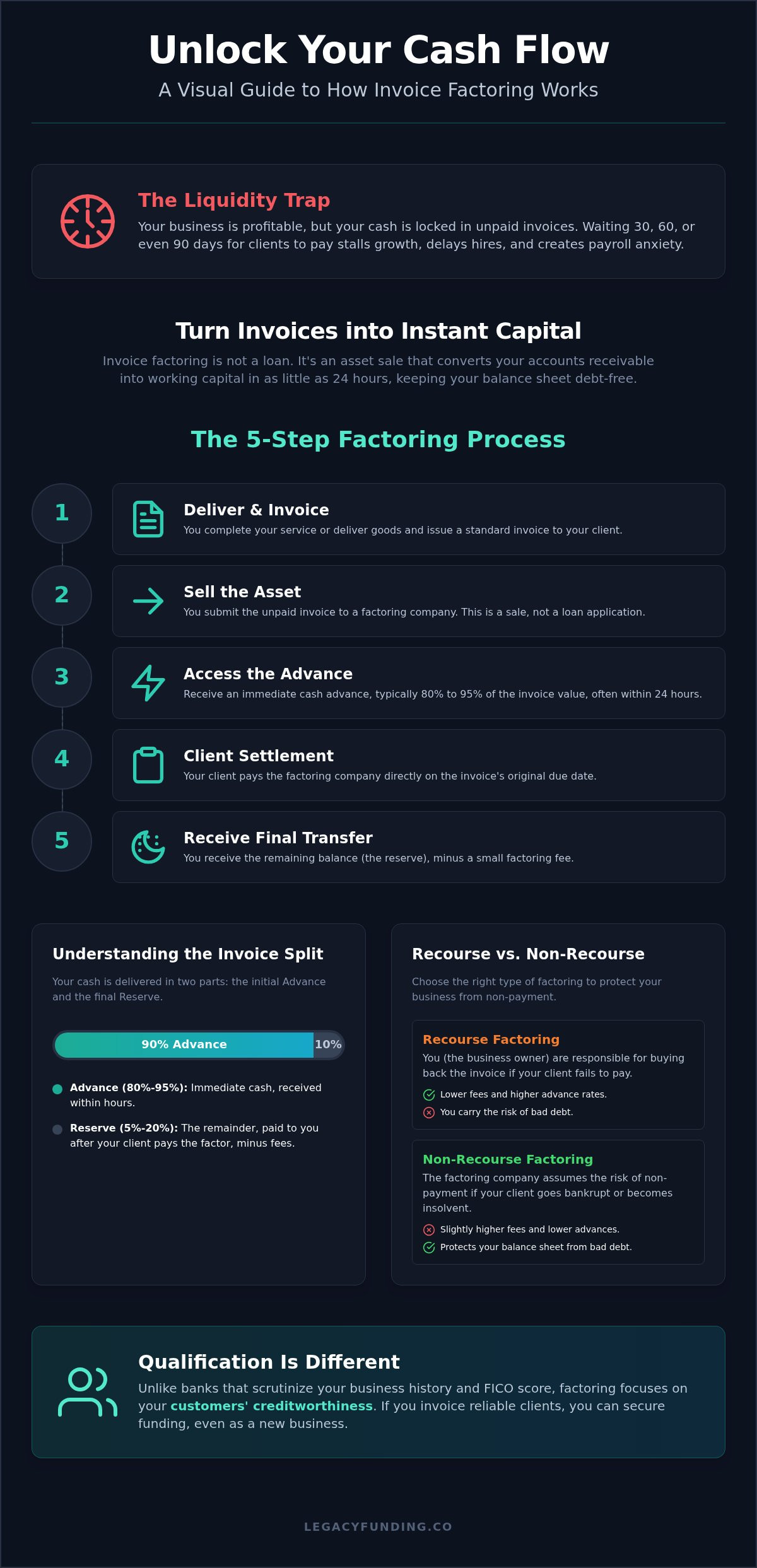
Capital should never be static. To maintain a competitive edge, you need to understand how does invoice factoring work as a tool for immediate acceleration. Unlike the bureaucratic hurdles of a bank loan, this process is designed for speed. It's a straightforward exchange that converts your accounts receivable into liquid power in five distinct steps. It's about moving from "waiting for payment" to "investing in growth" without the friction of traditional debt.
- Step 1: Deliver and Invoice. You complete your service or deliver your goods and issue a standard invoice to your client with net terms.
- Step 2: Sell the Asset. You submit that invoice to a partner like Legacy Funding Advisors. This is an asset sale, not a loan application.
- Step 3: Access the Advance. You receive an immediate cash advance, typically ranging from 80% to 95% of the invoice value, often within 24 hours.
- Step 4: Client Settlement. Your client pays the factor directly on the original due date. This removes the burden of payment tracking from your desk.
- Step 5: Final Transfer. You receive the remaining balance, known as the reserve, minus a small factor fee.
This cycle creates a predictable rhythm for your operations. It ensures that your cash flow is dictated by your sales volume, not by your customers' internal accounting schedules. If you're ready to see how these mechanics apply to your specific industry, speak with a liquidity specialist to explore your options.
Understanding Advance Rates and Reserves
Your advance rate isn't a random number. It's a calculated reflection of your industry, your monthly volume, and the credit strength of your clients. Modern digital platforms have automated the verification process, allowing for near-instant assessments of invoice validity. The remaining 5% to 20% stays in a reserve account. This acts as a security buffer until the client pays. Once the invoice is settled, that capital is released back to you. It's a transparent system designed to protect the integrity of your cash flow while providing the immediate liquidity you need to scale.
Factor Fees vs. Interest Rates
Don't confuse factoring with a traditional line of credit. Interest rates on loans are often opaque and compound over time. In contrast, modern factoring uses clear, flat-fee structures. A factor rate is a percentage of the invoice value charged by the lender. These rates are calculated based on the specific risk profile of the transaction and the length of time the invoice remains outstanding. You aren't paying for the "privilege" of debt; you're paying for the service of capital acceleration. This transparency allows you to bake the cost of funding directly into your margins, ensuring your growth remains profitable and sustainable.
Recourse vs. Non-Recourse: Protecting Your Business from Non-Payment
You've mastered the basic mechanics of capital acceleration. Now, you must decide who owns the risk when a client fails to settle an invoice. In the 2026 credit environment, liquidity isn't just about the cash you receive today; it's about the security of your balance sheet tomorrow. Understanding the distinction between recourse and non-recourse agreements is vital to building a resilient funding stack. This choice determines whether you are simply accelerating revenue or completely offloading the risk of bad debt.
Recourse factoring is the most common path, accounting for approximately 80% of the market in the U.S. In this model, your business remains responsible if the client never pays. If an invoice remains unpaid past a certain window, you must buy it back or swap it for a fresh receivable. Non-recourse factoring, conversely, means the factor absorbs the credit risk. If your client goes bankrupt or becomes insolvent, the factor eats the loss. However, this protection isn't a blanket guarantee. Most non-recourse agreements only cover specific credit events, not customer disputes or late payments. When you evaluate how does invoice factoring work for your specific needs, you must weigh this protection against the associated costs.
The Risk-Reward Tradeoff
Choosing the right model requires a cold, hard look at your client's creditworthiness. Recourse factoring is the high-efficiency choice. It offers lower fees and higher advance rates because the factor takes on less risk. If you work with blue-chip companies or established government entities, recourse is often the smarter strategic move. Non-recourse factoring carries a premium, typically costing 0.5% to 1.5% more than recourse options. Reserve this model for high-value, high-risk contracts where the "credit inversion" benefit is strongest. You don't have to factor your entire ledger. Be surgical. Factor specific clients where the risk of non-payment justifies the higher premium.
Factoring vs. Invoice Financing
Don't confuse these two distinct tools. The key difference lies in who handles the collections process. In factoring, the factor manages the collection of the invoice. This streamlines your back office and removes the "bad guy" role from your team. Invoice financing is a traditional loan where you keep control of collections but pay interest on the advance. Factoring is often faster to approve because it relies on the asset's quality rather than your company's credit score. Modern founders often prefer confidential factoring, which keeps the arrangement private from clients while still providing the speed of an asset sale. This allows you to maintain your professional image while securing the liquidity needed to scale.
Qualifying for Funding: Why Your Clients’ Credit Matters More Than Yours
Traditional banks look in the rearview mirror. They demand years of tax returns, collateral, and flawless personal credit scores. Factoring looks through the windshield. It focuses on the strength of your future revenue and the reliability of your customers. This is the "Credit Inversion." By leveraging the high credit ratings of your B2B or government clients, you can unlock capital that a legacy lender would never touch. Startups and businesses recovering from a credit dip find this model particularly empowering. If your clients are creditworthy, you're creditworthy. Understanding how does invoice factoring work in this context allows you to stop apologizing for your FICO score and start scaling based on your output.
To secure an offer in as little as 24 hours, you need a streamlined blueprint. Preparation is the antidote to delay. Gather your most recent accounts receivable aging report to show the health of your current ledger. Pull your last three months of bank statements to demonstrate consistent activity. Have your active client contracts or purchase orders ready for review. This transparency allows for a rapid assessment, moving you from application to funding without the bureaucratic drag of legacy institutions. When you provide clear data, you lower the barrier to entry and accelerate the approval process.
The 3 Pillars of a Strong Factoring Application
Success in factoring rests on three specific requirements. First, you must present verifiable invoices for completed work. Factors generally avoid progress billing or "work-in-progress" scenarios because they need a finished asset to purchase. Second, your clients must be established B2B or government entities with a track record of reliability. Finally, you need a clear history of business-to-business transactions. These pillars ensure a low-friction process that prioritizes your growth metrics over your historical baggage. Focus on these three areas to ensure your application moves to the front of the line.
Overcoming the "New Business" Hurdle
Traditional lenders often reject companies under two years old. They see a lack of history as an insurmountable risk. Factoring provides a vital bridge for these emerging enterprises. It allows you to scale based on the quality of your current work rather than the length of your tenure. As you factor invoices and settle payments, you're also building your own business credit profile. This creates a long-term impact on your company's financial health, positioning you for even greater opportunities in the future. See if your invoices qualify for immediate funding.
Stop letting a "short" business history or a less-than-perfect credit score stall your expansion. If you have solid invoices and reliable clients, you have the key to liquidity. Connect with a consultant today to accelerate your capital and secure your next growth milestone.
Accelerate Your Cash Flow with Legacy Funding Advisors
Legacy Funding Advisors acts as your savvy, tech-forward financial ally in a market that rewards speed. We understand that in 2026, commerce moves at a pace legacy banks simply can't track. While traditional institutions are buried in paperwork, we focus on your future revenue and the strength of your current contracts. Our process follows a clear triad: Simple. Fast. Flexible. By mastering how does invoice factoring work with a partner invested in your scaling, you bypass the soul-crushing bureaucracy of outdated lending. Join the community of founders who have chosen immediate impact over institutional inertia.
We don't treat factoring as a last resort. We position it as a strategic "Founders Advantage." This is non-dilutive capital that allows you to keep 100% of your equity while accessing the money you've already earned. You've done the hard work of landing the client and delivering the service. You shouldn't have to beg a bank for permission to use your own revenue. We've built a platform that mirrors the fast-paced nature of the businesses we serve, ensuring that your liquidity matches your ambition.
The Legacy Advantage
Speed is our signature. We provide a 24 to 48 hour turnaround from application to deposit, ensuring your operations never miss a beat. You gain more than just a transaction; you get access to a full suite of growth tools, including Merchant Cash Advances (MCAs), SBA loans, and revenue-based financing. Our expert advisors have been in the trenches. They understand the entrepreneurial struggle because they live it every day. We provide customized solutions for B2B industries that prioritize your specific growth metrics over historical baggage.
Secure Your Funding Legacy
Don't let a 90-day wait for a client payment stall your 24-hour ambition. Every day your capital sits in an unpaid invoice is a day it isn't fueling your expansion. Turn your balance sheet into a high-performance growth engine today. The key to generational impact isn't waiting for a check to clear; it's taking proactive control of your liquidity. Stop acting as a free bank for your customers and start investing in your own future. Apply for invoice factoring and get funded now.
Reclaim Your Revenue and Scale Without Limits
You've seen the hidden cost of waiting on net terms and how the right financial ally turns invoices into immediate power. Mastering how does invoice factoring work allows you to stop acting as a free bank for your clients. This strategy shifts the risk, accelerates your cash flow, and ensures you keep 100% of your equity. It's the difference between being profitable on paper and having the liquid capital to dominate your market in 2026. You're no longer limited by your customers' accounting schedules; you're fueled by your own success.
Legacy Funding Advisors is here to bridge your speed gap with a process built for the modern founder. Our simple 5-minute digital application removes the friction of traditional banking. Because we purchase your receivables as assets, there is no collateral required for factoring. You can have funds available in your account in as little as 24 to 48 hours. Don't let a 90-day invoice stall your 24-hour ambition. It's time to turn your balance sheet into a high-octane growth engine.
Secure Your Business Funding in 24 Hours
Your next major milestone is within reach. We're ready to help you seize it.
Frequently Asked Questions
How long does it take to get approved for invoice factoring?
Approval typically happens within 24 hours of your initial application. Modern digital platforms have streamlined the verification process, allowing for rapid assessments of your receivables. Once you're approved, funding often follows within the same business day or shortly after. This speed is essential for businesses that need to meet immediate payroll or inventory demands without the weeks of waiting required by traditional banks.
Can I get invoice factoring if I have a low personal credit score?
You can qualify even with a low personal credit score because factoring focuses on the creditworthiness of your customers. Since the factor is purchasing an asset from you, your personal financial history carries significantly less weight than it would for a traditional loan. This credit inversion makes it an accessible option for founders who are rebuilding their credit or have a limited business history.
What is the average cost or fee for invoice factoring in 2026?
Most businesses see a factor fee ranging from 1% to 5% of the invoice value. This rate is influenced by your industry, your monthly volume, and how quickly your customers typically pay. Unlike interest rates that compound, these fees are usually structured as a flat percentage or a tiered rate. It's a transparent cost that you can easily factor into your project margins to ensure continued profitability.
Will my customers know that I am factoring their invoices?
In most cases, your customers will know because they'll receive a notice of assignment directing their payment to the factoring company. This is a standard and professional practice in modern B2B commerce. However, if privacy is a priority, confidential factoring options are available where the arrangement remains private. Most large clients are already familiar with how does invoice factoring work and view it as a sign of a sophisticated financial strategy.
What happens if my customer refuses to pay the invoice?
The outcome depends on whether you have a recourse or non-recourse agreement. In a recourse agreement, your business must buy back the invoice if the customer fails to pay. In a non-recourse agreement, the factoring company assumes the credit risk if the customer becomes insolvent. It's important to remember that non-recourse typically only covers credit-related defaults, not disputes over the quality of goods or services provided.
Is invoice factoring considered a loan on my business balance sheet?
No, invoice factoring is not a loan and don't appear as debt on your balance sheet. It's legally structured as the sale of an asset, specifically your accounts receivable. This keeps your debt-to-equity ratio clean, which is a significant advantage if you're seeking other types of financing later. You're simply accelerating the arrival of cash you've already earned rather than borrowing against future earnings.
How much revenue does my business need to qualify for factoring?
Revenue requirements vary, but many businesses qualify with as little as $10,000 to $20,000 in monthly B2B receivables. The focus is less on your total annual revenue and more on the quality and consistency of your invoices. As long as you're billing other businesses or government entities for completed work, you have the foundation needed to access this type of liquidity.
Can I factor invoices for government contracts?
You can absolutely factor invoices for government contracts at the local, state, or federal level. Government entities are considered highly creditworthy debtors, which often leads to more favorable advance rates and lower fees. Factoring is a popular choice for government contractors who need to bridge the gap between long payment cycles and the immediate costs of fulfilling large-scale projects.