


Equipment Lease vs. Buy Calculator: A Strategic Guide for SMB Growth in 2026
Ownership is frequently the most expensive path to scaling. You feel the pressure of high upfront costs and the nagging fear that your new tech will be obsolete before it's even paid off. It's a common trap for ambitious founders who want to move fast but feel held back by capital constraints. We're here to change that perspective. By mastering an equipment lease vs buy calculator, you'll stop guessing and start making data-driven decisions that protect your cash flow.
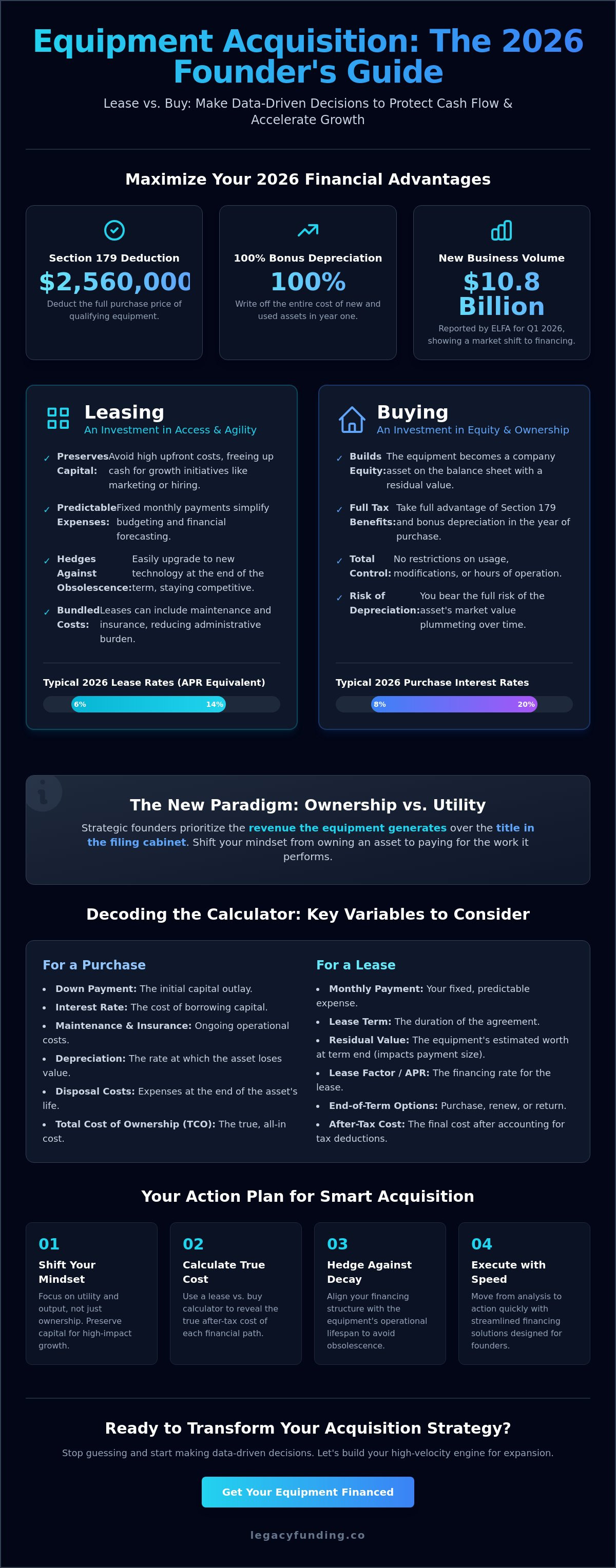
This guide delivers the clarity you need to choose the right financial path for 2026. You'll learn how to maximize the $2,560,000 Section 179 deduction limit and leverage the 100% bonus depreciation to keep more money in your business. We'll break down the variables that separate a winning lease from a strategic purchase. Discover how to align your equipment financing with your long-term growth metrics rather than just your immediate needs. It's time to transform your acquisition strategy into a high-velocity engine for expansion and generational impact.
Key Takeaways
- Shift your mindset from ownership to utility to preserve capital for high-impact growth initiatives.
- Input your specific tax data into an equipment lease vs buy calculator to reveal the true after-tax cost of each path.
- Hedge against technology decay by choosing financing structures that align with the equipment’s actual operational lifespan.
- Move from analysis to action quickly with streamlined equipment financing solutions designed for the pace of modern founders.
The Equipment Acquisition Dilemma: Strategic Growth vs. Capital Preservation
Stop viewing equipment as a simple line item or a necessary liability. In the current economy, equipment is a high-velocity lever for scaling. The Equipment Leasing and Finance Association (ELFA) reported a record $10.8 billion in new business volume for Q1 2026. This surge proves that modern founders are moving away from traditional hoarding of assets. They're using an equipment lease vs buy calculator to determine which path protects their runway while maximizing output. The choice isn't just about price; it's about the fundamental difference between the ownership mindset and the utility mindset.
Buying is an investment in equity. Leasing is an investment in access. When you buy, you're betting on the long-term value of the machine. When you lease, you're paying for the work the machine performs today. Tying up massive amounts of capital in a depreciating asset creates a significant opportunity cost. If you sink $250,000 into hardware, that's $250,000 you can't spend on a high-converting ad campaign or a key executive hire. To understand the legal and structural foundations of these agreements, it helps to review what is a lease and how it facilitates use without the burdens of title. Strategic founders prioritize the revenue the equipment generates over the title in the filing cabinet.
Why Your Choice Impacts Your 2026 Scaling Velocity
2026 market conditions reward agility. Heavy upfront spending stalls your momentum and leaves you vulnerable to shifts in demand. If you exhaust your cash reserves on physical assets, you're effectively paralyzed when a new market opportunity or a sudden pivot is required. Modern equipment financing provides a flexible alternative to the rigid, slow-moving approval processes of traditional banks. By keeping your primary credit lines open and your cash liquid, you ensure your business can accelerate when your competitors are forced to tap the brakes. Speed is your greatest competitive advantage.
Ownership vs. Access: The New Business Paradigm
The "as-a-service" model has migrated from software to the factory floor. This new paradigm treats equipment as a scalable resource rather than a permanent fixture. Ownership still makes sense for core assets with long lifespans, but it's a maintenance burden for technology that faces rapid obsolescence. Capital efficiency is the measure of how much revenue you can generate for every dollar of invested capital. Use an equipment lease vs buy calculator to find the tipping point where ownership stops being a strategic advantage and starts being a financial anchor. Choose the path that keeps your balance sheet lean and your operations fast.
Decoding the Variables: What Drives the Lease vs. Buy Calculator
The math behind equipment acquisition is more than a simple price tag comparison. To get an accurate result from an equipment lease vs buy calculator, you must look at the Total Cost of Ownership (TCO). For a purchase, this includes the down payment, interest, maintenance, insurance, and eventual disposal costs. Conversely, a monthly lease payment often bundles these expenses into a single, predictable line item. Understanding these inputs is vital. The SBA guide on buying vs. leasing highlights that while leasing usually has a higher long-term cost, it protects your liquid reserves for immediate operational needs.
Don't overlook the impact of residual value. This is the estimated worth of the equipment at the end of your term. In a lease, a high residual value often translates to lower monthly payments because you aren't paying for the full life of the machine. However, it also means you walk away with zero equity. Ownership gives you an asset to sell later, but you bear the risk of its market value plummeting. Hidden costs like specialized insurance and emergency repairs can quickly erode the perceived savings of buying used gear. Factor these into your projections to avoid a cash flow crunch six months down the line.
Interest Rates and Factor Rates in 2026
Capital isn't free. In 2026, highly qualified borrowers see rates between 8% and 10%, while most small businesses land between 10% and 20%. When you buy, you're sensitive to these interest rates. When you lease, you're often looking at a lease factor or an APR equivalent, typically ranging from 6% to 14%. Inflation also plays a role. A fixed lease payment becomes "cheaper" over time as the dollar's purchasing power shifts. When comparing products, use this checklist:
- Verify if the rate is fixed or variable for the entire term.
- Calculate the total interest paid over the full life of the loan.
- Check for hidden origination or documentation fees that inflate the cost.
If you're unsure how these rates apply to your specific industry, reach out to a specialist for a personalized breakdown.
Tax Advantages: Section 179 and Bonus Depreciation
Tax strategy is where the equipment lease vs buy calculator truly shines. For the 2026 tax year, Section 179 allows you to deduct up to $2,560,000 on qualifying equipment. This is a massive win for those who buy or use certain finance leases. Additionally, bonus depreciation remains at 100% for 2026, allowing for the immediate expensing of the full asset cost. This can result in a massive tax shield that offsets your growth expenses.
Leasing offers a different advantage. Standard operating leases are usually fully deductible as business expenses. You don't have to worry about complex depreciation schedules; you simply write off the payments. This creates a clean, predictable tax benefit that aligns with your monthly cash flow. Always consult your CPA to see which structure fits your 2026 tax liability, but use these frameworks to guide your initial analysis and decision-making.
How to Use a Lease vs. Buy Calculator: A 5-Step Evaluation
Most founders treat an equipment lease vs buy calculator like a basic addition tool. It's actually a strategic filter. To get a result that drives growth, you need to look beyond the monthly payment. You're comparing two different ways to consume capital over time. Follow this five-step evaluation to move from raw data to a definitive decision.
- Gather your core data: Start with the total invoice price, including delivery and installation. Define your expected lease term and be realistic about the equipment's salvage value at the end of that period.
- Input your marginal tax rate: Taxes are the great equalizer. Seeing the "After-Tax Cost" reveals how much the government is effectively subsidizing your acquisition through deductions.
- Adjust the discount rate: This represents your internal cost of capital. If your business generates a 15% return on marketing spend, using cash for equipment has a high hurdle to clear.
- Analyze the Net Present Value (NPV): Look at the NPV of both cash flow streams. The lower NPV represents the more efficient use of your company’s wealth.
- Identify the break-even point: Determine the exact month where the cumulative cost of ownership falls below the cost of leasing. If you plan to replace the gear before that date, leasing is your winner.
Execution requires precision. An equipment lease vs buy calculator only works if your inputs reflect the reality of your balance sheet. Don't just look for the lowest number; look for the path that keeps your scaling velocity high.
Understanding Net Present Value (NPV) in Simple Terms
A dollar in your bank account today is worth more than a dollar in year four of a lease. NPV accounts for this by "discounting" future payments back to today's value. This allows you to compare a large upfront purchase price against a series of smaller lease payments on an apples-to-apples basis. For a founder focused on cash flow, NPV is the total cost of the equipment expressed in today's purchasing power.
The 'Salvage Value' Trap
Many owners overestimate what their used equipment will fetch on the secondary market. Rapid technological shifts, like the $350 billion surge in AI infrastructure spending seen in 2025, can render "book value" irrelevant overnight. If your gear is tech-heavy, its resale value might drop to near zero faster than you expect. Use conservative estimates in your calculations. If the math only works with a high salvage value, the risk of ownership is likely too high for your current growth phase.
Qualitative Factors: When the Math Doesn't Tell the Whole Story
An equipment lease vs buy calculator provides a solid baseline, but it can't quantify the frustration of a broken machine or the cost of being stuck with yesterday’s tech. Obsolescence risk is a silent profit killer. In sectors like IT or healthcare, the equipment lifecycle is shrinking rapidly. If you own the asset, you're responsible for its disposal and the total cost of the next upgrade. Leasing transfers that risk to the lender. It gives you the freedom to rotate your inventory as the market evolves. You aren't just paying for a machine; you're paying for the ability to stay competitive without the burden of ownership.
Maintenance is another variable that often gets buried in the fine print. When you buy, every repair is an out-of-pocket expense that disrupts your cash flow. Many lease agreements bundle service contracts, ensuring your operations never skip a beat. Consider these three qualitative pillars before signing any agreement:
- Maintenance: Bundled service contracts in a lease vs. unpredictable out-of-pocket repairs when you own.
- Obsolescence: The ability to upgrade to the latest tech vs. being tied to aging machinery.
- Financials: Keeping debt off your balance sheet vs. building equity in a depreciating asset.
There is also the balance sheet impact to consider. Operating leases can help maintain a healthy debt-to-equity ratio, making your business more attractive to future investors or traditional lenders. By keeping equipment off the balance sheet, you preserve your borrowing power for other strategic needs.
Operational Agility vs. Sunk Cost Fallacy
The sunk cost fallacy is a dangerous trap for founders. You might hold onto a piece of machinery simply because you already paid for it, even if a newer model would double your efficiency. Predictable, fixed monthly expenses provide a psychological safety net. They allow you to forecast with confidence. In fast-moving industries like medical technology or AI infrastructure, the ability to pivot is more valuable than a title on a piece of metal. Short-term leasing offers a "hidden" benefit: the option to walk away or upgrade at the end of the term without the headache of selling used gear.
The Credit Score Myth in Equipment Funding
Many entrepreneurs believe they need a perfect credit score to secure competitive rates. This is a common misconception. Because the equipment itself serves as collateral, lenders have a built-in safety net. This makes funding accessible for businesses that might not qualify for traditional unsecured loans. When you run the numbers through an equipment lease vs buy calculator, the collateralized nature of these deals often results in surprisingly accessible payments. If your history isn't perfect, you can still find aggressive terms for Bad Credit Business Loans that fuel your next stage of growth.
Speak with an acquisition expert today to find a structure that fits your specific operational goals and preserves your scaling velocity.
Execution: Fast-Tracking Your Acquisition with Legacy Funding Advisors
The math is clear. You've dialed in your data using an equipment lease vs buy calculator. Now, the challenge shifts from analysis to execution. Analysis without action is just a spreadsheet. Legacy Funding Advisors acts as the bridge between your financial projections and your operational reality. We provide the capital velocity required to turn your acquisition strategy into a tangible competitive advantage. Our process removes the friction of traditional lending, focusing on your current momentum rather than just your historical data.
Traditional institutions often treat small businesses with suspicion. They demand mountains of paperwork and move at a glacial pace. Legacy Funding Advisors takes a different approach. We value your cash flow and your vision for scaling. Whether you need specialized Equipment Financing or a flexible Business Line of Credit, we align our products with your growth metrics. Our goal is to lower the barrier to entry so you can focus on what matters: running your business and outperforming your competition.
- Streamlined Access: Get approved without the bureaucratic hurdles of traditional banks.
- Strategic Partnership: Work with advisors who understand the high-stakes world of SMB growth.
- Flexible Structures: Choose from Revenue-Based Financing, Term Loans, or Merchant Cash Advances to fit your specific needs.
Why Speed is a Financial Metric
In a fast-moving market, waiting is a hidden cost. A three-month delay for a traditional bank approval isn't just an inconvenience; it's lost revenue. If a new piece of machinery generates $15,000 in monthly profit, a 90-day wait costs your business $45,000 in unrealized gains. Legacy Funding Advisors offers a 24-48 hour funding window. This speed allows you to capitalize on market opportunities the moment they appear. We prioritize your business's momentum. We understand that in 2026, the first to deploy technology is the first to capture the market.
Customized Funding: Beyond the Cookie-Cutter Lease
Your business doesn't fit into a standard box. Your funding shouldn't either. Legacy Funding Advisors provides tailored factor rates and flexible repayment terms that respect your seasonal cycles. From heavy construction machinery to high-tech healthcare tools, we support a diverse range of industries with precision. We also offer Revenue-Based Financing to complement your equipment acquisition, providing the working capital needed to hire staff or launch marketing for your new capacity. Don't let rigid structures hold you back. Apply for funding in minutes and get your equipment on-site this week.
Master Your Capital Strategy and Scale Faster
You now have the structural framework to choose between the weight of ownership and the agility of utility. An equipment lease vs buy calculator is your primary tool for securing financial independence. It reveals the true cost of your growth and helps you protect your liquid reserves for high-impact marketing or key executive hires. By aligning your 2026 tax strategy with your operational needs, you ensure your business remains lean, agile, and ready to dominate your niche.
Don't let bureaucratic delays stall your momentum. We provide comprehensive national coverage across the US, Puerto Rico, and Canada to support your expansion goals. Our modern underwriting process focuses on your current cash flow rather than just your historical credit score. Experience the speed of a partner who is personally invested in your scaling journey. Apply for Equipment Financing in 24 Hours and see your funding approved in as little as 24 to 48 hours. Your next stage of growth depends on the speed of your capital. Take the lead and build your legacy today.
Frequently Asked Questions
Is it better to lease or buy equipment for a startup?
Leasing is often the superior choice for startups because it preserves precious liquid capital for marketing and hiring. While buying builds equity, it drains the cash reserves you need to survive the first 24 months of operation. Focus on access to the tool rather than ownership of the asset to keep your scaling velocity high and your balance sheet flexible.
How do I calculate the total cost of an equipment lease?
Calculate the total cost by multiplying your monthly payment by the number of months in the term and adding any upfront origination fees. Input these figures into an equipment lease vs buy calculator to see how the total lease cost compares to the interest and maintenance of a traditional purchase. This ensures you're looking at the true financial impact over the asset's entire lifecycle.
What are the tax benefits of leasing business equipment in 2026?
Leasing allows you to deduct the full amount of each monthly payment as a business operating expense. If you opt for ownership or a finance lease instead, you can utilize the Section 179 deduction, which has a 2026 limit of $2,560,000 for qualifying equipment. Using an equipment lease vs buy calculator helps you determine which path provides the most significant tax shield for your specific revenue bracket.
Can I get equipment financing with a low credit score?
You can secure funding even with a less than perfect credit history because the equipment itself acts as its own collateral. Lenders prioritize your business's consistent cash flow and the equipment's resale value over a single credit metric. This collateralized structure lowers the risk for the lender and increases accessibility for ambitious founders who are focused on rapid expansion rather than past financial hurdles.
What is the difference between a capital lease and an operating lease?
A capital lease functions like a purchase and appears as both an asset and a liability on your balance sheet. An operating lease behaves like a traditional rental and is generally treated as an off-balance-sheet expense. Choosing the right structure impacts your debt-to-equity ratio and how attractive your business looks to future investors or traditional lenders when you seek additional working capital.
How long does it take to get approved for equipment financing?
Modern funding platforms have compressed approval times to a 24 to 48 hour window. This stands in sharp contrast to traditional banks that may take weeks or months to process a single application. Speed is a vital financial metric when you need to deploy new technology to capture a market opportunity or replace a critical machine that has stalled your production line.
Does equipment leasing include maintenance and repairs?
Maintenance coverage depends on whether you sign a full-service lease or a net lease. Full-service agreements often bundle repairs into the monthly payment to provide predictable operational costs and peace of mind. Net leases generally leave the responsibility for maintenance with you, so always clarify these terms before finalizing your acquisition strategy to avoid unexpected out-of-pocket expenses later.
What happens at the end of an equipment lease term?
You generally face three choices: return the asset, renew the lease for another term, or buy the equipment. Many founders choose a $1 buyout option at the end of the term to gain full ownership after the lease concludes. This flexibility allows you to decide based on whether the equipment is still a competitive asset or if technological shifts have made it obsolete.