


Equipment Financing for Startups with No History: The 2026 Guide
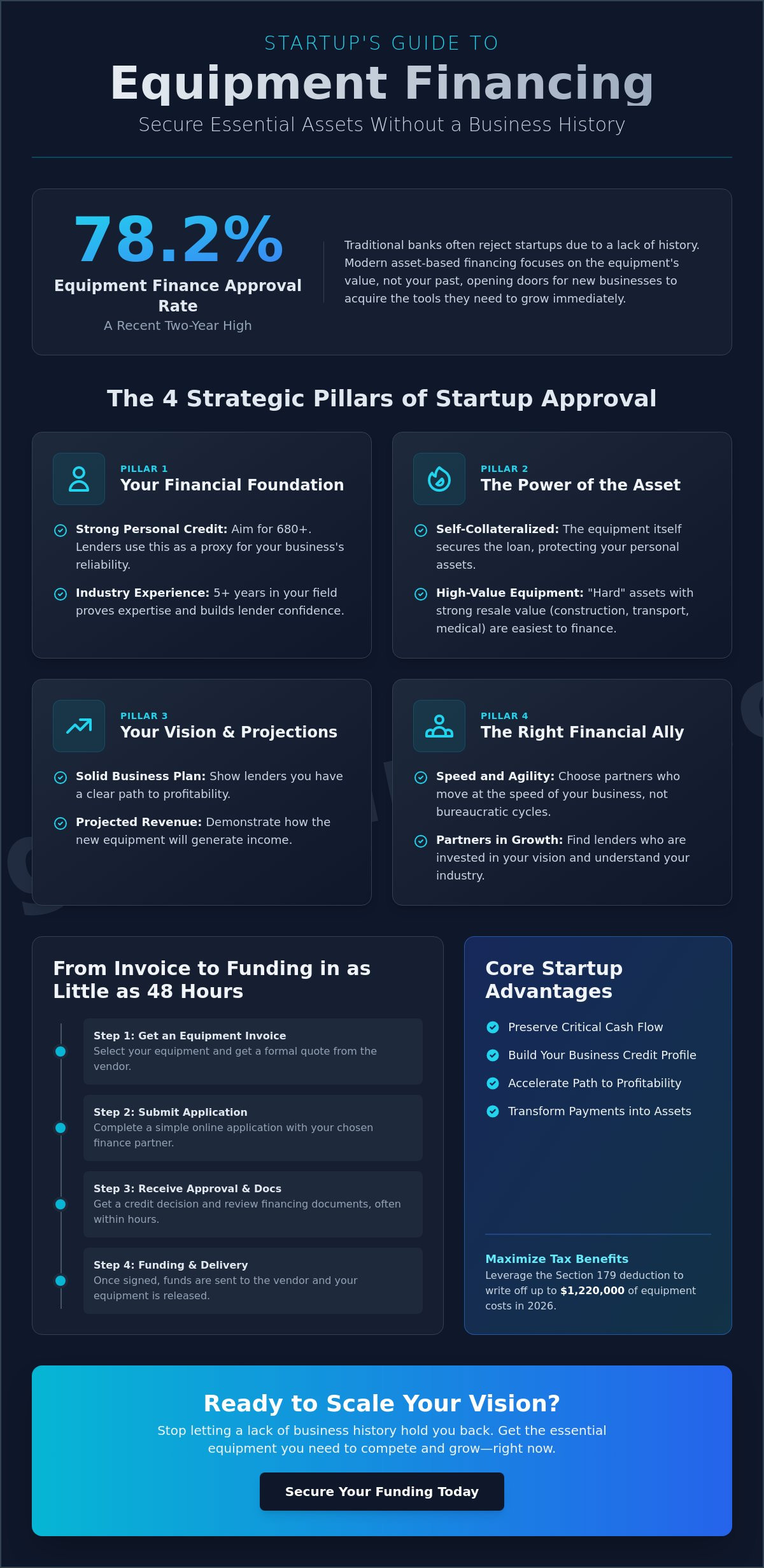
Did you know that equipment finance approval rates climbed to a two-year high of 78.2% recently? Traditional banks might treat your lack of business history as a deal-breaker, but the modern market disagrees. You've likely faced the frustration of slow approvals, high down payment demands, or outright rejections that stall your operations before they even begin. It's a common roadblock, but it doesn't have to be yours. Mastering the nuances of equipment financing for startups with no history is your gateway to the tools you need to compete right now.
This 2026 guide promises to show you exactly how to secure essential machinery and technology without a decade of financial data. We'll explore how to leverage your personal credit, maximize the $1,220,000 Section 179 tax deduction, and choose lenders that prioritize asset value over historical spreadsheets. Learn to preserve your cash flow, build business credit, and accelerate your path to profitability. Stop waiting for a legacy institution to catch up to your vision. Follow these actionable steps to scale your business today.
Key Takeaways
- Discover how self-collateralized assets lower the barrier to entry for new founders by using the equipment itself as security.
- Master the four strategic pillars that turn a lack of history into high-potential approval for equipment financing for startups with no history.
- Identify the critical differences between leasing and loans to choose the path that best preserves your operational capital and maximizes tax benefits.
- Learn the specific documentation required to move from an initial equipment invoice to full funding in as little as 48 hours.
- Transform monthly equipment payments into a powerful engine for building your business credit profile and securing future growth capital.
Understanding Equipment Financing for Startups with No History
Traditional banking is built on the rearview mirror. Lenders typically ask for years of tax returns and audited financial statements because they don't understand your future. Equipment financing for startups with no history flips the script. It focuses on what you are building, not just where you've been. This model relies heavily on Asset-based lending, where the intrinsic value of the hardware you are purchasing secures the capital. It's a strategic shift from history-based hurdles to asset-backed opportunities that empowers you to launch with the right tools.
Many founders believe the myth that two years of operational history is a hard requirement for all lenders. In the modern financial landscape, this is simply false. While traditional institutions remain stuck in bureaucratic cycles, alternative lenders see high potential where others see high risk. They recognize that a startup with a solid business plan and essential equipment is a growth engine. By prioritizing the utility of the equipment and your projected revenue, these lenders provide a path to funding that bypasses the red tape that kills most new ventures.
The Self-Collateralization Advantage
In a standard business loan, you often need personal property or massive cash reserves to act as a guarantee. Equipment financing is fundamentally different because the asset itself acts as the primary security. If you're acquiring a specialized medical device, a heavy excavator, or a high-end server rack, that item protects the lender's investment. This structure significantly reduces the need for an extensive business credit track record. Unlike unsecured business loans that rely solely on credit scores, this method values the tangible tools of your trade. You get the machinery you need while keeping your personal assets protected. It's clean, efficient, and designed for rapid scaling.
Why Startups Need a Modern Financial Ally
Speed is the only currency that matters when you're trying to capture a new market. A traditional bank might take months to process an application only to deliver a "no." A modern financial ally focuses on the "how" and moves at the speed of your business. You need to secure your infrastructure before your competitors do. This partnership-driven approach means looking at your industry experience, your cash flow, and your vision for the future. Don't settle for a distant corporate entity that doesn't understand your industry. Choose a partner that is personally invested in your growth. Secure the gear. Protect your cash. Scale your vision.
The 4 Strategic Pillars of Startup Approval
Lenders don't just look for a business history; they look for a story of stability. When you seek equipment financing for startups with no history, you aren't invisible to the financial market. You are evaluated through four specific lenses: your personal financial health, your professional background, the quality of the asset, and your future earning potential. Mastering these pillars allows you to bypass traditional hurdles and secure the capital necessary for rapid expansion.
Leveraging Personal Credit and Experience
Your personal credit score acts as the definitive foundation for your new entity's financial credibility. Because your business lacks a track record, lenders use your personal payment history as a proxy for how the company will handle its obligations. Aim for a score of 680 or higher to qualify for most programs, though scores above 700 typically unlock the best rates. Beyond the numbers, your resume carries significant weight. Documenting five or more years of direct industry experience builds lender confidence by proving you understand the operational nuances of your field. Most startup agreements will require a personal guarantee. This commitment signals that you have skin in the game and are personally invested in the long-term success of the venture.
Evaluating the Asset and Down Payment
The type of equipment you choose dictates the speed and ease of your approval process. Lenders prioritize "hard" assets with high liquidity and slow depreciation because they are easier to remarket if necessary. This focus on tangible security is a hallmark of asset-based lending and is a core component of many government-backed programs, such as SBA 7(a) loans. Certain equipment types are historically easier to finance due to their strong resale value. These include:
- Yellow Iron: Construction machinery like excavators and loaders.
- Transport: Semi-trucks, trailers, and delivery vans.
- Medical: Diagnostic imaging tools and specialized dental chairs.
While some modern programs offer low-entry options, preparing a down payment between 10% and 25% can drastically improve your approval odds. This upfront equity reduces the lender’s risk and lowers your total interest costs over the life of the loan. By combining a strong personal profile with high-value equipment, you position your startup as a high-potential partner rather than a high-risk gamble. If you are ready to see which assets qualify for your business, connect with a growth consultant to review your specific requirements.
Finally, utilize your revenue projections to prove repayment ability. Ground these numbers in signed contracts, letters of intent, or verified market data. Showing a clear path to cash flow transforms your application from a request for help into a strategic investment opportunity. When you align your personal credit, industry expertise, and asset choice, equipment financing for startups with no history becomes a powerful tool for generational wealth building.
Comparing Equipment Financing, Leasing, and Alternative Capital
Choosing the right capital structure is as vital as the equipment itself. While you've mastered the pillars of approval, you must now decide between equity-building ownership and cash-flow-preserving flexibility. Equipment financing for startups with no history isn't a one-size-fits-all transaction. It's a strategic choice between long-term asset value and immediate operational agility. Modern founders look beyond traditional bank loans to find structures that align with their specific revenue cycles and growth trajectories.
Financing vs. Leasing: Which Fits Your Growth?
Equipment loans grant you full ownership from day one. This path is ideal for "hard" assets with long lifespans, such as heavy machinery or diagnostic medical devices. The primary advantage here is the Section 179 tax deduction. For 2026, businesses can deduct up to $1,220,000 of the full purchase price of qualifying equipment. This immediately lowers your taxable income and keeps more cash in your business. For those seeking government-backed stability, SBA 7(a) loans for equipment provide a reliable benchmark for terms and rates, even for newer entities with strong personal credit.
Leasing offers a different advantage. It typically requires lower monthly payments and allows for easier equipment upgrades. If your industry relies on rapidly evolving technology, an operating lease prevents you from being stuck with obsolete hardware. You trade the long-term benefit of depreciation for the short-term benefit of liquidity. Consider the useful life of the asset carefully. If the equipment will be essential for a decade, buy it. If it will be outdated in three years, lease it to keep your operations modern and efficient.
The Role of Alternative Funding
Sometimes, the equipment itself is only part of the financial equation. Soft costs like installation, freight, and specialized staff training can drain your reserves. This is where alternative capital bridges the gap. Revenue-Based Financing allows you to secure funds based on your daily sales volume rather than a fixed monthly schedule. It's a flexible solution for high-transaction businesses that need to scale without the pressure of a rigid debt obligation. It complements equipment financing for startups with no history by providing the fluid capital needed to put those new tools to work immediately.
Merchant Cash Advances serve as a high-speed bridge. If you need to cover a 20% down payment on a major machinery purchase today, an advance provides that cash in hours. Additionally, a Working Capital Loan can fund the initial inventory or marketing push that makes your new equipment profitable from day one. Don't view these as isolated products. View them as a coordinated financial stack designed to accelerate your market entry and maximize your ROI. Speed is your greatest asset; use the right capital tools to protect it.
Step-by-Step Guide to Securing Funding in 48 Hours
Speed is your primary competitive advantage. While legacy banks move at a glacial pace, the modern alternative market is built for the 48-hour turnaround. Securing equipment financing for startups with no history requires a focused, aggressive approach to documentation and lender selection. If you have your documentation package ready, you can move from initial application to a funded equipment invoice in just two business days. Accuracy and velocity are the keys to unlocking this capital.
Preparing Your "Startup Funding Package"
Lenders need to see that you are organized and ready to execute. Your package should be lean and impactful. Don't overwhelm the underwriter with fluff; provide the hard data they need to say "yes" quickly. Start with these three essentials to build immediate trust:
- Bank Statements: Provide the last three months of statements. If your business account is brand new, include your personal statements to demonstrate consistent cash management.
- Itemized Vendor Quote: Get a professional quote from your equipment dealer. It must include the make, model, year, and total cost, including any shipping or installation fees.
- ROI Executive Summary: Draft a brief summary explaining how this specific equipment generates immediate revenue. Show the lender that the asset is a profit center, not just a debt obligation.
Navigating the 24-Hour Approval Process
Digital application platforms have revolutionized the underwriting cycle by replacing manual reviews with data-driven algorithms that prioritize asset value. This technology allows for a rapid assessment of the 4 strategic pillars without the need for weeks of back-and-forth emails. When you receive a funding offer, look for absolute transparency in the terms. Pay close attention to the factor rate, the total cost of capital, and any early repayment benefits. Avoid lenders that hide fees in the fine print or delay the process with unnecessary site visits.
Once you sign the digital agreement, the lender typically pays your equipment vendor directly. This removes the friction of handling large wire transfers yourself and ensures the vendor releases the machinery for delivery immediately. It's a streamlined transaction that reflects the fast-paced nature of your business. If you have your documentation ready and need to move now, apply for equipment financing today to start your 48-hour clock. Don't let a lack of history stop your momentum. Follow this structured path to secure the tools your vision demands.
Scaling Your Vision with Legacy Funding Advisors
Legacy Funding Advisors operates as your high-level financial consultant, not a distant corporate entity. We bridge the gap between the high stakes of finance and your aspirational reality. While traditional institutions hesitate, we provide capital in as little as 24 hours. Our focus remains on your business’s cash flow and growth potential, moving beyond the limitations of a simple credit score. We offer a comprehensive suite of tools, from Merchant Cash Advances to SBA Loans, ensuring you have the right instrument for your specific stage of development. Our national reach extends across the U.S., Canada, and Puerto Rico, providing a consistent gateway to scaling regardless of your location.
Securing equipment financing for startups with no history doesn't have to be a battle against red tape. We understand the speed of contemporary commerce better than legacy institutions. Our model is bold, transparent, and slightly disruptive, leaning into the idea that traditional methods are outdated. We hold the modern key to your growth by prioritizing metrics that actually matter to your daily operations. Whether you are in construction, healthcare, or transportation, we provide the liquidity you need to lead your market.
The Legacy Advantage for New Founders
The "Confident Partner" approach means we are personally invested in your scaling journey. Our application process is stripped of bureaucratic vocabulary and designed for the busy entrepreneur. You don't have time for long, winding explanations or weeks of silence. We provide a streamlined path to funding that removes ambiguity and lowers the barrier to entry. Our team funds various industries without the friction commonly found at local banks. We speak the language of the modern founder, focusing on your expansion goals rather than just your financial obligations. This efficiency creates a rhythmic pulse of growth that reinforces our promise of speed and accessibility.
Your Next Steps to Growth
View your financing as a strategic move to capture market share, not just a simple debt. Choosing a modern financial ally has a long-term impact on your business's trajectory. It’s a generational endeavor that builds business credit and preserves your precious cash flow for hiring and marketing. Every piece of machinery or technology you acquire today is a brick in the foundation of your future empire. Don't let a lack of history stall your momentum. Move quickly from the pain of equipment shortages to the relief of a fully operational facility. Take the decisive step toward financial independence and business scaling. Get the capital you need to scale today and transform your startup into a market leader.
Secure Your Future with Modern Capital
Your vision shouldn't wait for a legacy bank's approval cycle. You now understand that equipment acts as its own security and that your industry expertise serves as a powerful proxy for years in business. Equipment financing for startups with no history is no longer a barrier; it's a strategic launchpad for your operations. By focusing on your cash flow and growth potential rather than just a historical balance sheet, you can unlock the machinery and technology your business requires to lead your market. This modern approach ensures you preserve cash while building the business credit necessary for long-term independence.
Legacy Funding Advisors provides the speed and flexibility your venture demands. We deliver tailored capital solutions for all industries, often securing funding in as little as 24 to 48 hours. Our process prioritizes your current momentum and future ROI over outdated, bureaucratic credit requirements. Stop delaying your operations and start building your generational impact right now. We're ready to act as your savvy financial ally. Apply for Fast Startup Funding Now and put your growth plan into motion today. Your success is our mission, and your growth starts here.
Frequently Asked Questions
Can I get equipment financing with a new LLC and no business history?
Yes, you can secure equipment financing for startups with no history even with a brand-new LLC. Modern lenders prioritize the value of the asset and your personal credit profile over years of corporate tax returns. This asset-based approach allows you to launch with top-tier tools immediately. You don't need a legacy track record when the equipment itself serves as the primary security for the debt.
What is the minimum credit score for startup equipment financing?
A personal credit score of 680 is generally the minimum threshold for startup approval. While some programs exist for lower scores, reaching the 700 to 720 range unlocks significantly better interest rates and lower down payment requirements. Lenders use your personal financial history as a proxy for your business's future reliability. Maintain a clean personal profile to ensure the most competitive capital solutions for your new venture.
Is a down payment required for startup equipment loans?
Most startups should expect to make a down payment between 10% and 25% of the equipment's total cost. This upfront equity reduces the lender's risk and demonstrates your personal commitment to the business's success. In some cases, strong personal credit or high-value hard assets can lead to lower entry requirements. Contributing this initial capital often results in more favorable repayment terms and lower monthly obligations.
How long does it take to get approved for equipment funding?
You can receive an approval decision in as little as 24 to 48 hours through modern digital platforms. Unlike traditional banks that take weeks to process paperwork, alternative lenders use data-driven underwriting to move at the speed of your business. This rapid turnaround allows you to secure essential machinery and capture market opportunities before your competitors. Speed is a primary advantage in the current financial landscape.
What documents do I need to apply for financing as a startup?
You'll typically need to provide your last three months of bank statements and a professional equipment invoice. If your business account is new, lenders will review your personal bank statements and recent personal tax returns to verify your financial stability. A clear, itemized quote from your vendor is essential for the underwriting process. Having these documents ready ensures your application moves through the system without friction.
Can I finance used equipment as a new business?
Yes, you can finance used equipment as a new business if the asset maintains strong resale value. Lenders evaluate the age, condition, and remaining useful life of the machinery before approving the loan. Used equipment often carries a lower purchase price, which can help you preserve cash flow during your initial growth phase. Ensure the equipment is from a reputable dealer to simplify the valuation and approval process.
Does equipment financing help build my business credit score?
Equipment financing for startups with no history is an excellent tool for building your business credit score from the ground up. When you make consistent, on-time payments, most modern lenders report this activity to major commercial credit bureaus. This builds a positive track record that makes it easier to secure larger lines of credit in the future. It transforms a simple purchase into a long-term investment in your financial credibility.
What happens if I cannot make the payments on my equipment loan?
If you cannot make payments, the lender may repossess the equipment to recover their investment. Because these are self-collateralized loans, the asset itself secures the debt, which protects your other business resources. Most lenders prefer to work with you on a modified repayment plan before taking such drastic steps. Open communication with your financial partner is vital if you encounter temporary cash flow challenges during your scaling process.