


Equipment Financing Agreement Terms: A Founder’s Guide to the Fine Print
Your equipment financing agreement is a high-performance cash-flow weapon, but most founders treat it like a necessary evil. If you don't master the specific equipment financing agreement terms before signing, you aren't just buying machinery. You're potentially signing away your future margins to hidden fees and predatory penalties. You've worked too hard to let a confusing gross contract amount or a restrictive early-payoff clause stall your momentum. It's frustrating to feel like a legacy lender is holding your growth hostage with fine print you can't decipher.
Stop guessing and start scaling. This guide empowers you to take control of your capital. You'll gain a clear understanding of the differences between an EFA and a lease; learn how to secure immediate equipment ownership; and discover strategies to drive down your monthly payments. We'll break down the 2026 interest rate landscape, simplify technical jargon, and provide a roadmap to secure the best possible terms for your business. Master the numbers. Protect your cash flow. Scale your vision.
Key Takeaways
- Master the EFA framework to secure immediate equipment ownership through a predictable, fixed repayment structure.
- Decode critical equipment financing agreement terms like finance charges and gross contract amounts to protect your bottom line.
- Preserve your working capital by leveraging the low down payment requirements that distinguish EFAs from traditional bank loans.
- Match your financing duration to the equipment’s useful life to ensure your technology never outlasts your payment schedule.
- Accelerate your growth with streamlined funding solutions that deliver capital in 24 to 48 hours without the friction of traditional institutions.
Understanding the Equipment Financing Agreement (EFA) Framework
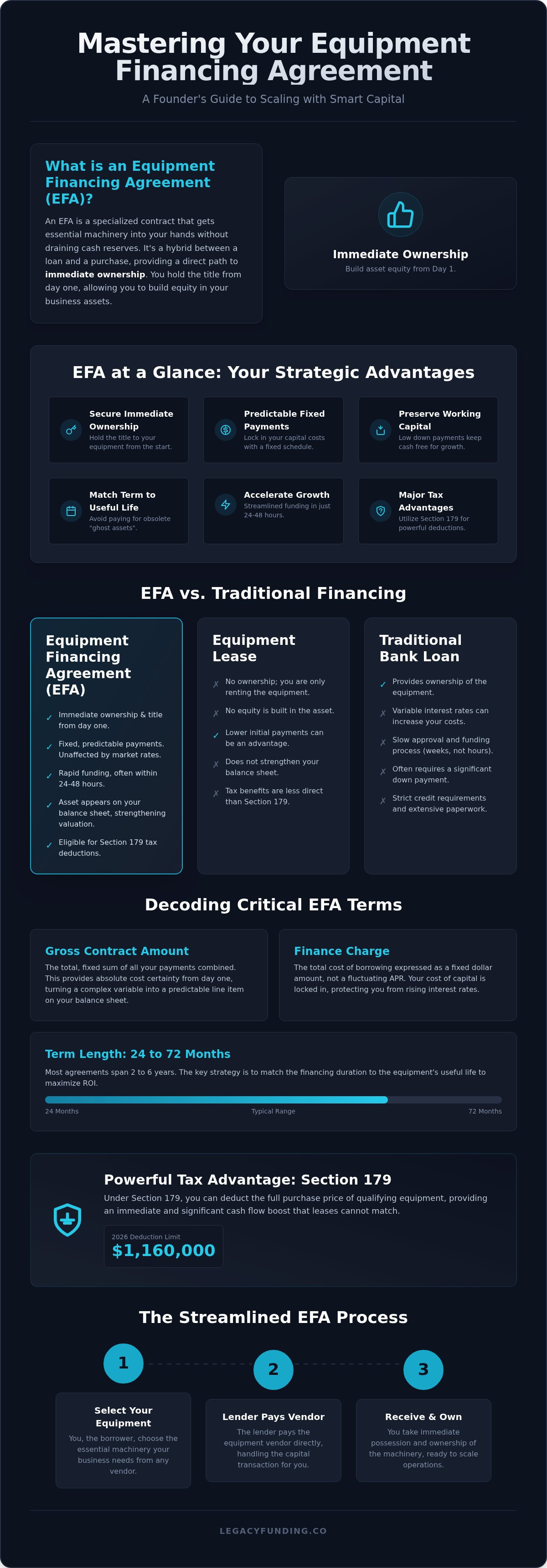
An Equipment Financing Agreement (EFA) is a specialized contract designed for one purpose: getting essential machinery into your hands without draining your cash reserves. Think of it as a hybrid between a traditional loan and a purchase agreement. In this structure, the lender provides the capital to acquire the asset, and you agree to pay back a predetermined, fixed amount over a set period. Unlike a lease where you pay for the use of an item, an EFA is a direct path to immediate ownership. You hold the title from day one. This distinction is critical for founders who want to build equity in their business assets rather than simply renting them.
When you review equipment financing agreement terms, the most prominent figure you will see is the Gross Contract Amount. This is the total sum of all your payments combined. Unlike a bank loan that might focus on a fluctuating interest rate, an EFA often presents the total cost of capital upfront. This transparency allows you to calculate your exact ROI on the equipment before you even sign. You know the cost. You know the schedule. You can plan your growth with total certainty.
The Legal Anatomy of an EFA
Every EFA involves a three way relationship between the borrower, the lender, and the equipment vendor. The lender pays the vendor directly, and you take possession of the machinery. To protect their investment, the lender retains a security interest in the equipment. This is a foundational example of Asset-based lending, where the value of the machinery itself secures the financing. If the payments stop, the lender has a legal claim to the asset. Most agreements span a duration of 24 to 72 months, typically matching the expected useful life of the equipment you are acquiring.
Why EFAs Appeal to Modern Founders
Founders choose EFAs because they prioritize speed and balance sheet strength. Owning the asset allows you to list it as a capital asset, which strengthens your company’s valuation. The tax advantages are equally compelling. Under Section 179 of the tax code, you can deduct the full purchase price of qualifying equipment up to a limit of $1,160,000 for the 2026 tax year. This provides an immediate cash flow boost that leases cannot match. While traditional SBA loans can take weeks to process, modern equipment financing agreement terms are built for speed. Legacy Funding Advisors often provides approvals and funding within a 24 to 48 hour window, ensuring your operations never skip a beat while waiting on a slow bank committee.
Key Clauses and Financial Terms in a Standard EFA
Your EFA is more than a monthly payment. It's a legal framework that dictates your operational freedom. When you dig into equipment financing agreement terms, you'll find several non-negotiable pillars: the payment schedule, the term length, and the total cost. These agreements are static. They are designed to provide stability. To maximize your ROI, you should always match the contract term to the expected useful life of the machinery. If a piece of technology will be obsolete in three years, don't sign a five-year agreement. Aligning these timelines ensures you aren't paying for "ghost assets" that no longer contribute to your revenue.
The most significant shift for many founders is the "Finance Charge." In a standard EFA, you won't see a traditional APR. Instead, the lender calculates a fixed dollar amount that represents the total cost of borrowing. This total is baked into your contract from day one. If you miss a payment, the "Default and Remedies" section takes over. This typically includes an acceleration clause, which means the entire remaining balance could become due immediately. To avoid this, ensure your cash flow projections align perfectly with the payment dates. Lenders also mandate "Insurance Requirements" to protect their collateral. You must maintain comprehensive coverage; if the machinery is stolen or destroyed, the lender expects to be made whole. If you have questions about specific requirements for your industry, speak with a funding specialist to clarify your obligations before signing.
Decoding the Gross Contract Amount
The Gross Contract Amount is the total sum of every monthly payment plus any applicable documentation fees. You won't find a breakdown between principal and interest in this document because the EFA is treated as a fixed-sum purchase rather than a revolving debt. This structure is a massive advantage when market interest rates are rising. Your cost of capital is locked in, protecting your margins from external economic shifts. It turns a complex financial variable into a predictable, manageable line item on your balance sheet.
The "Hell or High Water" Clause
This clause is the most rigid part of any EFA. It states that your obligation to pay is absolute, regardless of whether the equipment actually works. Even if a machine sits idle or breaks down, the payments must continue. Lenders require this language so they can bundle and sell these contracts to secondary investors with guaranteed returns. To mitigate this risk, never sign an EFA without a robust manufacturer’s warranty. Ensure the vendor is responsible for repairs so your production stays online even while you're fulfilling your financial commitment. This keeps the burden of equipment performance on the manufacturer while you focus on scaling your operations.
EFA vs. Traditional Equipment Loans: Comparing the Structure
Choosing between a bank loan and an EFA determines how much liquidity you keep in your business. While a bank loan might offer lower theoretical rates, the upfront costs often paralyze a growing company. Equipment financing agreement terms are built for speed and capital preservation. Traditional lenders typically demand a 20% down payment to "de-risk" the deal. EFAs frequently offer 100% financing, requiring as little as 0% to 10% down. This keeps your cash in your operating account where it belongs. When you're scaling, that 20% difference represents the capital needed for payroll, marketing, or inventory.
The documentation burden also creates a sharp divide. Banks require a mountain of paperwork: three years of tax returns, personal financial statements, and exhaustive business plans. This process can drag on for weeks. Modern EFAs prioritize your current cash flow over historical data. The application is streamlined, often requiring only a few months of bank statements to prove your ability to pay. However, you must understand the early payoff implications. A bank loan allows you to save on interest if you pay ahead of schedule. An EFA is a fixed-sum contract. Paying early usually means paying the full gross amount. You aren't saving interest because the total cost is already locked in.
When to Choose an EFA Over a Loan
Pick an EFA when cash flow preservation is your primary objective. If you need to scale rapidly, the "No Down Payment" advantage allows you to acquire multiple units without depleting your reserves. This structure is also ideal for founders with fluctuating credit scores. Because the equipment secures the deal, lenders focus on your revenue rather than just a FICO score. Legacy Funding Advisors specializes in this agility, providing a fast alternative to the bureaucratic delays of legacy institutions. Use this path when speed to market is more valuable than a slightly lower interest rate.
Understanding Interest vs. Finance Charges
Don't be fooled by the absence of a stated APR in your contract. Every EFA has a cost of capital. To compare it to a bank loan, you should calculate the "Effective Interest Rate." Divide the total finance charge by the number of years in the term, then divide that by the average principal balance. While bank rates in 2026 often range between 6% and 12%, an EFA might have a higher effective rate in exchange for its accessibility. Despite the math, the transparency of a fixed monthly cost is a massive budgeting win. You won't face the "sticker shock" of a rate hike in the middle of your term. Know your numbers, compare the effective costs, and choose the structure that fuels your specific growth metrics.
How to Evaluate and Negotiate Your Financing Terms
Negotiation isn't a luxury; it's a strategic necessity. Most founders accept the first draft of an agreement as final, but equipment financing agreement terms are often more flexible than they appear. Your primary goal is to align the financing duration with the equipment's useful life. If you are financing a fleet of delivery vans that will be cycled out in 48 months, do not sign a 60-month contract. Paying for an asset you no longer use is a drain on your growth. Additionally, ensure your agreement covers "Soft Costs." High-level agreements should include installation, shipping, and staff training in the total financed amount. This prevents you from paying for these essentials out of pocket, preserving your liquid cash for other operational needs.
Ownership is the standard outcome of an EFA, but you should still verify the "End of Term" language. Confirm that the title transfer is automatic and fee-free once the final payment is made. You should also push for "Prepayment Language" that offers a discount on the remaining finance charges if you settle the debt early. While Section 3 noted that many EFAs require the full gross amount, savvy founders negotiate a "sliding scale" or a "Rule of 78s" provision to save money during a mid-term buyout. If you want a professional eye to look over your current offer, contact our team today to ensure your terms are built for scale.
The Checklist for Reviewing Your Agreement
Before you put pen to paper, run your contract through this five point audit. These questions expose the reality of your financial commitment:
- What is the final Gross Contract Amount? Verify this matches your manual calculation of all monthly payments plus disclosed fees.
- Are there hidden Administrative Fees? Look for "origination charges" or "processing fees" that weren't in the initial quote.
- Is there a Cross-Default clause? This red flag means a default on this agreement triggers a default on every other loan you have with that lender.
- Are the insurance requirements reasonable? Ensure the mandated coverage doesn't exceed the actual value of the machinery.
- Does the agreement allow for equipment upgrades? Check if you can trade in the asset for newer technology before the term ends.
Negotiating for Flexibility
Your business doesn't always move in a straight line, and your payments shouldn't have to either. If your revenue is cyclical, ask for a "Seasonal Payment" structure. This allows you to make lower payments during your slow months and higher ones during peak season. You can also propose a "Step-Up" plan. This keeps payments low for the first six months while the equipment is being integrated into your workflow, only increasing once the asset is fully generating revenue. Use multiple quotes to leverage these concessions. When a lender knows they are competing for your business, they are far more likely to waive origination fees or adjust the finance charge to win the deal.
Scaling Faster with Legacy Funding’s Streamlined Agreements
Legacy Funding Advisors moves at the speed of contemporary commerce. We know that in a fast paced market, waiting weeks for a bank decision is the same as a rejection. It's a missed opportunity. Our approach to equipment financing agreement terms is built on the reality of your daily operations rather than just your historical credit score. We prioritize your current cash flow and growth potential. This allows us to provide funding in as little as 24 to 48 hours for approved applications. Whether you are on a construction site in Texas or a manufacturing plant in Canada, our nationwide reach across the U.S., Puerto Rico, and Canada ensures your business has the tools to scale.
Traditional institutions are bogged down by bureaucracy. They focus on what happened three years ago. We focus on what you're building tomorrow. Our agreements are transparent, removing the friction that usually slows down asset acquisition. You get the machinery you need exactly when you need it. You keep your momentum. You win the market. We understand that your business is a generational endeavor, and we provide the financial support to match that ambition.
The Legacy Application Advantage
Scaling a business is complex, but your financing shouldn't be. We've refined our process into a triad of ease: a simple application, fast approval, and immediate funding. We don't just act as a lender; we act as a high level consultant personally invested in your trajectory. This consultative approach means we help you structure equipment financing agreement terms that protect your liquidity while maximizing your tax benefits. Our low barrier entry requirements are specifically designed for high growth SMBs that need to move quickly without the weight of legacy banking requirements. We remove the ambiguity from the process, providing clear and actionable steps from start to finish.
Ready to Upgrade Your Operations?
Every day you wait for a traditional bank is a day your competitors are gaining ground. Traditional equipment loans are often too slow to meet the demands of modern industry. Waiting for a committee to review your file is a missed opportunity for revenue and market share. Take the next step toward financial independence and operational excellence today. Secure the assets that will define your company's future without the typical institutional headaches. Stop letting outdated lending models dictate your growth. You have the vision; we provide the gateway to the resources you need to execute it.
Get funded in as little as 24 hours with Legacy Funding and start scaling your vision now.
Secure Your Competitive Advantage
Mastering equipment financing agreement terms is the difference between stagnant operations and aggressive expansion. You now have the insider knowledge to decode finance charges, negotiate operational flexibility, and align your capital with your equipment’s actual utility. Don't let the technicalities of traditional lending or the bureaucratic delays of legacy banks slow your momentum. You've worked too hard to let a confusing contract stall your business vision.
Legacy Funding Advisors provides a modern alternative with cash-flow focused underwriting that prioritizes your future, not just your credit history. We deliver funds in as little as 24 to 48 hours to ensure you never miss a market opportunity. Our nationwide reach across the U.S., Canada, and Puerto Rico provides the tailored solutions you need to scale across borders. Your growth shouldn't wait on a bank's schedule.
Apply for Fast Equipment Financing Today
Take control of your capital, protect your cash flow, and build your legacy today. You've done the hard work of building the vision; now get the tools you need to execute it with total confidence.
Frequently Asked Questions
What is the difference between an equipment lease and an EFA?
An EFA grants you immediate ownership, whereas a lease allows you to use equipment for a fee without holding the title. In an EFA, you list the machinery as a capital asset on your balance sheet from day one. Leases often include buyout options at the end of the term, but an EFA is designed as a purchase from the start. This distinction is vital for founders who want to build equity in their business assets.
Do equipment financing agreements have interest rates?
Most equipment financing agreement terms don't specify a traditional annual percentage rate (APR). Instead, they utilize a fixed finance charge that represents the total cost of capital for the duration of the contract. This creates a predictable payment schedule that never fluctuates. You can calculate an effective interest rate for comparison, but the document itself focuses on a single, fixed dollar amount.
Can I pay off my equipment financing agreement early?
You can pay off your agreement early, but you will likely be responsible for the full gross contract amount. Unlike traditional bank loans, EFAs are structured as fixed-sum obligations. This means you don't automatically save on interest by settling the debt ahead of schedule. Always negotiate for prepayment discounts or sliding scale buyout options before you sign the final document to ensure maximum flexibility.
Is a down payment required for an EFA?
Down payment requirements for an EFA are significantly lower than traditional bank loans, often ranging from 0% to 10%. Many high-growth businesses qualify for 100% financing, allowing them to keep their liquid cash for operations. This low barrier to entry is a primary reason why founders choose EFAs over legacy banking products that frequently demand a 20% upfront commitment.
What happens if the equipment breaks during the financing term?
You are responsible for payments even if the machinery breaks down due to the hell or high water clause. This clause makes your financial obligation absolute and independent of equipment performance. Protect your production by securing a comprehensive manufacturer's warranty and maintaining proper insurance coverage. These safeguards ensure your business stays operational while you fulfill your contractual commitment.
Are EFA payments tax-deductible for my business?
Yes, EFA payments offer significant tax advantages through depreciation and Section 179 deductions. For the 2026 tax year, you can deduct the full purchase price of qualifying equipment up to the $1,160,000 limit. Because you own the asset immediately, you can leverage these incentives to offset your taxable income. Consult your tax professional to maximize the impact on your bottom line.
What credit score do I need for equipment financing?
Legacy Funding Advisors prioritizes your business cash flow over rigid credit score requirements. While traditional banks often require a FICO score above 700, alternative lenders look at your revenue and the value of the equipment itself. Stronger credit scores can lead to more favorable equipment financing agreement terms, but a less-than-perfect history won't automatically disqualify you from getting the capital you need.
Can I include installation and shipping costs in my EFA?
You can bundle soft costs like installation, training, and shipping directly into your financing agreement. This allows you to finance the entire project cost rather than just the hardware. Including these expenses preserves your working capital and simplifies your accounting. Ensure these costs are clearly itemized in the vendor's quote so they can be seamlessly integrated into your gross contract amount.