


Can You Have Multiple SBA Loans? Scaling Your Business in 2026
What if the $5 million SBA limit you've heard about is actually just the starting line for your expansion? Most founders believe they're capped once they secure their first round of funding, but that's a common misconception that stalls growth. You've likely felt the frustration of watching a prime opportunity slip away while waiting on bank bureaucracy. If you're asking, "can you have multiple sba loans?" the answer is a definitive yes, provided you understand the updated 2026 aggregate limits. This isn't just about debt; it's about building a scalable credit facility that supports your vision.
You already know that capital is the lifeblood of your business, and hitting a perceived ceiling can feel like a dead end. We promise to clarify the specific rules governing the new $10 million cumulative cap and show you how to strategically layer different SBA programs. You'll discover how to navigate the 165 minimum credit score requirement and explore fast-funding alternatives like revenue-based financing to keep your momentum high while waiting for government approval. We're going to break down exactly how to leverage these tools to turn a single success into a generational enterprise.
Key Takeaways
- Master the SBA "Exposure Rule" to understand how you can have multiple sba loans based on total dollar amounts rather than a limit on the number of notes.
- Navigate the updated 2026 aggregate limits to maximize your borrowing power across 7(a) and 504 programs.
- Identify high-impact scenarios for layering loans, from funding second locations to acquiring competitors for vertical integration.
- Secure your approval by auditing your Debt Service Coverage Ratio and collateral availability before submitting secondary applications.
- Leverage bridge capital options like Revenue-Based Financing to maintain momentum and capture fast-moving growth opportunities.
The Short Answer: Yes, You Can Have Multiple SBA Loans
The misconception that you're limited to a single government-backed loan stops many founders from scaling. The reality is that the Small Business Administration (SBA) does not impose a hard limit on the number of notes you can hold. You can secure a second, third, or even fourth loan to fuel your growth. The agency focuses on your total financial footprint rather than the quantity of applications. If you're wondering, "can you have multiple sba loans," the answer depends on your total exposure and your history as a borrower.
Lenders use the "Exposure Rule" to evaluate your eligibility. This rule dictates that your limit is based on the total dollar amount the SBA guarantees across all your active debts. As long as you remain in good standing, meaning your current payments are on time and your business remains profitable, the door to additional capital stays open. You can mix and match programs like the 7(a), 504, and Microloans to build a custom capital stack. The agency's primary gatekeeper is your status as a borrower. Maintaining "Good Standing" isn't just about making payments; it requires a minimum Small Business Scoring Service (SBSS) score of 165 for 2026 and compliance with the latest ownership rules. If you meet these benchmarks, your path to multiple funding rounds is clear.
The $5 Million Aggregate Limit Explained
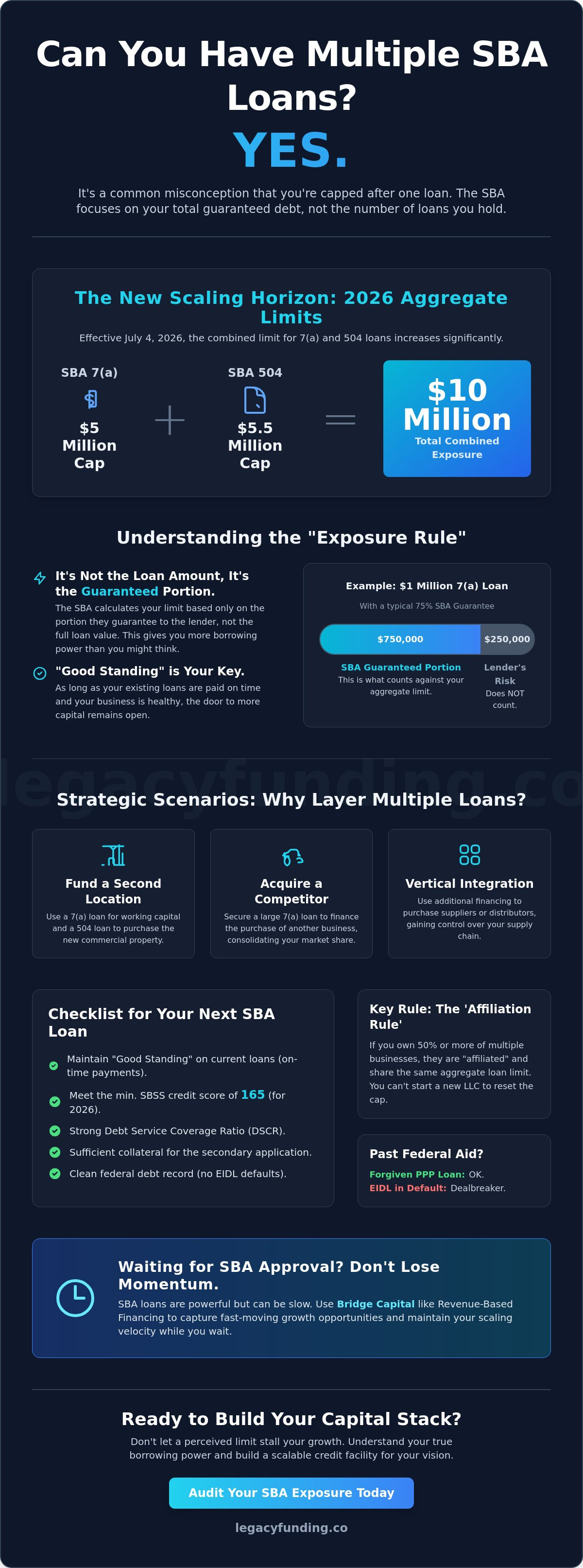
For the flagship 7(a) program, the SBA sets an aggregate guarantee limit of $5 million. It's vital to distinguish between the total loan amount and the guaranteed portion. If the SBA guarantees 75% of a $1 million loan, only $750,000 counts against your cap. This distinction provides savvy owners with more headroom than they initially realize. Aggregate exposure is the sum of all outstanding SBA-guaranteed balances currently linked to your tax ID. Once you reach this $5 million threshold, you aren't necessarily finished, but you'll need to look at other programs to continue your expansion.
Combining Different SBA Programs
Strategic scaling often requires using different tools for different jobs. You might use a 7(a) loan for working capital while simultaneously holding a 504 loan for a commercial real estate purchase. The 504 program offers its own specific limits, often reaching up to $5.5 million for the SBA-backed portion. You can even layer in Microloans, capped at $50,000, for tactical needs like specialized equipment or inventory spikes. Effective July 4, 2026, the cumulative limit for combined 7(a) and 504 exposure has increased to $10 million. This change allows you to hold multiple loans across different programs to maximize your total available capital. Understanding how these programs stack ensures you never have to turn down a growth opportunity due to a lack of liquidity.
Navigating the SBA Aggregate Loan Limits in 2026
Understanding the math behind the cap is the key to scaling. Many founders mistakenly believe the $5 million limit applies to the total amount of cash they receive. In reality, the SBA calculates your limit based on the "guaranteed portion" of your debt. If you secure a $1 million 7(a) loan with a 75% guarantee, the SBA is only on the hook for $750,000. This $750,000 is the only figure that counts toward your $5 million aggregate limit. The remaining $250,000 is the lender's private risk. It doesn't eat into your federal headroom. This distinction is vital for those asking, "can you have multiple sba loans," because it means your actual borrowing power can exceed the $5 million headline figure.
For 2026, the SBA Express loan remains a popular tool for rapid needs, with a maximum individual amount of $500,000. These loans typically carry a 50% guarantee, meaning a full $500,000 Express loan only utilizes $250,000 of your total SBA loan programs cap. Regarding past federal assistance, a successfully forgiven PPP loan won't block your current eligibility. However, any outstanding default on an EIDL or other federal debt is a dealbreaker. You must have a clean track record with the government to access secondary funding rounds. If you aren't sure how your current debt impacts your future limits, consult with a specialist to audit your aggregate exposure.
The 'Affiliation Rule' for Serial Entrepreneurs
The SBA views businesses with common ownership as a single unit. If you own 50% or more of multiple entities, they are considered "affiliated." This means they usually share the same $5 million 7(a) aggregate limit. You can't simply open a new LLC to reset your borrowing clock. To maximize your funding, you must demonstrate clear operational independence or structure your new ventures with minority ownership stakes to avoid triggering these restrictive affiliation rules.
Lender-Specific Limits vs. SBA Limits
A bank's internal policy often matters more than federal law. Every institution has an "internal concentration limit," which is the maximum amount they are willing to lend to one borrower or one industry. Even if you have millions in SBA headroom, your current bank might say no because they've reached their own risk ceiling. When you hit this wall, don't stop your expansion. Move your second application to a different lender who has a fresh appetite for your specific business model. This multi-lender strategy is a hallmark of the modern founder's playbook.
Strategic Scenarios: When to Apply for a Second SBA Loan
Scaling is a sequence of strategic moves. You've already established your first footprint; now you need the capital to multiply it. If you're asking, "can you have multiple sba loans," you're likely at a crossroads of expansion. Successful founders don't just take one loan and wait. They layer debt to capture market share and build resilience. This isn't about accumulating debt; it's about deploying capital where it generates the highest return.
Opening a second location is the most frequent trigger for a second 7(a) loan. While your initial loan funds your flagship site, a second note can cover leasehold improvements and initial inventory for your new territory. Vertical integration is another high-impact play. You can use an SBA acquisition loan to buy out a supplier or a competitor. This move increases your margins and secures your supply chain. Transitioning from tenant to landlord is a major milestone that requires a different tool. You can utilize the 504 program to acquire commercial real estate even if you have an active 7(a) for working capital. The recent update to SBA aggregate loan limits allows for a more aggressive expansion strategy than ever before. Finally, don't overlook major equipment upgrades. Layering an equipment-heavy loan ensures your production capacity matches your growing sales volume.
Refinancing Existing Debt into an SBA Loan
High-interest debt is a drag on your cash flow. You can use a second SBA loan to consolidate expensive non-SBA business debt. To qualify, you must prove a "Substantial Benefit," which usually means a 10% or greater improvement in your debt service payments. Keep in mind that you generally cannot use a new SBA loan to pay off an existing one. Focus on replacing predatory or high-rate private capital to free up your monthly revenue for new projects.
Seasonal Working Capital Surges
Growth isn't always linear. SBA CAPLines provide a revolving credit facility that sits alongside your fixed-term loans. This setup gives you a "standby" credit line for payroll or inventory during peak seasons. You can also use the SBA Express line for smaller, recurring needs. Having these multiple facilities ensures you never miss a growth signal due to temporary cash constraints. It provides a safety net that traditional term loans lack, allowing you to scale with confidence.
Why a Second SBA Loan Application Might Be Denied
Securing a second approval is significantly more rigorous than the first. Lenders focus heavily on your Debt Service Coverage Ratio (DSCR) to ensure your business remains resilient under added pressure. They calculate your net operating income against the total debt of both loans combined. If your DSCR drops below the typical 1.25x threshold, your expansion plans will likely hit a wall. While the answer to "can you have multiple sba loans" is technically yes, your cash flow must prove it can handle the combined weight of every monthly payment. Your minimum Small Business Scoring Service (SBSS) score must also meet the 2026 requirement of 165; anything lower triggers an automatic red flag in the underwriting process.
Collateral shortfalls present another major hurdle for growing enterprises. If you already pledged your equipment, inventory, or real estate to secure your first 7(a) loan, you may have little left to offer for a second note. SBA lenders typically demand a "best available" lien position on your assets. If you're tapped out on tangible collateral, you'll need to demonstrate exceptionally strong revenue or bring new assets to the table to offset the lender's risk. Personal guarantees also carry more weight the second time around. You're not just pledging your business assets; you're doubling down on your personal liability, which can strain your global financial profile.
Don't overlook the "Credit Elsewhere" test, which is a unique hurdle in federal lending. The SBA acts as a lender of last resort. If your business has grown so successful that a traditional bank would offer you a conventional loan without the government guarantee, the SBA might actually deny your application. They want to ensure their resources support businesses that truly need federal backing to scale. If you're concerned that your current debt load or success might lead to a denial, speak with our funding advisors to review your eligibility before you apply.
The Impact of Existing SBA Debt on Cash Flow
Lenders perform a comprehensive "global cash flow" analysis. They examine the health of every business you own alongside your personal finances. A second loan creates a "double payment" trap that can dangerously thin your operating margins if not managed correctly. Before applying for a second round, clean up your balance sheet by paying down high-interest lines of credit or consolidating smaller debts. A leaner debt profile makes your secondary application look much more attractive to cautious underwriters.
The Time Barrier: The Hidden Cost of SBA Bureaucracy
Federal funding is notoriously slow, and a second application is no exception. You should expect a 60 to 120-day wait for a second SBA approval. In a fast-moving market, this delay represents a massive opportunity cost. You might also experience "SBA Fatigue," which is the heavy documentation burden required for a second federal application. If your growth opportunity requires immediate action, the slow pace of the SBA can be as detrimental to your business as a flat-out denial.
Beyond the SBA: Fast Bridge Capital for Rapid Scaling
The question isn't just "can you have multiple sba loans," but rather "can you afford to wait for them?" In a fast-moving economy, the 90-day approval window of a traditional bank is a liability. You need a tactical bridge to cross the gap between opportunity and funding. Revenue-Based Financing serves as this vital link. It provides the liquidity you need to secure a new location or acquire a competitor while your secondary SBA application crawls through the federal system. Legacy Funding Advisors delivers this capital in as little as 24 to 48 hours, ensuring you never lose a deal to a slower competitor.
Merchant Cash Advances (MCAs) offer another high-speed tool for inventory surges. These facilities don't add to your long-term debt profile; instead, they scale with your daily sales. Our working capital loans focus on your current cash flow rather than just your credit score. This flexibility allows you to deploy capital immediately where it matters most. You aren't just borrowing money; you're buying time. While you're asking "can you have multiple sba loans" to build your long-term foundation, use these faster tools to handle the immediate demands of a growing enterprise.
When Speed Trumps Interest Rates
A 7% interest rate is useless if the property you're eyeing sells to a cash buyer while you're waiting on a government signature. Sometimes, getting capital in 24 hours is more profitable than waiting months for a slightly lower rate. Use fast funding to secure your down payment or lock in a real estate deal before an SBA 504 loan closes. We act as your tactical growth ally, providing the insider knowledge needed to navigate high-stakes expansion. Don't let a slow bank dictate the pace of your success. Move when the market moves, not when the bureaucracy allows.
Legacy Funding Advisors’ Streamlined Process
We've replaced the bureaucratic friction of legacy banking with a triad of simplicity: easy application, fast approval, and quick funding. This modern approach mirrors the speed of the businesses we serve. See alternative funding as a primary tool for rapid expansion rather than a last-ditch effort. It's time to stop waiting and start scaling. Evaluate your current cash flow today and secure an immediate capital injection to fuel your next move. Connect with Legacy Funding Advisors to bridge your growth gap and maintain your momentum.
Master Your Scaling Strategy for 2026
Scaling your business requires a sophisticated approach to capital. You now know the answer to can you have multiple sba loans is a resounding yes; the ceiling is often much higher than most founders realize. By mastering the $10 million aggregate limit and layering programs like the 7(a) and 504, you can build a robust financial foundation for generational growth. Success depends on your ability to manage global cash flow while keeping your momentum high.
Don't let the slow pace of federal bureaucracy stall your expansion. While you build your long-term foundation with the SBA, use tactical bridge capital to capture immediate market gains. We provide national coverage across the US, Puerto Rico, and Canada to ensure you're always ready to move. Secure your growth capital in as little as 24 hours with Legacy Funding Advisors. Our process focuses on your real-world cash flow rather than just credit scores. Your vision deserves a partner that understands the speed of modern commerce. Take control of your expansion and start building your legacy today.
Frequently Asked Questions
Can I have two SBA 7(a) loans at the same time?
Yes, you can hold two or more 7(a) loans simultaneously. The SBA evaluates your eligibility based on the total guaranteed dollar amount rather than the number of individual notes. As long as your business demonstrates strong cash flow and your total 7(a) exposure remains under the $5 million cap, you can continue to apply for new funding rounds to support your expansion.
What is the maximum total amount I can borrow from the SBA?
The maximum cumulative limit for combined 7(a) and 504 loans is $10 million as of July 2026. For the 7(a) program specifically, the individual loan maximum is $5 million, while the 504 program allows for up to $5.5 million per project. These limits refer to the portion of the loan the government guarantees, not necessarily the total capital you receive from the bank.
Does having one SBA loan make it harder to get a second one?
Holding an existing loan doesn't automatically disqualify you, but it does raise the underwriting bar. Lenders will perform a global cash flow analysis to ensure your business can comfortably service all debts. If you're asking "can you have multiple sba loans," remember that your Debt Service Coverage Ratio (DSCR) must typically stay above 1.25x across all active notes to secure a second approval.
Can I use a second SBA loan to pay off my first SBA loan?
You cannot use a new SBA loan to refinance or pay off an existing SBA debt. The agency's rules prevent debt shifting within their own programs. However, you can use a second SBA loan to consolidate high-interest private debt or Merchant Cash Advances. This strategy improves your monthly margins by replacing expensive capital with more favorable government terms.
How many businesses can I own and still get SBA funding for each?
There is no limit to the number of entities you can own, but the SBA's affiliation rules apply. If you have majority control over several businesses, they are treated as a single unit for borrowing purposes. This means they collectively share the $5 million 7(a) aggregate limit. You must demonstrate operational independence if you want to maximize funding across multiple ventures.
What happens to my personal guarantee if I have multiple SBA loans?
Your personal liability increases with every new note you sign. The SBA requires a personal guarantee from every individual owning 20% or more of the business. When you hold multiple loans, you are personally responsible for the full balance of each. This requirement means your personal assets are at risk if the business fails to meet its obligations.
Is there a way to get faster funding than an SBA loan for expansion?
Alternative options like Revenue-Based Financing and Merchant Cash Advances offer much faster speeds than the 60 to 120 day SBA process. Legacy Funding Advisors can provide capital in as little as 24 to 48 hours. These tools act as a bridge, allowing you to capture immediate opportunities while waiting for long-term federal funding to clear.
Can I get an SBA loan and a Merchant Cash Advance simultaneously?
You can hold both, but you must be transparent with your lenders. Some SBA lenders include clauses that prevent you from taking additional debt without their permission. However, many founders use Merchant Cash Advances as tactical, short-term injections for inventory or payroll while their SBA loan handles long-term real estate or equipment needs.