


Can I Get an SBA Loan After an MCA? The 2026 Guide to Refinancing and Eligibility
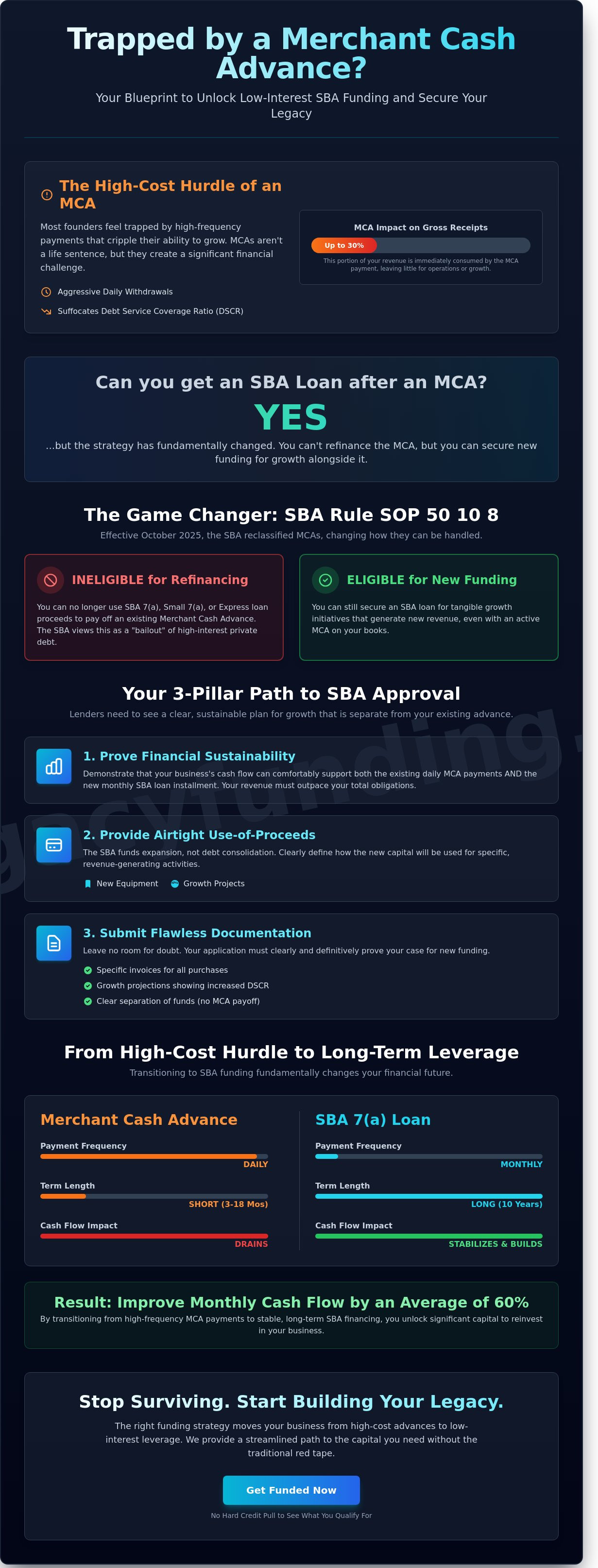
Your merchant cash advance isn't a life sentence; it's a high-interest hurdle that you can clear with the right strategy. Most founders feel trapped by daily withdrawals that consume up to 30% of their gross receipts. You might think your bridge to traditional financing is burned, and you're likely asking: can i get an sba loan after an mca? You're right to be concerned about the math. The high-frequency payment cycle of an MCA can suffocate the debt service coverage ratio that traditional banks demand, making expansion feel out of reach.
We're here to break that cycle. This guide reveals how to leverage the SBA’s October 2025 rule changes to refinance predatory debt into stable 10-year terms. You'll learn how to restructure your balance sheet, improve your monthly cash flow by an average of 60%, and secure the long-term capital you need to scale. Stop surviving and start building. We'll examine the specific eligibility criteria for 2026, the exact documentation required to prove your resilience, and the blueprint for moving from high-cost advances to low-interest SBA 7(a) funding. It's time to get funded and secure your legacy.
Key Takeaways
- Navigate the 2026 SBA landscape and learn how the latest SOP 50 10 8 updates have changed the rules for businesses with existing merchant debt.
- Master the Debt Service Coverage Ratio (DSCR) calculations to finally determine: can i get an sba loan after an mca?
- Address hidden UCC filings and high-APR hurdles that often block traditional funding paths to unlock a cleaner credit profile.
- Explore strategic debt consolidation and revenue-based alternatives to break the cycle of stacking and stabilize your cash flow.
- Implement a high-ROI blueprint to transition from fast capital to the long-term leverage required for business scaling and legacy.
The Reality of SBA Loans and Existing MCA Debt in 2026
Founders often ask a critical question: can i get an sba loan after an mca? The short answer is yes. An existing Merchant cash advance does not trigger an automatic disqualification for federal funding. It does, however, change the strategy you must use to secure capital. You aren't stuck. You just need a better blueprint to navigate the current lending environment. Legacy Funding Advisors is here to help you bridge that gap.
The SBA views your business through the lens of cash flow and debt coverage. If your revenue supports both your existing daily payments and a new monthly SBA installment, the door remains open. Many entrepreneurs use MCAs to bridge short-term gaps. The SBA recognizes this reality. They don't penalize you for seeking speed, but they do require you to prove your business is sustainable. Unlock your growth by understanding these new boundaries. Stop letting old debt dictate your future potential.
The SOP 50 10 8 Rule Explained
SOP 50 10 8 is the regulatory framework governing SBA loan eligibility and debt refinancing. This document changed the landscape on June 1, 2025. Under these updated guidelines, the SBA officially classified MCAs as ineligible for debt refinancing. This means you cannot use SBA 7(a) proceeds to pay off your advance. This restriction applies across the board to Standard 7(a), Small 7(a), and SBA Express loans.
The SBA made this change to prevent "bailout" scenarios. They want to fund expansion, not subsidize high-interest private debt. If your goal is to consolidate an MCA into a 10-year term, the SBA is no longer the vehicle for that specific move. Understanding this distinction is vital for your financial planning. Focus on using the SBA for what it does best: long-term leverage for tangible assets. This is how you protect your cash flow and your legacy.
Can You Still Get Funded?
You can still Get Funded even with an active advance on your books. The SBA allows loans for new equipment, real estate, or specific growth projects that drive revenue. The logic is simple. If the new capital creates more profit than the MCA takes out, you remain a viable candidate. You must clearly separate your existing debt from your new request. Don't let the technicalities slow you down. Focus on the expansion.
To succeed, you must provide airtight use-of-proceeds documentation. Lenders need to see exactly where the capital goes. Use these three pillars to strengthen your application:
- Specific Invoices: Show exactly which equipment or assets you are buying.
- Growth Projections: Demonstrate how this new capital will increase your debt service coverage ratio.
- Clear Separation: Prove that zero dollars will flow toward your MCA balance.
At Legacy Funding Advisors, we help you accelerate this process. We focus on your growth metrics rather than just your debt obligations. Secure the capital you need without the friction of traditional banking red tape. It's time to scale your business and protect your legacy. We offer a streamlined path with No Hard Credit Pull to see what you qualify for. Get the funding you deserve today.
Why the SBA Restricted Merchant Cash Advance Refinancing
The Small Business Administration exists to fuel growth, not to bail out high-interest speculation. For many founders asking, "can i get an sba loan after an mca," the answer hinges on a fundamental shift in government policy. The SBA views merchant cash advances (MCAs) as a purchase of future sales rather than traditional debt. This distinction matters. Because MCAs aren't technically loans, they don't follow the same usury laws or transparency standards as a bank note. The SBA's mission is "prudent lending," which focuses on long-term business health over the 24-hour liquidity that MCAs provide.
Data from recent fiscal years shows a sharp rise in defaults when businesses "stack" multiple advances. These high-frequency withdrawals drain the very capital needed to sustain a standard 10-year loan. When a business pays back 15% to 30% of its daily revenue to a third party, the SBA's taxpayer-backed guarantee is put at extreme risk. This led to the SBA's policy change regarding refinancing eligibility. The government decided to prioritize businesses that demonstrate sustainable cash flow management over those caught in high-interest cycles.
The Risk of Debt Stacking
Lenders look for a clean debt-to-income ratio to ensure you can handle monthly installments. MCAs disrupt this balance. Daily or weekly withdrawals create massive volatility in your bank statements. When you have two or three advances running at once, your cash flow becomes a sieve. This "stacking" is a major red flag for SBA underwriters. They also worry about UCC-1 filings. These liens give MCA companies a claim on your assets, which complicates the SBA's position as a primary creditor. To unlock your full capital potential, you must first stabilize these obligations and clear the path for traditional leverage.
Protecting the 7(a) Program Integrity
The 7(a) loan program is the gold standard for small business funding. It relies on a delicate balance of private lending and government backing. The 2025 rule updates specifically targeted predatory lending cycles to keep the program solvent. If the SBA allowed unrestricted refinancing of MCAs, they would essentially be subsidizing high-interest lenders with taxpayer money. Many entrepreneurs wonder, can i get an sba loan after an mca if the rules are this strict?
Legacy Funding views transparency as the ultimate tool for business scaling. We believe a clear financial blueprint is better than a quick fix. By restricting MCA refinancing, the SBA is forcing a return to fundamentals. It's a move toward business sustainability that ensures capital remains available for those who build for the long term. You can still find a path forward; it just requires a strategic approach to your current debt structure. Understanding the logic behind these rules is the first step toward your next funding milestone.
How to Qualify for an SBA Loan While Carrying an MCA
You can secure a government-backed loan even with a high-interest advance on your books. Success requires a blueprint that proves your business remains a healthy, profit-generating machine. Traditional banks often stall when they see daily debits on a bank statement. You must show them the math that works. Many founders ask, can i get an sba loan after an mca even if the daily payments are high? The answer is yes, provided you demonstrate that the capital was used for growth rather than survival.
The DSCR Calculation for MCA Holders
The Debt Service Coverage Ratio (DSCR) measures your business’s ability to pay its debts with its current operating income. SBA lenders typically target a 1.25x ratio or higher. To find your true standing, you must convert daily MCA payments into a monthly equivalent. If your business pays $450 daily over 22 business days, your monthly obligation is $9,900. Add this to your proposed SBA payment. Your net operating income must exceed this combined total by 25% to ensure approval. This buffer proves you can handle market shifts without defaulting on your obligations.
- Calculate Monthly Impact: Multiply your daily payment by 22 to show lenders the monthly cash flow drain.
- Target 1.25x: Ensure your EBITDA covers all debt payments with room to spare.
- Highlight Net Income: Focus on your bottom line after all MCA fees are deducted.
Cleaning Up Your Credit Profile
MCAs often cause temporary dips in your FICO SBSS score; this score is critical because the SBA uses a 155 minimum for its 7(a) small loan program. Leverage your business cash flow as the primary strength of your application. Many entrepreneurs utilize "No Hard Credit Pull" inquiries to preserve their scores while exploring other financing options before committing to a formal application. This strategy prevents unnecessary point drops during the research phase.
Address any UCC-1 filings immediately. These legal notices act as a "cloud" on your business credit. If you paid off an MCA in 2023 but the lender never filed a termination statement, it will block your SBA funding. Verify that your credit report accurately reflects your current debt levels. Clear the wreckage of old advances to present a clean slate to the federal government.
Your narrative must answer the core question: can i get an sba loan after an mca to scale my operations? Explain exactly why you used the MCA. If you used $75,000 in 2023 to buy bulk inventory that yielded a 30% profit margin, show those numbers. Demonstrate that the SBA loan will refinance this high-cost debt to accelerate your growth. Work with a lender who understands alternative funding structures. They see the MCA as a stepping stone, not a dead end. Get funded by focusing on your trajectory, not just your past receipts.
Strategic Alternatives: When an SBA Loan Isn’t the Immediate Answer
The SBA process moves at a glacial pace. While you’re asking "can i get an sba loan after an mca," your business needs capital to seize opportunities right now. Waiting 90 days for a government backed approval can cost you a 20% growth surge or a prime contract. You need a bridge. Strategic alternatives allow you to stabilize your cash flow, clean up your balance sheet, and position your company for that future SBA approval. These options don't just provide money; they provide the breathing room required to fix your debt to income ratios.
Revenue-Based Financing vs. SBA Loans
Speed is your greatest leverage. Revenue based financing delivers capital in 24 to 48 hours. Traditional SBA loans often require 60 to 90 days of intensive underwriting. While the SBA demands heavy collateral and a 680 or higher credit score, alternative markets focus on your actual cash flow. You can access funds based on your sales volume without the red tape. Many of these modern structures offer No Personal Guarantee and No Hard Credit Pull, protecting your personal legacy while you scale. It’s a faster, cleaner way to get the liquidity you need without the 25 page application.
- Funding Speed: 1 to 2 days versus 3 months.
- Qualification: Monthly revenue focus versus asset collateral.
- Flexibility: Payments that scale automatically with your sales volume.
The Power of Debt Consolidation
Multiple MCA payments can suffocate your Debt Service Coverage Ratio (DSCR). If your DSCR drops below the 1.25 threshold required by most SBA lenders, your application is dead on arrival. A reverse consolidation provides an immediate solution. This strategy merges your high frequency payments into a single, manageable weekly or monthly obligation. It lowers your daily burden by up to 40% in many cases, freeing the cash flow necessary to meet federal requirements. This isn't just debt management; it’s your blueprint for scaling. Using these strategies answers the question of "can i get an sba loan after an mca" by repairing the very metrics lenders scrutinize most.
Bridge financing acts as the tactical precursor to your long term capital plan. Use a business line of credit to handle inventory or payroll while your SBA file sits in underwriting. It gives you flexible access to funds without the rigid constraints of traditional bank products. Accelerate your growth today. Don't let a slow approval process stall your momentum. Unlock the capital you need to build your business legacy and prepare for a future of lower interest rates.
Blueprint for Success: Transitioning to Long-Term Capital
Stop the cycle of stacking immediately. Stacking multiple cash advances creates a debt spiral that suffocates cash flow and prevents real expansion. If you're wondering can i get an sba loan after an mca, the answer starts with committing to a single, sustainable funding path. High-interest capital should only serve as a temporary bridge to reach a more stable financial position. You deserve a strategy that builds equity, not just one that covers next week's payroll.
Use fast capital to execute high-ROI projects that boost your net income. When you leverage short-term funds for inventory bulk buys or equipment that increases production by 25 percent, you create the cash flow necessary to qualify for better terms. Traditional lenders want to see that your business generates enough profit to cover debt obligations at least 1.25 times over. Transforming your debt into a growth engine is the fastest way to prove you're ready for institutional capital. It's about moving from high-cost daily withdrawals to monthly, low-interest payments that let you breathe.
Founders often ask can i get an sba loan after an mca when they feel trapped by aggressive repayment schedules. Success requires a relationship with a funding advisor who looks beyond the credit score. A true partner analyzes your cash flow, your industry trajectory, and your long-term goals. They help you navigate the shift from survival mode to legacy building. Stop viewing capital as a simple transaction. Start viewing it as a blueprint for your future growth. Get Funded on your terms, not the bank's.
Why Legacy Funding Advisors is Your Strategic Ally
We provide the bridge from high-cost debt to sustainable growth capital. Our team possesses deep expertise in both MCAs and SBA products to guide your transition effectively. We understand the nuances of debt consolidation and how to position your balance sheet for federal approval. Accelerate your growth with tailored capital solutions that respect your timeline. We don't just provide funds; we provide the roadmap to financial freedom and business scaling.
Your Next Steps to Funding
- Apply online in minutes with no hard credit pull and no personal guarantee requirements on many products.
- Consult with a dedicated advisor to review your current debt structure and identify consolidation opportunities.
- Unlock the liquidity needed to scale without the friction of traditional banking red tape.
Take the first step toward your business legacy today. Our process is designed for speed, transparency, and results. Apply now at Legacy Funding and get the capital you need to secure your future. It's time to Get Funded.
Take Command of Your Capital Strategy
Success in the 2026 fiscal landscape demands a shift from reactive borrowing to proactive scaling. While SBA guidelines remain rigorous regarding debt coverage ratios, the answer to can i get an sba loan after an mca is a definitive yes for owners who prioritize cash flow management and strategic refinancing. You've learned how bridge capital and long-term debt must work in tandem to protect your margins. Don't let high-frequency payments stifle your expansion or drain your daily reserves.
Legacy Funding provides the blueprint for your next phase of growth. We eliminate the friction of traditional lending by focusing on your revenue performance rather than just a number on a credit report. You'll see your funding options with no hard credit pull; it's a risk-free way to evaluate your leverage. We deliver capital in as little as 24 to 48 hours so you can execute your plans without delay. Your business deserves a partner that moves as fast as you do.
Unlock Your Business Capital Now
The path to financial freedom is open. Let's build your legacy together.
Frequently Asked Questions
Can I use an SBA loan to pay off my merchant cash advance?
Yes, you can use an SBA 7(a) loan to refinance high interest debt like an MCA. To qualify, the SBA requires the new loan to improve your monthly cash flow by at least 10 percent. This strategy allows you to replace daily debits with a single monthly payment. It's a proven blueprint to lower your cost of capital and secure your business legacy.
Will an existing MCA UCC filing stop me from getting an SBA loan?
A UCC filing won't automatically disqualify you, but it complicates the process because the SBA demands a first lien position on business assets. You'll need to negotiate a subordination agreement or use the loan proceeds to pay off the MCA entirely. Most SBA lenders require clear titles to collateral before they authorize a final disbursement. Clear the path, settle the lien, and get funded.
What is the minimum credit score for an SBA loan if I have an MCA?
You typically need a minimum FICO SBSS score of 155 to pass the initial SBA screening. While the SBA doesn't set a hard floor for personal scores, most partner banks look for a 680 or higher. If your score sits at 640, you might still qualify by providing additional collateral. Use your credit as a tool to unlock better rates and accelerate your expansion.
Can I get an SBA Express loan faster than a Standard 7(a) if I have debt?
Yes, the SBA Express loan offers a 36 hour turnaround on initial approval, which is significantly faster than the 30 day window for Standard 7(a) loans. However, the maximum loan amount is capped at $500,000. If you need to know can i get an sba loan after an mca quickly, the Express route is your fastest blueprint for capital. It streamlines the process and reduces friction.
How does the SBA calculate my ability to pay if I have daily MCA withdrawals?
The SBA uses a Debt Service Coverage Ratio (DSCR) of 1.15 to evaluate your repayment capacity. They add back your daily MCA payments to your net income to see if the new loan is affordable. This calculation proves you can handle the debt without straining your operations. It’s about showing you have the cash flow to sustain growth and build your legacy.
Is it better to settle my MCA before applying for an SBA loan?
Settling your MCA before applying is often the smartest move to improve your debt to income ratio. Lenders view settled debt more favorably than active daily drains on your bank account. Reducing your total liabilities by 25 percent can significantly boost your approval odds. Clean up your balance sheet, remove the weight of high interest debt, and position your business for a successful application.
What are the best alternatives to SBA loans for businesses with MCAs?
Asset based lending, term loans, and lines of credit are the three best alternatives when an SBA loan isn't immediate. These options often provide faster access to capital without the strict 25 percent equity requirements of federal programs. They allow you to bridge the gap and maintain momentum. Choose the path that offers the least resistance to your goals and get funded today.
Can I have an SBA loan and an MCA at the same time?
You can technically hold both, but the SBA's restrictive covenants usually prohibit taking on new high interest debt without prior approval. Most SBA loan agreements include a negative pledge clause that prevents you from encumbering assets with further liens. Taking an MCA after your SBA loan could trigger a default. Protect your capital structure and consult your financial blueprint before adding new debt.