


Calculating Net Working Capital: A Founder's Guide
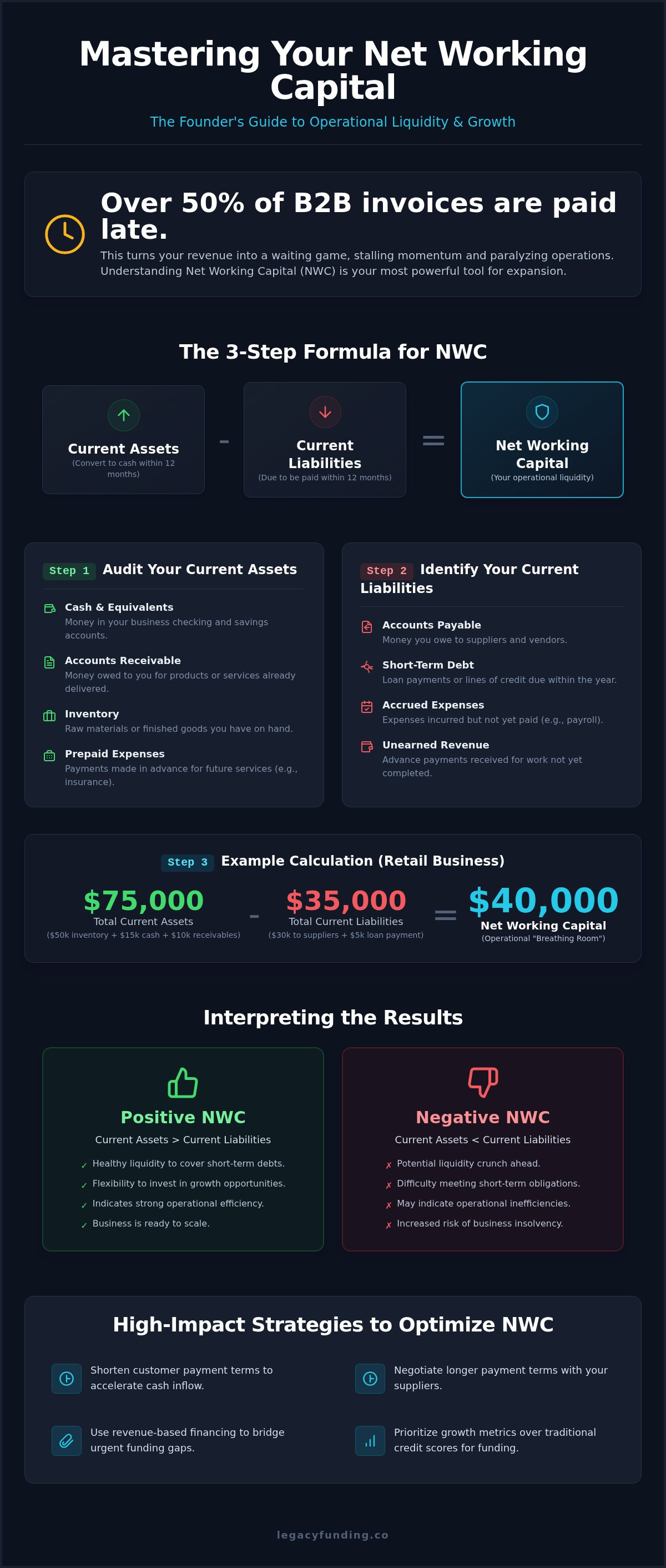
Over 50% of B2B invoices are paid late, turning your hard-earned revenue into a waiting game that stalls your momentum. When cash is tied up in unpaid bills or sitting on warehouse shelves, your growth hits a wall. You need to know exactly how to calculate net working capital to ensure these delays don't paralyze your daily operations. It's a vital metric that traditional banks often use to gatekeep their funds, but it should be your most powerful tool for expansion instead.
You've likely felt the sting of a cash flow gap or the headache of dense accounting terms. It's exhausting to build a business only to feel held back by technicalities and the fear of a loan rejection. We understand the high stakes of entrepreneurship. That's why we're showing you how to master the net working capital formula to drive growth, secure fast funding, and maintain total control over your financial future.
In this guide, you'll learn to calculate your NWC figure with precision. We'll explore strategies to improve liquidity and connect you with fast capital solutions that value your cash flow over your credit score. It's time to turn your balance sheet into a roadmap for scaling.
Key Takeaways
- Understand the vital role of operational liquidity and how to calculate net working capital to measure your business’s ability to meet short-term obligations.
- Identify the specific current assets and liabilities on your balance sheet required for a precise, three-step calculation.
- Decode the difference between positive and negative NWC to determine if your company is ready to scale or facing a liquidity crunch.
- Implement high-impact strategies like shortening payment terms and negotiating supplier extensions to maximize your internal cash flow.
- Learn how to bridge urgent funding gaps with revenue-based financing solutions that prioritize your growth metrics over traditional credit scores.
The Fundamentals: What Is Net Working Capital?
Think of your business as a high-performance engine. Profit is the horsepower, but Working capital is the oxygen that keeps the combustion happening. Without it, the engine stalls, regardless of how much potential power you have under the hood. Net Working Capital (NWC) is a specific measure of your company’s operational liquidity. It represents the funds you have available right now to meet your short-term obligations and fuel your daily growth initiatives. Understanding how to calculate net working capital is not just an accounting exercise; it is a strategic necessity for any founder looking to scale without hitting a wall.
Many founders confuse "Total Working Capital" with "Net Working Capital." While the former simply looks at your current assets, the latter provides the net reality of your financial health. It accounts for what you owe just as much as what you own. Learning how to calculate net working capital allows you to see the actual "spendable" room you have to maneuver. It’s the difference between having a full warehouse and having the actual cash flow to pay the team that moves the inventory. This net figure tells you if you are truly liquid or just asset-rich and cash-poor.
Why Founders Must Track NWC Regularly
NWC serves as an early warning system for your business. It often predicts near-term insolvency months before your bank account hits zero. Regular tracking builds immense trust with investors and lenders because it proves you understand your operational cycle. During seasonal peaks or rapid scaling phases, your NWC will fluctuate wildly. Monitoring these shifts ensures you don't outgrow your cash, allowing you to secure business financing before a gap becomes a crisis. It turns a reactive scramble into a proactive strategy that protects your long-term vision.
Operating vs. Non-Operating Components
To get a true sense of efficiency, you must distinguish between operating and non-operating items. Operating assets include things like accounts receivable and inventory; these are the functional gears of your business. Non-operating items include cash or short-term debt. Many sophisticated founders focus on "Operating NWC" by excluding cash and debt from the equation. This approach provides a clearer view of how well your core business generates liquidity without the "noise" of your current bank balance. It shows if your business model is actually self-sustaining or if you are simply leaning on a cash cushion to hide operational friction.
How to Calculate Net Working Capital: The 3-Step Formula
Calculating your liquidity shouldn't feel like a chore. It's a strategic audit that reveals the true strength of your business. The core formula is simple: Current Assets - Current Liabilities = Net Working Capital. Your balance sheet holds the keys to these numbers. Focus exclusively on items you expect to convert into cash or pay off within the next 12 months. This 12-month window is the standard benchmark for operational liquidity. If you're struggling to find these figures, reach out to our team for a professional review of your financial position.
Consider a hypothetical retail business. They have $50,000 in inventory, $15,000 in cash, and $10,000 in unpaid customer invoices. Their total current assets equal $75,000. On the other side, they owe $30,000 to suppliers and have a $5,000 short-term loan payment due. Their total current liabilities are $35,000. By applying the formula, their Net Working Capital is $40,000. This is the "breathing room" they have to buy more stock or hire new staff.
Step 1: Auditing Your Current Assets
Start by totaling everything you own that will become cash soon. Your audit must include:
- Cash and Cash Equivalents: Money in your business checking and savings accounts.
- Accounts Receivable: Accounts Receivable is the total amount of money owed to your business for services or products already delivered but not yet paid for.
- Inventory: The raw materials or finished goods you have on hand.
- Prepaid Expenses: Payments made in advance for future services, like insurance or rent.
Value your inventory correctly to keep your NWC calculation accurate. Use the lower of cost or market value. Overvaluing old stock will give you a false sense of security.
Step 2: Identifying Your Current Liabilities
Next, list everything you must pay within the year. Learning how to calculate net working capital accurately requires a transparent look at your debts. Include these essentials:
- Accounts Payable: Money you owe to vendors and suppliers.
- Accrued Expenses: Obligations like wages or taxes that have been incurred but not yet paid.
- Short-Term Debt: Loans or credit lines due within 12 months.
- Current Portion of Long-Term Debt: The specific amount of a multi-year loan that is due this year.
Watch out for deferred revenue. If a client pays you upfront for a year of service, that money is a liability until you actually deliver the work. It represents a future obligation of resources.
Step 3: Running the Calculation
Subtract the weight of your liabilities from the strength of your assets. Perform this calculation monthly to maintain a clear view of your trajectory. Once you master how to calculate net working capital, you can spot trends before they become threats. Compare your results over time. A shrinking NWC figure suggests your growth is eating your cash faster than you can replace it. A growing figure shows you're building a war chest for future expansion. Use these insights to drive every major financial decision you make.
Interpreting the Results: Positive vs. Negative NWC
Once you've run the numbers and learned how to calculate net working capital, you need to interpret the result correctly. A positive NWC figure is the standard goal. it means your current assets outweigh your liabilities, giving you the liquidity to cover debts and reinvest in your operations. You have a safety net. This surplus allows you to weather unexpected market shifts or equipment failures without pausing your momentum. It’s the financial equivalent of having a full tank of gas before a long haul.
Negative NWC occurs when your short-term debts exceed your liquid assets. While this sounds alarming, it isn't always a sign of failure. High-velocity businesses, like grocery stores or SaaS companies, often operate with negative NWC because they collect cash from customers instantly but pay suppliers on 30-day or 60-day terms. They use their suppliers' capital to fund their growth. However, for most SMBs, negative NWC signals a "Growth Gap." This happens when you have a surge in orders but lack the cash to buy the raw materials or hire the staff needed to fulfill them. You're growing yourself into a liquidity crisis.
Understanding how to calculate net working capital is only the first step; reading the story behind the numbers is where the real strategy begins. Your goal is balance, not just a massive surplus. Every dollar has a job to do, and "lazy" capital is an opportunity cost you can't afford.
The Dangers of Excessively High Working Capital
More isn't always better. If your NWC ratio is significantly higher than the typical 1.2 to 2.0 benchmark, you might be sitting on "lazy" cash. This is money collecting dust in low-yield accounts that should be fueling expansion. An excessively high figure often suggests stagnant inventory that isn't moving or a collection department that is too passive with accounts receivable. You're essentially giving your customers interest-free loans while your own growth plateaus. Efficiency means keeping just enough liquidity to stay safe while putting every other dollar to work.
When Negative Working Capital Is a Red Flag
Negative NWC becomes a red flag when it triggers a "death spiral." This starts when you lack the funds to pay vendors on time, leading to tightened credit terms or halted shipments. Your relationships sour. Suddenly, you can't fulfill orders, which further chokes your cash flow. This cycle limits your ability to seize sudden market opportunities. When a competitor falters or a prime piece of real estate opens up, you're stuck on the sidelines because your capital is already trapped in a web of past-due obligations.
Strategies to Optimize Your Working Capital Efficiency
Knowing how to calculate net working capital is only the first step toward financial mastery. Once you identify a gap, you must act aggressively to close it. Optimization isn't about cutting corners; it's about tightening your operational cycle to release trapped cash. Your goal is to move money through your business faster than it leaves. This requires a dual focus on accelerating your inflows and strategically managing your outflows.
Start with your accounts receivable. Shorten your payment terms immediately. If you're currently at 30 days, move to 15. Offer a 2% "early-pay" discount for clients who settle within 10 days. This small concession is often cheaper than the cost of a liquidity crunch. On the flip side, extend your accounts payable. Negotiate with your suppliers for 45-day or 60-day terms. Your vendors are often your most accessible source of interest-free credit. Use that leverage to keep cash in your accounts longer.
Inventory management is another massive lever. Adopt Just-In-Time (JIT) methods to ensure you aren't over-purchasing stock that sits idle. Every unit in your warehouse is capital that could be used for marketing or payroll. Finally, audit your operating expenses monthly. Trim unnecessary subscriptions and recurring costs that no longer serve your growth. Even small leaks can sink a large ship over time.
Mastering the Cash Conversion Cycle (CCC)
The Cash Conversion Cycle (CCC) measures the time it takes to turn an investment in inventory back into cash. It is the pulse of your NWC efficiency. A shorter CCC means your business is a lean, cash-generating machine. To reduce your cycle today, automate your invoicing to eliminate manual delays. Standardize your credit checks to avoid slow-paying clients. Re-evaluate your supplier lead times to ensure you aren't ordering stock too early. Efficiency here translates directly into a healthier balance sheet.
Leveraging Technology for Real-Time Tracking
Stop relying on static spreadsheets. Use automated accounting software to build real-time NWC dashboards. This allows you to see shifts in your liquidity as they happen, not weeks after the month ends. Pair this with rigorous cash flow forecasting to anticipate future needs. Legacy Funding integrates with modern business data to provide rapid capital solutions based on your real-time metrics. If your internal optimization isn't enough to fuel your next big move, apply for a working capital loan to bridge the gap in as little as 24 to 48 hours. Speed is your greatest competitive advantage.
Closing the Gap: Fast Funding Solutions to Boost NWC
Internal optimization has its limits. You can tighten your collection cycle and negotiate with vendors, but those efforts take time to bear fruit. When a massive contract lands on your desk or a seasonal surge requires an immediate inventory injection, you can't wait for your accounts receivable to catch up. External capital becomes the necessary bridge. Understanding how to calculate net working capital is only half the battle; the other half is knowing where to find the liquid fuel to fix a shortfall instantly.
Revenue-Based Financing offers a modern alternative to rigid bank structures. It provides a flexible injection of funds that scales with your performance. Similarly, a Merchant Cash Advance (MCA) provides immediate liquidity by leveraging your future sales. These aren't just loans. They are strategic tools designed for the speed, accessibility, and efficiency of contemporary commerce. Legacy Funding Advisors specializes in providing these friction-free growth solutions, ensuring your momentum never falters due to a temporary cash gap.
Why Revenue-Based Financing Beats Traditional Loans
Traditional bank loans are often too slow and too restrictive for the modern founder. While you wait weeks for a committee to review your credit score, your competitors are already seizing the market. Revenue-Based Financing beats traditional debt because it lacks fixed monthly payments. You pay more when you earn more, protecting your cash flow during slower periods. Speed is the primary differentiator. We deliver funding in 24 to 48 hours, whereas legacy institutions often take several weeks to process an application. This capital specifically targets NWC gaps, allowing you to secure inventory or hire talent the moment the need arises.
The Legacy Advantage: Funding Built for Speed
We've redesigned the funding experience to speak the language of the modern founder. Our application process is simple, transparent, and bold. We focus on your current cash flow and growth metrics rather than outdated credit requirements. This approach lowers the barrier to entry and removes the bureaucratic friction found in traditional institutions. Legacy Funding acts as a high-level consultant-partner, personally invested in your scaling journey. We don't provide a simple transaction; we provide a gateway to financial independence. Now that you know how to calculate net working capital and identify your needs, it's time to take decisive action. Apply for fast business funding today and secure the capital your growth deserves.
Take Control of Your Growth Strategy Today
Mastering how to calculate net working capital provides the clarity you need to lead with total confidence. You now have the tools to audit your liquidity, identify operational friction, and optimize your cash conversion cycle. These metrics are the heartbeat of your business. They tell you exactly when to push for expansion and when to tighten your internal processes. By staying ahead of your NWC, you ensure your business remains a lean, responsive, and resilient machine.
When internal shifts aren't enough to fuel your next big move, we are here to bridge the gap. We specialize in tailored capital solutions and cash-flow based approvals that prioritize your future potential over a simple credit score. You can secure the liquidity you need with a turnaround time of just 24 to 48 hours. Don't let a temporary shortfall dictate the pace of your success.
Get the capital you need to boost your working capital in 24 hours. Apply now.
Your entrepreneurial journey is about building something that lasts. With the right data and a fast financial ally, there is no limit to how far you can scale.
Frequently Asked Questions
What is the formula for net working capital?
The standard formula is Current Assets minus Current Liabilities. This calculation requires you to total your cash, accounts receivable, and inventory, then subtract your accounts payable and short-term debts. It is the most direct way to understand your operational liquidity. Mastering this formula is the first step in learning how to calculate net working capital for your specific industry.
Is a negative net working capital always bad?
Negative NWC is not an automatic sign of failure, but it demands your attention. Some high-velocity businesses, like subscription software or grocery chains, operate with negative NWC because they collect cash instantly while paying suppliers later. However, for most service or manufacturing businesses, it signals a dangerous liquidity gap. It means your immediate debts outweigh your available resources, which can stall your growth.
How does inventory affect net working capital?
Inventory is classified as a current asset, so it technically increases your NWC figure. However, inventory is often the least liquid asset you own. If your warehouse is full of stagnant stock, your NWC might look healthy on paper while your bank account is empty. Efficient founders focus on inventory turnover to ensure their capital is moving rather than sitting on a shelf collecting dust.
What is a good net working capital ratio for a small business?
A healthy working capital ratio typically falls between 1.2 and 2.0. A ratio below 1.0 indicates you may struggle to pay your short-term obligations. Conversely, a ratio significantly higher than 2.0 suggests you are holding too much cash. You might be missing opportunities to reinvest that capital into marketing, new hires, or equipment that could accelerate your scaling journey.
Can I get a working capital loan with bad credit?
Yes, you can secure funding even if your credit score is less than perfect. Modern alternative lenders prioritize your business’s cash flow and revenue history over traditional credit metrics. At Legacy Funding, we offer cash-flow based approvals that focus on your company’s actual performance. This approach allows you to access the capital you need to bridge gaps without the bureaucratic hurdles of a legacy bank.
How often should I calculate my net working capital?
You should calculate this metric at least once a month during your standard financial review. If your business is scaling rapidly or experiences heavy seasonal fluctuations, weekly tracking is even better. Knowing how to calculate net working capital frequently allows you to spot downward trends before they become crises. Consistent monitoring turns your balance sheet into a real-time roadmap for decision-making.
What is the difference between working capital and net working capital?
Working capital is often used as a general term for a company’s current assets. Net working capital is the specific, refined figure that remains after you subtract current liabilities from those assets. It provides the "net" reality of your spendable room. While working capital shows what you have, net working capital shows what you actually have left to work with after meeting your obligations.
How can I improve my net working capital quickly?
The fastest way to improve your position is to accelerate your accounts receivable and extend your accounts payable. Offer customers a small discount for paying invoices early to pull cash into the business faster. Simultaneously, negotiate longer payment terms with your suppliers to keep cash in your account. If these internal shifts aren't fast enough, a revenue-based financing injection can provide the necessary liquidity in 24 to 48 hours.