


Business Loan Calculator for Monthly Payments: The 2026 Growth Guide
Thirty-one percent of small business owners now rank cash flow as their primary concern, officially surpassing inflation for the first time in 2026. You likely feel this pressure every time you weigh the cost of expansion against your daily operating budget. Using a business loan calculator for monthly payments is the fastest way to replace that anxiety with actionable data. You're likely tired of the confusion between factor rates and interest rates. You want to grow, but the fear of hidden fees keeps you paralyzed. It's time to move past the uncertainty and regain control of your balance sheet.
We'll help you master your cash flow by calculating precise monthly obligations and the true ROI of your next capital infusion. This guide provides a clear understanding of your total costs and the confidence to apply for the financing your business deserves. We'll break down the 2026 lending landscape, simplify the math, and show you how to value capital speed over simple interest. Stop viewing capital as a simple transaction. Start treating it as a strategic investment. Build your growth engine today.
Key Takeaways
- Stabilize your operations by mastering the core formula that defines your monthly commitment.
- Use a business loan calculator for monthly payments to decode the difference between interest rates and factor rates.
- Calculate the "Speed Premium" to decide if rapid capital access provides a higher ROI than waiting for traditional bank approvals.
- Streamline your application process by identifying the exact cash flow documents required to verify your growth potential.
- Transition from managing debt to fueling expansion by aligning your payment schedule with your revenue cycles.
Mastering Your Monthly Commitment: How Business Loan Calculators Work
Your monthly payment isn't just another line item on a spreadsheet; it's the heartbeat of your business cash flow. If this pulse is too weak, your operations stall. If it's too fast, you risk burning through your reserves. A reliable business loan calculator for monthly payments provides the vital signs you need to scale without compromise. It transforms abstract interest rates and complex terms into a concrete figure you can plan around. This clarity is your primary defense against the "debt trap" of over-leveraging, where fixed obligations outpace your actual revenue growth.
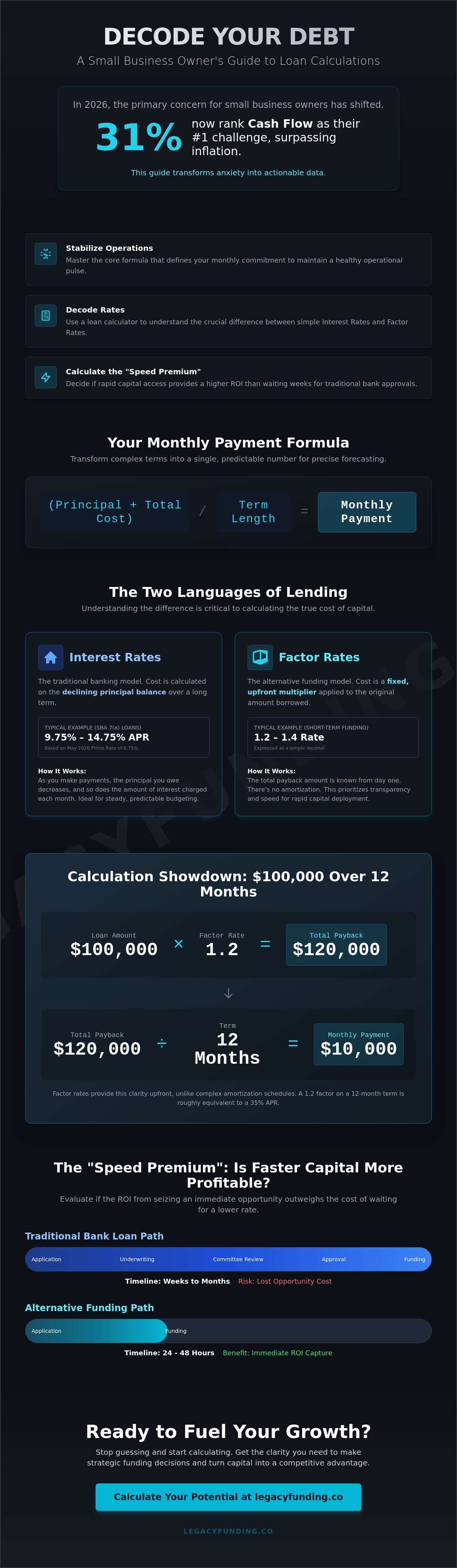
The math behind these tools is straightforward but powerful. At its core, the calculation follows a simple logic: (Principal + Total Interest) / Term = Monthly Payment. Understanding how financial calculators work allows you to see the immediate impact of every percentage point on your bottom line. While traditional term loans provide a fixed monthly payment for steady budgeting, other options like revenue-based financing offer flexible remittances. These adjust based on your daily sales, providing a safety net during slower months. You must decide which rhythm suits your 2026 growth strategy.
The Components of Your Monthly Payment
To get an accurate result, you have to look past the top-line number. Your monthly commitment consists of three distinct pillars:
- Principal: This is the raw capital you actually take home to deploy into your business.
- Interest Rates: The cost of time. With the Prime Rate at 6.75% as of May 2026, bank term loans currently range from 8% to 17.25%. Your credit profile determines where you fall on this spectrum.
- Hidden Add-ons: Don't let origination fees catch you off guard. These typically range from 0.5% to 3% of the total loan amount and are often deducted upfront or rolled into the balance.
Why Monthly Predictability Drives Scaling
Fixed payments allow for precise 12-month forecasting. This predictability is essential for maintaining a healthy Debt Service Coverage Ratio (DSCR), which is the metric lenders use to judge your repayment capacity. When you use a business loan calculator for monthly payments, you can determine the exact "break-even" point for a new project. If a $5,000 monthly payment fuels a project generating $15,000 in new revenue, the decision to scale becomes obvious. Stop guessing and start calculating. This level of insight turns a risky gamble into a calculated move for market dominance.
Interest Rates vs. Factor Rates: Calculating the Real Cost of Capital
Traditional banks and alternative lenders speak different languages. While a legacy institution uses interest rates, providers of Revenue-Based Financing and Merchant Cash Advances (MCAs) utilize factor rates. Understanding the distinction is the only way to use a business loan calculator for monthly payments effectively. A factor rate is expressed as a decimal, such as 1.2 or 1.4, rather than a percentage. Unlike an interest rate, which fluctuates based on a declining balance, a factor rate applies to the original principal for the entire duration of the funding. It's a static cost that doesn't change even as you pay down the balance.
The total payback difference is significant. For example, SBA loan interest rates for 7(a) programs currently range from 9.75% to 14.75% based on the 6.75% prime rate. These rates apply to the remaining balance each month. In contrast, a 1.2 factor rate on a $100,000 advance means you owe exactly $120,000. There's no amortization schedule and no complex compounding. You know your total cost on day one. This transparency allows you to weigh the speed of capital against the total dollar cost without the math games found in traditional banking.
Converting Factor Rates to Monthly Equivalents
To estimate your monthly commitment with a factor rate, multiply your principal by the factor and divide by the number of months in your term. Consider a $100,000 advance at a 1.2 factor rate over a 12-month term. First, calculate the total payback: $100,000 multiplied by 1.2 equals $120,000. Next, divide that total by 12 months to reach a monthly payment of $10,000. This straightforward approach is why factor rates are the standard for high-speed, short-term funding. They prioritize clarity and rapid deployment over the long-term, winding timelines of traditional debt. If you need to move fast, speak with a consultant to see which rate structure fits your current revenue cycle.
The APR Myth in Alternative Financing
Don't let high APR figures distract you from your growth metrics. Annual Percentage Rate (APR) is a tool designed for 30-year mortgages, not 6-month growth capital. When you use a business loan calculator for monthly payments on fast-turnaround capital, the APR may look high because the term is short. Focus instead on the "Cents on the Dollar" cost. If paying 20 cents for every dollar borrowed allows you to secure a bulk inventory discount that nets a 50% profit margin, the capital is undeniably profitable. Value the return on investment over the annualized rate. Your goal is rapid expansion, not a decades-long debt obligation.
Beyond the Payment: Evaluating ROI and Opportunity Cost
A monthly payment is only expensive if it fails to produce a profit. Many founders get stuck analyzing the cost of capital while ignoring the value that capital creates. A business loan calculator for monthly payments is a diagnostic tool, not a deterrent. It helps you define the "spread" between what the money costs and what the money earns. If your new equipment or inventory generates more cash than the loan consumes, you aren't spending money. You're buying a larger business.
Time is your most valuable asset in 2026. Research indicates that 76% of small businesses now bypass traditional banks for their capital needs. This shift isn't accidental. It's a response to the "Speed Premium." While SBA 7(a) loan volume declined by 18% in the first five months of fiscal year 2026, agile founders moved toward faster alternatives. Getting funds in 24 hours instead of 60 days allows you to secure inventory discounts or outbid competitors. The cost of a missed opportunity is almost always higher than the cost of a slightly higher rate.
The Cost of Waiting vs. The Cost of Capital
Waiting for your credit score to tick up a few points to save 2% on a loan is often a losing strategy. If an equipment upgrade increases your capacity by $10,000 per month, waiting 90 days for a "cheaper" bank loan costs you $30,000 in lost revenue. That loss far outweighs the interest savings. Fast funding is a strategic tool for "strike-while-it-is-hot" moments. Use a business loan calculator for monthly payments to see the raw numbers, then compare them to your projected growth. The math usually favors the fast mover.
Calculating Your Funding ROI
Determine your "ROI Floor" before you sign any agreement. Use this formula: (Net Profit from Project - Total Cost of Loan) / Total Cost of Loan. If a $2,000 monthly payment fuels a project that brings in $5,000 in new monthly margin, you've won. You can use a Business Loan Calculator to model these scenarios quickly. This approach shifts your perspective from debt management to wealth creation. You're no longer just looking at a bill; you're looking at a catalyst for generational impact.
Preparation Checklist: Using Your Calculations to Secure Funding
Crunching the numbers is only the first step. Once you've used a business loan calculator for monthly payments to find your ideal figure, you must use that data to vet potential lenders. Don't let a lender dictate your terms. Instead, walk into the conversation knowing exactly what your cash flow can support. This data-driven approach positions you as a high-level partner rather than a desperate applicant. It builds immediate trust and shows you've done the work to ensure a successful repayment cycle.
Before you submit a single document, perform a "stress test" on your projected monthly payment. Review your bank statements from the last 12 months and identify your lowest-revenue period. If your calculated payment consumes more than 20% of your gross revenue during that lean month, you may need to adjust your request. This proactive check prevents over-leveraging and ensures your business remains resilient regardless of seasonal fluctuations. Predictability is the key to long-term scaling.
The 24-Hour Funding File
Speed is a competitive advantage. In the fast-paced 2026 market, having a "funding-ready" file can be the difference between securing an opportunity and watching it slip away. For Revenue-Based Financing and MCAs, lenders prioritize your recent cash flow over legacy credit reports. You need to present a professional case that proves your ROI potential. To move from calculation to capital in one business day, prepare these three essential items:
- 4 Months of Recent Bank Statements: Ensure these are "clean" with minimal non-sufficient funds (NSF) alerts. Consistent deposits lead to better factor rates and lower payments.
- Government-Issued Photo ID: A clear, valid copy of your driver's license or passport for identity verification.
- Voided Business Check: This confirms your account details for the rapid ACH transfer once you're approved.
Refining Your Loan Request
More capital isn't always better. While it's tempting to ask for the maximum amount available, taking only what you need preserves your Debt Service Coverage Ratio (DSCR). A healthy DSCR makes you more attractive for future, larger infusions. If your business loan calculator for monthly payments suggests a $5,000 commitment but your project only requires $4,000, take the lower amount. This discipline lowers your total cost of capital and keeps your growth sustainable. Learn how to apply for Revenue-Based Financing to see how your specific numbers align with our modern funding models. If you're ready to secure your growth engine, connect with a funding advisor today.
Legacy Funding: Fast Capital Solutions That Scale With Your Revenue
Legacy Funding represents the modern alternative for founders who value momentum over bureaucracy. While traditional institutions remain tethered to outdated credit scoring models, we focus on the actual health and velocity of your business. Our evaluation centers on your real-world cash flow and revenue trajectory. This approach allows us to provide a streamlined 24-48 hour funding window for Revenue-Based Financing and Merchant Cash Advances. You've already used a business loan calculator for monthly payments to define your needs. Now, you need a partner that respects the speed of your commerce.
Flexibility is the cornerstone of our partnership. Unlike the rigid, unforgiving terms of a legacy bank loan, our revenue-based payments adjust naturally with your sales volume. If your revenue dips during a seasonal lull, your remittance decreases accordingly. This protects your daily liquidity and ensures your expansion remains sustainable. We don't just provide capital; we provide a financial buffer that scales alongside your success. It's about building a generational endeavor, not just completing a transaction.
Why Founders Choose Legacy over Traditional Banks
Over 76% of small businesses now report bypassing traditional banks for capital. They're choosing speed and accessibility over red tape. At Legacy Funding, we've eliminated the 90-day waiting periods and the endless paperwork cycles that stall growth. Our consultant-led approach ensures you find the right factor rate to maximize your ROI. We provide tailored solutions for businesses across the United States, Puerto Rico, and Canada. We speak the language of the modern founder, focusing on growth metrics rather than just financial obligations.
Take the Next Step Toward Scaling
The transition from calculation to execution should be seamless. You have the data, the strategy, and the drive to expand your market share. Now, you simply need the fuel to ignite the engine. Our process is designed to be simple, fast, and flexible. We remove the friction from the funding cycle so you can return to what matters most: leading your company toward its full potential. Move past the uncertainty of traditional lending and embrace a partner invested in your long-term impact. Apply for Funding Now and secure the capital your 2026 growth plan demands.
Ignite Your Expansion Strategy Today
You've moved past the uncertainty of traditional math. By using a business loan calculator for monthly payments, you've established a concrete baseline for sustainable scaling. You now understand that the true cost of capital is measured by the revenue it generates, not just the rate on the contract. Speed is your greatest asset in a competitive market. Waiting for legacy institutions often means losing ground to more agile competitors who move when the timing is right.
We specialize in rapid deployment. Our model prioritizes your current cash flow and business health over static credit scores, ensuring you have the liquidity to strike while the market is hot. We proudly serve founders across the United States, Puerto Rico, and Canada with funding delivered in as little as 24 to 48 hours. Stop analyzing the sidelines and start executing your growth plan. Get Your Fast Funding Quote in 24 Hours and secure the resources your vision requires. Your next level of growth is within reach. Build your legacy now.
Frequently Asked Questions
How do I calculate monthly payments for a business loan manually?
Calculate your monthly commitment by adding the total interest to your principal and dividing that sum by the number of months in your term. For a basic $100,000 loan with $12,000 in total interest over 12 months, your payment is $9,333.33. Using a business loan calculator for monthly payments is more efficient because it handles complex compounding and amortization schedules that manual math often misses.
What is a good interest rate for a small business loan in 2026?
A competitive rate depends on the product you choose and your financial profile. As of May 2026, bank term loans average between 8% and 17.25%, while SBA 7(a) variable rates range from 9.75% to 13.25%. These figures are tied to the 6.75% prime rate. Aim for the lower end of these ranges by showing consistent revenue and a high Debt Service Coverage Ratio.
Can I get a business loan with monthly payments if I have bad credit?
You can definitely secure monthly payments by looking beyond traditional banks. Alternative lenders prioritize your monthly revenue and cash flow over legacy credit scores. Revenue-Based Financing and Merchant Cash Advances allow you to access capital based on your business performance. This approach provides the liquidity you need to scale without being held back by past financial challenges.
What is the difference between a factor rate and an interest rate?
Interest rates apply to the declining balance of your loan, meaning you pay less interest as the principal decreases. Factor rates apply to the original principal for the entire duration of the funding. Factor rates are expressed as decimals, such as 1.2, while interest is a percentage. A 1.2 factor on $100,000 always results in a $120,000 total payback, regardless of your repayment speed.
How much of my monthly revenue should go toward loan payments?
Target a payment that consumes no more than 15% to 20% of your gross monthly revenue. This ensures you maintain a healthy Debt Service Coverage Ratio (DSCR) and keeps your daily operations funded. Use a business loan calculator for monthly payments to "stress test" your budget against your lowest-revenue months. This discipline prevents over-leveraging and protects your business during seasonal slow periods.
Does a business loan calculator include origination fees?
Most basic calculators only account for principal and interest, ignoring the origination fees that typically range from 0.5% to 3%. You must manually add these fees to your total loan amount to see the true monthly impact. Some lenders deduct these costs from your initial wire, while others roll them into the balance. Always confirm the fee structure to avoid unexpected hits to your cash flow.
What happens to my monthly payment if I pay off the loan early?
Early repayment effects depend on your specific contract. For traditional term loans, paying off the balance early saves you money on interest. For many factor-rate products, the total payback amount is fixed from day one. Paying early won't reduce your total cost in those cases, but it does clear your debt-to-income ratio. This allows you to apply for new, larger capital infusions sooner.
Is a business line of credit better than a term loan for monthly cash flow?
A business line of credit offers flexibility for recurring needs, while a term loan provides predictability for one-time investments. Use a line of credit to manage seasonal inventory shifts or short-term payroll gaps. Choose a term loan for large equipment purchases or facility expansions with a fixed ROI. Match the financing tool to the specific growth goal you want to achieve.