

Alternatives to Business Debt Settlement: A Tactical Guide for Founders (2026)
Traditional debt settlement is a defensive retreat that often burns the very bridge you’re trying to cross. If you're staring at your bank balance every morning, watching daily ACH withdrawals bleed your operating capital dry, you aren't alone. You know the pressure of a UCC-1 lien hanging over your assets like a ticking clock. While settlement companies promise relief, they often leave your credit score in ruins and your business locked out of future funding. It’s time to shift from survival mode to a strategic offensive. There are better alternatives to business debt settlement that protect your hard-earned reputation while fixing the underlying cash flow crisis.
You deserve a financial structure that fuels growth instead of strangling it. We’re going to show you how to restore your daily cash flow and consolidate those fragmented liabilities into a single, manageable rhythm. This guide breaks down tactical moves like reverse consolidation, revenue-based restructuring, and leveraging invoice factoring to reclaim your margins. You’ll learn how to navigate the 2026 lending landscape, bypass the recent SBA restrictions on refinancing, and emerge with a preserved credit profile ready for scaling. Stop managing debt and start mastering your capital.
Key Takeaways
- Identify the hidden costs of traditional settlement, including credit destruction and tax liabilities, to protect your business’s financial reputation.
- Master the shift from aggressive daily ACH withdrawals to consolidated monthly payments to immediately restore your operational cash flow.
- Utilize reverse consolidation to halt the MCA death spiral and regain control over your revenue without triggering default risks or liens.
- Discover high-impact alternatives to business debt settlement like revenue-based financing that align your repayment rhythm with actual sales performance.
- Leverage a 24-48 hour approval window to execute these tactical strategies and pivot from debt survival back to aggressive business scaling.
Why Founders Seek Alternatives to Business Debt Settlement
Business debt settlement is often marketed as a quick escape. It's a process where you negotiate to pay a lump sum that's less than the total balance you owe. While the idea of "erasing" debt sounds appealing, it's actually a tactical retreat that carries heavy consequences. Savvy founders look for alternatives to business debt settlement because they understand that business survival isn't the same as business growth. You need to maintain your "Good Faith" status with the financial community to keep the doors open for future capital.
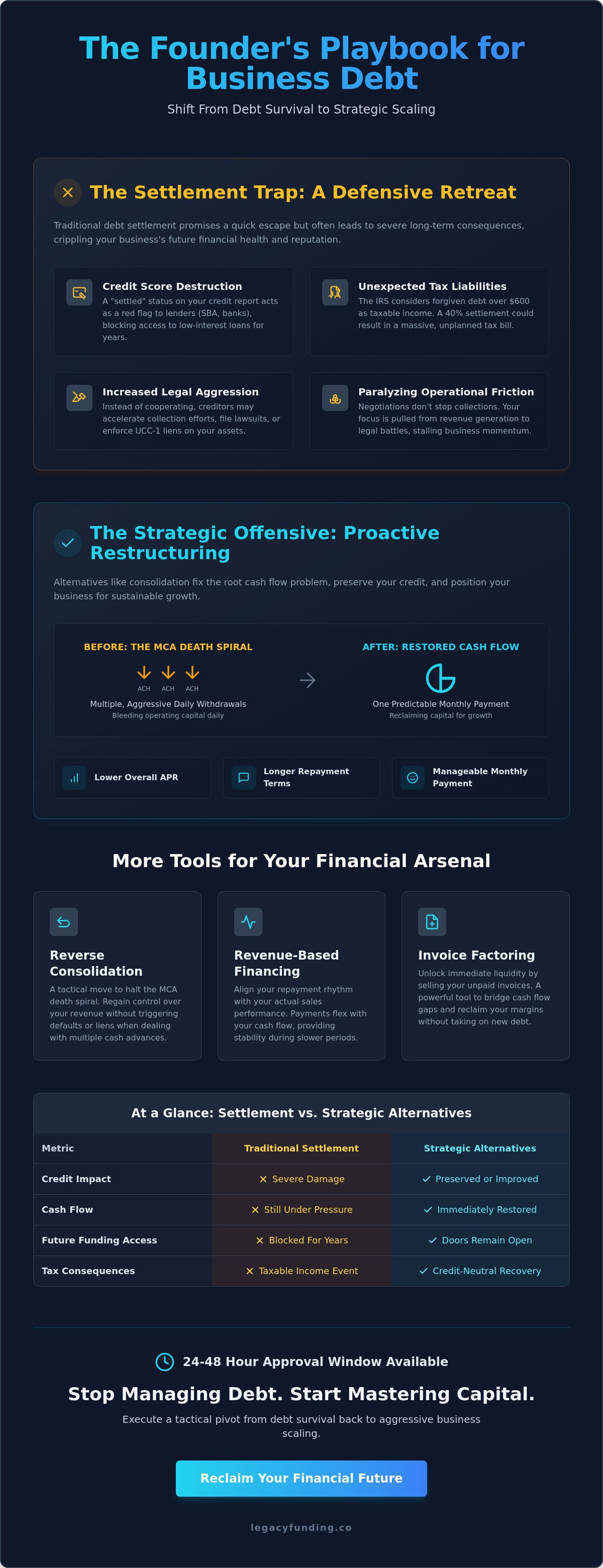
The hidden costs of settlement go far beyond the balance sheet. Forgiven debt isn't free money. The IRS generally considers any forgiven debt of $600 or more as taxable income. You might save 40% on a settlement only to owe a massive tax bill the following April. Beyond taxes, settlement invites legal aggression. Many creditors respond to settlement requests by accelerating their collection efforts or filing lawsuits to secure their position before you run out of cash. Creditors almost always prefer proactive solutions that ensure they are made whole over a contested, messy settlement process.
The Credit Impact: Settlement vs. Proactive Restructuring
A "settled" status on your credit report is a scarlet letter for traditional lenders. It tells the SBA or commercial banks that you didn't fulfill your original contract. This single mark can block you from qualifying for low-interest bank loans for years. Contrast this with proactive Debt restructuring or consolidation. These strategies allow your previous liabilities to be reported as "paid in full." This creates a credit-neutral recovery. You satisfy your obligations and preserve your reputation, ensuring you're ready to scale when the market shifts.
Operational Friction: Why Settlement Can Stall Your Business
Settlement negotiations don't stop the clock. While you're trying to negotiate, aggressive collection tactics often intensify. This creates a level of operational friction that can paralyze a growing company. Your assets remain at risk and your focus is pulled away from revenue generation. A UCC-1 lien is a legal notice filed by creditors to publicly declare their interest in your business assets. These filings are public record and can freeze your ability to secure new equipment or trade credit. Choosing alternatives to business debt settlement like consolidation allows you to satisfy these liens immediately. You clear your record and keep your operations moving at full speed without the shadow of a legal battle.
Strategic Debt Consolidation: The Cleanest Alternative to Settlement
If settlement is a defensive retreat, strategic consolidation is a tactical reorganization. It stands as the most effective of the alternatives to business debt settlement because it preserves your credit while fixing your cash flow. Business debt consolidation involves taking a single, lower-interest loan to pay off multiple high-interest liabilities. You stop the bleeding of daily ACH withdrawals immediately. By moving from a daily or weekly repayment schedule to a single monthly installment, you reclaim your operating capital and your sanity.
A successful consolidation must meet three specific criteria. First, it requires a lower APR than the weighted average of your current debt. Second, it must offer longer terms to spread out the principal. Third, the resulting monthly payment must be manageable within your current revenue reality. This structural reset provides a powerful triad of benefits: it simplifies your accounting, improves your credit utilization, and delivers the mental clarity needed to focus on growth again. You can also explore operational ways to Reduce Small Business Debt through budgeting and sales growth to complement this financial shift.
Using a Term Loan for Debt Exit
A fixed-rate term loan is your primary exit ramp from high-cost debt cycles. Unlike revolving credit, a term loan provides a predictable, non-fluctuating path to a zero balance. Use this capital to aggressively pay off high-cost merchant cash advances that are currently strangling your margins. When structuring these deals, always insist on a "No Prepayment Penalty" clause. This gives you the flexibility to accelerate your debt exit as your cash flow improves without being punished for your success. It's about maintaining control of your timeline.
The Impact on Debt-to-Income (DTI) Ratios
Your Debt-to-Income (DTI) ratio is the primary metric traditional lenders use to judge your risk. Consolidation naturally improves this ratio by lowering your monthly debt service requirements. A cleaner DTI makes you significantly more attractive to bank lenders and SBA programs in the future. You aren't just managing current debt; you're preparing your balance sheet for larger capital rounds. Professional advisors play a critical role here, as they can structure these deals to ensure your debt is categorized in a way that supports future scaling. If you're ready to see how a structured reset fits your specific numbers, speak with a consolidation specialist today to map out your recovery.
Reverse Consolidation: A Tactical Alternative for Multiple MCAs
If you're managing three or more active Merchant Cash Advances (MCAs), you're likely feeling the weight of the "burn rate." Traditional consolidation might be out of reach if your current debt load prevents you from qualifying for a standard term loan. This is where reverse consolidation serves as one of the most powerful alternatives to business debt settlement. It’s a specialized funding structure where a new financial partner provides you with weekly funds designed specifically to cover all your existing daily MCA payments. You keep your original agreements intact, but you gain immediate liquidity through the "spread" between what the reverse funder provides and what your daily withdrawals consume.
Founders seeking alternatives to business debt settlement choose this path because it avoids the catastrophic default triggers that come with traditional settlement talks. You maintain your "Good Faith" status with your original creditors while stopping the "death spiral" of taking out new, expensive advances just to pay off the old ones. It’s an offensive maneuver for businesses with strong current revenue that are simply being strangled by the timing of their payments.
How the Reverse Consolidation Mechanism Works
The process is methodical and designed for speed. Unlike a standard loan that pays off debt in one lump sum, the reverse consolidation funder works alongside your existing daily schedule. They deposit a calculated amount into your account every week. You then use these funds to satisfy the daily ACH withdrawals from your existing MCA providers. Some industry professionals report that the targeted goal of this structure is to reduce your total daily burn rate by 25% to 50%. This shift allows you to:
- Stop the daily drain: You move from managing dozens of daily withdrawals to managing one weekly deposit.
- Preserve your credit: Since you're still paying your original creditors in full, your credit score remains untouched.
- Retain your assets: You avoid the risk of UCC-1 liens being called or legal action being taken against your business.
Transitioning from Reverse Consolidation to a Clean Slate
Think of this as a bridge, not a permanent home. The freed-up cash flow should be immediately redirected into revenue-generating activities. Use that recovered 25% to 50% margin to buy inventory, hire talent, or launch marketing campaigns. As your original advances are paid down, the "spread" becomes more favorable. Eventually, you clear the high-cost debt entirely, leaving only the more manageable reverse consolidation. This tactical maneuver restores your financial health and prepares your balance sheet for traditional bank financing. It’s a clean slate achieved through strategic cash management, not through burning bridges with lenders.
Revenue-Based Financing and Invoice Factoring as Liquidity Tools
Traditional settlement is a credit-based surrender. Revenue-Based Financing (RBF) and Invoice Factoring are asset-based offensives. These alternatives to business debt settlement focus on your business's intrinsic value rather than your past credit mistakes. You aren't just adding another layer of debt; you're accelerating your liquidity. You're turning your future revenue or current unpaid invoices into immediate strategic capital. This shift moves you from a defensive posture to an active growth phase. While settlement destroys your reputation to save a few dollars, these tools leverage your success to clear your path.
Founders often ask if this is just more debt. It isn't. It's a liquidity acceleration tool. By accessing capital tied up in your operations, you can aggressively pay down high-interest liabilities that are currently strangling your cash flow. You stop the bleeding by using your own performance as the tourniquet. This approach keeps your credit intact, satisfies your creditors, and maintains your status as a viable, growing enterprise. It’s about using the assets you’ve already built to buy the freedom you need to scale.
Revenue-Based Financing: Flexibility for Seasonal Businesses
Revenue-Based Financing (RBF) aligns your repayment rhythm with your actual sales. Instead of a fixed monthly payment that might crush you during a slow month, you pay a percentage of your revenue, typically between 2% and 10%. This structure includes a critical "reconciliation" feature. If your sales dip, your payment dips automatically. This is the ultimate protection for a founder. You can use an RBF infusion to offer a strategic lump-sum payoff to a high-interest creditor. You exit the toxic debt cycle and replace it with a flexible, performance-linked agreement that breathes with your business.
Invoice Factoring: Turning Receivables into Debt Relief
If you have capital locked in unpaid B2B invoices, you're sitting on "dead" money. Invoice factoring allows you to sell these outstanding invoices for an immediate cash advance, often receiving 80% to 95% of the invoice value upfront. Use these proceeds to immediately pay off a high-rate line of credit or a predatory advance. Factoring is frequently considered "off-balance sheet" because it’s a sale of an asset rather than a traditional loan. It doesn't bloat your debt-to-income ratio. You're simply getting paid today for work you've already completed, allowing you to settle debts without the stain of a formal settlement program. If you're ready to unlock your trapped capital and clear your balance sheet, get a liquidity assessment now and see which asset-based tool fits your growth trajectory.
Transitioning from Debt Survival to Business Scaling with Legacy Funding
Understanding the mechanics of debt restructuring is only the first step toward recovery. To move from survival to scaling, you need a tactical partner with the capital to execute these alternatives to business debt settlement. Legacy Funding Advisors functions as that bridge. We provide the high-level consulting and rapid funding required to reclaim your operational independence. You don't have to wait months for a bank's committee to review your file. We offer a streamlined 24-48 hour approval process for consolidation and Revenue-Based Financing solutions. This speed allows you to seize settlement windows or pay off predatory advances before they do further damage to your margins.
Our "Cash Flow First" underwriting model is designed for the modern entrepreneur. Traditional institutions are obsessed with credit scores and historical collateral. We know that a credit score rarely tells the whole story of a business's health or its future trajectory. We look past the credit damage often caused by high-interest debt cycles. We focus on your current revenue and your ability to grow. This approach allows us to fund businesses that legacy banks often overlook. Consult with a Legacy Funding Advisors representative to map out your debt exit strategy and see how we prioritize your business's momentum over its past obstacles.
The Legacy Approach: Speed and Partnership
Fast funding is a strategic weapon. It gives you the leverage to negotiate from a position of strength. When you have capital ready to deploy, you can exit high-cost agreements on your own terms. We don't just provide a transaction; we build a partnership focused on your long-term financial health. Legacy Funding Advisors focuses on your future revenue potential, not just your past financial hurdles. This mindset ensures that our capital solutions are personalized to your specific industry and scaling goals. We move at the speed of commerce, not the speed of bureaucracy.
Your Next Steps Toward Financial Independence
Reclaiming your cash flow starts with simple, decisive preparation. You don't need a mountain of paperwork to begin the process of restructuring your liabilities. Gather your last three months of business bank statements and your most recent revenue reports. These documents provide the data we need to prove your business's resilience and current performance. Once you have these ready, apply for a consolidation or RBF solution to regain control of your cash flow. The path to a clean balance sheet is shorter than you think. You have the tools and the strategy. Now, you just need the partner to help you cross the finish line. Get the capital you need to scale-apply with Legacy Funding Advisors today.
Reclaim Your Growth Trajectory
Managing liabilities shouldn't mean destroying your business's future. You've identified that traditional settlement is a defensive retreat that often burns critical bridges. Strategic consolidation and asset-based liquidity are the offensive moves that allow you to scale. By prioritizing alternatives to business debt settlement, you preserve your credit score and maintain the "Good Faith" status required for long-term expansion. You now have the tactical roadmap to replace daily withdrawals with manageable monthly rhythms and predictable cash flow.
Legacy Funding Advisors moves at the pace of modern commerce. We deliver funding in 24-48 hours. Our underwriting model focuses on your current cash flow rather than just your past financial hurdles. We provide national coverage across the U.S. and Puerto Rico to ensure founders everywhere have access to elite capital solutions. You've built the revenue; now it's time to protect your margins and focus on the next level of your journey. Stop managing debt and start mastering your capital.
Secure your business future-explore our flexible funding and consolidation options today
Your legacy is waiting. Let's build it together.
Frequently Asked Questions
Is debt consolidation better than debt settlement for my business credit?
Yes, consolidation is significantly better because it results in your liabilities being reported as "paid in full." Debt settlement leaves a permanent mark on your credit report that indicates you did not fulfill your original contract. This "settled" status often blocks you from qualifying for SBA loans or traditional bank financing for several years. Consolidation preserves your reputation and keeps your future funding options open.
How does reverse consolidation differ from a standard consolidation loan?
A standard consolidation loan pays off your existing debts in one lump sum to create a single monthly payment. Reverse consolidation is a specialized structure where a funder provides weekly deposits to cover your current daily MCA withdrawals. You don't pay off the original principal immediately. Instead, you gain instant cash flow relief through the "spread" between the weekly deposit and your daily obligations.
Can I get a consolidation loan if I already have multiple MCAs?
Yes, you can qualify if your current revenue supports the new repayment structure. Lenders prioritize your daily or monthly gross deposits over the number of active positions you hold. If your debt-to-income ratio is too high for a standard term loan, tactical alternatives to business debt settlement like reverse consolidation are designed specifically for businesses with 3 or more active advances.
What is the fastest alternative to business debt settlement?
Revenue-based financing and merchant cash advances are the fastest options, often providing funding in 24 to 48 hours. These tools bypass the lengthy collateral audits and bureaucratic delays found in traditional banking. By focusing on your future sales potential rather than just your past credit score, these alternatives provide the rapid liquidity needed to exit toxic debt cycles before they stall your operations.
Will my creditors agree to a consolidation plan instead of a settlement?
Creditors almost always prefer consolidation because they receive the full balance owed to them. Settlement requires them to take a financial loss and often involves a contentious legal process. When you use a new loan to pay off an existing creditor, you satisfy the original contract and clear any UCC-1 liens. This "Good Faith" approach maintains your professional relationships and your standing in the credit market.
How much revenue do I need to qualify for revenue-based debt alternatives?
Most alternative lenders look for a consistent monthly gross revenue of at least $15,000 to $20,000. Your sales volume is the primary metric for underwriting because it proves your business has the "legs" to support a restructuring plan. Consistent daily or weekly deposits are more important than a perfect credit score. Strong revenue history allows lenders to look past historical financial hurdles.
Can I use invoice factoring to pay off a merchant cash advance?
Yes, using invoice factoring is a smart way to convert "dead" capital into immediate debt relief. You sell your outstanding B2B invoices to a factoring company and use the advance to clear high-interest advances or lines of credit. This move is often considered off-balance sheet and doesn't count as traditional debt. It allows you to settle obligations using money you've already earned but haven't collected.
How long does it take to see cash flow relief from these alternatives?
Relief is typically immediate once the new funding is deployed. A consolidation loan stops the bleed of daily ACH withdrawals the same day the previous balances are satisfied. Reverse consolidation provides a liquidity injection the moment your first weekly deposit arrives. These alternatives to business debt settlement are designed to restore your working capital and stabilize your bank balance within the first week of execution.