


10 Critical Mistakes to Avoid When Taking a Business Loan in 2026
Your biggest financial risk in 2026 isn't a high interest rate. It's the silent cost of missed opportunities while you wait for a perfect bank loan that never arrives. With cash flow now surpassing inflation as the top concern for 31% of business owners, waiting is no longer a viable strategy. Understanding the specific mistakes to avoid when taking a business loan is the difference between scaling your vision and stalling your momentum. You need a partner who speaks the language of growth, not just the language of debt.
You've likely felt the exhaustion of complex documentation or the fear of predatory lending terms. It's a common struggle, but it doesn't have to be yours. You will learn how to master the complex realities of business financing by avoiding the strategic, financial, and structural pitfalls that derail most growth plans. We will break down the true cost of funding in a 6.75% prime rate environment, explain the impact of the March 1 SBA citizenship rules, and show you how to maintain healthy cash flow during repayment. Let's secure your capital, protect your equity, and accelerate your expansion.
Key Takeaways
- Align your debt structure with specific growth goals to prevent the strategic mismatch of using long-term capital for short-term operational needs.
- Protect your funding momentum by eliminating "Document Fatigue" and understanding how personal credit scores influence your commercial capital options.
- Identify the critical mistakes to avoid when taking a business loan by looking beyond misleading APR figures to calculate the true total cost of capital.
- Stop the cycle of expensive emergency borrowing and avoid "debt stacking" traps that erode your business equity and cash flow.
- Shift from slow bureaucratic processes to agile financing that secures capital in 24 to 48 hours, allowing you to seize market opportunities before they vanish.
Why Most Business Loan Applications Fail Before They Start
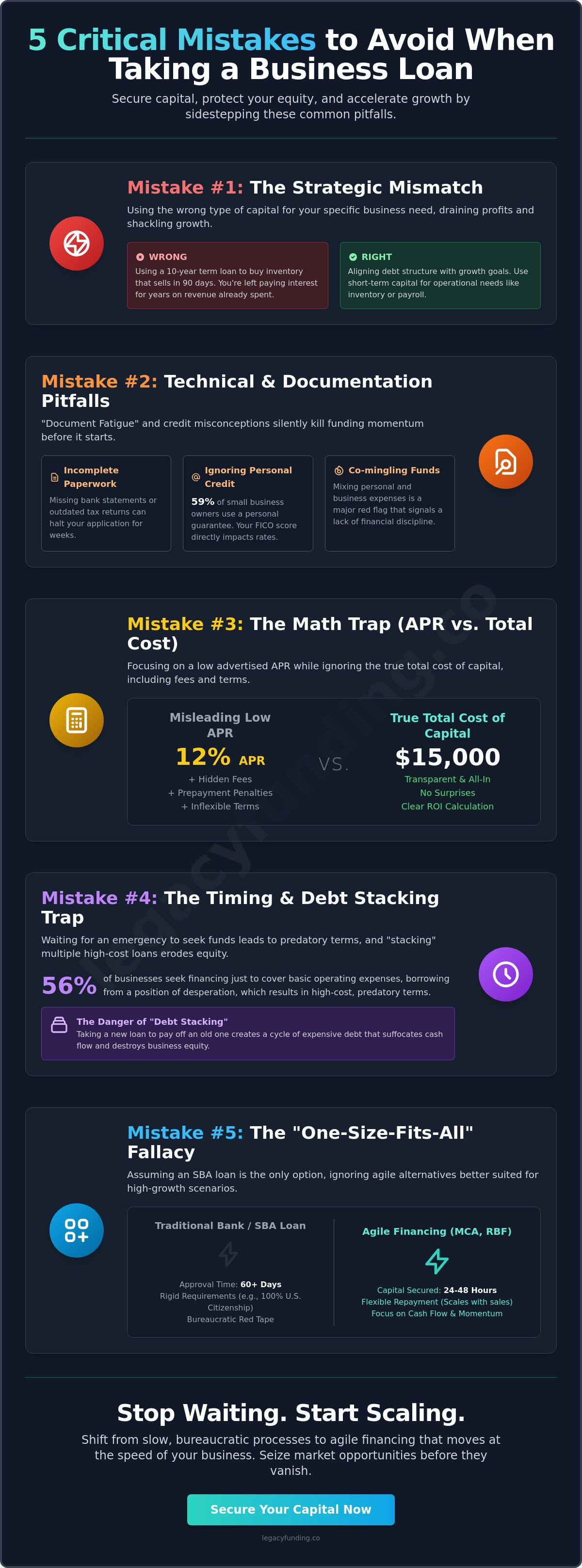
Success in business financing starts in your boardroom, not at the bank teller's window. One of the most common mistakes to avoid when taking a business loan is the "Strategic Mismatch." This happens when you secure long-term debt to solve a short-term cash flow gap. Imagine taking a ten-year term loan to purchase inventory you plan to sell in ninety days. You're left paying interest on capital long after the revenue it generated has vanished. This misalignment drains your profit margins and shackles your future growth.
Many founders adopt a "wait and see" approach. They delay seeking capital until an emergency strikes. This is a tactical error. According to the Federal Reserve’s 2026 Report on Employer Firms, 56% of businesses seek financing just to meet operating expenses. When you borrow from a position of desperation, you lose your leverage. You end up with high-cost, predatory terms because you didn't plan ahead. Desperate borrowing is the most expensive capital you'll ever buy.
Instead, focus on "Funding Velocity." This is the speed at which capital enters your business to capture a specific ROI. If a market opportunity expires in 48 hours, a bank loan that takes 60 days to approve is worthless. You must understand the different types of business loans available to ensure your funding speed matches your market reality. Real growth requires capital that moves as fast as you do.
The "One-Size-Fits-All" Fallacy
Assuming every business needs an SBA loan is a recipe for rejection. While SBA loans offer competitive rates, they come with rigid requirements. Effective March 1, 2026, new SBA rules require 100% U.S. citizenship for eligibility. If your ownership structure doesn't fit, don't waste time. High-growth scenarios often thrive on Revenue-Based Financing or Merchant Cash Advances rather than traditional term loans. These options provide flexible repayment schedules that scale with your sales. They prioritize your momentum over bureaucratic check-boxes.
Misunderstanding Your Own Financial Narrative
Lenders don't just buy your data; they buy your story. Presenting raw profit and loss statements without a clear "use of proceeds" plan is a major mistake. You must articulate how every dollar will generate a return. Modern lenders are increasingly empathetic to the struggle of scaling. They often care more about your future cash flow projections than past credit hiccups. Stop obsessing over old mistakes. Start demonstrating how your current revenue will support your next stage of expansion. Clear, actionable narratives remove ambiguity and lower the barrier to entry.
Technical Pitfalls: Documentation and Credit Misconceptions
Precision wins capital. Speed demands accuracy. One of the most common technical mistakes to avoid when taking a business loan is underestimating the weight of your personal credit profile. Even in a commercial setting, 59% of small business owners use a personal guarantee to secure funding. Your business and personal financial health are inextricably linked in the eyes of a lender. Ignoring your FICO score while seeking a Revenue-Based Financing or SBA loan is a tactical error that leads to instant rejection or inflated rates.
Document Fatigue is the silent killer of growth plans. Missing a single page of a bank statement or providing an outdated tax return can halt your momentum for weeks. Lenders in 2026 move fast; they expect you to move faster. Shopping for capital recklessly also creates a trail of "Hard Inquiries" that signals desperation to underwriting algorithms. Focus on avoiding business loan mistakes by preparing a digital vault of your last six months of bank statements, most recent tax filings, and a clear debt schedule before you hit submit.
You don't need a five-year track record to qualify for significant capital. This is a persistent myth that keeps many founders from scaling. Modern underwriting focuses on your current trajectory rather than your distant past. If your business shows consistent monthly revenue and healthy margins, you are a candidate for funding today. Don't let a lack of "legacy" history stop you from seizing a market opportunity.
The Clean Data Requirement
Co-mingling personal and business expenses is a massive red flag. It suggests a lack of financial discipline and makes it impossible for lenders to verify your true cash flow. Pre-flight your bank statements to ensure they show consistent, identifiable business revenue. Digital transparency is the foundation of our 24-hour approval process. When your data is clean, capital flows faster. If you need help organizing your financial narrative, connect with a consultant today to streamline your application.
Credit Scores vs. Cash Flow Health
2026 has seen a definitive shift toward "Revenue-Based Underwriting." While personal credit still matters, your daily bank balances and cash flow consistency often carry more weight. A mediocre credit score can be overcome by strong, predictable revenue and a lack of existing UCC liens. Always check for outstanding liens before you apply. Lenders prioritize your ability to repay from current operations over a static number on a credit report. Focus on maintaining a healthy daily balance to prove your business can handle the debt service.
The Math Trap: APR vs. Total Cost of Capital
APR is a legacy metric designed for mortgages, not modern business expansion. One of the most dangerous mistakes to avoid when taking a business loan is using APR as your sole decision-making tool. If you take a six-month Working Capital Loan to flip inventory, an annualized rate is often mathematically irrelevant. You need to focus on the total dollar cost of capital. A report indicates that 60% of borrowers using online lenders found the actual cost was higher than expected. This happens because they didn't distinguish between compounding interest and a fixed factor rate.
Factor rates are a simple multiplier. You borrow $100,000 at a 1.20 factor, and you pay back $120,000. There is no compounding interest. There are no hidden amortization schedules. It is a transparent, fixed cost. Compare this to the "Cost of Waiting." With the prime rate at 6.75% as of May 2026, traditional bank capital is becoming more expensive and harder to access. If waiting three months for a bank approval costs you a 20% discount on bulk inventory, the alternative capital was actually the cheaper choice. Do the math. Protect your margins.
Focusing on the monthly payment instead of the total repayment amount is another common pitfall. Low monthly payments often mask a longer term that significantly increases your total cost. Always calculate the "cents on the dollar" cost. This clarity allows you to treat financing as a strategic tool rather than a looming debt. Understanding these nuances is essential when identifying mistakes to avoid when taking a business loan in a fast-paced market.
Calculating Real-World ROI
ROI in the context of inventory or equipment financing is the net profit generated by the asset minus the total dollar cost of the capital used to acquire it. If $50,000 in Equipment Financing allows you to fulfill a contract worth $150,000 in revenue, the financing cost is a minor line item, not a burden. Determine your margin first. If your project's profit exceeds the cost of capital, the loan is an investment. Choose a Business Line of Credit for ongoing needs and lump-sum Term Loans for specific, high-yield projects.
Repayment Structure and Cash Flow Impact
Monthly payments create "Payment Shock." Writing one massive check on the first of the month can cripple your liquidity. Many founders now prefer Revenue-Based Financing with daily or weekly micro-payments. These smaller increments align with your actual sales volume. They stabilize your cash flow instead of draining it. Avoid the mistake of negotiating for the lowest payment if it means a longer term that doubles your total interest. Focus on the exit. Get the capital, hit the goal, and clear the balance quickly.
Strategic Blunders: Timing, Emergency Funding, and Stacking
Timing is the silent variable in your capital strategy. One of the most critical mistakes to avoid when taking a business loan is waiting until your back is against the wall. The "Emergency Funding" mindset is the most expensive way to borrow because desperation limits your leverage. When you need cash by Friday to meet payroll, you lose the ability to negotiate. You end up accepting the first offer, regardless of the impact on your long-term margins. Savvy founders build a "Capital Runway" at least six months before they actually need the funds.
Over-borrowing is equally dangerous. Taking a $500,000 Term Loan when you only need $200,000 means you're paying for unused capital. In a 2026 market where the prime rate sits at 6.75%, every dollar of unnecessary debt service is a drain on your scaling potential. Don't take money just because it's offered. Take exactly what your ROI projections justify. Precision in your borrowing amount keeps your cash flow lean and your growth aggressive.
The Danger of Debt Stacking
Debt stacking is a toxic cycle. It occurs when a business takes a second or third loan, such as a Merchant Cash Advance, on top of an existing one. This often triggers default clauses in your primary contracts, leading to immediate legal action or account freezes. If your daily debt service exceeds 15% of your gross revenue, you are likely over-leveraged. Look for Debt Consolidation or Reverse Consolidation as a pivot. These tools restructure your obligations into a single, manageable payment. Protect your equity by stopping the stack before it collapses.
Proactive vs. Reactive Funding
Lenders prioritize businesses that don't "need" the money today. It's the ultimate paradox of finance. To stay proactive, follow this 3-step forecast: analyze your trailing 12-month seasonal dips, project inventory needs for the next two quarters, and add a 10% buffer for volatility. Instead of a lump-sum loan, consider a Business Line of Credit. It acts as an insurance policy against market shifts. You only pay for what you draw, keeping your costs low while maintaining maximum agility. If you're ready to build your runway, talk to a strategic advisor about a customized funding plan today.
The Legacy Path: Fast, Flexible Funding Without the Red Tape
Legacy Funding Advisors prioritizes your business potential over bureaucratic check-boxes. Traditional institutions act as gatekeepers; we act as partners. In an environment where large banks approve only 44% of applications, you need a tech-forward ally that understands the speed of contemporary commerce. We move at the pace of your ambition. Our process provides a 24-48 hour funding window to ensure you never miss a critical market opportunity or a bulk inventory discount. This speed is your competitive edge in 2026.
Our revenue-based approach is fundamentally safer for businesses facing seasonal fluctuations. Unlike rigid bank loans with fixed monthly obligations, your repayment aligns with your actual sales volume. If your revenue dips, your payment adjusts. This flexibility prevents the cash flow strain that leads to the common mistakes to avoid when taking a business loan we've analyzed. You get a partner who is personally invested in your scaling journey. We provide the insider knowledge and strategic support necessary to turn capital into a generational legacy.
Having a dedicated funding advisor who understands your specific industry is essential. We don't just look at profit and loss statements. We look at your growth metrics and your "use of proceeds" plan. We speak the language of the modern founder. We focus on accessibility and a lack of friction. Our goal is to move you quickly from a specific pain point to the relief of a streamlined funding process. We treat your financial support as a long-term impact endeavor rather than a simple transaction.
Modern Funding for Modern Founders
We prioritize cash flow health and high-level consulting over rigid, outdated credit metrics. Our partnership bridges the gap between high-stakes finance and your entrepreneurial reality. We've simplified the path to capital into a rhythmic pulse of efficiency. Stop waiting for a "perfect" loan that never arrives. See our Revenue-Based Financing options to find a structure that fits your specific expansion goals. Apply, Approve, Accelerate. It's that simple. We provide the modern key to growth.
Your Next Step Toward Scaling
Waiting for a traditional bank in 2026 is a strategic mistake. Legacy institutions are tightening their credit standards, making it harder for even healthy businesses to qualify. You need a disruptive alternative that values your momentum. We remove the bureaucratic vocabulary and the friction from the application process. Get a no-obligation quote today to see your real-time funding power and maintain your healthy cash flow. Consult with an advisor and secure the capital you need to build your generational vision without the debt trap.
Fuel Your Expansion and Secure Your Legacy
Scaling a business in 2026 requires more than just ambition; it requires strategic capital. You've learned that the real cost of funding isn't just the interest rate. It's the speed of access and the alignment with your cash flow. By mastering the mistakes to avoid when taking a business loan, you protect your equity from debt stacking and avoid the "wait and see" traps of traditional banking. Focus on your total cost of capital. Prioritize your revenue health. Move with the speed your market demands.
Legacy Funding Advisors provides the bridge to your next growth milestone. We deliver tailored solutions across the U.S., Puerto Rico, and Canada with a focus on your actual cash flow rather than just static credit scores. Our process delivers funds within 24 to 48 hours to ensure you never miss a growth opportunity. Stop the cycle of uncertainty and secure the resources you need to build a generational impact. We are here to partner in your success. Get Funded in 24 Hours—Apply Now and seize your market today.
Frequently Asked Questions
What is the biggest mistake business owners make when applying for a loan?
The most significant error is the "Strategic Mismatch," where founders use long-term debt to solve short-term cash flow gaps. This creates a permanent financial burden for a temporary need. It is one of the top mistakes to avoid when taking a business loan because it drains profit margins long after the capital's utility has ended. Align your funding type with the specific ROI of your project to maintain healthy liquidity.
How does debt stacking affect my business credit?
Debt stacking often triggers default clauses in your original financing agreements; this can lead to immediate account freezes. While it might not immediately lower a score, it increases your credit utilization and debt-to-income ratio significantly. Lenders view multiple active advances as a sign of financial distress. This behavior often leads to a cycle where your business credit profile becomes toxic to both traditional and alternative lenders.
Is a high factor rate always worse than a low APR?
A high factor rate isn't always worse if the capital generates a rapid ROI that exceeds the fixed cost. APR is a legacy metric designed for multi-year loans, whereas factor rates provide total cost transparency for short-term expansion. If waiting months for a lower APR bank loan costs you a massive contract, the faster factor-rate funding is the more profitable choice. Focus on the total dollar cost rather than an annualized percentage.
Can I get a business loan if I have a low personal credit score?
You can secure capital with a low personal credit score by leveraging Revenue-Based Financing or Merchant Cash Advances. Modern underwriting in 2026 prioritizes your daily bank balances and consistent cash flow over a static FICO number. If your business shows strong monthly revenue and healthy margins, you can bypass the rigid requirements of traditional banks. Focus on maintaining a clean financial narrative to prove your ability to repay from current operations.
How much documentation do I really need for a fast business loan?
Fast business loans typically require only the last six months of business bank statements and your most recent tax return. This streamlined approach eliminates the "Document Fatigue" associated with legacy banks. Digital transparency allows for 24-hour approvals without the need for extensive business plans or collateral appraisals. Ensure your data is clean and your business and personal expenses are strictly separated to accelerate the verification process and secure capital quickly.
What is the difference between revenue-based financing and a traditional term loan?
Revenue-based financing adjusts your payments based on your daily or weekly sales volume, while traditional term loans require a fixed monthly check. This flexibility makes revenue-based options safer for businesses with seasonal fluctuations or rapid growth phases. Traditional loans offer lower rates but come with rigid amortization schedules that can cripple cash flow during slow months. Choose the structure that aligns with your specific revenue cycle and expansion pace.
How can I tell if a business lender is legitimate or predatory?
Legitimate lenders provide a clear breakdown of the total repayment amount and have transparent, accessible terms. Predatory lenders often hide fees or use aggressive sales tactics to push for debt stacking. Check for a physical business address, verifiable reviews, and a consultant who is personally invested in your growth. If a lender refuses to provide a written "cents on the dollar" cost before you sign, you should walk away immediately.
What should I do if my business loan application is denied?
Review the specific reason for denial, which is often high existing debt or inconsistent cash flow. Use this feedback to identify mistakes to avoid when taking a business loan in the future. Pivot toward alternative solutions like Invoice Factoring or Working Capital Loans that prioritize your current assets over your credit history. Strengthening your daily bank balances for 90 days can often turn a rejection into an approval with a more flexible partner.